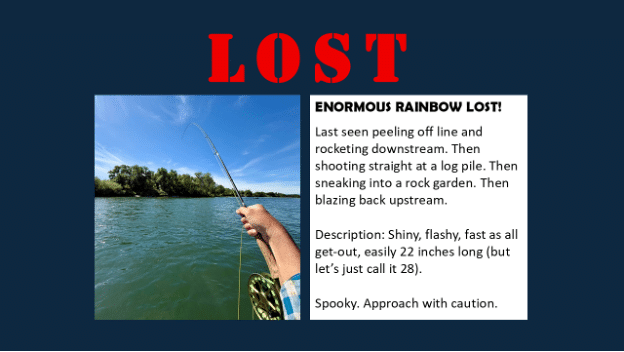
“It is not the fish you land that defines you.
Not Izaak Walton, but he probably felt this way
It is the fish that broke off with your
size 18 Weiss nymph and your dignity.”
I’ve been thinking about Richard Anderson’s recent California Fly Fisher Reflections article, “The Fish I Remember,” a lot lately. What struck me the first time I read it (yeah, I said “first time” ‘cuz I keep going back to re-read it) is that I’m sure Richard has caught thousands of fish, yet his list includes only 24 notable ones.
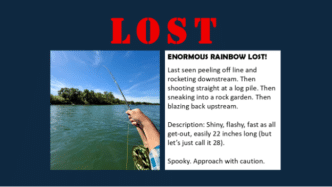
That short list got me thinking about my own memorable fish. I’ll spare you the sometimes vague, sometimes pedantic details of my list. There are, of course, the First Timers for various species and the Personal Best F.O.U.S.es (Fish Of Unusual Size—a Princess Bride honorific I refuse to retire). But what’s remarkable about my list—what would make any honest angler a little uncomfortable on my behalf—is that easily a third of the most memorable fish I’ve ever encountered got away. Some of them I never even saw. They were just a violent bend in the rod, a reel screaming like a dial-up modem, and then, eerily, nothing. Silence. The sudden silence of a fish that clearly had somewhere better to be.
Why would those sometimes-never-seen fish imprint on my memory and haunt me so?
What I’ve deduced so far is this: what makes those lost fish notable is that a) most of them were enormous, b) some of them were smart, and c) with every fiber of my being, I hate to lose. I’m also, apparently, sometimes terrible at fighting fish. That doesn’t help my distaste for losing—especially in our awesome sport.
I’ve heard friends bemoan that we don’t learn how to land big fish. Better lucky than good, amiright?
We spend a lot of time learning how to cast—that is, after all, the first step to get the fly into the fish’s mouth—but we rarely spend any time learning what to do once the fish is hooked. That’s like learning to make delicious cookie dough but never learning to put it in the oven. What are we even doing here, people? The Cookie Gods demand a sacrifice—one baked at 350 degrees until golden, not just left raw on the counter, threatening to become a health code violation while you stare at it thinking, “It should be fine, right? This has to be fine.” It is not fine.
As a newly anointed casting instructor, I end my lessons with beginners by pretending to fight fish. I’ll grip the end of the line, then teach my students how to battle a 200-ish-pound man-fish (me*) who doesn’t want to be landed. It’s always a fun way to end a lesson. *For the record, no student has ever asked for a grip-and-grin photo with me at the end of this exercise. I’ve wondered why. I’ve decided not to ask.
THE MAIN EVENT: FISH VS. HUMAN
Sometimes it seems we humans have an unfair advantage when it comes to fishing. From our big squishy brains and opposable thumbs to Fishfinder sonar, it almost feels like we’re cheating. But then, throwing a poky bit of feathers and fur at a fuzzy blip on a screen might even the odds a bit. It is a sport, after all.
But don’t cry for the fish. The fish came to this fight prepared. They have advantages that no 9-foot 5-weight is going to neutralize:
- They are excellent swimmers—aggressively so. Like they’ve been training with Katie Ledecky.
- They jump. Violently. Joyfully. Like they know what jumping does to your line and they find it to be hilarious.
- They are P90X-sculpted materials engineers who have apparently identified the exact break strength of 5X tippet and committed it to memory.
- They know where the sharp rocks are. All of them. They’re practically leading tours of the sharp rocks.
- And then – then – there are the ones that swim directly at you. These are the ones I have the most contempt for. These fish have studied close-quarters jiu-jitsu, narrowed the gap, created slack, and watched me strip line like I’m trying to rip laundry off a clothesline in a hailstorm.
Those swim-at-you fish are jerks. I said what I said.
All I want is a fair fight, but I’m sometimes clearly outmatched by my opponent.
Fighting—and then losing—a big fish is like the chaos of a Japanese game show, where the rules change mid-round, everyone is wet, and no one truly wins. You don’t get a trophy for losing a 24-inch brown. You get a story you’ll tell for the rest of your life to people who will pretend to feel bad for you while secretly being glad it wasn’t them.
On the human side of this fight, I don’t need Marquess of Queensberry rules. This isn’t a sanctioned bout. I’ll stack and move all day. I’ll work the side pressure. I’ll lead the fish into open water, like I’m my then-teenage sister, pulling 7-year-old me out past the breakers at the beach. What I won’t do—and I want to be clear about this—is bite off a niblet of the fish’s ear. I’m not Tyson. They’re not Holyfield. Probably. Don’t look at me like that.
So yes. I hate losing fish. I’ll never stop hating it. I’ve accepted that some of those losses are on me—a death grip here, a botched hook set there, and the entirely avoidable moment when I got overexcited (i.e., panicked) after hooking a heavy coastal steelhead and started furiously slapping the reel to pick up stripped line before the fish even realized it was hooked and spit the egg bead. That one still stings.
But some of those fish—those lost, unnamed, never-fully-seen fish—are the reason I keep going back. Not to beat them. Not exactly. Just to find out what happens next.
Just, you know, don’t swim at me.