
It will come as no surprise to most California fly fishers that our steelhead and salmon are in serious decline, with populations in many waterways listed as threatened or endangered.
One of the main reasons for this sorry state of affairs is that these fish are unable to access spawning and rearing grounds. Even when the fish can reach them, these habitats are often so degraded that the fish can’t find suitable spawning sites, or their eggs and young simply don’t survive.
This is why projects that restore access and rejuvenate spawning areas are so important. One that has gained plenty of well-deserved attention is the $450 million restoration project on the Klamath River. The removal of four hydroelectric dams reconnected hundreds of miles of habitat for steelhead and salmon.
SMALL BUT MIGHTY
But what about the state’s smaller, less famous waters? Steelhead and salmon once swam in hundreds of smaller coastal creeks and the tributary streams of larger rivers. For example, more than 40,000 steelhead are estimated to have spawned in the coastal creeks and rivers from San Francisco Bay to Monterey Bay. Steelhead in these smaller waters have developed unique genetic adaptations, such as tolerance for higher water temperatures. This provides an obvious evolutionary advantage in a state where droughts are common. It may also be essential to their future survival, given that climate change is projected to raise peak water temperatures in many streams to levels lethal to most steelhead and salmon.
Perhaps one of these creeks is near where you live or work. In the distant past, you might have gone there to fish for trout, steelhead, or even salmon. As a parent or grandparent, you could have introduced the youngest members of your family to the joys of nature and fishing from its shaded banks. Sadly, those days are gone. Decades of neglect and ill-advised “improvements” have turned many once-vibrant creeks into little more than stormwater conveyances.
It’s natural to assume that “your” creek is too small to warrant restoration efforts. The truth is that work on numerous small creeks across the state has restored many miles of habitat for steelhead, salmon, and other species. Indeed, one or more of these projects may be close to home. You can find them on the EcoAtlas website, which offers easy-to-use interactive maps.
LOCAL SOLUTIONS
Ask most fly fishers about conservation groups, and you’ll no doubt hear about California Trout, Trout Unlimited, and The Nature Conservancy. These well-known organizations have done amazing work across the state. But did you know there’s a local government special district that’s also helping folks restore habitat and improve water quality on smaller streams throughout the state?
These restoration projects are the result of collaborations between landowners and their local Resource Conservation District (RCD). RCDs are local government agencies that were created specifically to help their communities care for natural resources. RCDs have no regulatory power. They work closely with their communities to secure funding through federal, state, local, and private grants, obtain necessary permits, and manage projects. Given that restoration projects can cost tens of thousands to over a million dollars, the value of grant funding cannot be overstated. For many landowners, having this kind of one-stop local assistance makes the daunting task of restoring their creek much simpler.
Here are some examples that describe how landowners and staff at the RCD of Santa Cruz County have collaborated on vital restoration work. These are not unique; similar relationships and projects have taken place with RCDs across the state.
DAM BUSTERS
According to the California Fish Passage Assessment Database, there are more than 25,000 known or potential fish barriers across the state. These include abandoned logging or mining dams, water storage facilities, and recreational pools. Most of these structures are located on small creeks or the tributaries that once provided critical spawning and rearing habitat.
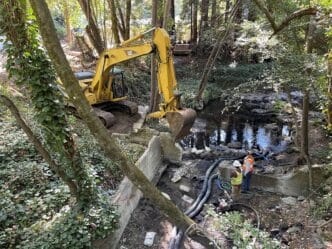
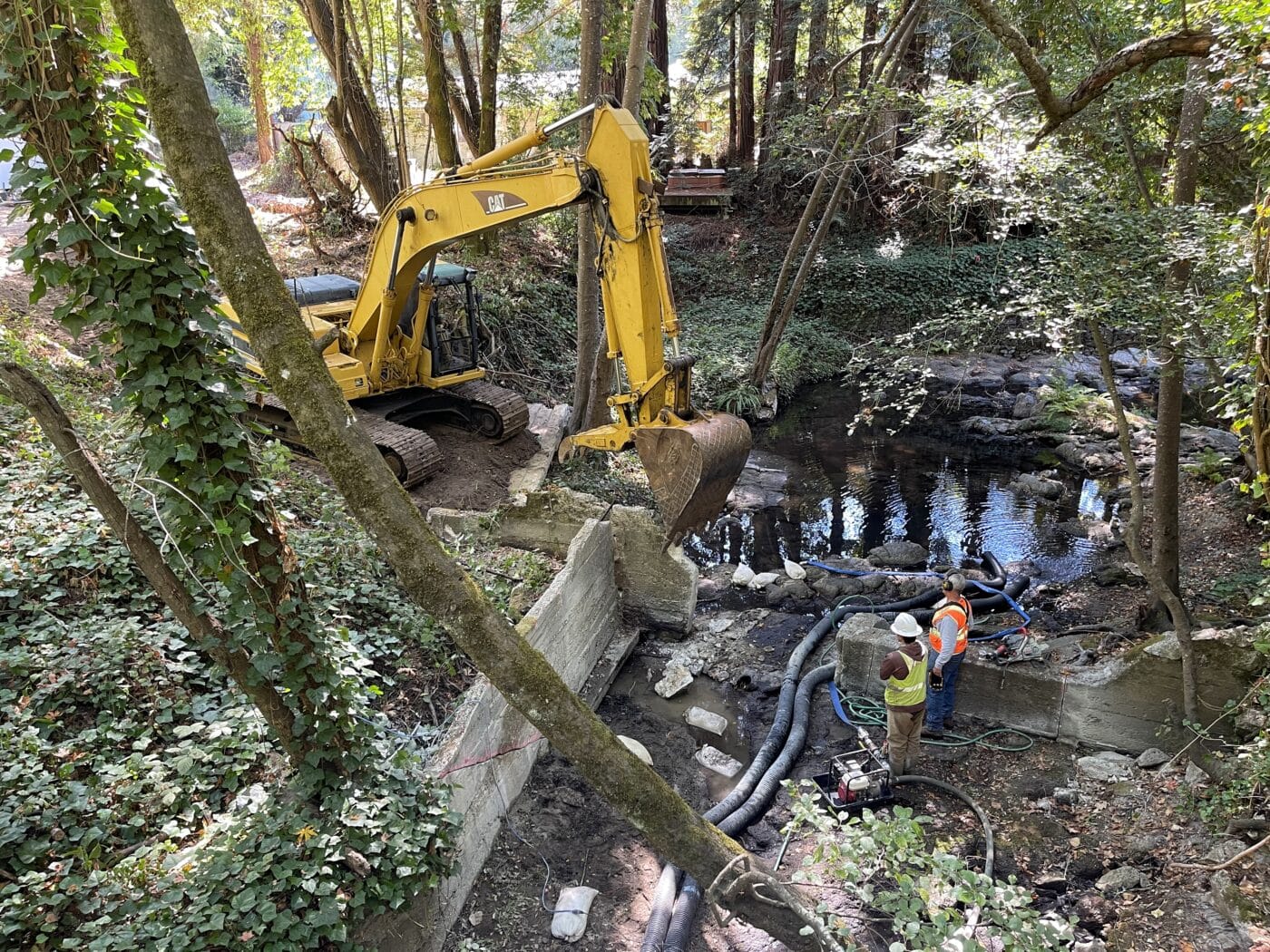
Happy Valley Conference Center on Branciforte Creek in Santa Cruz County is an excellent example of a small dam removal project. I visited the site in July 2026 and was met by members of its management team, whose passion for the creek was infectious. What I expected to be a quick meet-and-greet turned into an almost hour-long chat about the project and the subsequent positive changes to the creek. Fittingly, the meeting concluded above a pool where several young steelhead were confidently rising to bugs.
The project took place in 2021 and involved the removal of two concrete dams. The first step was to safely collect fish using a seine net and move them downstream to undisturbed waters. Once the fish had been relocated, the sites were dewatered with bypass pipes that conveyed water from above the site and released it downstream. When the work sites were dry, crews broke up the dams and removed the debris. The final step involved removing the bypass pipes and allowing the creek to flow through the restored area.
It didn’t take long for the site to face a serious test. The winter of 2021 brought a series of heavy rain events courtesy of an atmospheric river. That was the year many of us became painfully familiar with the term “bomb cyclone.” The project handled these exceptionally wet storms with ease, and in March 2022, an adult steelhead was seen swimming in the creek. That was probably the first one to make it this far upstream in almost a century!
LARGE WOODY DEBRIS
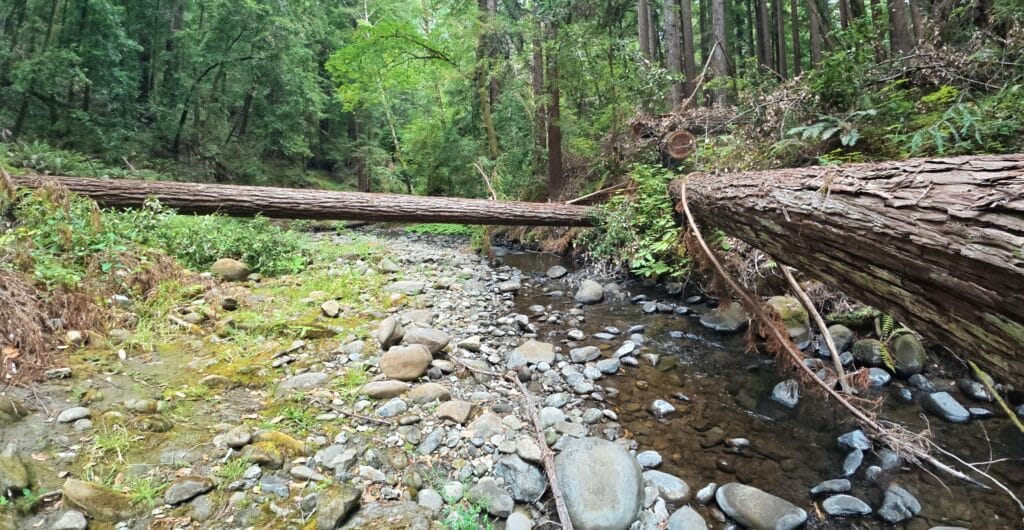
For decades, federal and state fish and wildlife agencies encouraged the removal of trees from rivers and creeks. It was believed that streams needed to be cleared so fish could navigate upstream. By the late 1980s, it became clear that this logic was wrong; large woody debris (LWD) was essential to fish habitat. Downed trees slow currents, allowing gravel to settle and form spawning beds. When trees are removed, high-velocity currents sweep gravel downstream, leaving bare rock. In addition, trees provide protective habitat for juvenile fish. I’ve shot underwater videos of juvenile and adult steelhead using LWD.
In 2025, the RCD worked with California State Parks to place large woody debris in Aptos Creek within the Forest of Nisene Marks. The project was relatively straightforward, using a “chop and drop” approach in which trees were felled so that the tops were in the water, while the base of the trunk remained on land. There was no need to secure the trees to the bank, as is often the case with larger streams and rivers. I visited the site in the summer of 2026 and found several areas of spawning gravel and about 30 young steelhead along a 100-yard stretch.
STREAM-SIMULATION CULVERTS
Drive alongside a small creek, and you’ll no doubt see culverts wherever a road or driveway crosses the water. These large metal or concrete pipes are much simpler and cheaper to build than bridges, and at first glance, it may seem that fish would have little trouble swimming through them. Unfortunately, this is not the case. During summer and fall, the water level inside the culvert can be too low for juveniles to reach cooler upstream waters, exposing them to potentially lethal water temperatures and disease. Even if there is enough water in the culvert, its smooth surface provides no resting areas, so fish can become exhausted before they reach the end. In winter, the water velocity inside the culvert can be so high that even large steelhead and salmon can’t make it through. And last but not least, downstream erosion can create a drop below the pipe that neither juveniles nor adults can navigate.
One restoration option is to replace the culvert with a bridge, though this may not be technically or financially feasible in many cases. In these circumstances, the best approach is to replace it with a culvert designed to mimic the natural stream. These are commonly referred to as stream-simulation culverts. Unlike conventional culverts, stream simulators have a layer of rocks and sand at the base. Materials can sometimes be obtained from the stream, but it’s often safer and easier to use a special blend of rocks, gravel, and sand called engineered streambed material. This material is placed in the culvert, washed in with a high-pressure hose, and then compacted to ensure it stays in place during winter’s peak flows.
In 2018, the RCD worked with a homeowner in the San Lorenzo River watershed to replace a degraded culvert at the entrance to their property. In addition to being unsafe for vehicles, the original culvert created a three-foot drop into the downstream pool, an insurmountable barrier for steelhead. The replacement stream-simulation culvert provided the homeowner with safe access to their property and eliminated the three-foot drop, allowing steelhead to reach upstream waters. Looking into the new culvert, you’d swear the streambed had naturally formed inside the pipe. With the shade and overhead protection the culvert provides, I’d be very surprised if it wasn’t home to some young steelhead.
RURAL ROADS
Throughout the state, many unpaved, privately owned roads have seen better days. They are usually made of compacted dirt, gravel, or local materials. Many are remnant logging roads that were never intended to provide year-round access to homes. Regular traffic causes surface wear as tires crush the materials into fine particles. This produces the familiar dust trail that billows behind your vehicle in summer. In winter, saturated roads are subject to “pumping,” where the weight of vehicles forces silt-laden water out of the road base.
Roads cut into hillsides can cause catastrophic sediment releases when a culvert fails or when the inside or outside slopes collapse. These events render the road impassable and can dump many tons of sediment into a creek in a few hours. Sediment released through regular wear and tear and catastrophic events can clog spawning beds, suffocating eggs or trapping newly hatched young.
Engineers calculated that a private road in the Bear Creek watershed was producing 230 tons of sediment per year. The excessive sediment loading was caused by poor grading and too few, undersized drainage structures. Large volumes of water ran along the road, creating gullies before finally breaking free and discharging into the creek. In 2023, landowners worked with the RCD to install new and additional culverts and reshape the road to eliminate gullying. This safely routed road runoff in smaller volumes over a more dispersed area.
LOCAL HEROES
We should acknowledge the landowners, businesses, contractors, consultants, and RCD staff who have worked on projects like those described above. Their work may not be as newsworthy as the big projects, but it is essential to the long-term survival of steelhead and salmon in this state. Maybe you need help with your property—or know someone who does. A call to your local RCD may be all it takes to get steelhead and salmon back in your creek.