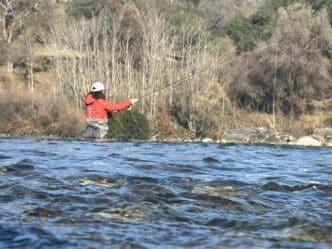
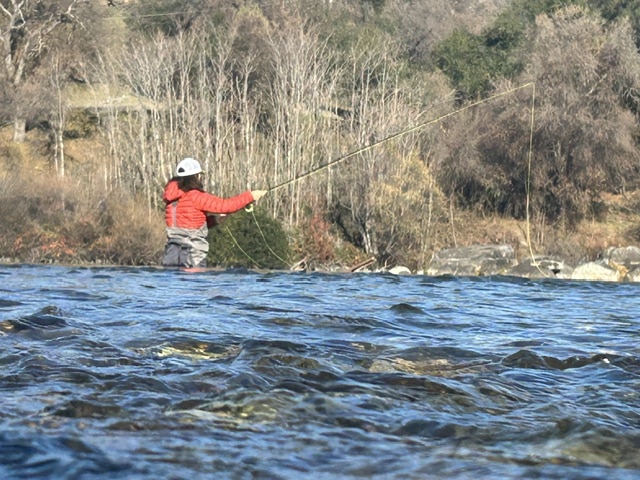
The tumbling riffle was clearly too shallow and fast to hold fish, but narrowed before pouring into the downstream pool, briefly slowing into a short, deep slot. An old, broken tree trunk extended an arm’s length from the grassy bank into the stream, taking the brunt of the flow and forming a textbook current seam. Tiny mayflies emerging in the riffle fluttered weakly as they tried to escape the water’s grasp, the current funneling them into the bucket.
The brown was big and feeding greedily. An angler was walking up the creek, headed for a known pool upriver, when he noticed the snout poking rhythmically through the surface. It was easily the largest fish he’d seen all day, and he was excited! Wading to a point across and above the fish, he cast and began feeding line into the drift. Just as his dry reached the fish, the current swept the leader downstream, dragging the fly unnaturally. There was a violent boil beneath the surface as the fish spooked, and the fisherman knew he would not have another chance.
This is a lesson I have had to learn the hard way many times, and the frustration has proven to be an effective teacher. Whenever you find a fish rising in a river, and it’s one you really want to hook, train yourself to stop and spend a few minutes observing before making your presentation. Very often, this will make the difference between a hooked trout and disappointment. Ask yourself the following questions:
- How often is the fish rising—can you time your presentation to match its rhythm?
- Is it changing position from rise to rise, or is it feeding in a stationary spot? If the former, factor that into where you make your initial cast to avoid lining the trout.
- What are the currents like between you and the fish?
- Is there fast or slow water between you and your target?
- How will you need to present not only your fly but also your fly line and leader to compensate for this potential drag?
A good technique for defeating drag is to position yourself as close as possible directly upstream of the fish and present with a pronounced reach cast; this allows your line and leader to land in water that is close in current speed to that of the trout. Another trick is to simply add extra tippet (preferably supple, not stiff material), sometimes as much as 5 to 6 feet, to the end of your tapered leader. This additional, limper monofilament tends to land in s-curves on the water, absorbing drag as it straightens out, buying you a bit more drag-free drift.
Often the best presentation to a rising fish involves casting downstream from above, then feeding line into the drift so the fish sees the fly first, not any part of the leader. When setting up for this cast, first strip off more line from your reel than you will need to reach the fish, letting it trail in the water at your feet (or knees if you’re wading more deeply). If you don’t strip off enough and run out of loose line to feed before your fly reaches the fish, it will be difficult to correct the problem before drag sets in. This is a common error and is solved by taking a little extra time when preparing for that first cast.
These same strategies apply when fishing nymphs or even streamers.
The key is to think through every cast before making it, considering what the fish will see with your chosen presentation.
Having done so, commit to it. Don’t rip the fly out of the water midway through the drift because you think you can do better—this is a sure way to spook fish. If you recognize partway through the presentation that it isn’t going to be right, keep the fly moving at a dead drift until it is well past the trout before stripping it back in to try again.
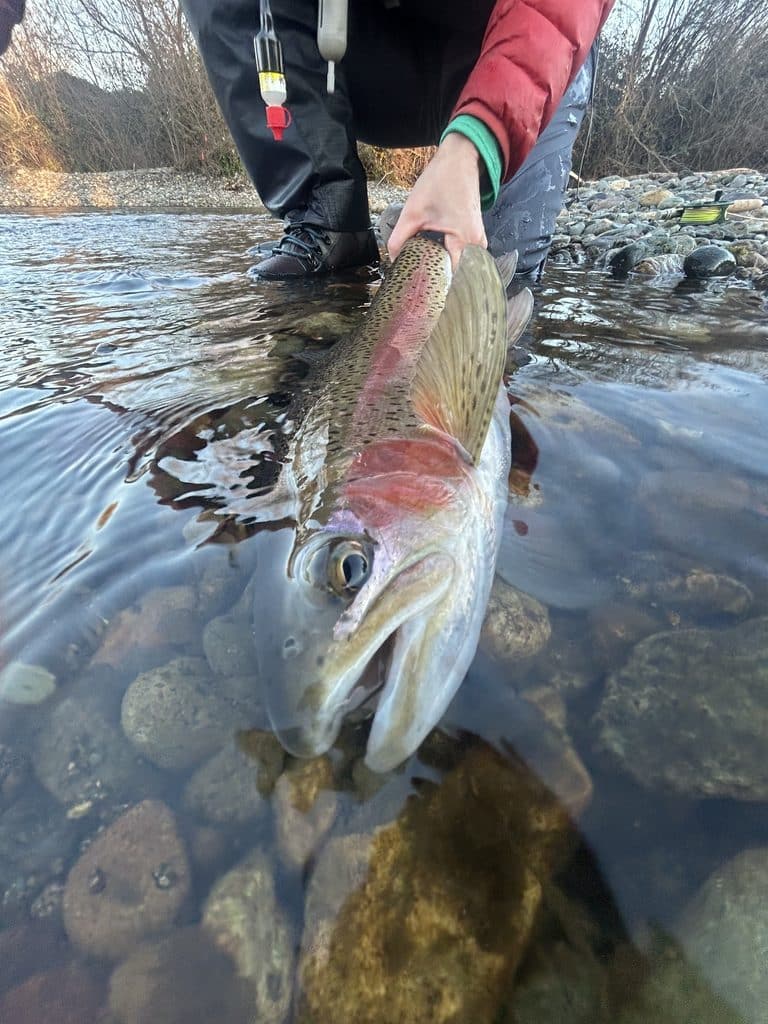
If you are presenting to a large fish, especially a wily old brown trout on pressured water, do so with the mindset that you are only going to get one shot, so make the first one count. Don’t be in a hurry, and examine the currents between you and the fish with as much scrutiny as you give to choosing the fly pattern. Don’t be afraid to make a couple of test runs with shorter casts to get the “lay of the land” and see what any conflicting currents will be like before making your final presentation.
Heed the tactics above, and you might find yourself hooking more of those previously problematic fish!