Photos by Pete Butler
At the vise, I’m not usually listening to podcasts or simul-watching a show in the background; I’m imagining fishing my fly. Yes, tying brings me closer to the river, and I get to live out little slices of the season in my head while I’m sitting at my desk, but I also mean that more literally: The decisions made at the vise directly determine how we fish a fly. Foam over dubbing, hackle over bare thread—every material choice is really a decision about the day we’re setting ourselves up for. Use this material instead of that one, and you’ve changed how you’ll be fishing. Even more intuitively, every pattern choice is a commitment to fish a particular method or to maximizing our chances during a specific hatch. Among my favorite hatches to tie for and to fish is the October Caddis hatch.
Crowds thin out, and I’ve witnessed frenzied fish leap clear out of the water at slow, low-flying false casts (not an exaggeration!). When it comes to an all-you-can-eat buffet of two-inch-long caddisflies, fish get gripped by that rare fervor that fishermen spend seasons looking forward to. If you haven’t experienced it, it belongs on your bucket list, right up there with the best hatches, insect or baitfish.
And when I find myself standing in the middle of a swarm of these bugs, you can bet I’m fishing a dry, which, incidentally, happens to be my very favorite category of fly to tie! So, for this column, at least, I’m giving the cold shoulder to nymphs, emergers, and cripples. They all have their place—you just won’t find me reaching for any of them in October. Partly because the adult imitation is simply that effective, and partly because when I’m at the vise, there’s nothing quite like tying a big, bushy dry to transport me straight to the river’s edge.
VISUALIZE FISHING THE FLY
We’ve all watched caddis dart and skitter across the surface while laying eggs, but nothing compares to the aggressive bounce and skate of these larger October bugs. The lesson in picturing this movement in your mind’s eye isn’t to start at the vise asking, “What materials do I need to tie this fly?” It’s to ask, “What do I need this fly to do on the water, and how do I construct it to make that happen?” Everything else follows that question.
For a big, bushy dry fly, that means thinking through three things before you load a hook into your vise: the profile (the silhouette a fish reads from below), the footprint (how the fly sits on and disturbs the surface), and what’s happening underwater—legs, hackle, and body parts hanging beneath the film, which fish see even more clearly than anything up top.
Broadly, how a dry fly floats is split into two camps: high-floating and low-riding. Which camp a fly falls into is a construction decision—whether it’s designed to ride on the abdomen and hackle tips or settle into the surface on the wing and legs. That’s something you decide at the vise. Of course, floatant plays a role too, but if you’ve read this far, hopefully what you take away from the following fly pattern deconstructions are a few tips for how to think about building big dries for success in October.
RIDING HIGH
A high-riding fly sits prominently on top of the water rather than flush with the surface film. What matters most is silhouette—a fish looking up sees a dark, contrasting shape against a bright ceiling of light. A high-riding fly creates a bigger, cleaner silhouette against that ceiling, puts more of its body, legs, and hackle into the shape the fish is reading, and is generally easier to detect in broken or fast water.
Buoyancy is partly about staying afloat and mostly about altering the three-dimensional shape a fish sees. The same materials riding an inch lower in the film present an entirely different signal.
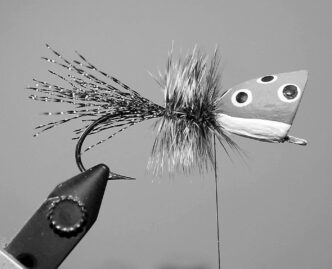
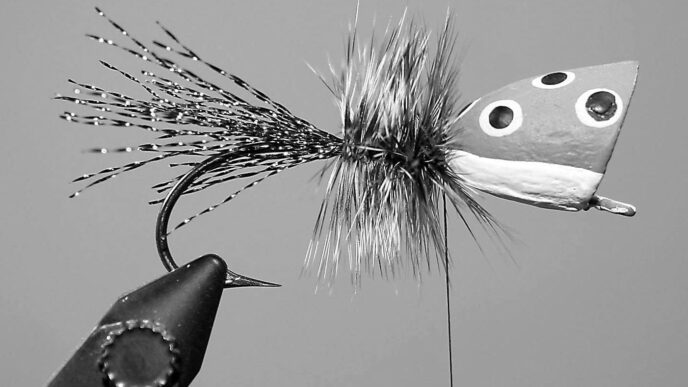
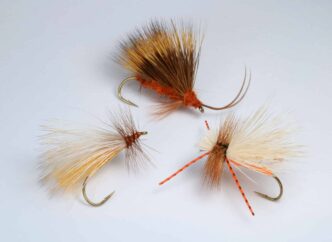
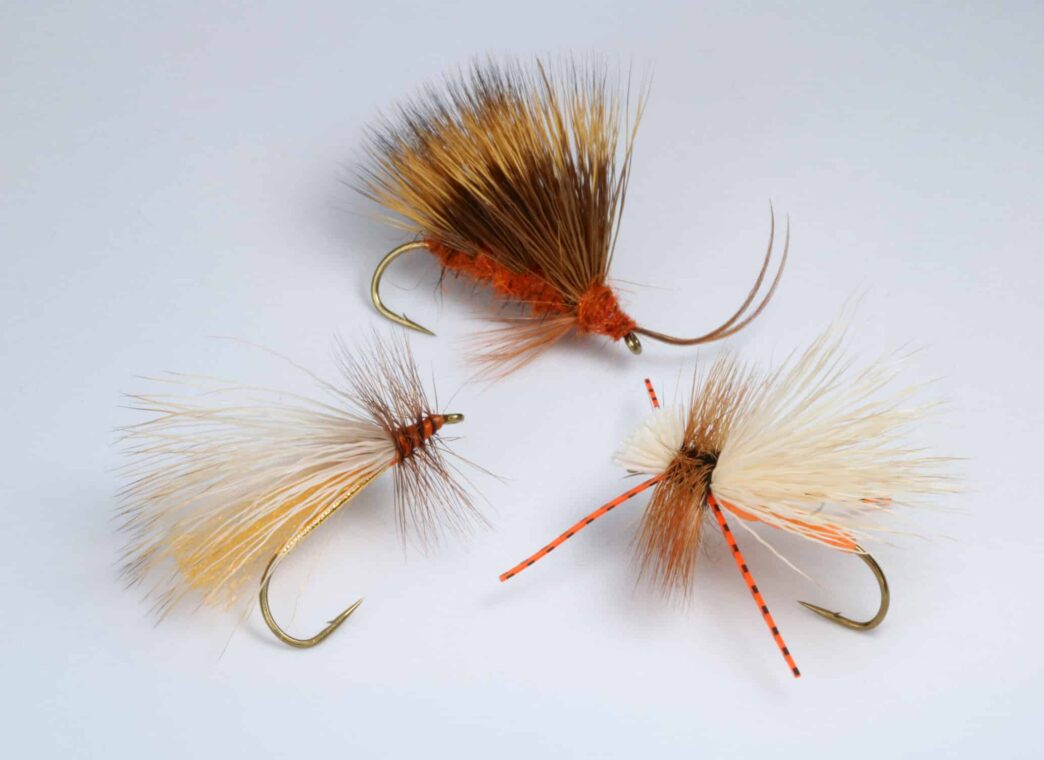
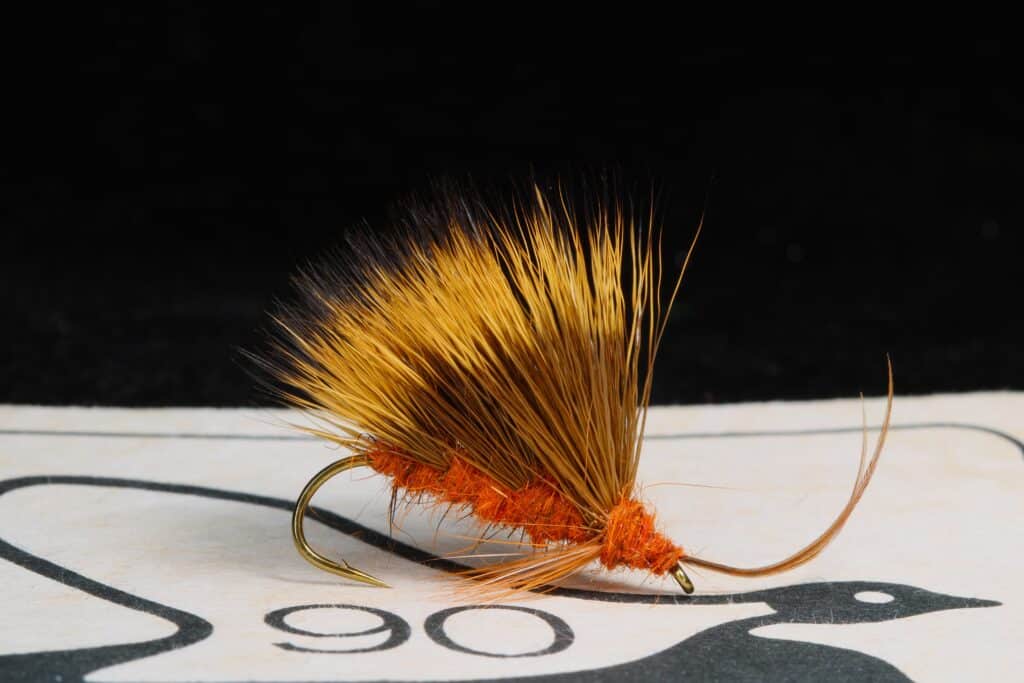
The Rocktober Caddis by Pete Rosenau is a newer pattern, purpose-built to imitate a mature adult. It wears its job description on its sleeve: a foam body topped with a generous stack of elk hair and capped with bushy hackle. It’s impressionistic rather than exact, but the silhouette and footprint it casts are unmistakably October caddis—bulky, buoyant, and loud.
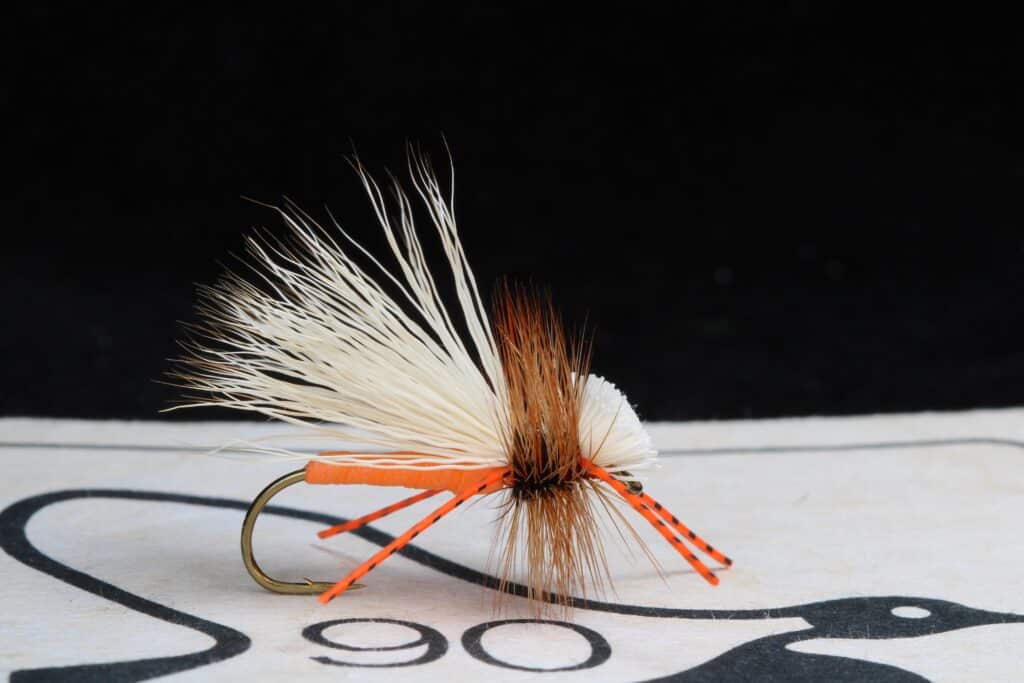
Foam handles flotation. The bushy elk-hair wing adds bulk to the silhouette without adding weight. The legs are for profile and movement—they don’t do much work underwater, but they matter from below, helping break up what would otherwise be a clean adult-caddis shape so the fly reads less like a textbook insect and more like a large, disheveled natural having a rough go of it on the surface.
Fishing tip: October caddis make noise, so you’re allowed to make some noise, too. Don’t be shy about slapping this fly down hard on your cast—in both fast and slow water, that racket is often what triggers the take, and, given its foam-body construction, it will remain buoyant beyond what some other patterns can withstand.
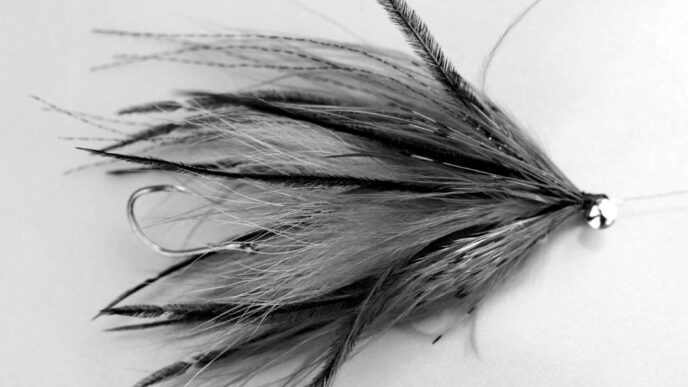
There’s a second high-rider I’ve apparently been tying and fishing a version of for years without knowing its real name until I wrote this column: the Burkus Sedgeback October Caddis, created by Ken Berkholder.
The Sedgeback’s defining feature is its tri-wing—even as the body begins to saturate and sag toward the film, the wings keep standing up to repeated abuse before the fly finally goes under (if it ever does). The body itself is best built with dubbing or a dry-fly poly yarn. Much of the actual flotation comes from the wing, so it’s okay to use that buggy nymph dubbing, too. A saturated body hanging in the film isn’t a bad thing—it simply means the fish see something slightly different.
Through the film, the legs create appendages that hang below the main body. From below, those legs give you a dangling silhouette — quite unlike the clean outline of a standard dry fly and closer to what a real adult caddis actually looks like from underneath.
Fishing tip: Apply floatant liberally to the wings and lightly to the body. The fly rides high at first, then, as the floatant on the body wears off, it settles lower in the film—giving you two presentations from one fly without having to go back to your fly box.
LOW RIDER
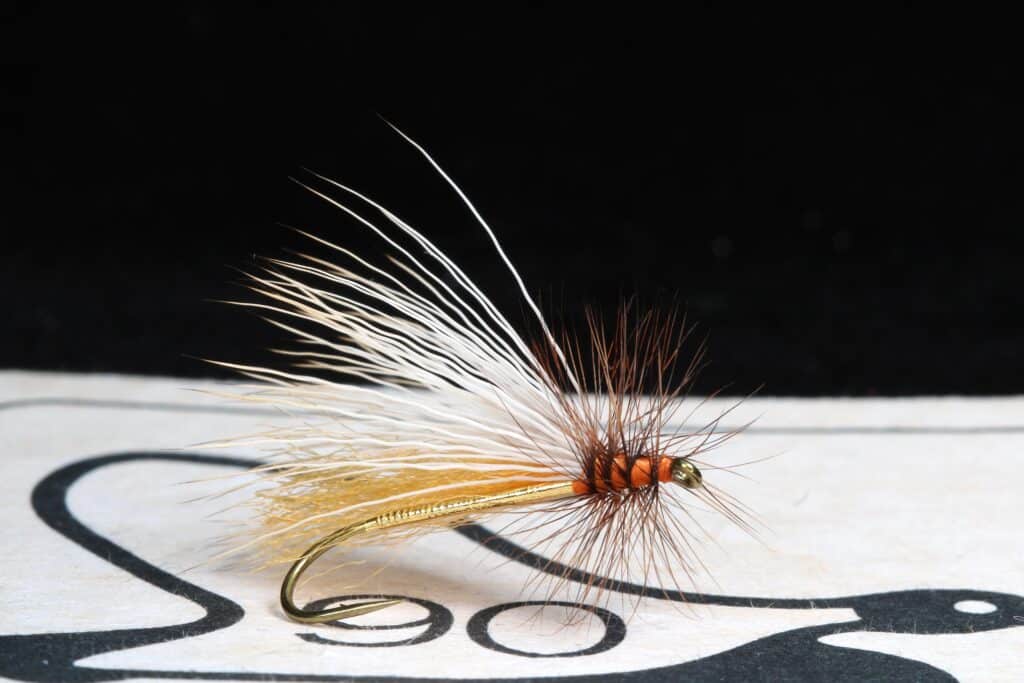
A low-riding dry sits partially submerged in the film rather than standing above it—body, legs, and hackle pressed down into the surface rather than perched on top of it. From a fish’s window, that fly stops looking like something floating on the water and starts looking like part of the water’s surface itself, the way a naturally struggling or spent insect looks once it’s succumbed.
Clark’s Golden Stone is a fantastic example, and if you already know this pattern, you know. Lee Clark developed it in the
early 1980s to mimic the flat, vulnerable profile
of a stonefly resting in the surface. Its large size and colors make it a great October caddis imitation.
The body sits embedded in the film so the fish sees a broad, relatively flat golden-orange silhouette breaking the surface rather than sitting proud of it. The hackle intersects the film and breaks up that silhouette, suggesting real legs rather than a tidy, elevated dry-fly profile. The wing adds a dark, fairly flat shape within the surface that helps define the outline without adding height. Because so little of the fly protrudes dramatically above the water, the overall impression shifts from “large bug standing on the water” to “insect trapped in the surface film”—which, for a struggling adult or an egg-layer that’s spent, is a much more honest presentation.
Fishing tip: Budget for a long-lasting floatant here. I find the powdered stuff wears off quickly, given how sparsely the fly is built. Splurge on something like Fly-Agra, or be ready to reapply floatant often. Tying it on a light-gauge dry fly hook helps extend its buoyancy a little longer.
MATERIALS ARE SECONDARY
I hope you get to experience the phenomenon of an October caddis hatch this fall. Tie up all three flies—each one solves a different problem the same insect presents, depending on the moment you find it out there.
That’s the part worth carrying to your own vise. One fly slaps and skates, another rides less proudly as the evening wears on, and a third all but disappears into the film. None of that will show up on a materials list. It appears once you’ve decided what the fly needs to do first.
So, skip the question of what a pattern calls for. Ask what you need the fly to do out there, then build backward from there. Thinking that way turns tying into something more than assembly and pulls you deeper into manifesting your own fishing experience at the vise—long before you’re standing in the water, watching a fish chase down the thing you created exactly for this moment.