Two-Handed Spey Lines
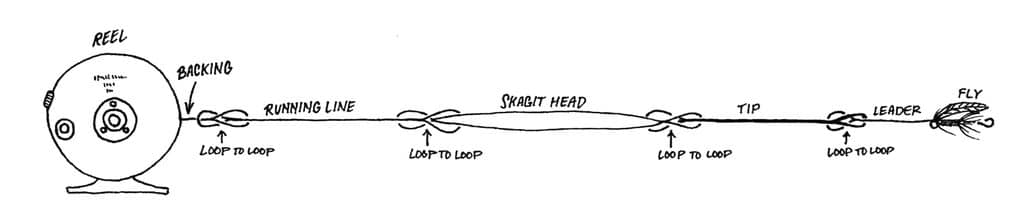
Countless times, customers have walked into my fly shop in complete desperation with a gallon Ziploc bag full of Spey fishing components. We dump it out and start sorting, weighing, and measuring each component to identify it. To the untrained eye, this process looks like a strange drug deal, with small baggies and a grain scale on the counter, surrounded by slightly anxious, addicted customers. Not only customers, but the average fly shop employee, too, can be baffled by the innumerable combinations in the Spey line category. Meanwhile, the Spey nerds (of which I am one) will casually discuss the merits of an extra foot of length on their shooting head or swapping the head for one that is slightly heavier to bring their rod to life. Admittedly, I don’t buy rods and then find out what line they like; I choose a rod based on the line I want it to cast for situational fishing. More complicated than simply casting a 5-weight line on a 5-weight rod, modern Spey line systems have three components: running line, shooting head, and tips.
Running line/shooting line
This is the line you hold while casting, and it pulls through the rod when you cast the shooting head. There are two major categories of running line for Spey fishing.
Nylon or mono running lines are my first choice because they shoot well, are lightweight, and have low friction. They are thinner than other options and take up less space on your reel. For all that is great about mono running lines, the complaints are that they’re hard to grip, can slip through your fingers in cold conditions, and can slip through the frame of the reel, necessitating a closed-frame reel or at least one with very tight tolerances between the spool and frame. Mono running lines are typically measured in pound test, not diameter, and come in round, oval, hollow, and even hybrid configurations with a coated handling section. If you purchase one of these and load it yourself, you will need to install loops on both ends. I recommend a double surgeon’s loop, 4–5 inches long, tightened as much as you can muster—if it doesn’t hurt while tightening, you’re not doing it right. The knot should end up football-shaped, with the tag trimmed close so it will slide through the rod guides smoothly.
Coated running lines don’t shoot as well, but they’re less likely to slip through your fingers in cold weather and almost indistinguishable from a normal fly line. New Spey casters and those without great dexterity will prefer coated running line. You’ll sacrifice some distance, but gain features like welded loops, color changes, and even thicker handling sections to aid energy transfer. In some cases, coated running lines are integrated into the shooting head, creating a smooth transition between head and running line. Integrated running lines are best for stripping streamers as there is no clunky knot to coax through the guides.
Favorite shooting line: Hazumi 50lb for rod weights 5+. I like 50-pound because it’s thicker to hang onto, and I’d really hate to lose a shooting head. For rods lighter than 5-weight, I prefer SA Absolute Flat 30-pound.
Shooting Head
A head is the weighted section you cast, and it carries your tip and/or fly to the target. Often called out by their taper design, like Scandi or Skagit, the head you choose is the most complex and important part of the system to understand. Before we jump into tapers, a few important factors to suss out are length and mass. In North America, Spey heads and tips are measured in grains (gr) and feet. In Europe, they are measured in grams and meters. We will stick to the North American approach.
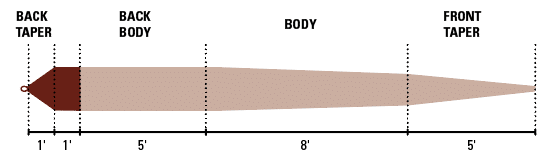
Figure 2. Elite Skagit Max Power
A few maxims on length and weight:
- Length is relative to rod length—a short rod will cast a shorter head.
- The shorter your head, the less backcast room you will need, but it will hamper your casting distance and control at distance.
- Shorter heads have more condensed mass and are typically better for casting heavier sinktips and flies.
- Longer lines let you cast farther and require less stripping between casts. Longer heads are most popular for greased-line and dry-fly fishing in the summer and fall.
- The longer the head, the heavier line you’d want to choose for your rod. If my rod casts a 500gr 20-foot Skagit head and I wanted a 50-foot head, I would choose something closer to 580gr, since the weight distribution is less condensed.
- Heavier lines will cast heavier tips and flies better.
- Rods have a grain window. For example, 450-525gr: 450 is the Scandi recommendation, and 525gr is the Skagit recommendation.
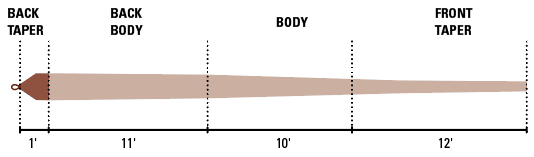
Figure 3. Elite Scandi Launch
Tapers bring length and mass together in ways that actually matter to the angler. Where and how the mass is distributed in the line will drastically affect how it casts.
Skagit Heads were first developed on the Skagit River to cast heavy sinktips and flies with minimal backcast. Characterized by a short, aggressive front taper, they range from 13 feet for trout Spey rods to about 25 feet in length and from 150gr to 750gr in mass. A tip that falls within a balanced ratio to the head is required to complete the Skagit system. The ratio between tip and head should be around 4:1. Meaning, for a 500gr head, a 125gr tip +/- 20 grains is the right ratio to stay within. The head propels the tip and needs a balance between the two to do so effectively. Too heavy and the head won’t be able to carry it; too light and the line will kick over and crash. If you want to get your fly deep, Skagit heads are traditionally the way to do it. Skagit heads do come in densities other than floating for when you really want to dredge. For a different take on Skagit lines, try a Skagit head in a grain weight you’d normally use for your Scandi for a crisper, lighter feeling sinktip setup.
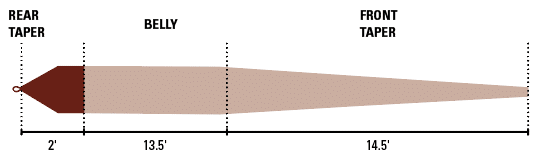
Figure 4. Airflo Rage “Scandit” Style Taper
Scandi Heads were developed to cast light flies and present delicately with minimal backcast. “Scandi,” short for Scandinavian, was developed for Atlantic salmon fisheries where long casts and delicate presentations are needed. Scandi heads are designed with the weight in the rear of the head and a long front taper. Many anglers put a polyleader on the end of their Scandi head, but I find even light polyleaders add too much mass for a traditional Scandi head, removing the system’s finesse. For most modern rods, I prefer a Scandi head around 30 feet +/- and a 12- to 15-foot tapered leader tied directly to my fly (typically size 4 or smaller and unweighted).
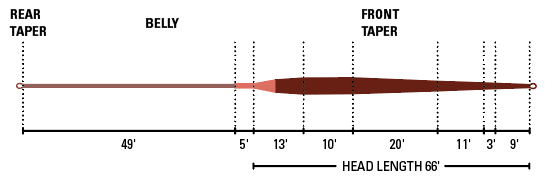
Figure 5. InTouch Long Head Spey
In recent years, Scandi lines have started to resemble Skagit heads more closely. This line mash has earned the moniker “Scandit.” When I first started Spey casting, I would cut back the tip on my Scandi lines to create a lighter-presentation Skagit head. Now, luckily for us, we can buy a much more polished version of this in the Airflo Rage or the Rio MDC system. These systems are where I find 10- to 14-foot polyleaders useful. Another recent evolution of Scandi heads is that they’re now available in a variety of sink rates, giving anglers the ability to fish Scandi tapers deeper.
Mid/long belly heads were developed to cast long distances with minimal backcast. Now dubbed “traditional,” long-belly lines are having their moment in the Spey world, as most steelhead anglers fish summer and fall-run fish where these lines excel. Your casting style changes to include more top hand than with their shorter Skagit and Scandi.
If you don’t need sinktips, the general theory is that longer heads mean less stripping and more fishing.
TIPS
Tips are a major source of confusion. No surprise, considering my tip wallet rivals George Costanza’s. The cleanest way to break this down is by the head you are using.
Skagit: The most popular tips for Skagit heads are the RIO MOW series. These tips come in 4 different weights: Light (8gr per foot), Medium (11gr per foot), Heavy (14gr per foot), and X-heavy (17gr per foot). Much of the confusion comes from the naming convention. One might assume I really want to get down, so I will get the X-heavy. Those tips are 170 grains at 10 feet and would be out of balance with any Skagit head under 575gr (discussed in more detail below). The difference in sink rate, when you consider the current’s effect on the larger diameter of T14 (Heavy) and smaller diameter of T11 (Medium), is nominal.
The main thing to note is the balance of the weight of the tip and the Skagit head. The idea behind the MOW Tip system is that varied lengths of very fast-sinking tungsten sections, melded to either floating or intermediate line, always equal 10 feet in length until you reach all-sinking material, letting you adjust your sink rate without casting a different length tip. Essentially, the tip is always the same length, but the sinking section could be as short as 2.5 feet, giving you a tip to fish the scallops in a shallow tailout, or as long as a 12.5-foot sinking section to dredge a deep hole. There are also 10-foot and 15-foot tips, rated by type or sink rate. I tend to like the 15-foot type 3 (sinks at 3-4 inches per second) in the even laminar flow of tailouts. I don’t like them when the current varies a lot, as there are too many opportunities for slack.
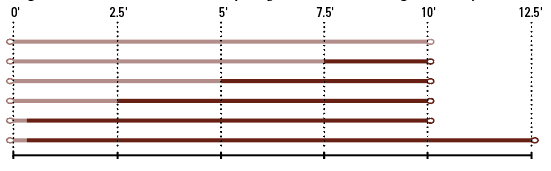
Figure 6. Skagit MOW Tips
Scandi: As stated, when I use a Scandi head, I add only a 12- to15-foot tapered nylon leader and a dry fly. It is the most aspirational version of steelhead fishing that exists. RIO has released an interesting line called the Scandi MDC, with a 22-foot Scandi body (essentially a Skagit head) and 12- to 18-foot tips. The difference is that the tips are more like interchangeable front tapers with different sink rates than a level sink tip. Because of the taper and lack of mass, the sink rates won’t compare to what you can achieve with a Skagit head, but it’s an elegant solution when you need to get down but still need finesse.
While I hope this high-level overview helps you have a better understanding of the Spey system as a whole, it just scratches the surface of the nuance involved in choosing lines for two-handed fishing. Take it one piece at a time, and you will build an intentional Spey line system that will have you outfishing your friends in no time. So, as always, if you want thoughtful, well-considered fly-fishing advice, reach out to us at the shop, and we can answer questions in real time. Happy fishing and don’t trout set! ing it an excellent choice for beginner to intermediate casters in windy flats situations.
Tips on Tips
If I had to choose one tip:
RIO MOW 5 and 5 in a grain weight that balances with my head. This tip has a 5-foot floating section and a 5-foot tungsten section, and it’s extremely versatile. A light fly and quartered downstream cast, and you can fish it shallow. Put on a heavy fly, use a slightly longer leader, and cast across the river; let it sink a bit, and you can get down deep. If I were adding a second tip, it is a 10-foot section of tungsten that balances with my line.
Head-to-tip ratio: 4 grains of head to 1 grain of tip. Of course, you can fudge this to 3 to 1 or 5 to 1, but it gives you an idea of optimal balance.
- Polyleaders 45-75gr 150-300
- MOW Light Tips 80gr 325-450gr
- MOW Medium Tips 110gr 450-525gr
- MOW Heavy Tips 140gr 550-625gr
- MOW Extra Heavy Tips 170gr 650+
Use a leader/tip wallet and always put your old tip away when changing out to a new one. Staying organized with Spey gear is critical.
What is a polyleader? Polyleaders are coated nylon leaders that can extend the forward taper of your head and give you the ability to sink your fly. I really like polyleader for Skagit heads under 300gr and Scandit-style lines like Scandi bodies and Airflo Rage.
Visit Lost Coast Outfitters in San Francisco to shop fly lines.