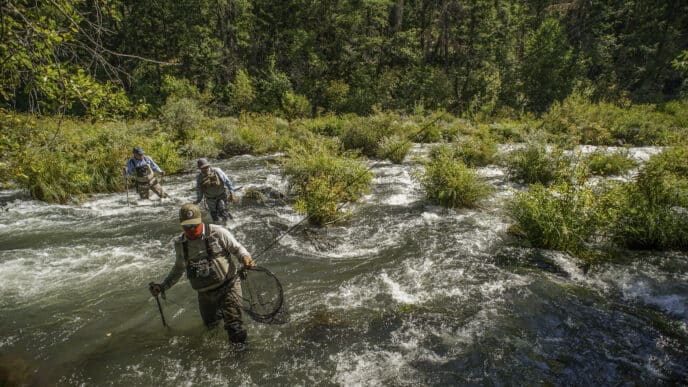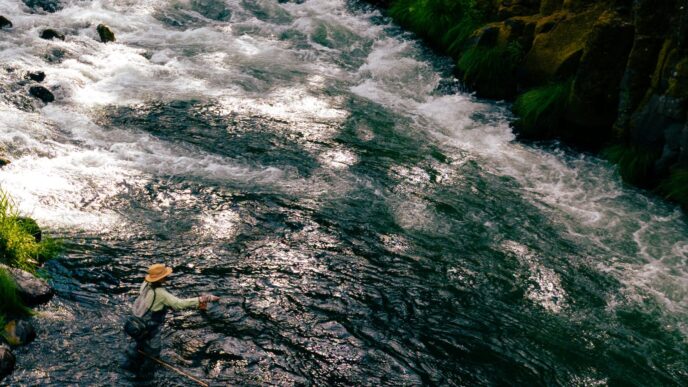
Before I took up the sport, if someone had asked me what my perfect day of fly fishing would look like, I’d probably have described something that sounded more like a painting than an actual experience: standing waist-deep in a crystal river as it flowed through a scenic valley, reeling in fish after fish until the sun set over the rugged mountains around me. But if someone were to ask me the same question now, I’d tell them that my perfect day of fly fishing would involve crawling through deep mud, thick brush, battling a vicious swarm of mosquitos in the hope of catching an 8-inch fish before rushing to pick up my kids.
I had been warned that a certain percentage of people who pick up a fly rod end up going crazy as a side effect of the pursuit’s tendency to morph from a hobby into an addiction. At first, I thought they were just talking about buying too much gear, waking up at 4 a.m. to drive to distant waters, or binge-watching YouTube videos. But it wasn’t until I visited a meadow at the headwaters of the Upper Truckee River in June of 2024 that I truly understood what it meant to become crazy about fly fishing. I haven’t viewed the sport, the world, or myself the same way since.
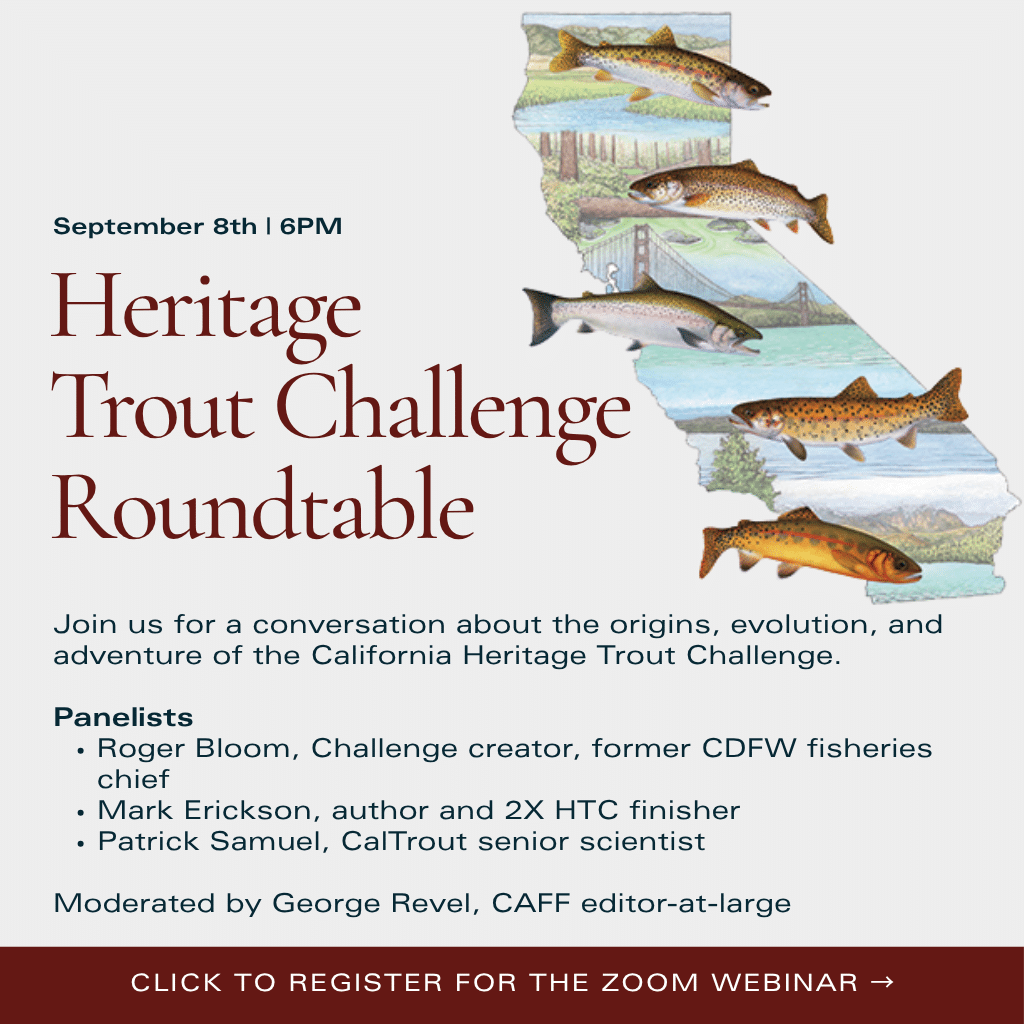
My descent into madness began about a year before that trip, when I took a beginner fly-fishing class while on a trip to Utah. I’d spent most of my life as a spin fisherman, but one hour with a fly rod in my hand seemed to flip some kind of switch inside me. Back home in Los Angeles, I found time to make trips to the Kern River and Bishop Creek, where my new interest grew into an obsession. After going down a lot of internet rabbit holes, I came across the California Department of Fish and Wildlife’s Heritage Trout Challenge, which encourages anglers to learn about and appreciate the state’s native fish by catching six of the ten species of California native trout and submitting a photo of each. Anyone who successfully completes the challenge receives a beautiful certificate featuring the art of renowned fish illustrator Joseph Tomelleri, commemorating their achievement. But for a fish to qualify, it must be caught within its historic range, the area where the trout were found in California prior to statehood (1850). It sounds easy, but once you start digging into the historic ranges of these fish, you realize why it’s called a “challenge.” Most of the places where they can be found are remote, require a lot of hiking to reach, and can be uncomfortable, if not outright unfriendly, to the humans who manage to get there.
And that brings me back to being devoured by mosquitos while covered in mud, with a fly rod cradled across my arms. It wasn’t the way I had imagined things would go when I drove two hours from Truckee, California, then hiked three difficult miles up to the meadow where the Upper Truckee River begins to take form out of the melting snow of the surrounding mountains. The fish that compelled me to make the journey was one of the 10 species I hoped to catch: the Lahontan cutthroat trout (LCT).
Many anglers are aware of the giant Lahontan cutthroat trout in Pyramid Lake, Nevada, which can grow up to 20 pounds. Although Pyramid Lake is indeed within the LCT’s native range, catching the fish there wouldn’t help me complete the California Heritage Trout Challenge because the lake is in Nevada. So, in searching for where I could find the fish in California, I learned that the species had been wiped out by the late 1930s due to logging, dams, and competition from non-native species. In 1989, the California Department of Fish and Wildlife and the U.S. Forest Service reintroduced them to the Upper Truckee, and the fish have thrived there ever since. Even though the stream-resident type of LCT found in the meadow is much smaller than their lake-dwelling cousins in Nevada (average size is between 6 and 10 inches), I was resolved to do everything I could to catch one.
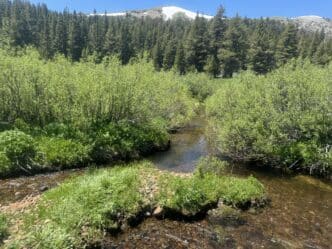
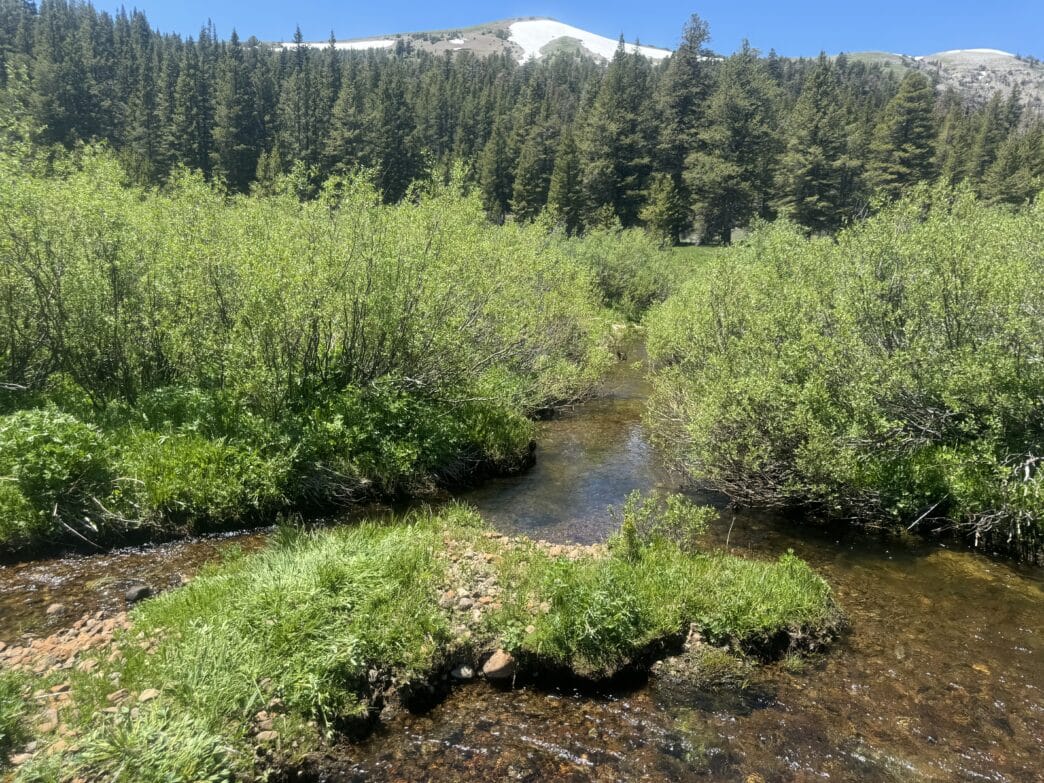
My quest began with a scenic drive along Lake Tahoe, then a gorgeous hike along a stretch of the Pacific Crest Trail, where wildflowers lined my path and snow-capped peaks gleamed in the distance. Exactly the image you might conjure when you hear the phrase, “High Sierra.” I walked through this daydream, feeling at one with the world for a few miles, then crested a ridge and looked down at my destination. What I saw was a textbook example of a high-elevation watershed, where snowmelt trickled into a meandering creek winding through a grassy alpine valley. While it looked like a paradise, the meadow would soon reveal itself as a spiritual testing ground where I had to overcome a lack of knowledge, a lack of skill, and, worst of all, an abundance of self-doubt.
From the trail, I spotted a group of fish just past a bend in the creek and couldn’t believe my luck. I’d found them right away. But the moment I stepped off the path, they vanished, and I had no idea why. It was literally one step. Maybe these fish knew that anyone who stepped off the trail had bad intentions, or maybe it was just bad luck. Either way, they were gone, and my feeling of being at one with nature had swam away with them. Undeterred, I kept walking. After twenty minutes, doubt crept in. I started talking to myself, mostly self-directed insults followed by hopeful prayers, as I walked on for another ten minutes. Finally, beneath some overhanging brush, I caught sight of three fish holding steady in the current. I froze, dropped to one knee, and mapped out my next move.
Knowing that trout can’t see directly behind them, I backtracked and calculated a route that would put me in the perfect position to make a cast.
Staying low, I crept closer, getting just about to the point where I was ready to launch a fly, and POOF! They bolted.
I was confused and upset because there was no way they could have seen me. Did they feel the vibration of my footfalls through the ground? Hear my breathing? Smell me? I began to wonder if there might be a spiritual reason those trout took off. Since I had only been fly fishing for a year, maybe I simply hadn’t earned the right to fish for them yet.
I shook off those negative thoughts and reminded myself that I was trying to complete a “challenge,” after all, so why would I expect it could be accomplished without overcoming some obstacles? Or maybe even a lot of obstacles. So if I wanted a chance at one, I’d have to figure out what I was doing wrong and figure it out fast, because this might be my only shot for the foreseeable future.
For those unfamiliar with California’s geography, Los Angeles is more than 470 miles south of Truckee. The only reason I made the journey that far north was in an attempt to make my sons as obsessed with fly fishing as I was. That morning, I dropped them off at Trout Unlimited’s Sierra Trout Camp in Truckee, an amazing annual program for kids ages 10 to 12 that was a perfect fit for my boys. But since they wouldn’t make an exception for me, I had to find another way to fill my time and decided to head into the mountains in search of the LCT. Excited as I was about this opportunity, it came with a catch: I had to pick my boys up by 5 p.m., and it was already past noon. Factoring in the hike and drive back, I only had about an hour left. So I pressed on, desperately hoping for a chance to make another cast.
After 30 more minutes of searching to the end of the meadow and doubling back the way I came, I almost gave up hope, but luck, in the form of knee-deep mud, intervened. In an effort to get a different view of the creek, I stepped off the trail, only to have my left foot sink into the soft ground. When I stopped to pull myself free, I was thrilled to spot another group of fish in a shallow run, impossibly bracketed by thick brush on one side and tall reeds on the other. Luckily, I was behind them, and they hadn’t yet noticed me. I intended to keep it that way.
After my earlier blunders, I decided to get on the ground and crawl my way to a casting position. Moving at the speed of melting butter, I lowered myself face down into the mud. Then, cradling my rod in my arms, I propelled myself through the muck with my elbows while mosquitos swarmed, biting me through both my clothes and a thick layer of insect repellent. After about 30 yards of this ordeal, I finally made it to a position about 25 feet from the trout, and that was as close as I was willing to risk. Staying prostrate on the ground, I unhooked my size 18 Elk Hair Caddis from the hook keeper and took a look at my impossibly small target, which somehow seemed even smaller now that I had gotten closer. Knowing there was no room for error, I pulled line off my reel, drew back, and cast.
My fly sailed through the air and landed in the brush on the left bank. What a screw-up. I dared not speak or move, but I gritted my teeth in anger so hard I nearly broke my jaw. How could I have gotten so close only to mess it up on the first cast? Seeing the fish were still there, I quickly pulled back on the line and felt a massive rush of relief when the fly came free. I had just witnessed a miracle, made even more miraculous by the fact that the fish somehow didn’t notice. Knowing that could change at any moment, I adjusted my angle and cast again.
This time, my fly floated into the reeds on the opposite bank, landing softly on a green stalk, like a real caddis would. I doubted the trout would appreciate my accidental artistry and tried to jerk the fly back again, but this time it wouldn’t budge. A stronger yank only sank the hook deeper into the vegetation, sinking my hopes in the process. Apparently, my neck couldn’t bear the weight of my anguish, because my head involuntarily fell forward, planting my forehead in the mud. For a few seconds, there were no words or thoughts, just emotions. All the bad ones.
I don’t know how long it lasted because my soul was somewhere outside of time, but once I regained lucidity, I realized I had two options. I could stand up, retrieve the fly, and scare off every fish in the creek. Or I could crawl over, cut the leader, and re-rig everything. I chose the latter and started crawling through the mud again, taking the long way to the snagged line so I wouldn’t risk spooking the fish. When I reached where my leader met the fly line, I clipped the lower nine feet of nylon and retreated to my muddy bunker to regroup.
Re-rigging should have been straightforward, but mud-slicked hands and smeared glasses turned it into a trial of will and a reckoning with my limited capabilities. Rolling onto my side, I wiped my lenses on my already-soaked shirt, dug through my vest for a tapered 5X leader, attached it to the welded loop, and tied on a length of 6X tippet while a swarm of mosquitos drained my blood and buzzed in my ears like mini-chainsaws. As you might imagine, threading the tippet through the hook eye took a few too many tries, but I finally got it through and tied on another caddis. Luckily for me, the fish remained oblivious to the pitiful drama unfolding in the muck behind them.
I took a deep breath and remembered the advice I’d heard since learning to fly fish … “Be patient,” “Take your time,” and all the other clichés people use to coach and console beginners like me after we screw up.
Once I got my emotions under control, I took a few seconds to think about where I wanted to place the fly, pictured it in my mind, then drew the rod back and released. …
The fly landed exactly where I wanted it to, but instead of triumph, the only feeling I registered was the absence of angst. It was as if I were in a trance, absorbed in focused anticipation, without any opinion about the fly or its position on the water. The problem was the same could be said of the fish, who didn’t seem to notice the fly at all. I watched as the small tuft of elk hair floated past one, then another, as if it were nothing more than a fallen leaf. Having put my emotions in standby mode, I began planning my next cast. But before I could pick my line off the water, the last fish in the group turned and slowly rose. Near the surface, he drifted alongside my caddis, assessing it with a long, skeptical glance. Then, with what can only be described as the fish-equivalent of a shrug, he cautiously sipped the fly, like a toddler putting a toy in its mouth to test whether the object is actually food.
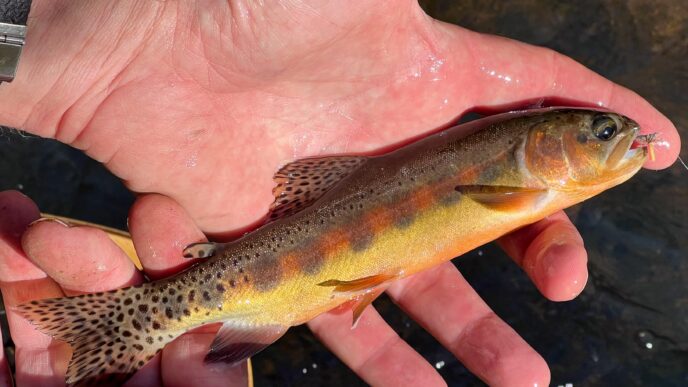
Spellbound and in disbelief, I nearly forgot to set the hook. But when I raised my rod and felt that beautiful tug, I knew I had him. Adrenaline launched me to my knees, and I started stripping line. As the fish slid closer to my net, I whispered, “Please stay on,” as if it might decide to comply out of respect for everything I’d been through. It must have worked, because before I knew it, I was looking down at a Lahontan cutthroat specimen so perfect it seemed to have jumped off one of Tomelleri’s prints into my net. Generously, this fish might have been 8 inches long, but in that moment it felt as worthy to be called a “trophy” as any giant that had ever been pulled out of Pyramid Lake.
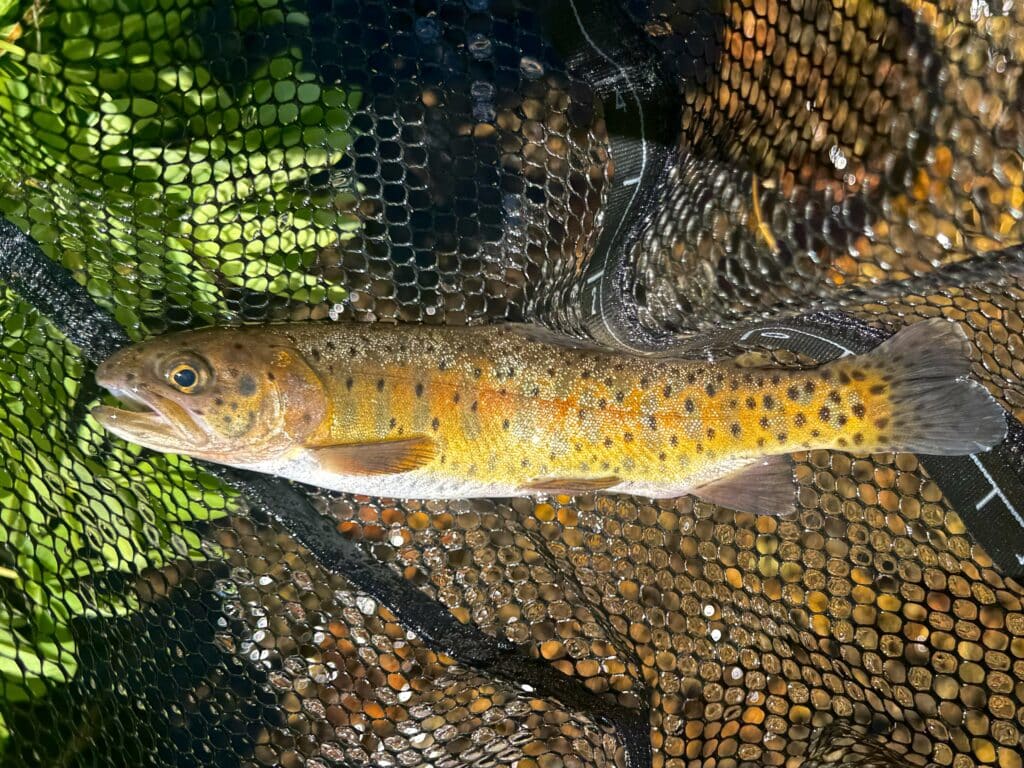
Now that our respective struggles had ended, I decided it would be best for both of us to get some oxygen, so I lowered the net into the water. The barbless hook had already slipped out of the fish’s mouth, and I spent a few seconds in disbelief, checking to make sure I had really caught one and hadn’t imagined the whole scenario in a state of hope-induced delirium. Once I caught my breath, I grabbed my phone and snapped a few photos. Not only did I need proof for the Heritage Trout Challenge, but I also wanted visuals for the stories I’d tell about this day. When I released the fish, it hovered nearby, weightless in the soft current, until it regained enough sense and strength to head upstream.
I sat and stared after him for a few seconds, lost in awed appreciation of what those last few seconds had given me. My consciousness drifted from the side of the creek to the place where moments become memories, this one already embossed with a nostalgic golden glow despite having just happened. After a few seconds, I drifted back into my body and realized the rest of the fish in the group were still there. I took it as a sign from the universe to cast again, this time without even bothering to get down in the mud. Within 10 seconds, I had another LCT in my net. The effort it took to land that one scared off the rest, but I didn’t care. Getting two fish to the net was more than I could have hoped for when I started the hike up to the meadow, or even five minutes earlier, so I was content to call it a day.
The hike back down the mountain felt like a blissful three-mile glide. At my car, I changed into dry clothes, then drove back to Truckee with the radio blasting songs I’d loved in my early teens. Rocking out somewhere along the western shore of Lake Tahoe, it struck me: I’d just had the perfect day of fly fishing. Most trips don’t offer so many chances to confront the impossible and come out a better person. Every time my boot sank into the mud, I faced a choice: Turn back or press on? Each mosquito bite forced me to take stock of my determination. Each spooked fish reminded me to practice humility and respect for the creatures I pursued. Every errant cast offered a lesson in patience and an opportunity to sharpen my skills.
When I finally made it to Truckee and picked up my kids from Trout Camp, I was thrilled to hear their day had been as transformational as mine, and I could see signs that an insanity-inducing passion was taking root. They told me stories of fish they’d landed and lost, of knots they could now tie, and of fish they could identify, especially native ones like the coastal rainbow, McCloud River redband, and, of course, the Lahontan cutthroat trout. When I showed them photos and told them about my adventure, they lit up with excitement and wanted every detail. Even though we’d been apart, our experiences felt intertwined, and I could sense that the day had given us a new language for expressing our love.
My boys made me promise to take them to catch the LCT one day, and I can’t wait. Sharing my experience with them expanded my concept of perfection, stretching it beyond a singular event and into the future, knowing the lessons from that day would echo for years, maybe even generations. Passing that wisdom on gave me a new lens on fly fishing and a deeper understanding of why I loved it so much. I finally understood that the ‘crazy’ people tried to warn me about wasn’t a diagnosis but a misunderstanding, a label conjured only because there’s no other word for what happens when someone falls in love with something that makes them reject the usual metrics of success. We live in a world where achievement is everything, and the quicker you gather accolades, the better. So when people steeped in that kind of thinking look at those of us who fly fish, of course it seems crazy to see someone love a sport not in spite of the obstacles to success but because of them. That day I learned a deeper truth than any postcard image could ever convey, a truth I could only appreciate now that I was a fly fisherman, and I would pass on to my children once they were ready to learn it: The highest ideal in fly fishing is much more about ourselves than the fish we are after, and real perfection lies in the mud, the struggle, and the moments when we refuse to quit, because what we’re actually out there fishing for can’t be caught on a hook.