
Discovering Shasta Lake’s surprisingly wild winter bass fishery
I often think about where some of our Northern California rivers would have converged before humans altered them. How amazing it would have been to see the confluence of the Pit and McCloud Rivers and to imagine what the canyon must have looked like, especially in years of heavy runoff. Or to see salmon and steelhead running up nearly all our Northern California trout rivers before there were any dams.
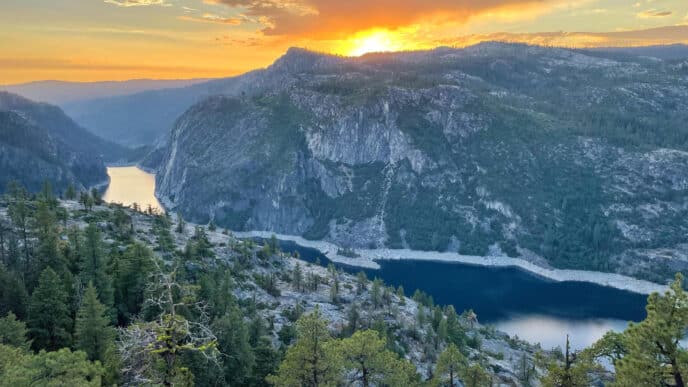
Well, that has been altered for better or worse, and now most of our major rivers and creeks in Northern California flow into Shasta Lake, a reservoir. The waters from the Pit River, McCloud River, Hat Creek, Burney Creek, Fall River, Upper Sacramento River, Squaw Creek, Backbone Creek, and so many other creeks and watersheds converge to form the largest reservoir in California.
Shasta Dam was completed in 1945, with most of the concrete material sourced near the Sundial Bridge, where a 10-mile conveyor belt transported it through modern-day Redding. The dam contains some six million cubic yards of concrete, and 12 million tons of material were taken from the Sundial or Kutras Tract. If you’ve fished the lower Sac or stayed at the Sundial Sheraton, you’ve seen the monolith; you just may not have known what it was. It’s the big concrete structure just southeast of the Sheraton and was part of the plant that processed the raw material.
I often hear people call Lake Oroville (also a reservoir) an inland ocean because of its size; for perspective, Shasta Lake is almost twice as large. Shasta Lake has a surface area of 30,000 acres at full pool and about 365 to 420 miles of shoreline.
A DIVERSE FISHERY
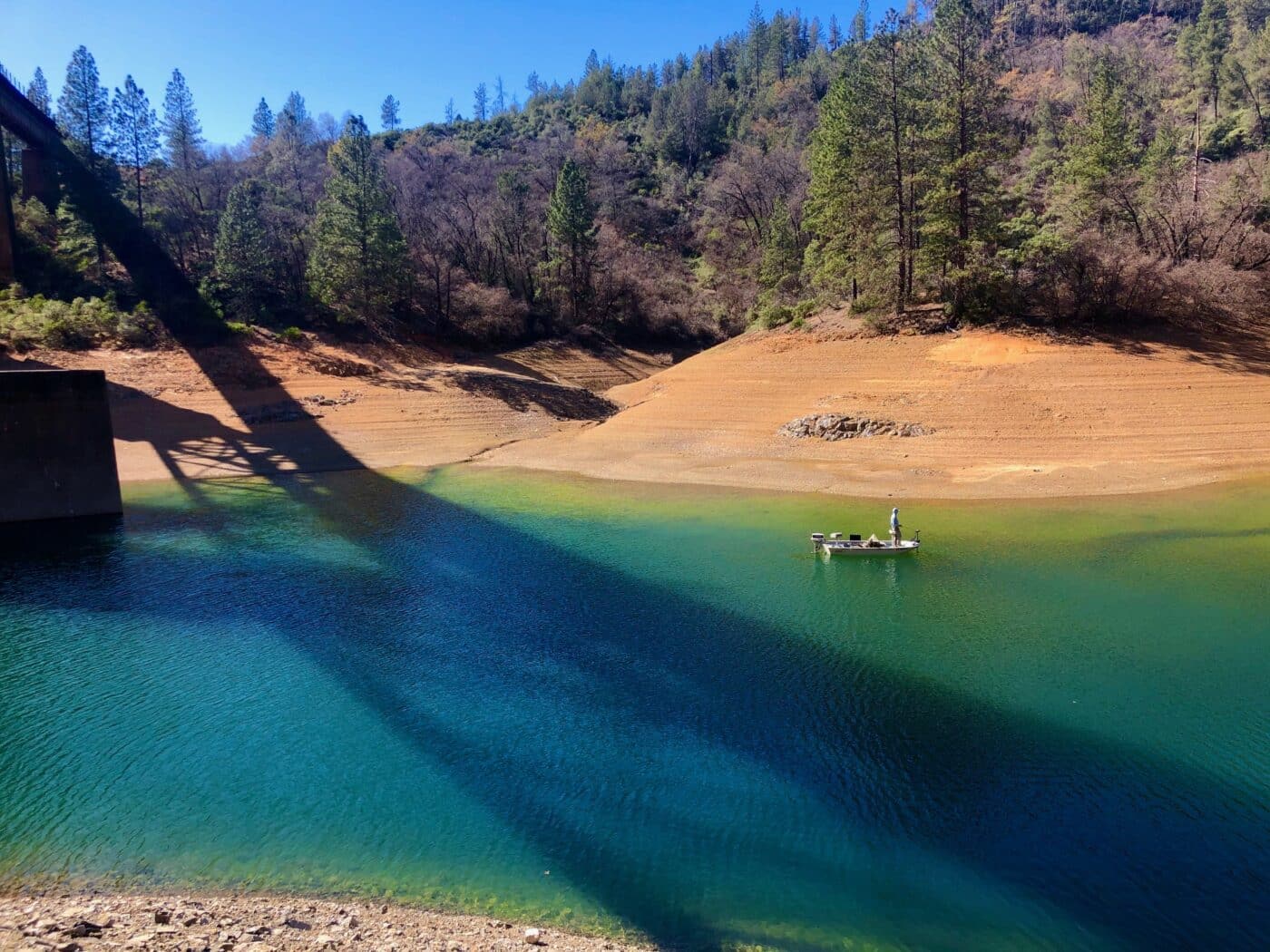
Let’s just say Shasta Lake is an absolutely massive fishery that would be almost impossible to fish every nook and cranny in a lifetime. For the past 10 years, I have spent about three to four months fishing and guiding on the lake and have still only seen a portion of it. Often, I push myself to find “new” water, and there’s an endless amount of it on this lake. When the lake is full, there are small creek arms that go for miles off any of the main river arms. It is an ever-changing, ever-evolving fishery, with water levels that vary immensely from year to year. Just five years ago, the lake was at one of its lowest levels ever, at 177 feet below full pool; last year, it was only a few feet from being full. When it is full, compared to being really low in drought years, it feels like there is a million times more water to explore.
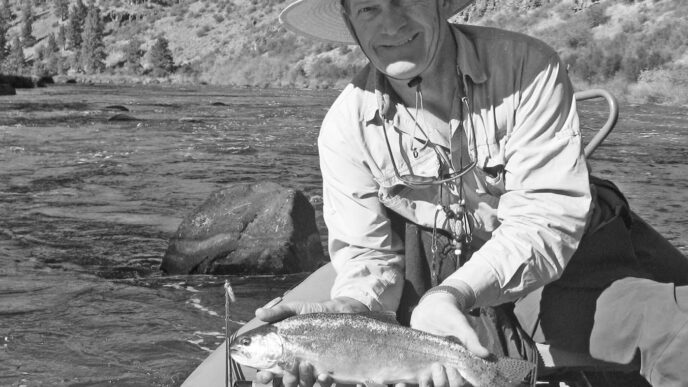
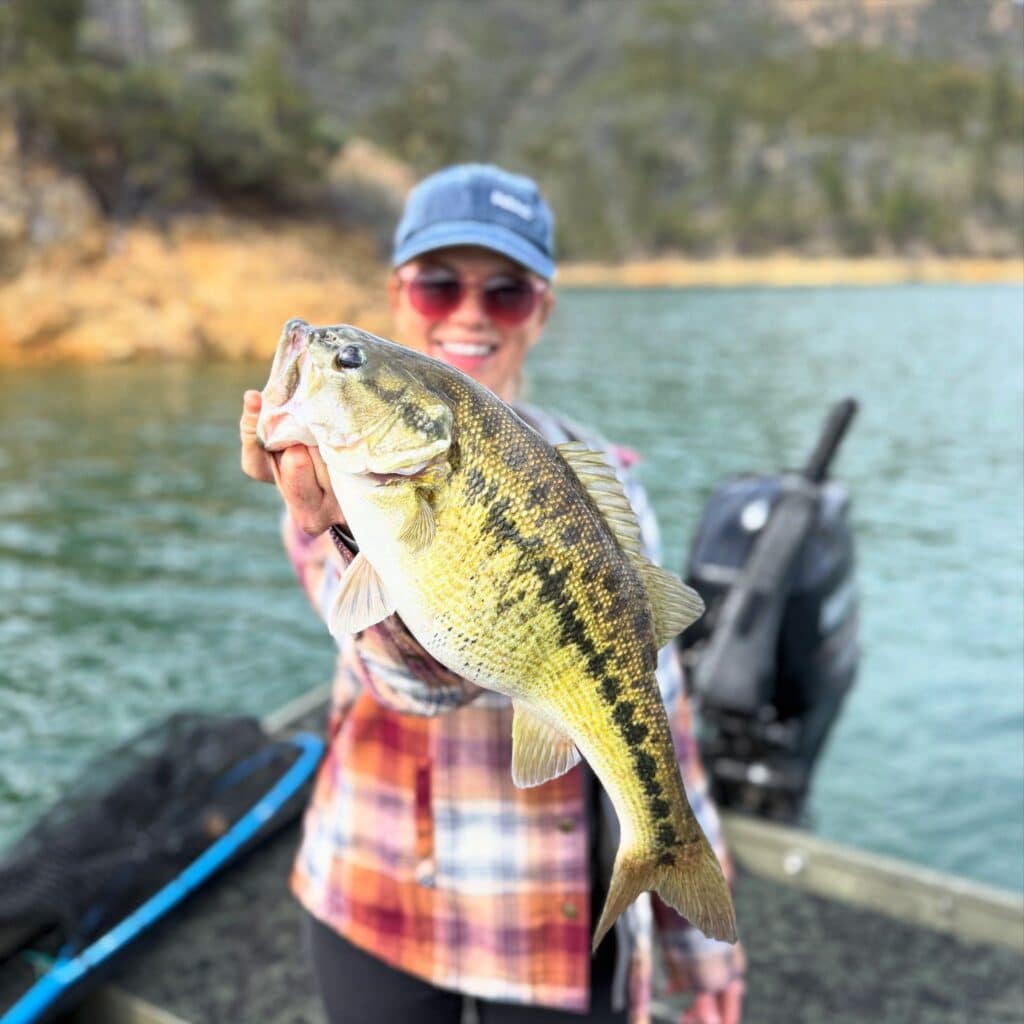
With all this super-clean, cold water, there are hundreds of thousands, if not millions, of bass in Shasta Lake, including largemouth, smallmouth, spotted bass, and a hybrid between smallies and spots often called “meanmouth bass.” We mostly catch spotted bass, and the winter months are a great time to land an absolute monster. Last season, one of my clients landed a 7.5-pound spotted bass. However, most fish range from 1.5 to 2 pounds, and most days yield a couple of 3-pound fish. There are plenty of other gamefish to target in the lake, including large rainbow trout. Late winter is typically when I catch some while targeting bass.
This is one of the reasons I enjoy guiding on this lake so much; it’s always changing, and you have to adjust your tactics not only year to year but also month to month and day to day. There are so many different types of features, structures, and depths to fish on this lake; it’s insane. You can fish sheer, steep rocky walls that drop straight down into the abyss, super long points that stretch out for hundreds of yards, super shallow flats at the back end of creek arms, or trees and shrubbery submerged in the lake.
WINTER-SPRING FISHING
For all its size and variety, I’m going to focus here on the late-winter and early-spring fishery. It’s an amazing option in years when all the steelhead rivers on the West Coast are blown out. Just a few years ago, nearly every fishery in Northern California was chocolate milk or running way too high, even Hat Creek. However, Shasta Lake was still an option. You can literally go there any day and find fish; it’s very difficult to get skunked, though some days can be challenging.
Water temperatures are typically 48–60 degrees from December to March. However, conditions are always changing, and there are years that just don’t fit the mold. I’ve seen years when temperatures are near 60 degrees in early January, and you’re already catching 75–100 fish a day. That’s not the norm in January, and you can expect that you’ll have to search the lake and look around for them.
At this time of year, I like to focus on steep, sheer main-lake walls. The fish can simply move up and down the wall to stay in the desired water temperature and hunt right there, hanging out in all the rock outcroppings. However, like all fishing, they aren’t always in the same spots, so find a pattern that is working, and when you do, keep matching it. If they are on steep, dark, south-facing rocks, keep looking for that; if they are on sunny rocks warming up, keep looking for more of that.
Often, the fish come up from 20–30 feet down, or even deeper, to eat the fly, and they aren’t racing up to get it; they are sloooowwwwly rising to check it out.
The main food sources for Shasta Lake bass are threadfin shad and crayfish, along with various other fish species. However, threadfin shad aren’t around in late winter and early spring, so I like to throw a dark leech. (In late spring, there are ocean-sized bait balls of shad, with bass busting them. When you find one of these, you can throw streamers, poppers, or fish the bobber. It honestly doesn’t matter—you hook a fish on every cast, but that will be for another issue.)
When water temperatures are cold, I fish steep walls with the float-and-fly technique; it’s an amazing option for when the fish are lethargic. Think about someone dangling your favorite food just above your head. No matter how full you are, you’ll eventually jump up and grab it. That’s exactly how it works; you dangle that lifeless fly above them, and eventually they are going to eat. But this brings us to a very important part of winter bass fishing: patience. You cannot move too fast in the winter; slow it down and let ‘em soak.
RIGGING
The float-and-fly bobber that Jaydacator and now Solitude Fly Co. make is the perfect tool for the job; it shows you so many things a regular round bobber just can’t. It tells you instantly whether you’re on the bottom; it shows the tiniest grabs (which, often in the winter, are very, very subtle, so make sure to hit on everything), and it shows you different kinds of grabs. This is one of the most important things for catching more bass on a big lake. You can identify the small bites, especially if it’s calm; however, if the bobber flips up instantly, it’s a fish eating it on the drop, and if it’s sitting upright and then falls onto its side, it’s a fish coming up from below and taking tension off the bobber. Kind of hard to explain on paper, but you get it once you’re on the water.
I rig from bobber to fly between 8 and 10 feet. When attaching the bobber, I use a 40-pound, 18-inch chunk of fluorocarbon from the fly line to the bobber with a non-slip mono loop, then I use another 18-inch piece of 40-pound fluorocarbon attached to a 30-pound swivel. Below the swivel, I use 8-pound fluorocarbon to my fly.
My flies for the lake are tied on a 1/16-ounce Wapsi jig head; I have found this to be one of the strongest hooks out there. Make no mistake: a two- to three-pound bass will straight up kick your butt, and when you hook into something above three, hold on because they pull ten times harder than a trout. The reason we can land them is because we are on 8-pound test; no way you’d land a 3-pound fish on 5X tippet.
The fish are moving slowly, and so am I. A lot of the time, I’m fishing on spot lock (a digital anchor on the trolling motor). This lets us cover every inch of water very discriminately. Casting five feet to the right or left can cover different fish. As I said before, fish very slowly; the fish are lethargic, so don’t fish too fast! Let ’em soak.
Find your “pattern for the day.” If you are not getting any fish, then move to a different kind of rock structure or to a point if you are fishing walls. One thing I would avoid at this time of year is going way to the back of the creek arms. My advice is to focus on the main lake body.
You may be thinking, “I’m never going bass fishing under a bobber.” Well, join the crowd. It took me years and years of trying to get people to fish the lake with me. Once I get them there, they instantly book for the following year. It’s just a fun fishery with little fishing stress. I guarantee that if you came out with me, your mind would be changed.
Oftentimes, when I’m guiding on a river, you need to make the perfect cast or drift, or, sorry, you put that fish down … let’s move on. Or you need to cast in there right when we get past that snag on river-right, 35 feet over, so it drops perfectly into that trench, or right off that shelf … ooh, sorry, you snagged up, and the river is too fast to get back up… break off the line. You’ve all been there. Shasta is not that. You’re in a lake. You didn’t make the perfect cast? No problem. Just fish that one out for a minute and make a better one on the next.
This is why it’s a great place to bring beginners, especially kids, because they have all the time in the world to make the right cast, learn how to set and fight fish, and worry less about not having another chance.
LOVE IT FOR WHAT IT IS
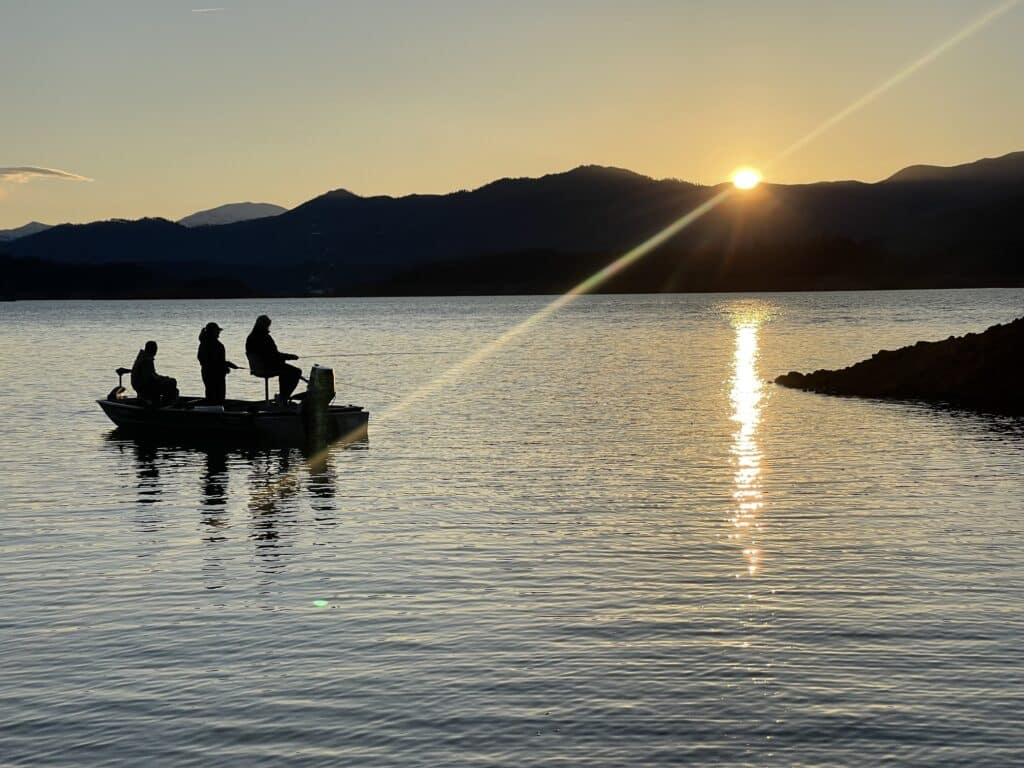
Shasta is an incredibly vast wild place with bears, mountain lions, turkeys, bald eagles, otters, and countless other species of wildlife. On multiple occasions, I’ve seen huge sturgeon leap from the water. It truly is a beautiful place—and one of the reasons I keep coming back.
Maybe Shasta Lake isn’t what this country looked like before the rivers were dammed, and I’ll probably always wonder what the old confluence of the Pit and McCloud looked like. But this is the fishery we have today, and I’ve come to love it for what it is: a huge, wild, constantly changing body of water where there’s always another wall, point, or creek arm to explore. In the middle of winter, when the rivers are blown out and everything else looks unfishable, that’s a pretty good place to be. Slow down, let ’em soak, and see what happens.