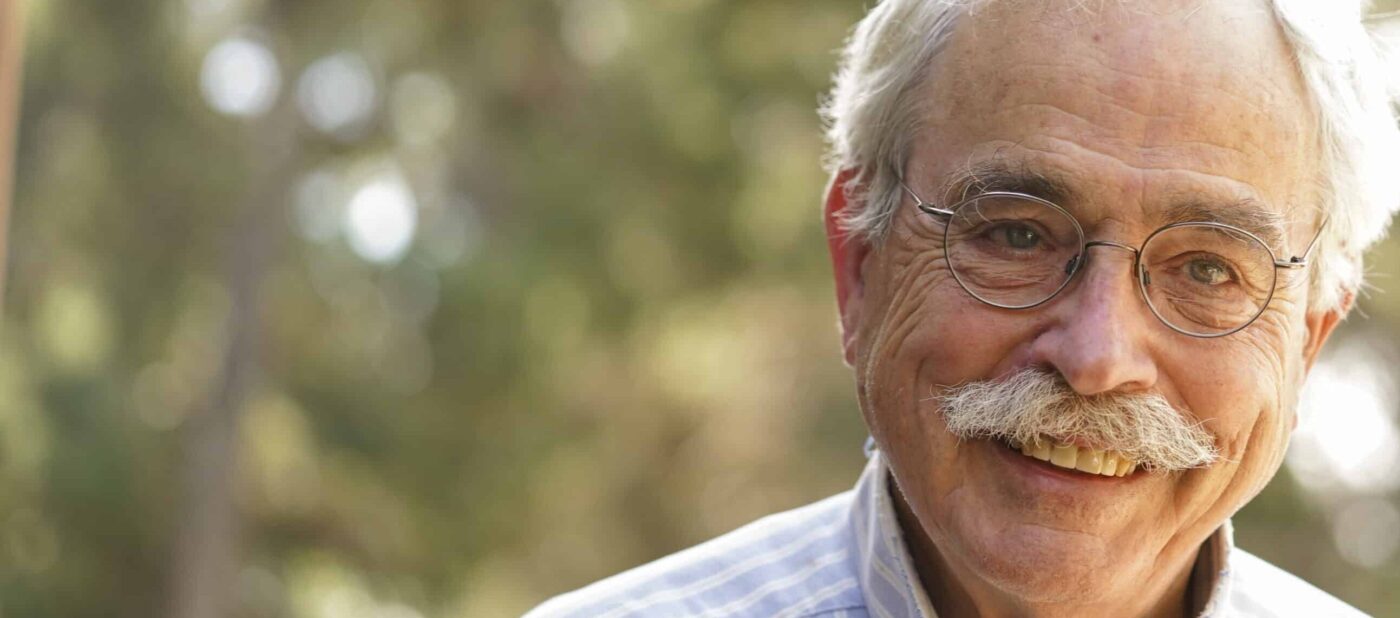

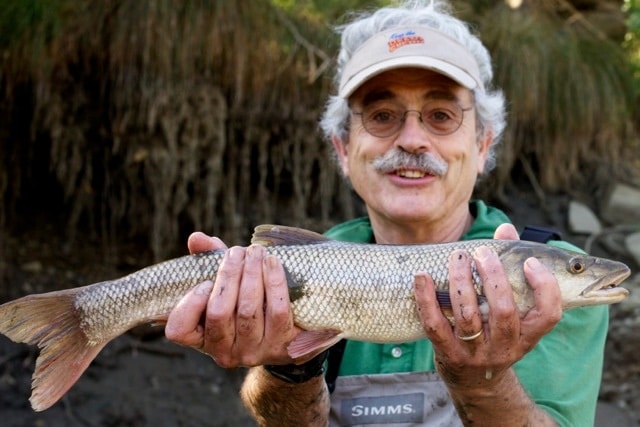
For those of us who work on rivers, we often have nicknames for each other’s professions. I’m a rock kicker (fluvial geomorphologist), for example. But let me introduce you to my friend and colleague, Peter Moyle, the consummate fish squeezer.
Peter is familiar to many readers of California Fly Fisher, even though he is not a member of the fly-fishing fanatics family.
But he is, by far, the most important scientist ever to have worked on—or squeezed—freshwater fishes in California, and his lifetime of work undergirds everything that fly fishers in California love.
Origin Story
It is worth looking at the arc of Peter’s amazing career and considering its impact on how California’s freshwater fish are managed today. It all starts in Minnesota, where the winters beat the mean out of you. He is the essence of Minnesota nice.
His upbringing—raised by a PhD plant biologist father and an MS zoologist mother—shaped his interest in natural history, making him fluent in everything from birds to bears. Walks in the woods of Minnesota with his parents were all about discovery and reciting Latin names for plants and animals. He also spent countless hours boating and fishing on Lake Minnetonka or exploring its endless shoreline.
Most of us can point to an inflection point in our lives or careers. For Peter, it was getting summer jobs, first with Montana Fish and Game and then as a field assistant studying remote salmon streams in Alaska. That sold him on studying freshwater fishes for his career.
The Prolific Academic
Peter completed his MS at Cornell, studying brook trout. While there, he learned to question authority and challenge conventional wisdom—both necessary traits for a good academic, though they can make life tough for a grad student. He happily departed Cornell in 1965 and returned to Minnesota to pursue his PhD in Zoology and to court the love of his life, Marilyn, whom he would marry and raise a family with.
At Minnesota, he proved himself to be a very good graduate researcher and an outstanding teacher. These talents landed him his first academic job in 1969 at what was then known as Fresno State College. It was only three years later when UC Davis learned of his skills and recruited him to his present academic home, the Department of Wildlife, Fish and Conservation Biology.
When Peter arrived at Fresno State College, he made two cogent observations that would shape his entire career: 1) not much was known about native or non-native California fishes; and 2) many native fishes were in decline, and the causes were either poorly understood or not well-documented.
For the former, Peter has spent 50 years studying fish throughout California. He has an encyclopedic knowledge of the 130 native fishes of California and the 50 non-native species. You can ask him about any river or stream in California, no matter how obscure, and he will tell you when he sampled it, which fish are there, and the status of their populations. He has no peer in this. Much of this knowledge is contained in his seminal book Inland Fishes of California, first published in 1979 and revised and updated in 2002. It is the bible of California fishes.
The causes of fish decline in California became a centerpiece of Moyle’s research program. He has published more than 250 journal articles on California fishes. Most notable is his love for all fishes, not just salmon and steelhead. He has studied some of the least-loved “rough” fish, such as roach, dace, sculpin, and various minnows and suckers. Indeed, he has long championed the importance of these unloved fishes as indicators of the health of our rivers and streams.
But Moyle is, by far, the most important voice when it comes to salmonids. Working closely with the staff at CalTrout and the UC Davis Center for Watershed Sciences, he led the preparation of State of the Salmonids: Status of California’s Emblematic Fishes (2008) and State of the Salmonids II: Fish in Hot Water (2017). The latter was a first-of-a-kind synthesis showing that climate change will drive almost half of salmonids to extinction if we don’t act now.
Peter retired in 2015 as Distinguished Professor Emeritus, but he continues to publish new work. He also regularly contributes to California WaterBlog, offering insight into all things fish-related in the state.
An Impactful Career
The arc of Peter’s career coincides with dramatic changes in how we manage native fish species and their waters. Landmark environmental laws, such as the Endangered Species Act and the Clean Water Act, were enacted as he began his career as California’s preeminent fish squeezer. There have also been seismic shifts in thinking about water and fish as public trust resources, protected by the state constitution and other laws. Given the volume and integrity of his research, Peter has—more than any other researcher in California’s history—shaped many of the efforts to conserve native fish species over the past 50 years. I challenge you to find a biological assessment, an endangered species recovery plan, a water quality control plan, a journal article, a conservation organization’s strategic plan—anything that touches California fishes—where Peter’s work is not foundational. You won’t.
This extraordinary body of work, based on decades of studying the fish of California’s streams, rivers, and estuaries, has framed the problem, documented the evidence, and shown the path forward for conserving native fishes, all while learning to live with invasive fishes and adapting to a changing climate. That is the hallmark of a very impactful scientist.
And to Peter’s credit, he is unafraid to bring his expertise to some of the thorniest controversies, always providing evidence-based conclusions, unpleasant as they may be for some to hear, delivered with a touch of Minnesota nice (see sidebar).
But Peter himself will tell you that all this research and writing is not the greatest impact of his career: It is the students. Journal articles and books, no matter how impactful, fade with time. Students are the most important “product” of any academic worth their salt.
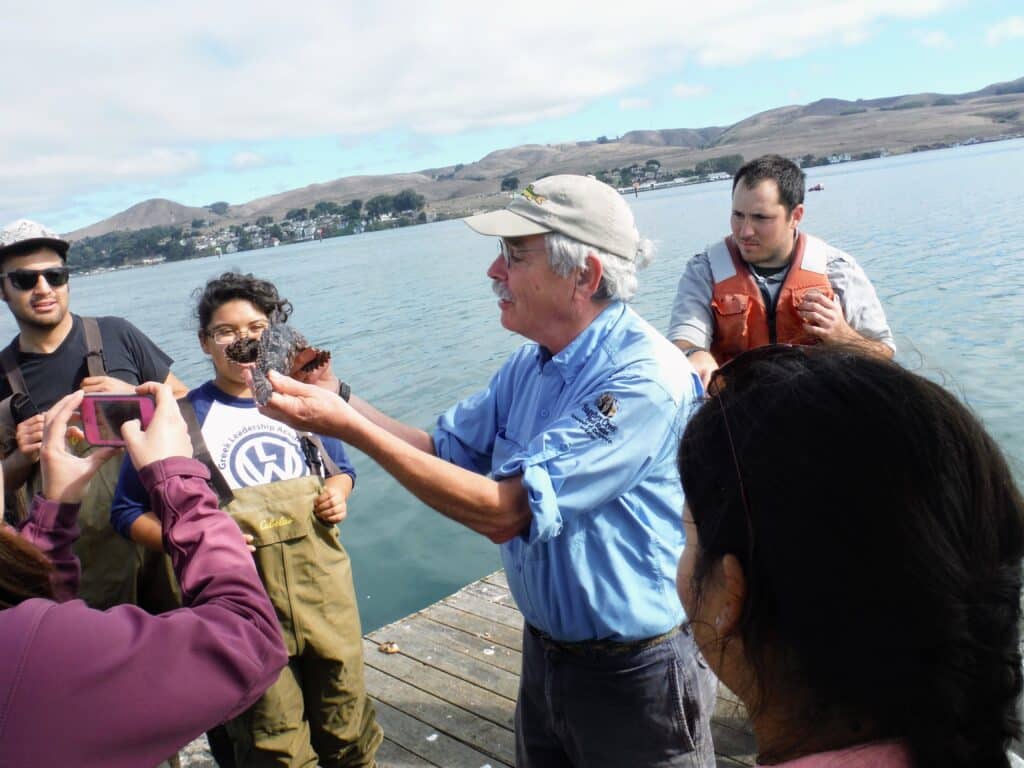
I sat by rivers in Alaska, Canada, and the western US, watching Peter, standing chest-deep in his waders, patiently and expertly guide students toward a deep understanding of fishes and their conservation needs. He and I share the same teaching philosophy: We teach in the classroom, but we inspire in the field. Peter was a master at this, teaching more than a thousand undergraduate and graduate students, many of whom are out there today thinking and acting differently when it comes to native fish conservation.
As anyone working in the field today knows, Peter’s students, particularly his graduate students, are the force multiplier. Scan the employees and leadership of any federal or state agency, consulting firm, or conservation organization working on California fishes, and you will inevitably encounter Moyle students. Many of his students are now successful researchers at universities, carrying on the tradition.
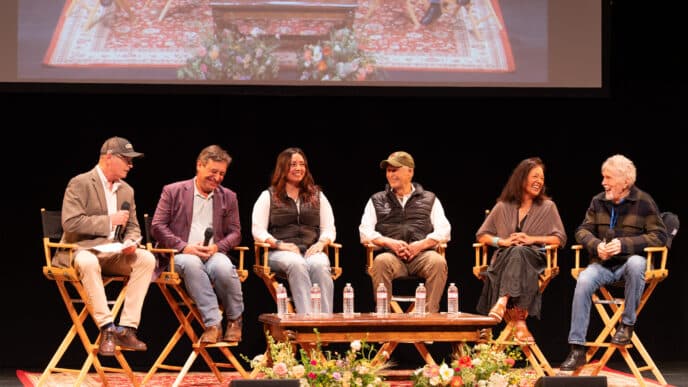
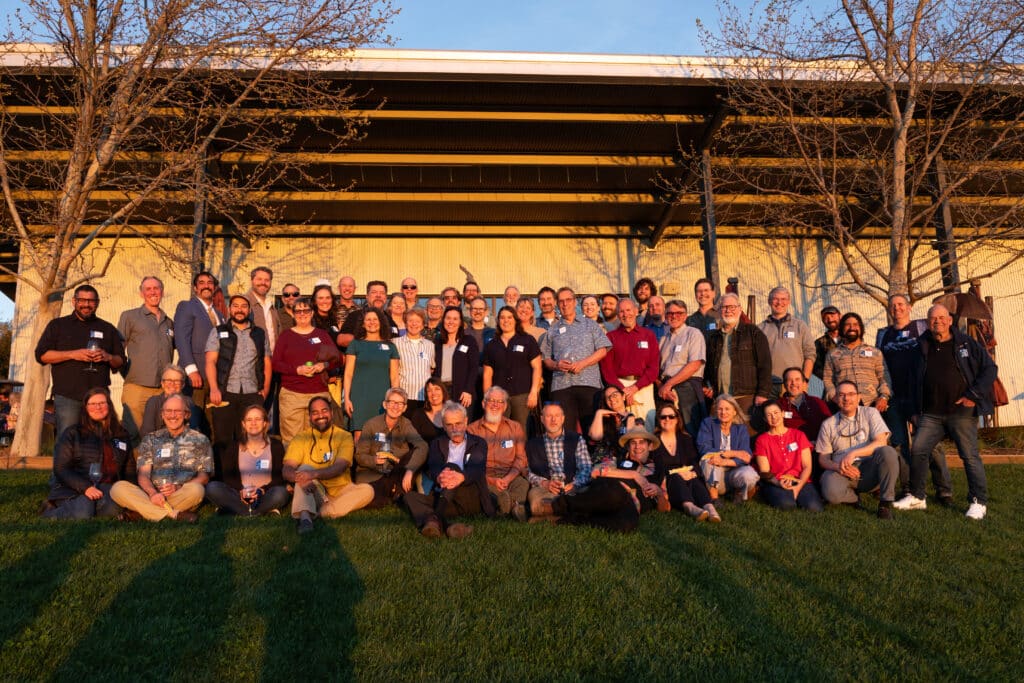
In early March of this year, 160 of us gathered to celebrate Peter’s career. The event was funded by donors to the Public Policy Institute of California’s Peter B. Moyle Fund for Environmental Water Policy. More than 50 of his former graduates from around the country were there (see photo). Each of them credits their career success, if not their lives, to Peter Moyle.
Now THAT is lasting impact.
An Enduring Legacy
To be clear, I am not an unbiased observer of Peter’s career. We met in the 90s at UC Davis and began working together—the rock kicker and the fish squeezer—on problems we both found interesting because their solutions lay at the boundaries of our disciplines. Peter and I went on to establish the Center for Watershed Sciences at UC Davis, which is flourishing today. We published papers together and shared a love of taking students into the wild to study rivers and fish, knowing they would be inspired to do more for fish in the future. I am proud to call him my friend and colleague of many decades: He is the inflection point in my career.
Peter Moyle has changed the course of fish conservation in California’s streams, rivers, and estuaries, and has shaped the lives of many students. In doing so, he has made things better for the readers of this magazine. Fifty years of hard work he loved have left a remarkable legacy. Remember that the next time your indicator suddenly disappears. Peter, along with your fishing skill, helped make that happen.
Wading into Controversy
Dr. Peter Moyle has engaged in some of the thorniest, but most important, court cases affecting native fishes in California. Here’s a sample:
Putah Creek Council v. Solano Irrigation District (1996)
Heavy diversions of Putah Creek in Solano County decimated native fish populations. Based in part on Dr. Moyle’s testimony, the court ruled in favor of the fish in 2000. Since then, he has helped revive Putah Creek’s ecosystems, with abundant native fish and Chinook salmon returns. It is often cited as a conservation success.
National Resource Defense Council v. Rodgers (1998-2006)
The construction and operation of dams and diversions on the San Joaquin River contributed to the loss of the largest run of spring-run Chinook salmon in California, as Dr. Moyle documented in one of his earliest journal papers. His testimony in the lawsuit against the US Bureau of Reclamation helped lead to a 2006 settlement agreement that launched the ongoing San Joaquin River Restoration Program.
Environmental Protection and Information Center v. Andrea Tuttle et al. (2001)
Logging practices in California have long been known to harm coho salmon, primarily through the introduction of fine sediment and increases in water temperature. The California Board of Forest rarely required restrictions on logging operations to protect salmonids. Dr. Moyle’s research played a key role in documenting this deficiency. The lawsuit was settled when the Board rewrote its Forest Practice Regulations to protect endangered fish species.
National Resources Defense Council (NRDC) v. Kempthorne (2007)
Delta smelt were once one of the most abundant fishes in the Sacramento-San Joaquin Delta. Dr. Moyle’s expert testimony regarding the biology of Delta smelt, along with his decades of research in Suisun Marsh, established a link between water exports and the decline of smelt populations. His earlier work also led to listing of Delta smelt as federally threatened.
Section 5937 of the California Fish and Game Code: Fish in Good Condition
This section of the Fish and Game Code requires dam operators to maintain fish below the dam in “good condition.” In a series of cases involving fish on Putah Creek, the Ventura River, and the Tuolumne River, Dr. Moyle and his students developed a scientific standard for what this means in practice. This standard is playing an important role in multiple lawsuits seeking to improve conditions for fish today, including the ongoing lawsuit to restore flows on the Kern River near Bakersfield.
Dam Removal
Dr. Moyle’s work has been used extensively to guide the removal of dams to improve fish conditions or to modify dams to improve fish passage. He was an early advocate for removing San Clemente Dam on the Carmel River to protect endangered steelhead and, in a 2002 National Research Council report, recommended removing the Klamath Dams to restore endangered coho salmon. San Clemente Dam was removed in 2015, and the four Klamath Dams were removed in 2024. All current proposals for large dam removals, including Rindge and Matilija Dam in Southern California and dams on the Eel River and Battle Creek in Northern California, are guided by the research of Dr. Moyle and his students.