Wouldn’t it be nice if you could buy a piece of gear that actually made you a better angler? Not just something that helped you catch more fish—but something that improved the way you cast, mend, and control your fly?
Fly lines are at the very top of that very short list, though many anglers overlook their impact.
Fly lines are also among the least understood pieces of fly-fishing gear. This confusion is understandable given the sheer number of fly lines on the market. At my fly shop alone, we have more than 2,100 in stock—so many that I joke, after “the big one”—earthquakes being a common topic in San Francisco—they’d find my body buried beneath a mountain of fly lines. The goal of this article is to help you choose the perfect fly line for your needs without getting overwhelmed by all the options. This is part one of a three-part series; without this knowledge, you will wish you were buried under a mountain of fly lines.
FLY LINE ANATOMY
My favorite way to explain the importance of fly line is with a simple thought experiment. If you handed me $150 and told me to buy a rod, reel, and line, would I really spend $100 of that on the fly line?
The answer: absolutely. I would spend $100 on the fly line and find a rod and reel at a garage sale for $50.
To help you make informed choices, I’ll break down the key components of a fly line. That way, when you flip over a fly box or study a line diagram, you’ll understand exactly what that line is designed to do—and whether it’s the right one for how you like to fish.
Explained in simple terms:
- Head length determines how much line you can false cast or control on the water (mend).
- Tapers
- Front Taper controls presentation.
- Rear Taper controls turnover and mendability
- Fly Line Mass/Weight is how heavy that section of line is. This weight loads (bends) the rod during the cast and provides the force needed to cast the fly or multiple flies (a rig).
- Density refers to whether the line floats or sinks. It controls the depth at which your fly will be presented in the water.
- Core Composition is the material at the center of the fly line. This determines if the line will remain supple (flexible) in cold temperatures or stiff in hot conditions.
HEAD LENGTH
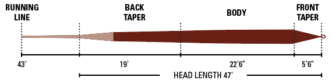
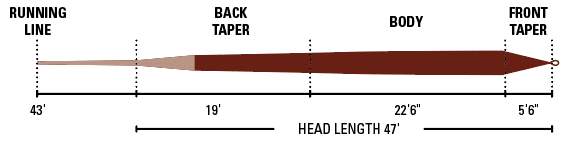
The head is the thicker, heavier part of the fly line that you cast. The rest of the line, called the running line or shooting line, is thinner and designed to move easily through the rod guides when you shoot line. Casting with some running line past the rod tip is called ‘overhang.’ The length of the head, combined with your casting skill and the shape of the rear taper, determines how much overhang you can manage. The main question here is: How long is the part of the fly line that you actively cast? These days, an average head length is about 45 feet. Longer heads are above this length, and shorter heads are below it.
Scenario 1: To cast 60 feet accurately, use at least a 50-foot head to reduce line shooting. See figure 3.
Scenario 2: On small creeks, a short head is best for short, effective casts. See figure 5.
Scenario 3: Streamer fishing from a boat on the Delta? Choose a short head for quick pickups and efficient line shooting. See figure 6.
Scenario 4: Fishing indicators on the Fall River? You’d use a long head to mend line at a distance and avoid spooking fish. See figure 4.
TAPERS
Weight-forward and double are where most anglers’ knowledge of tapers ends. However, there is a much richer story in taper design that can be read on the taper diagram. Tapers have exploded in recent years with the advent of compound tapers. Tapers are simply how weight is distributed along the head. Weight near the front of the head helps turn over heavy flies, while weight toward the rear aids roll casting and accuracy.
The front taper controls how much energy hits the leader.
A short front taper delivers a burst of energy to the leader, making it great for casting heavy bass bugs, streamers, or indicator rigs. You can soften a short front taper’s harsh presentation with a long leader and a heavy butt section (the thick/stiff part of a leader before it tapers to the tippet), which absorbs power and effectively lengthens the taper. This makes it more versatile than a long front taper.
A long forward taper decreases in mass and diameter over 15 feet or even 20 feet. As the line diameter decreases, the loop gradually speeds up as it unravels, helping turn over long leaders, while the reduced mass helps the line land more softly. A great choice for a size 18 PMD on Fall River, but a poor choice for short casts or large, heavy flies.
One important detail: Pay attention to where most of the weight is on the line. If most of it is in the rear, the line is good for roll casting. These lines narrow from the heavy rear section to the main body, then taper to a short front taper. This construction is very different from lines where most of the weight is near the tip, which affects how they perform.
The rear taper is straightforward. A short rear taper goes quickly from thick to thin, making it ideal for shooting line but poor for mending. A long rear taper gradually steps up in mass toward the head, allowing better energy transfer and making it great for mending and carrying more line while casting.
MASS/WEIGHT
The weight of a fly line’s head determines how it feels when matched with your rod. Experienced anglers often talk about grain weight, which is the weight of the first 30 feet of line, measured in grains, a unit of measure. In the past, a 5-weight line was always 134–140 grains, but now many lines are made 5–13 percent heavier to better match modern rods. These heavier lines are typically noted as half-size heavy or full-size heavy. If your rod is fast (stiff), you may prefer a heavier line. Heavier lines also help cast large or wind-resistant flies. “More mass, more better” when casting heavy flies or poppers. I check the weight in grains to compare lines accurately.
You will free your mind if you stop thinking about lines by the weight that is labeled on the box, 5-weight for example, and consider the actual weight of the head. Here’s why: Two “5-weight” lines can feel completely different because one might be 140 grains and another might be 160+ grains. Same line-weight label, but a totally different casting feel.
When you see a line labeled WF5F, it is telling you: (WF) weight forward (not a lot of info there) | (5) That the line was designed to be cast on a 5-weight rod | (F) That it floats.
CORE
The Core has become more complex in recent years, with compound multifilament braids in which the running lines are designed for a hot boat, while the head is designed for cold water. But the major buckets here are coldwater and warmwater lines. Coldwater lines are designed to be supple in cold conditions, while warmwater lines will maintain stiffness even in heat. I would much prefer a warmwater line in coldwater because a coldwater line will wilt and become more of wet noodle than fly line and not convey power.
DENSITY
A sinking 5-weight and a floating 5-weight line have the same mass. The rate at which a fly line sinks depends on its density: A denser line is thinner and sinks faster. Most lines we sell are floating—at least when they leave the shop and before they are abused on stream. Floating lines are best suited to the most common methods of fishing: dry fly, dry dropper, and nymphing. Sinking lines are labeled as follows:
- Hover: sinks at 0.5-1 inch per second (IPS)
- Intermediate: Sinks at 1–2 IPS
- Sink 3/ Type 3: Sinks at 3–4 IPS
- Sink 6/ Type 6: Sinks at 5–6 IPS
You get the picture. …
Typically, the darker the line’s color, the more tungsten powder it contains and the faster it sinks. Additionally, fly lines come in full-sinking, sink-tip, and even multi-density options to achieve different sink rates. A sinktip is preferred for rivers and fishing from shore on lakes because the back portion of the line floats, and only 10 or 15 feet of the front of the line sinks. This will keep the line from sinking to the bottom and hanging up in the shallows near the bank. Keep in mind that the majority of your line is floating and will cause your fly to rise as you are stripping it in. Full sinking lines are better suited for fishing from a boat, where you are trying to keep your fly and line at a desired depth. When you strip, the fly will stay at the depth that the fly line has sunk down to and not come up until the fly is right below you.
COMMON FLY-LINE FOLLIES
Not labeling your fly lines. These days, fly lines have ID markings. However, they can become scuffed, or poor eyesight can make them impossible to decipher. At the shop, we label every outbound reel and line (even if you say “That’s okay, I will remember”) with our handy Dymo Label Maker.
Not cleaning your fly lines. If you want to protect the investment you’ve made on a nice fly line, clean it periodically with warm water and Dawn dish soap and treat it with a line dressing.
Casting your line without a leader. The turnover is too harsh, akin to cracking a whip, and will bust the front loop.
Buying a line for how you wish you fished. Too often, customers tell me they want a versatile line, but I know they spend nearly all of their time hucking indos on the Sacramento and Trinity. If you fish a particular way, choose a line that optimizes for that method.
COLOR
Lines today come in every imaginable color. I’ve heard stories about guides in New Zealand dyeing their clients’ lines to make them more camouflaged. When I made my first trip to New Zealand, I was surprised to find the guides I fished with really were not bothered by my brightly colored lines, only that I could cast well enough to turn over a long 15-foot leader so that the line would stay out of the fish’s field of vision. Companies have taken it a step further with totally clear and clear-tipped floating lines like Scientific Anglers’ Magnitude lines. The Idea is that you can fish with a shorter leader, making it easier to cast to wary fish.
BEST FLY LINES BY TAPER
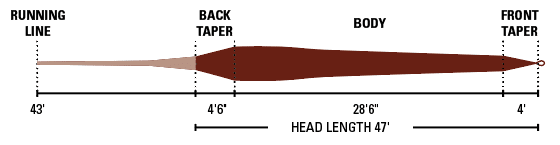
Best All-Around Line: RIO Elite Gold Max Line. I love the taper on this line, it roll casts like a champ because of the mass toward the rear of the head. It will throw streamers, indicators, dry droppers, and even smaller dries if you put a 12-foot leader on it. It is a heavy line, so you can fish the line labeled 4-weight on a 5-weight rod if you have a softer rod or want a little less mass.
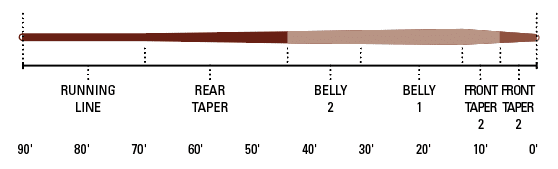
Best Delicate Dry Fly Line: Scientific Angler Trout Expert Line. A smooth 70-foot taper with a 15-foot buttery front taper unravels with incredible elegance. This line is a must-have for any stillwater or spring creek angler.
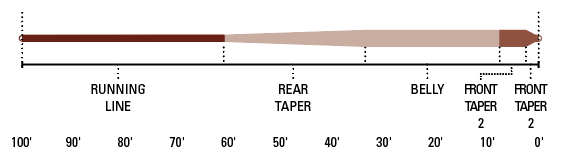
Best Boat Indicator Line: Scientific Angler Anadro Line. A 60-foot, weight-forward head with a short front taper and really long back taper makes the SA Anadro a top choice when drifting with indicators.
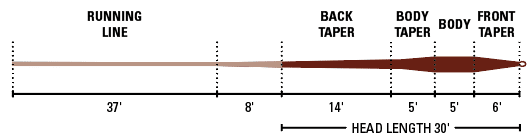
Best Small Creek Line: RIO Creek Line, A short, punchy head perfectly designed for short casts and flicking hoppers to alpine trout.
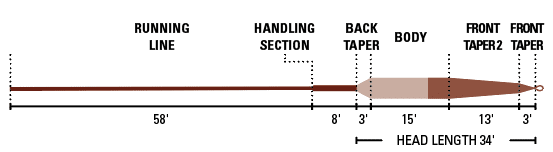
Best Streamer Line: RIO Predator Line, featuring a short, powerful head, this line has what it takes to move heavy flies quickly. The weight balance is superb for roll casting your fly to the surface before recasting.
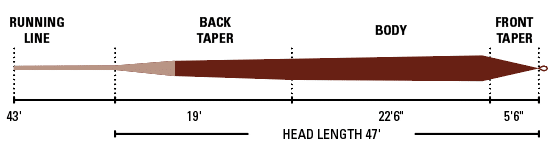
Best Value Line: RIO Avid Trout Gold, the good old 47-foot head of a RIO Gold has caught me a lot of fish. Don’t sleep on the SA Mastery series with nearly all their tapers available in a more price-conscious package.
Visit Lost Coast Outfitters in San Francisco to shop fly lines.