It is all over the news: A very strong El Niño is brewing along the equator.
This one looks to be on track to become a record-breaker. It will wreak havoc on the global climate and be a big deal for California. What does it mean for California fly fishing? While there is a lot of media coverage focused on El Niño’s reputation as a troublemaker, I think we will see it bring some good things to California fly fishing in the coming fall, winter, and spring.
First, a little background: El Niño is Earth’s top source of year-to-year global climate variations. It naturally arises from a dance between winds and the tropical Pacific Ocean. An El Niño event typically plays out over 9 to 12 months, usually starting in the summer and ending the next spring or summer, and they happen two or three times each decade but on an irregular schedule. El Niño includes changing tropical rainfall patterns, where typically wet areas in Indonesia experience extended drought and typically dry areas in the central and eastern equatorial Pacific get soaking rains. Its best-known signature is a dramatic warming of the eastern tropical Pacific Ocean that reaches the coast of South America.
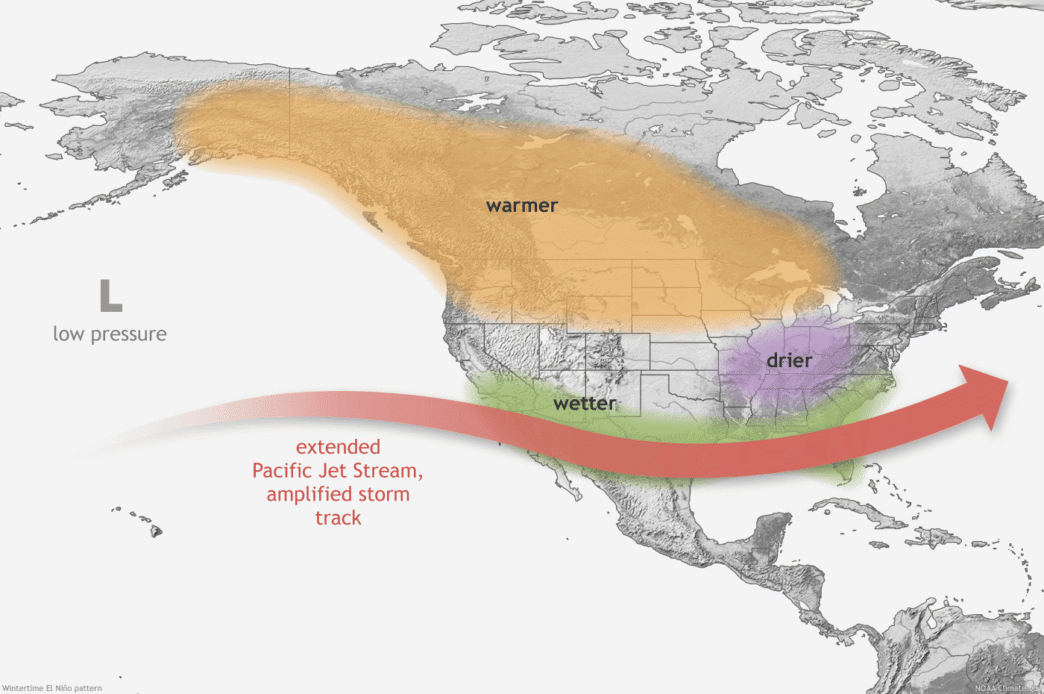
So that’s a lot about the tropics. Why should we care about it in California? Simply put, the massive and persistent changes in El Niño-linked tropical rainfall influence winds, storm tracks, and ocean currents thousands of miles away. Its influence on the North Pacific and North America is especially strong from October through March—the cooler, wetter half of California’s year.
Significant work has gone into extending El Niño monitoring and prediction into 3- to 12-month climate forecasts for other parts of the world, including California. A climate forecast differs from a weather forecast in that it predicts the statistics of weather for a given region, rather than the actual day-to-day weather. Climate forecasts out to a year in the future are informed by both past weather records and output from climate models. For instance, records going back to the late 1800s show that El Niño has favored wet winters in Southern California, but overall hasn’t produced a consistent pattern of wet or dry, or warm or cold, winters in Central or Northern California. While El Niño has come with an energized storm track pointed at the Southwest, it has not always brought flood-generating atmospheric river storms to California.
The wintertime strength of this event is predicted to rival or exceed that of the strongest events on record. The strongest events of the past have brought near-average to well-above-average rain and snowpack in California. If you’ve been around a while, you might recall California’s relentless rains and deep snowpack during the El Niño winters of 1982–83 and 1997–98. You might also recall that California precipitation was near normal during the El Niño winter of 2015–16 and below normal in 1991–92. I mention those four El Niño events because they are the strongest on record and in the class of projections for the current event.
Climate models that account for the developing El Niño and other factors also point to a wet California winter. The latest climate model forecasts from the United States, Canada, and Europe have painted a bull’s-eye on California for increased odds of a wet to very wet winter. Skill in long-range (three to six months in advance) winter precipitation forecasts is notoriously low in most situations, but it rises substantially when a strong El Niño event is underway. Winter temperature forecasts are more skillful, and they do not show increased odds of an especially warm winter—a key factor that led to a paltry snowpack throughout the western United States last winter.
For my day job, I’ve spent a lot of time investigating links between climate and California’s cold-water fish (including salmon, steelhead, and resident trout). Generally speaking, more cold water is better for our cold-water fish because it increases the quantity, quality, and accessibility of critical cold-water habitats. Likewise, a colder ocean favors higher productivity in the ocean food web where California’s salmon and steelhead thrive. But that’s about the fish, not the fishing.
This El Niño will impact California fly fishing. Impacts will come from months of warm ocean temperatures and a likely abundance of winter weather that affects California’s coast, streams, estuaries, and stillwaters. El Niño affects fly fishing by influencing conditions in different ways across different situations. I break these down into a few of my favorite ways to fish: fly fishing the salt, winter steelhead fishing, and high-elevation trout fishing.
Beach and nearshore saltwater fly fishing
If you fish saltwater, you probably know that 2026 ocean temperatures have been very warm from Santa Barbara to Baja and mostly warm along California’s Central Coast. This warm spell in the coastal ocean will continue as El Niño-influenced winds and ocean currents take hold this fall and winter.
Our warm ocean has already brought many reports of southern or offshore game fish moving into more northern and inshore waters. For the Central Coast, this includes Pacific bonito, white sea bass, and even yellowtail. While I haven’t heard of anyone targeting these species with a fly rod in Monterey Bay, some anglers do so in Southern California. There has also been a (sometimes incredible) abundance of Pacific mackerel in Central California’s nearshore waters. I can confirm that Pacific mackerel will eat a stripped Clouser minnow on a sinking shooting head, and they pull hard on a 6-weight. I found them on the grab when they were schooling on the surface, chasing pinhead anchovies off Capitola. For bonito and white sea bass, bring an 8- to 10-weight. This summer’s fishing in the Southern California Bight—in historically warm ocean temperatures—has already featured some incredible inshore fishing for yellowtail, and tuna have been in range for day trips.
The growing influence of El Niño on California’s coastal ocean from late fall through next spring should only increase opportunities to target fish we’d usually have to travel for. For the Southern California Bight, we should see more reports of dorado, barracuda, and striped marlin, along with continued opportunities for yellowtail, bonito, and tuna. For the Central Coast, I’m keeping my hopes up for those white sea bass and bonito, and maybe even a shot at yellowtail. If you’ve got access to a small boat, it should be a great fall to hunt central and south coast kelp beds, kelp paddies, and bait balls with deceivers, Clousers, and squid patterns on fast-sinking shooting heads.
Along California’s ocean beaches, El Niño winters bring elevated coastal sea levels—up to one foot above what you’ll see in your tide table—along with large ocean swells that tend to come more often than normal from the west/southwest. This combination has caused extensive coastal flooding and erosion in past El Niño winters and is very likely to happen this winter. If you fly fish the beaches this winter, you will probably notice significant changes between storms, with energized waves and higher sea levels removing sand in some places and depositing it in others. I also suspect there will be fewer opportunities to fish in calm, low-surf conditions this winter and more days with hazardous surf conditions to avoid for personal safety.
Steelhead fly fishing
This year’s El Niño may shuffle the deck for fall steelhead fishing in Northern California. Though rare, with El Niño and the existing ocean warmth off Baja and Southern California, a wayward tropical storm from the tropics has a greater chance to sustain itself up the coast of Baja and deliver its moisture plume to a fall rain event that reaches California. A sizable fall rainstorm would bring a mix of impacts, ranging from ending our wildfire season to a brief rise in streamflow and a drop in temperature that gets steelhead moving and improves fishing conditions, or a major and lasting rise that blows out rivers for a few days or even weeks. These are the kind of things that can impact fall steelheading trips to the Trinity and Klamath Rivers.
Like every year, this winter’s steelhead season will be shaped by where, when, and how much rain falls on California. While “more is better” when it comes to cold-water supplies that benefit our cold-water fish, that is clearly not the case when it comes to fly fishing for winter steelhead. Too much rain often means high, muddy, and unfishable rivers during our prime winter steelhead months. While writing this article, I reviewed U.S. Geological Survey stream gauge data for a few of my favorite coastal rivers. In 1983 and 1998, mid-January through March brought weeks of high, what I consider unfishable water, but quite a few days of good fishing conditions before that window. By contrast, the 1992 and 2016 seasons had more low-water than high-water days. This one may bring a very wet winter, when, even more than usual, fly fishers will need contingency plans and flexibility in order to spend quality time chasing winter steelhead.
Trout fishing
Fly fishing for our resident cold-water fish will also feel El Niño’s influence through hydrology—specifically the combination of winter and spring temperatures, snowpack, soil moisture, and rain-fed and snowmelt runoff next winter, spring, and summer. A big Sierra snowpack like those of 1983 and 1998, or at least a near-average snowpack as in 2016, looks much more likely than the meager snowpack we had following recent drought years or last year’s exceptionally warm winter. The depth and duration of next spring’s snowpack will affect access to high-elevation backcountry streams and lakes. A healthy snowpack could also make springtime fishing in high-elevation streams more challenging and delay the onset of favorable conditions from the typical April-May to June-July, but then keep conditions favorable deeper into late summer.
I hope this helps you anticipate the next few fly-fishing seasons. But I’ll close with this disclaimer: No two El Niño events have been the same. This El Niño may defy the patterns of the past I’ve relied on for this perspective and will likely deliver at least a few climate surprises before it runs its course. Whatever it brings, I’ll be doing what I always do—reaching out to my network of fishing friends, watching ocean and stream reports and forecasts, and getting out on the water as much as I can.