Living in the West is an exercise in the willful suspension of disbelief. Each day, we must ignore the reality of our surroundings, pretending we don’t live on the precipice of environmental collapse. As Marc Reisner argued in his masterful Cadillac Desert, we don’t so much live in the West as hang on from year to year; Western U.S. cities are more beachheads dug in against catastrophe than functioning, sustainable societies. Our rivers are stretched to the breaking point to provide us with drinking water, irrigation, flood control, and electricity.
While we flock to them for their healing powers and hypnotic allure—we ignore the fact that they are artificial constructs manipulated beyond any semblance of their natural selves. As we don waders to pursue “wild” trout and “reconnect with nature,” we choose to disregard our rivers’ long, sordid histories and the myriad interests that pull them apart and reconstruct them, and that continue to wage war over them every year.
The Truckee River snakes its way from Lake Tahoe to the Nevada desert, where it plunges into an ancient sea that once teemed with Ichthyosaurs but is now a fraction of its former self. The Truckee has the misfortune of being Lake Tahoe’s only outlet and therefore serves as the lifeblood of cities and towns—beachheads—in California and Nevada. Even San Francisco once dreamed of siphoning its waters through granite barriers for the city’s burgeoning population. The Truckee collects precipitation that blows in from the Pacific and piles up against the Sierra’s spires, tumbling down the granite ring around Lake Tahoe. From the moment of European contact, the Truckee has been taxed beyond its means. Early settlers, racing to scavenge gold and silver and build a railroad, denuded the area completely; the river was choked with the pulp and sawdust from millions of board feet of lumber used to construct a massive skeleton of timber frames under the nondescript hills east of Reno. The Comstock Lode pumped millions of dollars (billions in today’s dollars) into California and helped the Union prevail over the underfunded and disorganized so-called Confederacy. This required a novel approach to reach the deposits of silver. Square setting, as it was called, required massive amounts of timber and water, both of which the Nevada desert boasted little of. The Truckee River provided water for the mines and floated the necessary timber into the desert while collecting the trees’ discarded remains; the ancient Lahontan cutthroat trout, a fish the explorer and presidential candidate John C. Fremont called a salmon-trout, saw its historic range vanish.
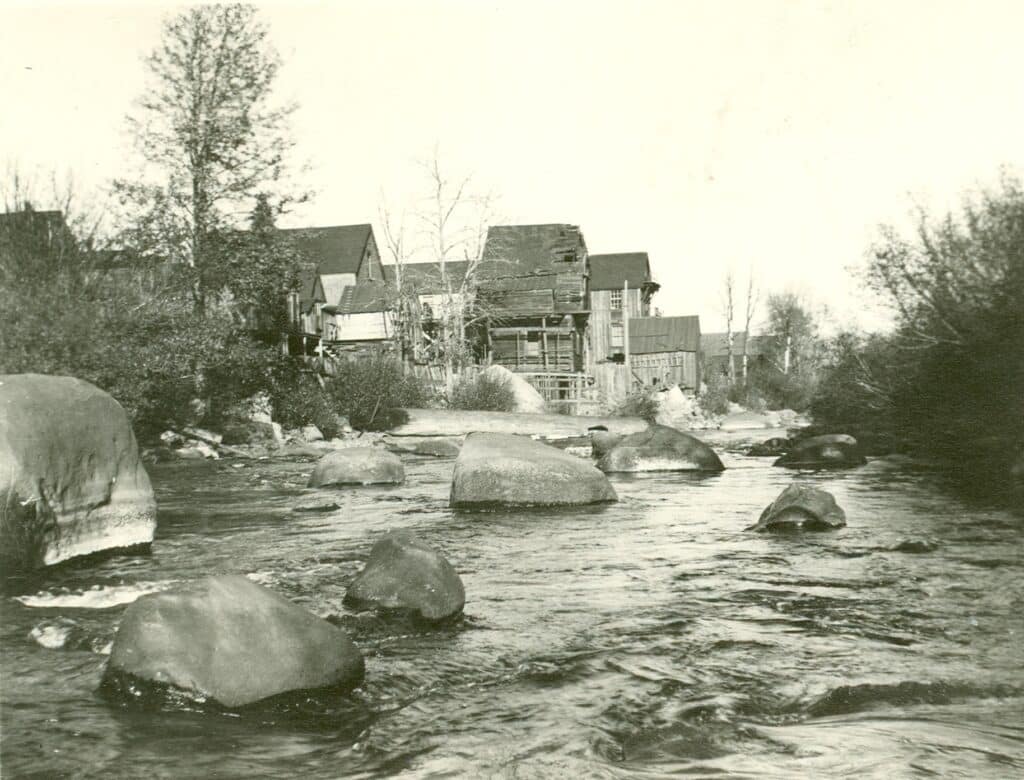
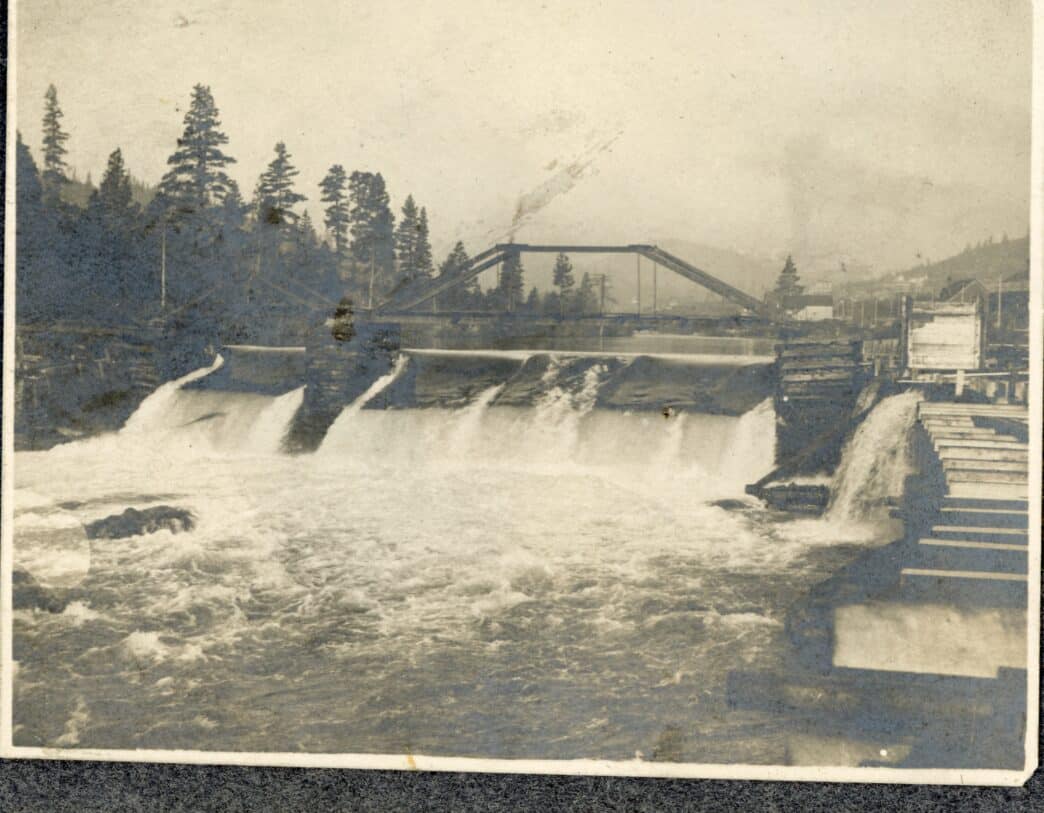
As the bonanzas of the mid-19th century withered, the Truckee did not find reprieve. Irrigation interests, in the form of timber and mining companies, built dams like so many beavers, competing to secure rights to the Sierra Nevada’s real treasure—snowmelt. In 1870, California granted the Donner Lumber and Boom Company the exclusive right to improve the Truckee River; the company immediately constructed a crude dam at the egress of Lake Tahoe, attempting to provide a more predictable flow of water. Additional dams sprang up downstream, diverting more water each year. By 1900 so many interests from Tahoe to Reno had their straws in the river, along with their untreated contaminants, Reno residents had to boil whatever little drinking water reached them. The cutthroat continued to decline.
In 1903, the U.S. government, with visions of an agrarian republic, under the auspices of the newly formed Bureau of Reclamation (BOR), authorized the first attempt at what they characterized as reclaiming the arid desert. Their trial balloon was the Truckee River.
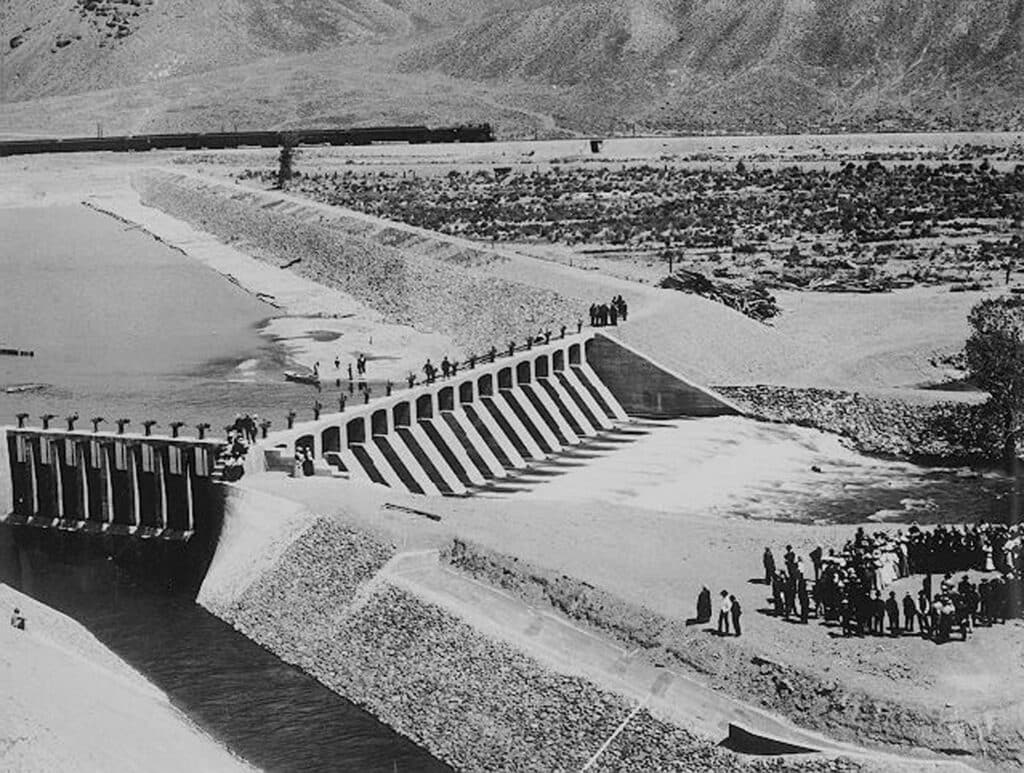
Construction on a diversion project outside Reno, near the raucous settlement of Derby, began in 1903 and aimed to irrigate over 300,000 acres 65 miles east of Reno. Why would the government spend millions to divert water to a desert sink? The United States may have “owned” the West, but until it was populated, it remained contested territory; the sprouting of alfalfa, sugar beets, and melons would, in their minds, turn the Nevada desert into productive farmland for Americans rather than a vacant wasteland. Thousands of God-fearing settlers would then flock to the reborn land to raise alfalfa and children—the next generation of Jeffersonian Americans. The following proclamation appeared in the Reno Gazette as the project neared completion: “[A] new era for Nevada and the entire arid west. Where the cacti, the silent sentinels of the desert, kept vigil over the wastes forgotten by God and man, there the yellow grain will ripple in the breeze…'[W]ater, water, give me water!’ has been Nevada’s lament and moan, but not until a truly paternal government heard the ‘plaint was the thirst assuaged.” Unfortunately, but perhaps predictably, the government miscalculated; the Truckee-Carson Project—eventually renamed the Newlands Project after Nevada Senator Francis Newlands—has irrigated only a fraction of the original estimate, leaving in its wake numerous subsequent conflicts.
The Newlands Project was contingent on many factors; one was the construction of a new dam at Lake Tahoe to raise the lake level by six feet, creating an additional 700,000 acre-feet of water. Of course, this also meant the project was dependent on Mother Nature providing the requisite precipitation; both the dam and the rain were far from guaranteed. The dam at Lake Tahoe was eventually built, but not before the courts got involved. Power companies immediately filed an injunction against the feds to stop construction of the dam; it seems that the Donner Lumber and Boom Company, while brokering a deal with the U.S. government, was also in negotiations with several downstream power companies, including the Truckee River General Electric Company (TRGEC). TRGEC bought the dam from the lumber company for $40,000 in 1902 and, six months later, negotiated a deal with the Bureau of Reclamation to sell it for $100,000, turning a cool profit. Before they could collect, however, wiser, higher-up government officials rejected the deal by acquiring property downstream and beginning construction of another dam that would circumvent the power company. The 1915 United States v. Truckee River General Electric Company decision settled the dispute and cleared the path for construction.
Americans flocked to the western United States largely on wishful thinking. The adage “rain follows the plow” stood in place of more logical reasoning and justified the construction of massive water projects that often lacked only one crucial ingredient: sufficient rainfall. Drought, flooding, and other natural disasters also shaped the fate of Tahoe’s waters. The original plan for the Newlands Project included five additional reservoirs along the Truckee River to store water for future use. Without those reservoirs, dry years exacted a heavy toll on the river. The growing Reno area demanded more and more water, as did hopeful Fallon farmers, who, with the help of federally subsidized irrigation, sought to find freedom in the Nevada desert. Several years of less-than-hoped-for precipitation, coupled with the legal struggle over Lake Tahoe’s only outlet, finally led the federal government to authorize an additional storage facility along the Truckee-Carson project. Lahontan Dam was built hastily on the Carson portion of the project to capture more runoff and generate electricity. Its design and construction foretold the fate of other Truckee tributaries like the Little Truckee River. But, like thousands of farmers who took up the government’s offer of free land west of the 100th meridian and whose busy plows did not summon climatological shifts, these new dams did not increase precipitation. The often-meager flow of water in the Truckee continued to cause bitter fights on land and in the courts. With an additional storage facility completed and the dam at Lake Tahoe in BOR’s possession, the Truckee River began to look more like the river we anglers appreciate today. The decision handed down in federal court a decade earlier included an agreement that the BOR would provide year-round flows to downstream users known as Floriston Rates, helping maintain minimal flows. However, the Floriston Rates did not create new rain each year, nor did their creation end the controversy surrounding ownership of the Truckee’s water; it took three decades before additional federal tinkering ensured adequate flows.
Droughts are a way of life in the West, and planning for them often determines whether communities survive or wither and vanish, becoming relics of a bygone past—novelty roadside attractions full of non-native tumbleweeds and imagined ghosts. The Truckee is no exception. Many of us can remember drought years as recent as 2015, as well as the severe drought of the late ’80s. The drought of the late 1920s was worse. Like its more famous cousin that occurred at about the same time in the Midwest—the Dust Bowl—the Truckee drought severely altered the relationship between California and Nevada and forced several changes to how the Sierra’s snowmelt was divided. In 1926, a district court in Reno apportioned the Truckee’s contents among users—notably excluding, as was customary in American history, the Native American population at Pyramid Lake—and appointed a federal water master with the entirely western name of Harry C. Dukes. The Talbot Decree now tasked the federal government with guaranteeing that the Floriston Rates reached the right (white) people. Later that same year, the Bureau of Reclamation turned over control of the Newlands Project to the recently formed (1918) Truckee-Carson Irrigation District (TCID). This agreement gave TCID full control over the Newlands’ many mechanisms for delivering water, including the dam at Lake Tahoe, Derby Dam, Lahontan Dam, and all the canals and ditches. TCID immediately began making decisions that clearly reflected their interest in protecting Nevada farmers—decisions that would come back to haunt them decades later.
Though the drought began in 1928 and lasted roughly eight years, an earlier episode in 1924 foreshadowed events to come. In that year, Lake Tahoe dropped below its “natural” rim of 6,223 feet. Since Mother Nature is typically a no-show in court, Nevada’s desert farmers immediately threatened to sue property owners along Tahoe’s vast shores if they did not receive their fair share of water that Uncle Sam had convinced them would allow them to live an independent and free life coaxing the dry, infertile soil in Nevada to sprout sugar beets. The more zealous among them threatened to chisel away Tahoe’s rim in order to permanently siphon more water downstream. The property owners acquiesced and allowed the irrigation district to pump approximately 34,000 acre-feet from the lake. As the United States and the rest of the world realized in 1938, appeasing the threats of bullies rarely produces the desired effects.
When drought returned in 1928 with a vengeance, these same Fallon farmers returned, this time with greater demands. In the meantime, the largest recorded Pyramid Lake cutthroat trout was hauled in by a Pyramid Lake native named Johnny Skimmerhorn. It weighed 41.5 pounds and, despite its size, symbolized the vanishing, ancient fishery that increasingly couldn’t survive what the emerging desert civilization was doing to its historic range. In 1929, the lake again fell below its rim, and TCID was allowed to pump more than 33,000 acre-feet of water; 1930 would see over 25,000 acre-feet pumped out. Not willing to merely threaten lawsuits this time, the agricultural interests took more pointed action. An attempt to install permanent pumps at the lake began in July 1930 but was immediately countered by an injunction from property owners. Soon, a rogue team of Nevadans arrived with a steam shovel, intent on digging a trench from the lake to the proposed pumping area, thus allowing more water to find its way to Nevada via ditches, pumps, and flumes; when the granite proved too tough for the shovel, blasting commenced. Tahoe residents again retaliated, filling the already begun ditch with sandbags and vandalizing the steam engine. The sheriff arrived and threatened arrests. Though the injunction stopped the proposed pumping station, the drought persisted; 1931 and 1934 both saw below-average precipitation, and the pumping—and the fighting—continued.
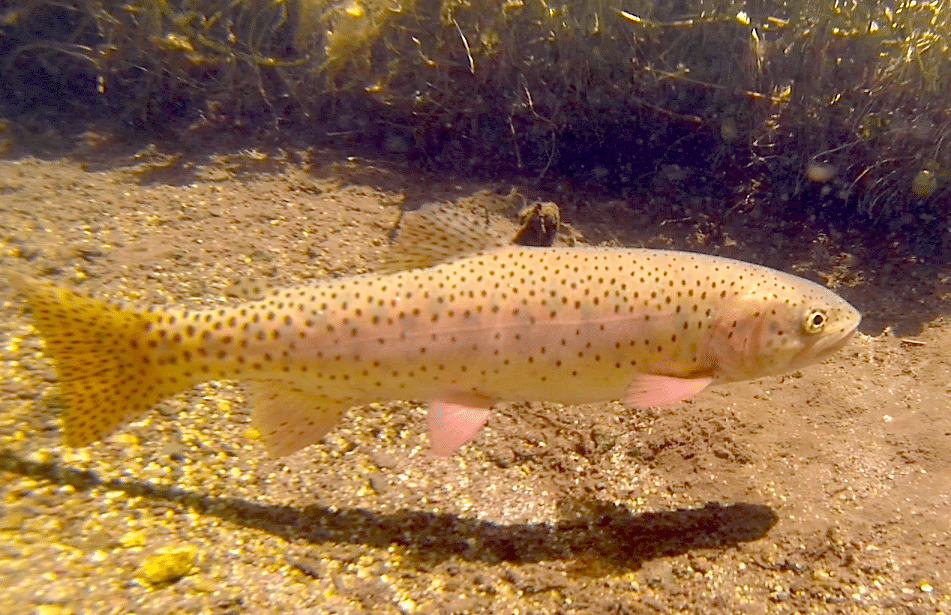
Eventually, Mother Nature relented, and storms rolling in from the Pacific returned, replenishing the area. Nevada ranchers and Tahoe homeowners settled into an uneasy coexistence, flaring up only during drought years. The Truckee River continues to defy disbelief as more people take up residence along its banks, and its water is divided among competing interests. However, storage projects, conservation, and a more ecologically informed public have resulted in a thriving fishery. Yes, you will still hear plenty of complaints about the water master, tourists, Nevadans, Silicon Valley, and myriad other boogeymen, but the fact remains that the Truckee from Lake Tahoe to Pyramid Lake is a world-class fishery. This has not happened by accident, and the more we understand our watersheds and the forces that affect them at a deep level, the more likely we are to protect and care for them. When we deceive ourselves into believing that our watery haunts are primitive or untrammeled, and that our fish are all native and wild, we blind ourselves to the reality of how our fisheries have developed and the challenges they continue to face. With eyes wide open and a sense of history, protecting our watersheds—whether for angling, drinking, or irrigating—will remain a priority for all stakeholders. And hopefully we’ll all just keep our dynamite at home.