To Read
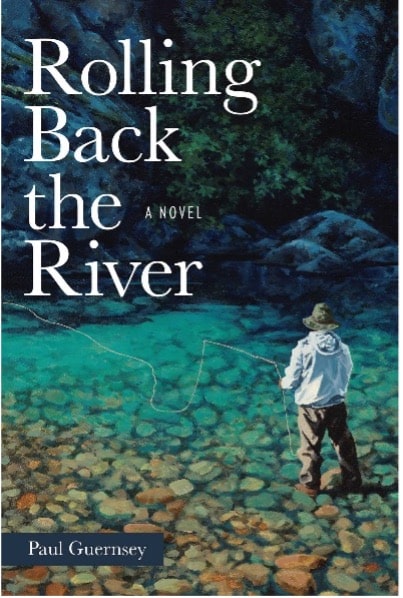
ROLLING BACK THE RIVER
By Paul Guernsey
$25, Stackpole Books
2026
Most books here in “The Paper Hatch” are nonfiction. That’s just how it is. Angling writers revel in experiencing the travel and the fishing for themselves, then passing it along to their readers firsthand. Maybe a few of the details are heightened (the size of the fish), but the heart of their tale is unembellished.
Yet fiction plays an equally important role for the well-read angler. How else would we meet Ed Abbey’s cast of Southwest characters like George Washington Hayduke? Or The Judge in Cormac McCarthy’s Blood Meridian. Or Jim Harrison’s countless yarns. Or Norman Maclean’s seminal fly-fishing tale.
Now, Rolling Back the River is no Blood Meridian or The Monkey-Wrench Gang, but it is a damn good fly-fishing novel.
First, meet its author, Paul Guernsey. Writer, editor of a fly-fishing magazine, river stalwart, Mainer. Then meet his main character, Vincent. Writing professor, angling stalwart, fly-fishing magazine editor, takes an assignment to track down landlocked salmon in Patagonia that descended from salmon in Maine. Write what you know, indeed.
Vincent dawdles through each day teaching composition to dim students so he can get to the river each night. His wife loves him but leaves him. And he can’t seem to break the monotony that he’s stuck in. Teach, fish, drink himself to sleep, day upon day upon goddamn day. He knows he’s stagnant but can’t find the will to blow it all up. He tries to fill the void with fly fishing, but the void still finds him. Relatable.
Finally, he accepts a trip to Patagonia for landlocked Atlantic salmon, adjacent to the ranch of a mysterious billionaire old guy from the States. Mysterious, as in, nobody knows who he really is, when he comes and goes, and which parts of the river he fishes. And old guy, as in, he has an assistant cast and hook a fish while he rests in an easy chair by the river, then gets handed the rod to reel the brute in. Vincent is wary but intrigued. I’m wary but intrigued by that easy chair.
It’s here when Guernsey’s tale really takes off. Even the couple who pick up Vincent from the Bariloche airport are dressed in cowboy attire with pistolas on their hips. One even has an eye patch. Odd. Are these cartel members, or special angler security? Nope, turns out they just came from a dress rehearsal for a play they are putting on at the lodge. Compelling.
Feels like Guernsey took a similar trip to Patagonia and encountered many of these same escapades. Regardless, I’m here for it. His book is chock-full of well-versed anglers and true-to-life exploits. “No sooner did the fly touch the water before a nine-inch brook trout lift from the bottom to hammer the dry fly.”
Fishing in his home base of Maine early in the novel, Vincent even gets some herring action in the streams during summer. “Being a 12-inch cousin of the giant tarpon, the herring danced on the water as Vincent drew it in to release it.” I’ve done plenty of two-step with trout, never a herring.
When introducing us to Vincent and an assignment for an angling magazine, Guernsey writes, “When Vincent was running the magazine, a decade and a half ago now, not only did magazines still exist but people thought they were important.”
Hey, watch it there, Guernsey.
He continues, “Vincent himself, as a writer and editor through and through, was still hopelessly loyal to and enamored by the idea of print on paper.”
Okay, that’s better, Guernsey.
Vincent eventually does find himself in Patagonia, in over his head but escaping that void for a stretch. He finally realizes that rivers and lives move in only one direction. What a shame that is sometimes. But we would miss all the bends and eddies still ahead of us. And what a shame that would be.
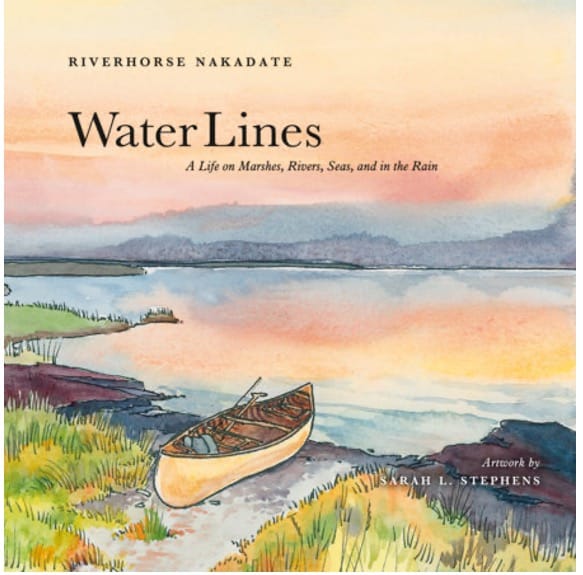
WATER LINES: A Life on Marshes, Rivers, Seas and in the Rain
By Riverhorse Nakadate
$29, Patagonia
2026
A book release from Patagonia is cause for raucous celebration. Well, perhaps for quiet contemplation while reading it. Their new one, though, Water Lines, is indeed cause for celebration, raucous or quiet, or a combination. Maybe raucous contemplation.
First of all, it’s all about its author, Riverhorse Nakadate. If you haven’t come across Riverhorse, he’s a Patagonia fly-fishing ambassador, a surfer, writer, busker, baked-goods aficionado, and all-around gadabout. And he’s a character, as the boomers would say. A stumbling, bumbling, damn-fine angler of a character.
He’ll drive all night to purchase a skiff a few states over, drive all day back home, maybe take an hour or two to nap under his truck, then fish half the night in said skiff. He’ll buy the last sweet potato pie at the sketchiest-looking gas station, and it’ll turn out to be homemade and positively delicious. In fact, he’ll buy a single slice at first, realize its deliciousness a few miles down the road, turn around to go back and buy the whole pie. “My mouth is blooming and alive with cinnamon, pungently soft and tender yams, that crust, and a slew of other unreal spices.” Is this a fishing book, or a cookbook?
Yes indeed, there’s the fish. Bass, trout, up and down the country, redfish and tarpon up and down the continents. Oh, and he doesn’t care about permit. Couldn’t care less. Would take a scrappy striper over a permit any day. He’s down and dirty, catching a lunker largemouth in a golf-course pond during a tournament while the crowd looks on. Not casting with his pinkie out like the Queen.
Short vignettes of his travels and travails make up each chapter, enough to whet your appetite for the next chapter and for the water he paddles. He’s a bit Ed Abbey, but lighter on the cynicism. More like happily cantankerous. He wouldn’t size you up like Abbey or judge your circumstances. After all, we’re all in the same boat, ahem, canoe, on these waters.
On one such canoe trip, he tips and loses a favorite rod and reel, then shrugs it off like the possessions they are. Hell, of a canceled flight a few hours before takeoff, he writes, “I love it when things go sideways, as it often means they will become even more interesting.” Even when he meets an asshole on an Idaho river, he smiles, outfishes him, then raises a cold beer his way. I wish I had one ounce of his chill.
There are times, though, when I want Riverhorse to slow down. Pump the brakes. Spend a little more time with that lady he fancies. Go for a walk in the cool Texas night. Grab a warm shower and sleep in his own bed. But no, that’s not Riverhorse, dammit, not in his nature. The chase is all there is for him. For boats and fish and guitars and friendship, as fleeting as they all are.
He befriends everyone who crosses his path, even assholes and the lady selling pies at the gas station. Or the esoteric Floridian who sells him the skiff. A complete stranger, this skiff seller, until they get to talking, share a beer, and Riverhorse makes plans to fish with him the next time he’s passing through. I wish I had a few more pounds of his gregariousness.
Oh, and he taught high school English in Texas to Andrew Luck. Yes, the NFL quarterback, whom he writes a chapter about. Luck, whose arm isn’t nearly as adept at casting as it was at spinning the pigskin at Stanford, is nevertheless thrilled to be on the water with his teacher. And yes, Riverhorse is still a schoolteacher (an English teacher, a noble profession). One can only assume he grades essays between casts.
The times when he gets reflective and sentimental are sparse, but every once in a while, Riverhorse offers up a: “Only when the last tree has died and the last river has been poisoned and the last fish has been caught will we realize that we cannot eat money.” Or, “For a moment it was hard to breathe—the trout are jewels. There should be museums in New York City dedicated to paintings of them by Renaissance masters.” To that, I disagree. Those museums should be in Dunsmuir or McCloud.
After closing the book, I wondered, “What is Riverhorse doing at this very moment?” I want to hang out with him, you’ll want to hang out with him, and guess what, you get to. For two hundred odd pages.
You can live a thousand lives through the books you read. I’d like to live several chapters as Riverhorse.
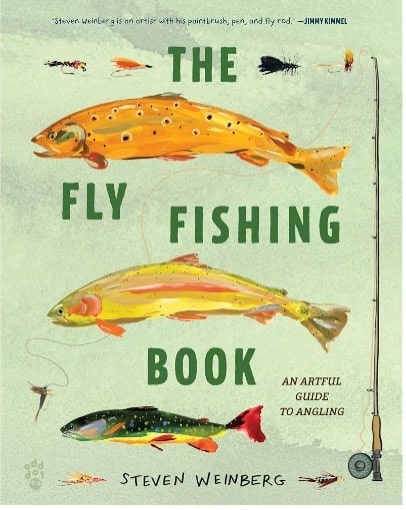
THE FLY FISHING BOOK: An Artful Guide to Angling
By Steven Weinberg
$30, Odd Dot Books
2026
As a kid, I just wanted to go fishing. Books and television shows about fishing were neat, but the only way to get the fishing fix I so desperately needed was, well, to go fishing.
Problem was, good trout fishing was four odd hours north of us—Hat Creek from Sacramento. Tahoe and anywhere near Yosemite were out of the question, too many damn people.
And my father had to get a week off work. And we had to plan and pack. And go to the fly shop (a bonus). And get some firewood. And procure a 24-pack of Coors (my dad’s). Plus a 12-pack of Henry Weinhard’s root beer (mine). And make sure I hadn’t outgrown last year’s wading boots (waders you could squeeze into for another year). And get some canned crab meat to stuff into the single trout we were allowed to keep. And sardines. Sardines at home were peculiar. But sardines while camping are delectable.
Once we were home from fishing, or it was winter, or my dad couldn’t get another week off work, then I wanted to read about fly fishing or watch it on TV (though almost all the fishing shows were bass fishing crankbaits, hard to relate).
Steven Weinberg’s new book, The Fly Fishing Book: An Artful Guide to Angling, is perfect for those days and months between a youngster’s trout season. It’s like the spiritual successor to The Curtis Creek Manifesto. They’re like brothers from another publisher. Had I had this book in the early ’90s, I would’ve worn the pages down to their pulp.
Within the first few pages, Weinberg declares, “Go fish!”
Sold! I’m as sold in my forties as I would’ve been when I was 10.
The ensuing pages are filled with his paintings of fish and flies, streams and anglers. It has history, ecology, conservation, even a few trout culinary tips. Oh, did I mention this is as much a book of art as it is a book of angling. It flows like a graphic guidebook. The trout (and tarpon, and bass, and marlin, and on and on) are striking; the caricatures (of Swiss Army knives, bear spray, wading boots, and on and on) are clever.
Some of those anglers he’s drawn are ones with white beards (like Tom Rosenbauer), ones with blond hair (Marina Gibson), and ones with different skin tones (Brandon Dale). The community of anglers he portrays is infectious. I want to fish for carp with Brandon in New York City (if he can fit me in between his doctor shifts), and Atlantic salmon with Marina in Scotland (and wear a flat cap on the water like her).
Hell, you know the paperback of McGuane’s The Longest Silence, the one with the three trout painted on the cover? You know it; it’s practically fly fishing’s Starry Night. Well, that’s this very artist (and author) Steven Weinberg. He writes: “My favorite part of fly fishing is this: There is NO perfect way to go about it. Just like art, the beauty is in the trying. And maybe failing. But then trying again.”
Fly fishing and art certainly mix. One is honing your skills for decades until you’ve mastered a technique. The other is angling. Honing your skills for decades and still getting hooked on a branch. Just ask Russell Chatham.
In discussing his art and his cast, Weinberg mentions, “I’ve noticed people from all walks of life love fly fishing. It just seems intuitive to represent that!” He declares, “No matter who you are, fly fishing is for you.”
I like that. It’s been an old white man’s club for so long, but it doesn’t have to be. If you like hikes and trees and the sound of a brook, fly fishing is for you. If you like a challenge and catching some rays and leaving the world behind for a day or a week, fly fishing is for you. Hell, if you like gear and strategy and excuses to drink, fly fishing is for you. Just don’t go spooking the fish.
The hardest part is simply getting out on the water that very first time. Best to find a mentor. I bet if you’d ask at the fly shop, they’d know someone you can tag along with. We’ll even let you keep one (hatchery-raised, of course) if you’re a bon vivant and a crackerjack in the kitchen.
But nonetheless, fly fishing is for you. And so is art. And so is Weinberg’s book.
It dredged up memories of fishing trips I took as a kid. Such as: Have you ever seen what a campfire does to an aluminum Coors Light can? Have you ever watched your father burn off the oil in a sardine can by throwing a match into it?
And do you remember that yearning to fish as a 10-year-old, and how it felt like forever before you’re back on the water? This book would’ve eased those withdrawals.
Today, there are no children downstream from me, so the fishing is lonely. But all the rules still apply. Except the Coors. That’s for me now.
THE DOG STARS
By Peter Heller
$28, Vintage Contemporaries
2013
Is there fly fishing after the world ends? I don’t see why not. As long as the trout survived. You’d have all the best waters to yourself. Unless the other survivors took up angling. Then again, they’re more scavenger than angler. They crave ammo and Dinty Moore, not that delicate white flank of a rainbow trout.
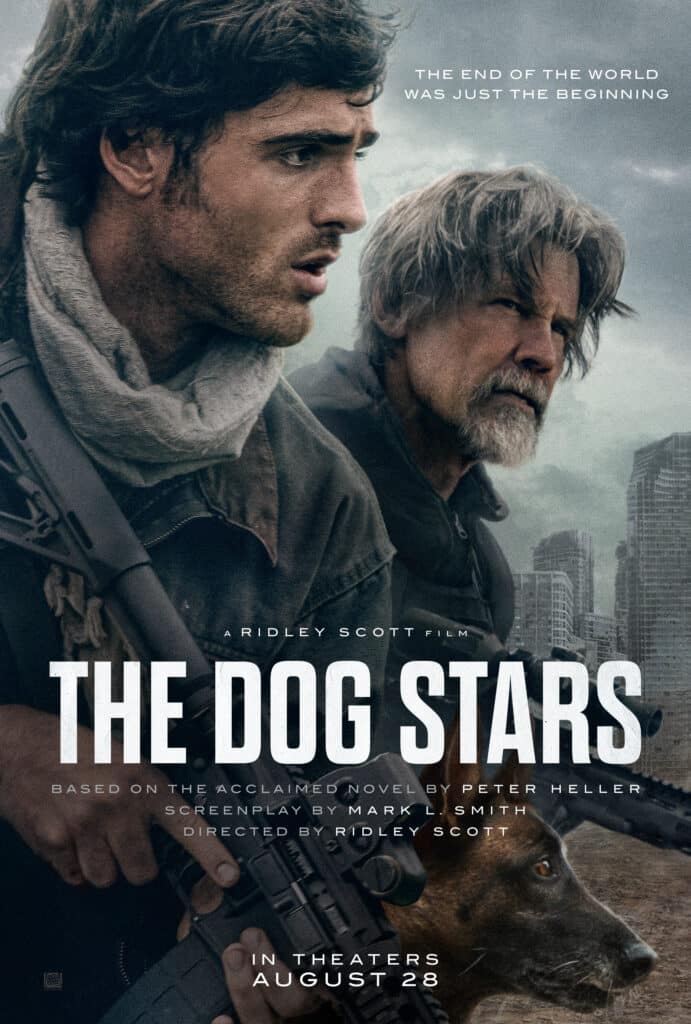
Hig is the one who will find out. He’ll fly fish with his dog Jasper after the world’s ended in The Dog Stars, the post-apocalyptic book by Peter Heller, and new film by Ridley Scott.
I caught up with The Dog Stars author Peter Heller, an avid fly fisherman himself (who had yet to see the final film), for a quick round of tight-lined questions. I suppose these would count as Hig’s answers as well.
Your favorite fly pattern?
Elk Hair Caddis, no contest. Hook, fur, thread.
Favorite place you’ve fly fished?
Opoyastin River, Kaska Coast, Hudson Bay; sea-run brook trout, with polar bears. Mostly because it’s invigorating not to be at the top of the food chain.
Favorite fly-fishing writer?
Chris Dombrowski [The River You Touch] and David James Duncan [The River Why].
Favorite cold drink after a day on the water?
Spindrift Grapefruit.
Now, if you’ve yet to meet Hig and Jasper in Heller’s 2012 novel, they’ll be found in the deciduous meadows high in the Colorado foothills. You’ll recognize Hig with a 5-weight and a rainbow dancing on the end of his line. Jasper will be watching from the bank, eyes intent on the trout, ears perked, drool pooling from his maw. If you find them there, at a time of contentedness, count yourself lucky. For the world has indeed ended, and they are on the defensive from the slack-jawed and dead-eyed drifters that raid the valley floors and small towns for food and gasoline and weapons.
Hig whiles away his days with fly rod in one hand and submachine gun in the other. It’s kill or be killed, after all. Oh, and he’s a pilot too, with a 1950s Cessna single-prop and a thin airstrip, and enough fuel to fly scouting missions to look for other friendly survivors. Perhaps one of them will be a hip brunette in worn-in jeans and an aw-shucks smile. Perhaps.
Fly fishing solitary waters (alongside your dog) and taking joy rides in your airplane (and finding a cute-as-a-button survivor girlfriend). If it weren’t for those other ravenous human scavengers, this apocalypse sounds pretty nice.
Hig, played by Jacob Elordi, has his homestead set up in a small-town airport hangar. He has one neighbor over in the next hangar, Bangley. Played by square-jawed Josh Brolin, Bangley’s the ultimate survivalist (and badass). Together they thwart the horde of less-than-friendly survivors with sniper rifles and night vision. Bangley loves it. Hig is more reluctant but proves to be as good with a rifle as he is with a fly rod.
Oh, and Jasper is Hig’s dog, the third central character in this tale, while Margaret Qualley plays Cima, the hip brunette. It’s as good as it can get in the post-apocalypse, and the fishing’s swell in the mountain streams. Those rainbows provide a culinary reprieve from the cans of whatever goulash are left. And when the armed riffraff continue to pop up, Bangley continues to pop their heads.
But a fuzzy cockpit transmission leads Hig to wonder if more is out there besides the mundane survival and his revolving memories of the world before. Perhaps there’s more civilization, others like him, valleys where amity exists rather than this ramshackle existence of putting down each attacker like a rabid dog.
Heller’s book is the perfect stage for Ridley Scott’s direction. Scott’s films need not be listed in full; you’ve surely seen them. From Blade Runner to Thelma & Louise, to
Gladiator and Black Hawk Down and Alien. Character-driven epics. Thumping action, with an artist’s eye.
An early start as a painter, his films have an expressionist quality to them, almost a tinge of oil on canvas. His Gladiator was directly inspired by a French oil painting of a slaying in the Colosseum. He’s as accomplished a film director as you’ll find.
Heller too is a rich storyteller. He cut his teeth in nonfiction before laying out this yarn about Hig and Jasper. A number of novels have followed, including: The Painter, The River, and Burn.
All stellar. Each is set in a wooded locale with protagonists who belly up to the river with an Elk Hair Caddis.
And each novel comes to a heart-pounding end, The Dog Stars included. The film takes its Hollywood liberties (the Italian Dolomites serve as a stand-in for Colorado. Blasphemy, I know, but beautiful nonetheless … and cheaper to film there), but it adheres to the heart of Heller’s tale. The film is big and glossy, and the protagonists of a virus apocalypse are all coiffed and handsomer than a cutthroat.
The film serves the novel well. The adventure and the heart are there. I would’ve liked to spend a little more time with Hig and Jasper fishing in those mountains on the big screen, but I can always return to Heller’s novel. After all, the characters and landscapes you build in your mind will always surpass anything they can put on the screen.