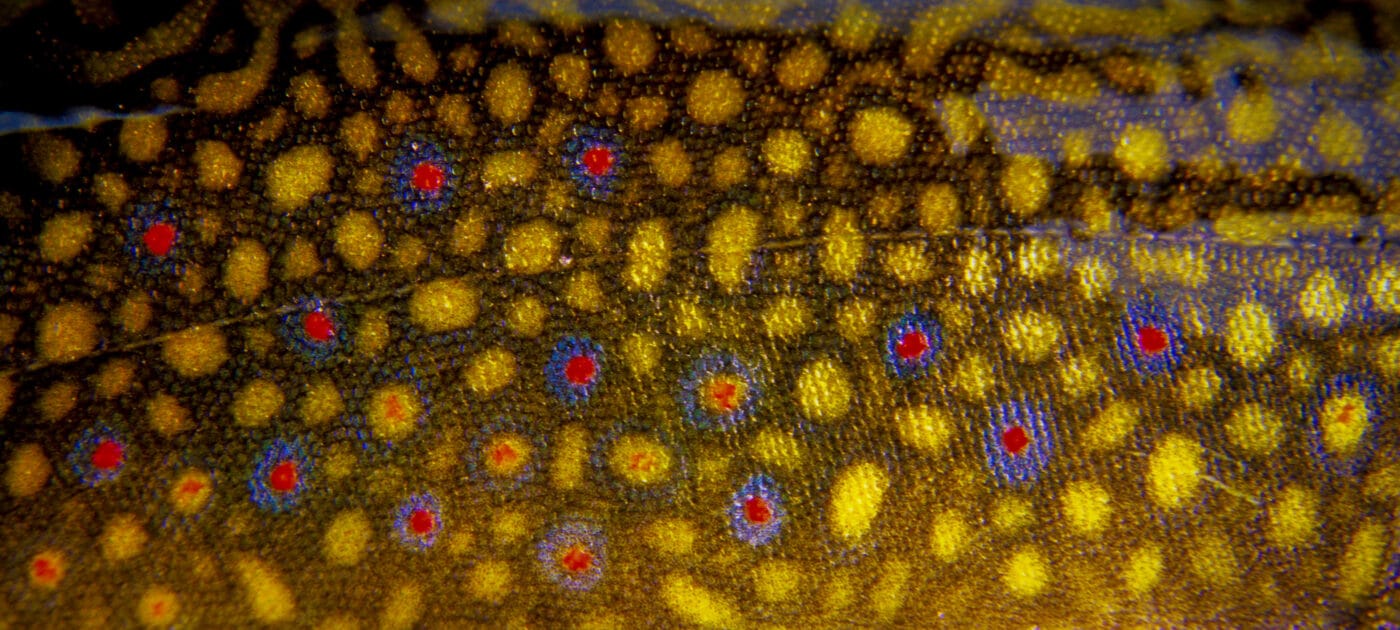

I’ve always been fond of brook trout. I caught my first while at college in upstate New York, fishing the little streams near campus to escape the boring lectures of certain professors. The trout were all brookies, the only kind I knew back then. They were beautifully colored, scrappy, and quick to rise to any dry, but you wouldn’t call them trophies. If I’d caught one bigger than nine inches, I’d have demanded a front-page story in the Syracuse Post-Standard.
The Sierra Nevada taught me how much I’d been missing. When I moved to San Francisco, I felt as if I’d ingested a powerful drug and been granted a vision of Angler’s Paradise—and it was no hallucination! Those blue-ribbon rivers existed, and they were full of browns and rainbows. I fished them all, checking off each as birders do with a life list. But the rivers were also very crowded, and there came a time when I tired of the crowds and craved the simple pleasure of fishing for brookies I’d known in college.
One morning on a fishing trip, I packed up my camp and drove idly down a back road, where I crossed a bridge and noticed the sparkle of sunlight on the creek beneath it. Something—call it providence—urged me to pull over and investigate. Up close, I saw that the creek was deeper than I suspected, deep enough to be fishable, although no anglers were around.
It was a glorious June day, and it felt good to be out of the car. I stretched my legs and admired the landscape, a forest of lodgepole and Jeffrey pines where mule’s ears bloomed in clumps. A trail ran along the creek, so I followed it. It was an easy walk, no deadfall or boulders to scramble over. After a mile or so, the forest opened onto a pristine alpine meadow. The show of wildflowers was spectacular—meadow penstemon, monkey flower, and at least a dozen others I could identify.
The trail ended at a reservoir. I doubled back, my eyes fixed now on the swirls and tentative rises of the fish I assumed must be trout. I retrieved my tackle from the car. It was all wrong, a 6-weight rod meant for bigger game, but I was curious enough to tie on a tiny Adams and dap it over a pool. Sure enough, a little trout took it right away, the first brookie I’d caught in years, as brightly colored and just as scrappy as I recalled, and not much fatter than its relatives in upstate New York.
I’m ashamed to admit how much fun I had hooking and releasing those miniature trout. The smallest would practically fit inside a sardine can. I knew lots of fly fishers who’d write me off as eccentric. They’d never waste a cast on such puny fish, but that was a mistake. I was delighted with the solitude, in touch with the natural world, alone with the creek, the forest, and the meadow. I felt refreshed and didn’t care a damn about trophies. I remembered Norman Clyde, the legendary climber, who loved brook trout and planted them as a freelance operative in barren, high-altitude lakes in the 1950s and ’60s.
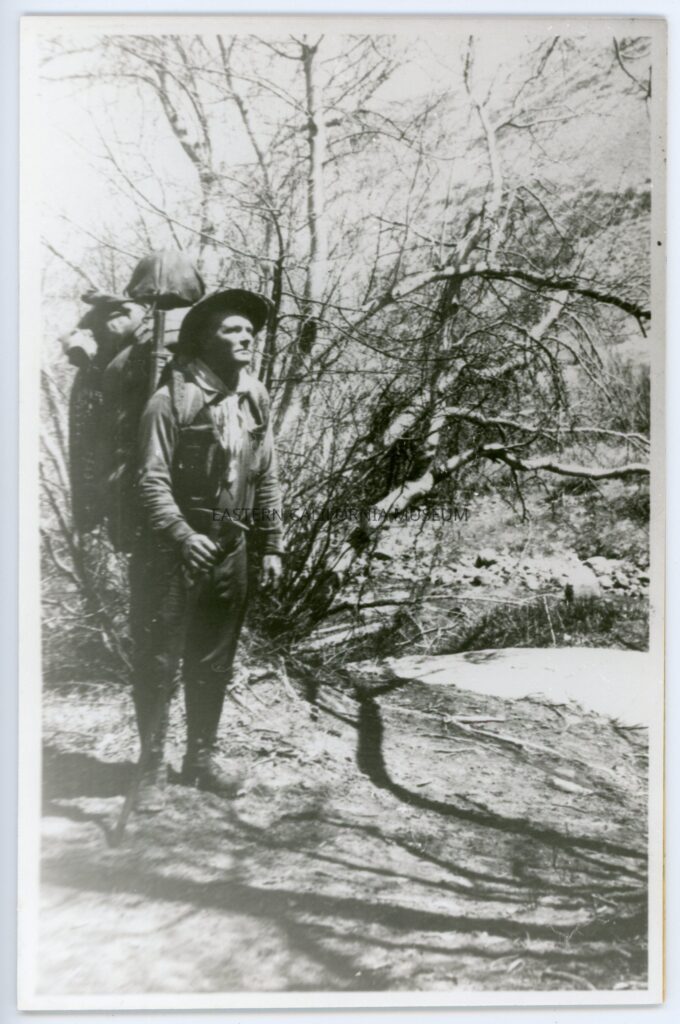
My guess was that Clyde fished for brookies as a boy. He grew up back east, born in Philadelphia in 1885. It didn’t look as if he’d be the outdoorsy type. You’d take him for a future academic with his degree in classics from Geneva College. He taught school in North Dakota and Utah before drifting west and enrolling in Berkeley as a grad student in 1911. He explored Yosemite and Sequoia National Parks around the same time and took to climbing.
“I climbed the highest mountains in the region,” he wrote proudly to his mother. He’d found a lifelong passion. He must’ve been a natural, too, because soon he was piling up first ascents of peaks and would record more than 130 before he was done.
He married Winifred May Bolster in 1915. She worked as a nurse at a hospital for tuberculars, contracted the disease herself, and died at 28, a tragedy that hastened Clyde’s retreat into the Eastern Sierra. His last job was as principal of the high school in Independence, but he lost it in 1928 after shooting at a car carrying some students. He believed they intended to vandalize the school on Halloween. The school board had its doubts and agreed not to press charges if he resigned.
After that Clyde was on his own, a world-class solitary. He seldom had a fixed address, bunking in borrowed cabins. He toted a 90-pound pack that held a cast-iron frying pan, textbooks in Latin and Greek, firewood, a hammer, and an anvil for repairing boots. He scraped by as a guide, freelance writer, photographer, and amateur naturalist. The Sierra Club often employed him. He once spent 36 days in Glacier National Park and scaled 36 peaks. Even in his 70s, he was still guiding hikers. He met his end in Big Pine, where he had a cabin, and died in a hospital at 87 in 1972.
It’s unclear why Clyde chose to plant brook trout as a side project. The California Department of Fish and Game (DFG) had been stocking them since the 1870s, although not in high-altitude lakes, and warned him it was illegal. I imagine he was too much of a maverick to listen to any authority. Surely he meant well, but the plan backfired. The brookies, being nonnative invaders, muscled in on threatened native species like the golden and Lahontan cutthroat, which can only survive in a limited range. The DFG has set out to correct the imbalance, capturing the brookies with gill nets and electrofishing, and relocating them.
I’m reasonably sure the trout in the creek I’ve been describing are wild. Over the years I’ve returned there many times and been rewarded. It’s not always as secluded as I’d like, of course. I share it with birders, walkers, wildflower enthusiasts, and the odd fly fisher, but I think of the creek as my own. And I’ve learned that the brookies are not always so puny. You’d be surprised at the size of those I’ve caught in October when they’re preparing to spawn.
October can be tricky in the Sierra. You might be freezing one minute and sweltering the next. Among the biggest trout I’ve caught was a substantial brown on the Feather River in a sudden flurry of snow. But it was mild and warm on the evening I’m talking about, the trees flaring with color and the creek at a seasonal low. On the trail I could see the creekbed in places. The spots for brookies to hold or hide were few.
The creek had been good to me, so I trusted it to deliver. I’d brought a proper lightweight rod to give the fish a fighting chance. It doesn’t pay to deliberate over flies on such creeks. Brook trout aren’t very discriminating, and one bug works as well as the next if you stick with the standards and avoid the fancy stuff. I tried a #16 Elk Hair Caddis on a short leader to better control the drift, making myself as inconspicuous as possible as I moved along the creek.
Within minutes I had a solid strike. I could tell it wasn’t another aesthetically pleasing but tiny specimen. No, this one had plenty of flesh and backbone. Usually I landed them in less time than it took to brush my teeth, but not this bruiser. Instead of flipping into the air and wriggling in distress, the brookie held fast to the bottom and made it clear it had no interest in quitting. I let the fish lead me for 10 yards or so until it grew weary and allowed itself to be taken, a lovely trout that weighed about a pound.