
Salmon would probably have a few things to say about dams and being cut off from the places where they spawn. Steelhead might ask why every drought seems to come out of their hide first. The Smith River’s fish would ask why one of California’s last great salmon strongholds still has to fight for a clean estuary. The Klamath’s constituents might remind us that restoration is possible, but only after decades of pressure, lawsuits, tribal leadership, political risk, and a refusal to accept that a broken river had to stay that way.
If fish could vote, Jared Huffman believes he would do pretty well.
After looking at his record on Lagunitas Creek, the San Joaquin, the Klamath, and Potter Valley, it is easy to understand why.
Huffman is one of us, not because he is a Democrat or Republican, but because he is an angler who grew up hunting and fishing and loves many of these places for the same reasons we do. His newly drawn district stretches from Marin County into the northeastern corner of California and contains remarkable salmon and steelhead fisheries and water-producing watersheds.
District 2 includes all or portions of Marin, Sonoma, Mendocino, Humboldt, Del Norte, Trinity, Siskiyou, Modoc, and Shasta counties.
I sat down with Huffman to discuss the rivers that shaped his career, the battles still ahead, and what it means to represent some of the most consequential salmon and steelhead country in the nation.
“I have always appreciated Congressman Huffman’s passion for California and especially our fish and rivers. He is incredibly knowledgeable about water issues in the state and a true champion of everything we care about.”
– Curtis Knight, Executive Director of California Trout.
Tell me about your career and where you got your start. Was it at NRDC?
No, actually. I spent 12 years on the Marin Municipal Water District Board, where I played a major role in settling 14 years of litigation with the State Water Board over flows in Lagunitas Creek.
That helped jump-start a Lagunitas Creek restoration project that has invested millions of dollars in the creek and surrounding watershed, made a range of habitat improvements, and reset how the district approaches its public-trust responsibilities on Lagunitas Creek.
Now, when you go out to Lagunitas Creek during the spawning season, you will be amazed by how many people know about the salmon there.
Then you worked on the San Joaquin River settlement with NRDC, where some of the state’s largest salmon runs had fallen to zero, right?
Yes. The river dried up for 50 miles downstream of Friant Dam.
The Bureau of Reclamation built the project, but there is blame to go around for how we allowed that salmon run to die off. The California Department of Fish and Game at the time did not step up and assert Section 5937 and the other authorities it had.
I think there was a lack of courage and a failure to appreciate just how much they had been snookered. The project was billed as something that would be great for fish and navigation. There used to be ferryboats that went all the way to Fresno, and navigation was one of the stated purposes when the project was proposed.
Then they turned around and literally took all the water.
When a settlement like that goes through, who is ultimately held responsible?
That settlement took more than 20 years to resolve. It was a massive piece of litigation involving a coalition of approximately 14 environmental and fishing groups on the plaintiff’s side. That is what I got to be part of and work with.
On the defense side were the United States Bureau of Reclamation and a group of irrigation districts that were water contractors within the Friant Division.
There were also interveners, including Westlands and other agencies farther downstream, that did not want to see the river restored. That only complicated matters further.
The fact that we were able to win those court rulings, ultimately settle the case, secure an act of Congress implementing the settlement, and return water and salmon to the San Joaquin River is pretty amazing. Being a small part of that was an awesome experience.
From there, you were elected to the State Assembly, where you worked on a major water-reform package in 2009?
Yes. I was chairing the Assembly Water, Parks and Wildlife Committee at the time, and we put together a bipartisan water-reform package that helped manage the Delta as an ecosystem, reduce water use, begin measuring groundwater, and improve oversight of water diversions.
Groundwater was a total third rail. No one wanted to touch it. But we were able to reach an agreement that became a baby step toward the Sustainable Groundwater Management Act.
That act was ultimately made possible because the policy of denial was no longer working. Infrastructure was crumbling, wells were running dry, litigation was breaking out, and we could no longer afford to indulge the denial.
I am amazed by how far we have come on these issues during the past decade.
The larger issue is over-allocation, isn’t it?
We have promised far more water than we actually have. That is the story not just in California, but throughout the Colorado River Basin, where we are at a huge impasse.
You have interstate compacts involving the upper and lower basins and a watershed on which something like 40 million people depend. We now realize that the river is not delivering anything close to the amount of water on which those agreements were based. Everyone is pointing fingers at everyone else over who needs to absorb the sacrifice required to make it work.
That is probably the most glaring example of over-allocation, but you get the same thing with water rights here in California.
We are probably not going to rewrite the entire California Water Code or tear up all the water contracts and rights that have been granted, including those sacred pre-1914 water rights that apparently came straight from heaven.
But I think we have everything we need within California’s existing system of water law to begin fixing the problem. The State Water Resources Control Board already has the authority to examine beneficial use,
waste, and other relevant standards. What has often been missing is the political will to use that authority against some of the largest and most powerful water users.
There are water contracts that, if the public knew about them, would be very difficult to defend. Some interests receive hundreds of thousands, and sometimes more than a million acre-feet of water, essentially for free. They can then turn around and sell it.
Others irrigate at lavish levels partly to preserve their historical allocations, while communities elsewhere face shortages and pay enormous sums for water.
It is not fair, and it is not equitable. In this day and age, a state water regulator ought to be able to look at those arrangements and impose some common sense.
Tell me about your role in the Klamath dam removals.
While I was in the State Assembly, we put together the water-bond contributions from California and Oregon that helped make the deal possible. That happened under my watch, and the effort really began heating up when I got to Congress.
There was a lot of opposition from the Central Valley and the Columbia Basin, including from people like Doug LaMalfa. His militant opposition was based on the premise that dams are inherently good and an unwillingness to acknowledge the harm those dams had caused.
There was a moment on the Klamath when Berkshire Hathaway was preparing to pull the plug and walk away from the deal.
I was chairing the Water, Wildlife and Fisheries Subcommittee of the House Natural Resources Committee, and we held a hearing to bring people in and put maximum pressure on PacifiCorp and Berkshire Hathaway. We wanted them to know how miserable they were going to be if they walked away from this historic agreement.
It was not just my hearing, me lighting my hair on fire, or the elected officials I brought into the effort. It was the tribes. It was NGOs attending
corporate board meetings. It was the cumulative pressure of all of those efforts that got the company back to the table and saved the deal.
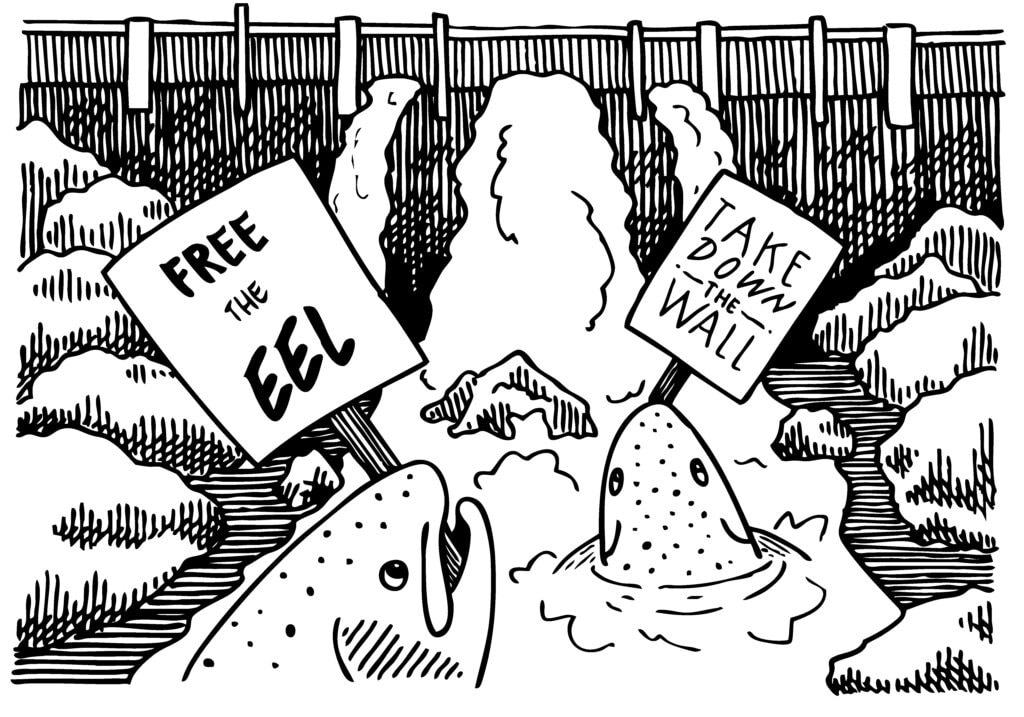
Now another historic dam-removal project falls within your district. Tell us about the Potter Valley Project on the Eel River. It seems to be moving much faster than the Klamath did.
We had been holding stakeholder meetings for several years before PG&E decided it wanted to decommission the project.
We knew change was coming through the relicensing process, somewhat like what happened with PacifiCorp on the Klamath. We knew it would be important to get everyone around a table, and we did, including people who wanted to keep the dams.
They were at the table. Today, some of them will tell you they were steamrolled and ignored. They were not. They were in the room. We heard each other out and tried to develop common principles that became the foundation for the Two-Basin Solution.
It involved several years of very good work. I am glad it appears to have come together quickly, but a fair amount of groundwork was laid over a long period of time.
It has been faster than the Klamath, but we are also not finished yet. If all goes well, PG&E will file its final plan with FERC, and FERC will accept it. Even then, we will probably still be years away from the pyrotechnics, groundbreaking, and everything else.
These are enormous efforts and incredible fights. How do you keep fighting for so long?
No one wants to fight all the time.
I would much prefer a consensus resolution to complex water and natural-resource issues whenever I can get one, and I will compromise to reach something durable and broadly supported.
That is what we did in 2009, when I helped steer a bipartisan package of water reforms to Governor Schwarzenegger’s desk. It is what we did on the San Joaquin River, when we reached an agreement that helped meet the water-supply needs of irrigators in the Friant Division while returning flows and fish to the river.
Those kinds of win-win solutions are very satisfying. I would always prefer to do it that way.
But there are times when you simply have to stand and fight.
The Smith River is one of California’s last great salmon strongholds, but the lower river and estuary continue to face water-quality problems tied to lily-bulb agriculture. What needs to happen there?
We have to acknowledge that it is a problem. That takes us into some long-standing traditions and a well-established part of the agricultural economy that people in Del Norte County are proud of. But the Smith River is a one-of-a-kind resource, and the estuary is critically important. The Tolowa Dee-ni’ Nation cares deeply about it, as do anglers, kayakers, and everyone who understands this iconic river.
The rest of the watershed is in such remarkable shape. It is so pristine, and it could be a real salmon stronghold. All arrows point to the estuary and water quality there as something we simply have to tackle.
I think water regulators have been hesitant to fully use their authority because of the politics. You see agricultural waiver programs throughout California where, instead of enforcing a water-quality standard, regulators ask people to adopt best practices, sign memorandums of understanding, and call that an alternative to enforcement. But on the lower Smith River, what you really need is to stop the discharge.
We ought to be finding partnerships that can move operations farther back from the river, transition land into different types of agriculture that do not put these chemicals into such sensitive estuarine habitat, or use easements, buyouts, and other strategies to change the pattern of agriculture there.
I have been hearing about this since my first year representing the area in Congress. People have known about it for a long time. It is not a secret, yet it gets bumped along year after year.
I would love to see a breakthrough using funding, partnerships, easements, buyouts, or other resources. But ultimately, it comes down to stopping the discharge. This is pollution entering extremely sensitive salmon habitat, and it needs to stop.
The State Water Resources Control Board and fisheries officials are going to have to be willing to act. It may even take someone filing a lawsuit, because that is often how major breakthroughs happen in places like the Klamath and the San Joaquin. I hope it does not come to that.
Your newly drawn district brings Marin County together with rural and conservative communities in Shasta, Siskiyou, and Modoc counties. How are you going to represent those different interests?
I think it starts with being honest about those extremes, both geographically and politically.
In a perfect world, they probably should not be in the same congressional district, and I have to be honest about that. This is an extraordinary time, with a gerrymandering race to the bottom taking place throughout the country. California did it because we were forced into this fight and had to fight back.
I do not think it will be a permanent arrangement. I think there will come a point when the country comes to its senses, adopts independent redistricting, takes gerrymandering off the table, and creates coherent, rational districts.
At that point, you probably will not see Modoc and Marin counties joined together in this monstrous hockey-stick-shaped district.
In the meantime, somebody has to represent this massive, diverse district, and I think I am a pretty good choice to do it. I understand the needs and issues facing all of these different places. I respect these communities. I am experienced and pretty good at taking on complex challenges.
I will not be everything Republicans in Shasta, Modoc, and Siskiyou counties would want to see, but I think I will surprise them on a few things.
Your district includes people in Marin who support wolf recovery and ranchers in rural communities who are living with its consequences. You are on record saying you are not opposed to shooting a few wolves.
I would prefer nonlethal hazing where it is effective.
But I believe four wolves were killed in the Sierra Valley several months ago because they had locked onto cattle, the hazing was not working, and there was nothing else that could be done. I did not oppose that. I was fine with it.
One of the scientists with the California Wolf Project at UC Berkeley recently completed a master’s thesis in which she conducted dozens of interviews with ranchers throughout Modoc, Shasta, Siskiyou, Lassen, and Plumas counties.
It went into great detail about the many ways ranchers are being affected—not just through the direct loss when you can prove a cow was killed by a wolf, but through reduced herd productivity, declining birth rates caused by stress, additional workforce costs, and the emotional strain on ranching families.
These are people eking out a living as ranchers who are worried sick about losing cattle. Their margins are already tight. Losing enough cattle could be the difference between surviving and going under.
We have to find ways to do a better job. We can find a better way to coexist.
I will be sympathetic to those people, but I will not repeal the Endangered Species Act. I am not going to support putting bounties on wolves, extirpating them, or driving them out of California.
You described the hallmark of your approach as “science-based environmentalism.” What does that mean?
It means I am going to follow the science, even when the answer is uncomfortable. I care about animal welfare, and I do not like the idea of killing wildlife. But there are times when science puts you in conflict with the emotions of some advocates.
That is why I reluctantly support controlling barred owls to protect spotted owls. It is why I support eradicating invasive mice from the Farallon Islands. It is why I have supported targeted lethal removal of sea lions at Bonneville Dam when they are having a serious effect on salmon.
I love marine mammals. I do not like killing owls. I would prefer nonlethal management of wolves whenever it works. But I am going to err on the side of science-based wildlife and environmental management every time.
What else should people know about you?
I like fishing. I like the outdoors.
I am not just a limousine liberal who is an environmentalist because of esoteric values. I actually get outside and enjoy these places.
I grew up hunting and fishing. Like you, I appreciate working landscapes and the idea of harvesting nature’s bounty, provided we can do it responsibly and sustainably.
IN CONCLUSION
Jared and I spoke for more than an hour, moving from the Smith River to groundwater, wolves, dams, ocean science, democracy, and the difficult politics of keeping fish in California’s rivers. What stood out was not blind optimism, but persistence. Huffman has spent much of his career inside fights that take decades to resolve, and he does not appear discouraged by the length of the work.
Discussing the collapse of California salmon, Huffman asked, “How bad does it have to get?” It is a question anglers should be asking, too. How many closed seasons, dry river reaches, collapsing runs, and emergency restoration programs will it take before California treats salmon recovery as something more than an aspiration?
Fish cannot vote. They cannot hire lobbyists, write campaign checks, or defend their water in court. They simply return—or they do not. Under California’s new congressional map, many of the state’s most important salmon and steelhead watersheds may soon share a representative who has spent much of his career arguing that fish still count, even when they cannot cast votes.