As anglers, we usually think of “flow” as water moving through a river. We talk about flow in objective terms of cfs (cubic feet per second), almost in the same breath as water temperature and color. In his February 1, 2010, California Fly Fisher article “Going with the Flow,” Bob Marshak waded deeply into flows, covering how to improve your fishing success through a better understanding of river flows.
But the “flow” I’m thinking of today is the chewy-chocolate-centered peak-performance “flow state,” as coined by the father of flow, psychologist Mihály (“Mike” to those who don’t know his mom hates when people call him “Mike”) Csíkszentmihályi. Call him “Chiclets” if his last name gives you the hiccups. His mom’s not here; she won’t know.
Dr. Chiclets’s flow state findings describe the state in which people become so immersed in the joy of their work or activity that nothing else matters. Cue the Metallica song of the same name.
Being in a flow state is often described as being “in the zone.” To me, being in the zone means being focused and open to what’s possible. But flow is different for everyone. During a flow state, people are not distracted, and time seems to pass unnoticed. It can be fleeting, too. Apparently, flow is fickle like that.
Flow state can happen anywhere, at any time. It’s often associated with creative pursuits—think of painters and jazz musicians, or of painting jazz musicians. But it also shows up in sports—think of the New York Yankees’ Don Larsen pitching a perfect game in Game 5 of the 1956 World Series. Or that time you made two free throws. In a row. Undeniably flow state.
Our awesome sport offers many opportunities to achieve a flow state
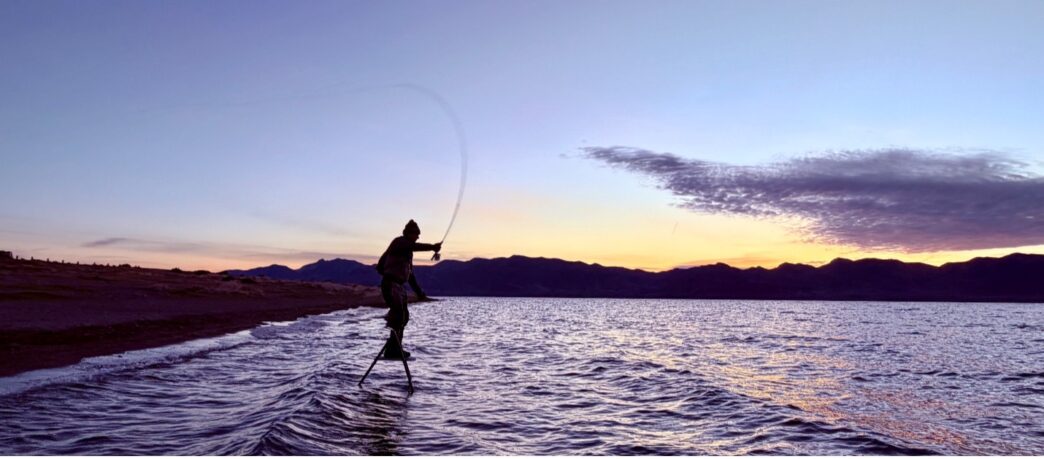
Maybe you can recognize times you were in a flow state while fly fishing? Working dry-droppers or tightlining seams and micro-seams in a stretch of pocket water. Double-hauling clousers from the beach into a maelstrom of waves as you rhythmically two-step with the tidal swirl. Standing in a swing run, falling into the hypnotic cadence of sweeping big Spey casts into languorous swings, taking a couple of steps downstream, then sweeping more reel-banger casts into more languorous swings. Lather, rinse, repeat.
Flow is a positive mental state. Well, of course it is, since flow triggers a healthy release of that feel-good brain goo, dopamine. Which then makes me wonder: is flow also potentially addictive? Should I seek immediate medical care for flow lasting more than four hours?
Thanks, in part, to that dopamine drip, flow feels good. Like the sound of puppies playing at recess and everything smelling like fresh-baked cookies, good. Or like finding 20 bucks and a forgotten spool of fresh fluorocarbon tippet in a coat pocket, good.
The benefits of flow range from the objective and clinical (e.g., emotional regulation and improved performance) to the subjective and deep-in-your-feels (e.g., fulfillment and happiness), with everything in between. Flow exists on a spectrum.
Flow is also mostly a solo endeavor. So don’t go looking for a Groupon for it.
THE FLOW FACTORS
Dr. Mikey Chiclets outlined 10 factors* associated with experiencing flow. Your mileage may vary, but you likely won’t experience all 10 at once, since flow affects everyone differently. Studies have used the term “micro flow” to describe when someone experiences only a few of the factors. I prefer “flow tasting menu” to “micro-flow”.
Let me flowsplain Mikey C’s 10 factors using fly fishing terms as you peruse the menu to decide whether you want to order the Dalai Lama “One with Everything” or just some from Column A and some from Column B.
- The activity is intrinsically rewarding. You caught a fish on a fly rod!
- There are clear goals that, while challenging, are still attainable. Your goal is to catch a fish with a fly rod! That’s why you’re on water where fish live instead of standing in a sea of Kirkland sweatpants at Costco.
- There is a complete focus on the activity itself. Cast, mend, drift, mend, mend, drift, SET!
- People experience feelings of personal control over the situation and the outcome. This sounds more like a drug ad warning than a scientific/psychological phenomenon. “Fly fishing may be habit-forming. Do not take fly fishing if you are allergic to it. Ask your doctor if fly fishing may be right for you if you’re experiencing a sense of personal control over the situation and the outcome.”
- People have feelings of serenity and a loss of self-consciousness. It was a peaceful, beautiful day being out in nature and on the water today—and yeah, sure, that Martha’s Vineyard souvenir bucket hat really tied together your super cool fly fisher’s costume. <end Sarcastica font>
- There is immediate feedback. The fish is either well hooked—or it isn’t.
- People know the task is doable, and there is a balance between skill level and the challenge presented. So you’re saying luck’s got nothing to do with it…
- People experience a lack of awareness of their physical needs. Check the boxes below if you “Strongly Agree” or “Somewhat Agree” with this statement: “Sometimes while fly fishing, I’ll neglect to eat, hydrate, or go to the bathroom.”
- There is intense concentration and focused attention. And the bobber always drops when I’m not watching it.
- People experience timelessness or a distorted sense of time that involves feeling so focused on the present that you lose track of time passing. This explains why I find myself surprised at how quickly it gets dark out when I’m fishing. Bring a headlamp.
How do I achieve flow while fly fishing?
To achieve flow in fly fishing, it’s like getting good at anything: practice, practice, practice.
Achieving flow is straightforward, but it takes time, work, and—oh, did I mention—practice? It won’t just happen while you’re lazily flipping loose stack mends or juicy burgers. Don’t confuse those with each other.
To give yourself a shot at reaching a flow state, according to Dr. Chiclets, try the following.
- Set clear goals. Clear goals will demand specific responses. Goal: catch that fish taking gentle, barely noticeable sips six feet off the bank. You know it’s a tank…
- Add an element of challenge. Did that fish just eat again? Okay. Now throw a 36-foot cast in a prevailing 14 mph downstream wind with a big reach mend to compensate for some near quick water and send your fly in the slow lane right into that ninja sipper. Too much challenge? Okay, maybe just try not to think about how hungry you are while you’re casting to that hungrier fish.
- Eliminate distractions. Set the stage for your success. Stretch your line straight before going out so you don’t have a Slinky of memory-coiled line bunching up below you. And stop thinking of that sweet new Fishpond pack you covet.
- Practice meditation and mindfulness. You don’t need to align your chakras when you first enter a run (even though I used to think that would help). But I like to try to move with mindful intention. And my intention is to make eating get weird for a fish when I’m on the water.
- Choose a pursuit you enjoy. Read the warning label again: Fly fishing may be habit-forming.
Add a little challenge and minimize distractions if you want to find flow while fly fishing. Feel the water moving under and around your feet. Flow will find you if you’re open and ready for it.
On a final note, if you want a taste of flow from some killer stoke reels, CalTrout is hosting its Fish, Water, People Film Festival with screenings up and down California in June. This year’s theme? Flow State. Shyah! So brace yourself for a full-on flow state this season. Just don’t bogart the Have’a chips when you get there.
* Csíkszentmihályi, Mihaly. Finding Flow: The Psychology of Engagement with Everyday Life. New York: Basic Books, 1997.