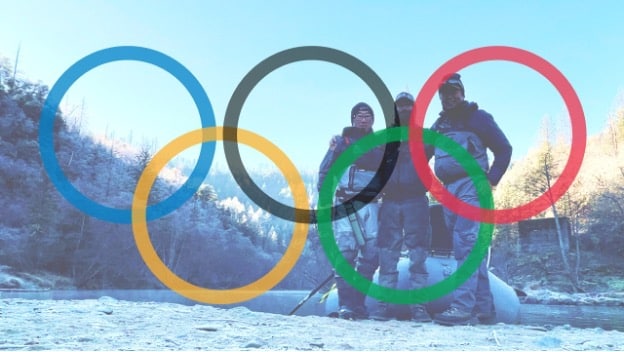
As a self-avowed Olympics junkie, this has been a glorious 2026 Winter Olympics. I’ve been glued to the coverage from the Opening Ceremonies and lighting of the cauldrons to the figure skating exhibition gala at the end-ish of the games (my wife likes it when I watch figure skating with her; she hates it when I provide my own color commentary, though). Main takeaway? I never thought I’d ever know as much as I do now about the sport of curling.
My kids have baited me with the question, “What Olympic sport do you think you’d be good at?” My fishy daughter’s pick for herself is short-track speed skating. She’s a fearless girl, and at only four-and-a-half feet tall, she’d probably make speed skating great and the most-decorated Winter Olympian, Apolo Anton Ohno, pee a little if he saw her take the starting line with him. She doesn’t need much room to pass you, Apolo.
Me? Even though I now have a deep understanding of curling and have some pretty mad broom skills, I’ve always thought I wouldn’t be terrible at the Olympic shooting sports.
But as a fly angler, being allowed to dream of becoming an Olympic athlete has made me wonder whether fly fishing might one day be included in the Olympics. And if so, what would it look like?
Turns out, fishing did make an appearance at the 1900 Olympics in Paris.
The games lured 600 anglers from six countries to compete in angling on the Seine. Records show that 20,000 spectators showed up over four days to watch anglers, both men and women, fish. And probably smoke.
Organizers set the competition on an island in the Seine. The choice of location posed some problems for the international angler-athletes, though.
First, those Olympics were held in August. And in August 1900, that part of the Seine was poorly oxygenated, and any fish that were there were small. And few. And unapologetically Parisian. Et alors, Olympiques…
Second, just days before the start of the competition, a sewer accident killed 30 tons of fish in the Seine. Remember how the Seine underwent a massive cleanup leading up to the 2024 summer games so that long-distance swimmers could compete in the river without contracting a case of Can’t-Leave-The-Bathroom-For-Seven-Days and a permanent sore throat? Yeah. For about a hundred years, the Seine has been in a semi-toxic state of “Do not drink zat, let alone sweem in eet.”
After that summer in Paris, fishing never returned to the Olympics. Bummer that. With the modern Olympics now embracing new sports like Big Air Snowboarding, Ski Mountaineering, and BMX Racing, why not introduce fly fishing? Shoot, if even the good-walk-spoiled sport of golf can be an Olympic event, why not the way-less-nap-inducing sport of fly fishing?
So follow me through the beaded curtain to the black-light corner of my imagination, where my dream of Olympic fly fishing lives. Cue John Williams’s “Olympic Fanfare and Theme” <bom-bompa-bom-bompa-bom-bompa-bom-bompa>… And fade to camera two…
MIKE TIRICO: Good evening from Milan and NBC’s coverage of the 2026 Olympic Winter Games. Tonight, we introduce you to this year’s newest exhibition sport… Fly-Skï. A unique combination of fly fishing and overland ski racing. Let’s go now to Umbria, where our special correspondent and two-time European Fly-Skï Champion, Cat Schrödinger, is on Lake Trasimeno for the start of the Fly-Skï competition… Cat?
CAT SCHRÖDINGER: Thank you, Mike. I’m here with Team USA’s Fly-Skï National Team Coach, Levi Stoltzfus. And I can’t think of anyone better to introduce our viewers to the sport of Fly-Skï. Tell us, Levi, how Fly-Skï came to be.
LEVI STOLTZFUS: Thanks, Cat! Fly-Skï started in Iceland. Home to Laufey, a state-centered universal healthcare system that’s rated #2 in the world, and a lot of people named “Frejya” and “Jóhann”, but only one person named “Björk”.
The Icelandic people are pretty reverential of nature. They kinda live in the now, if you know what I mean. So how they came up with Fly-Skï… No one really knows! I’m guessing it was out of boredom. But hey, boredom’s how we got other sports like Zorbing, competitive eating, and Canadian Football.
In Iceland, the sport is called Fluguveiði Skíða Skauta, which means “Fly Fishing Ski Skate” literally. I learned it there—and fell in love with it—after getting pretty lost coming home from Burning Man 22 years ago. I brought it back to America, but when the rugged rodeo-set Americans went to adopt it, that Icelandic tongue twister of a name was harder to say than ripping a Shaun White Double Cork 1440. So… Fly-Skï! You know how we Pennsylvania Dutch love putting an umlaut on anything Scandinavian.
CAT: Ummm, Iceland isn’t a Scandinavian country. And you’re not Pennsylvania Dutch! You’re from Costa Mesa.
LEVI: Hey, potato tomahto. We got ourselves a fly-fishing sport in the Olympics! Go Estancia Eagles!
CAT: <badly masking a slight eye roll> So how does Fly-Skï work, Levi?
LEVI: Fly-Skï is a mash-up sport, sort of like how biathlon is a mash-up of cross-country skiing and shooting. Fly-Skï takes the target casting of fly fishing and puts it on the shore of a frozen lake with overland skis.
Competitors must first race along the lake’s shore on skis. Along the course are fly-casting target stations where the competitor must successfully cast their fly into a target that most Americans might recognize as a 16-ounce red Solo cup. In international competition, though, we use a 473 ml size cup. ‘Cuz, ugh… the metric system.
CAT: Some people compare Fly-Skï to Flyathlon, which started in Colorado.
LEVI: Flyatha…? I guess… Maybe—but not really? Fly-Skï’s a little different from that beer-swigging, running with a fly rod, Mile-High hobby. I mean, that might be fun, but these are serious world-class athletes who compete in Fly-Skï, Cat.
So anyway, after completing the fly-casting target stations along the snowy shore, competitors then race out to designated stations on the frozen lake where they’ll have to catch a fish.
CAT: Fly fishing on a frozen lake, Levi…?
LEVI: You bet, Cat! That’s the trickiest part of this sport. This isn’t jigging for shivering rainbows through a 6-inch hole on Lake Winnipesaukee. Although that ain’t easy either! No, no. These angling competitors have to cast to their fish in these frozen lake conditions. That means they’ve gotta cut a lane in the ice to strip their flies through.
That’s why the skis have saw blade edges, Cat.
CAT: I was hoping you’d bring up the saw blade skis, Levi. What does that equipment bring to the sport? And what should spectators new to Fly-Skï look for when watching?
LEVI: Oh, Cat. This isn’t a civilized sport like biathlon, where a competitor might accidentally bump into another racer or—Woops!—shoot Ralphie’s eye out.
No. The Fly-Skï race is a full-contact event! Remember, the Icelandic people are descended from Vikings. Vikings! We’ve had to standardize and fine-tune the rules over the years because, in the early days, people were getting hurt really badly out there. Back in the ‘70s, world records were being set not for race times but for the number of participants needing to have various fingers—and sometimes limbs—reattached!
Competitors aren’t out there on the course in those long, skinny cross-country skis, either. These are specially crafted overland ski blades. <picks up a ski blade to wave around> They’re a couple of feet long and can be used to batter other competitors—as long as they stay attached to the competitor’s feet. It takes a certain type of athlete-fly angler to be competitive at Fly-Skï, Cat. You know!
CAT: I do, Levi! For me, it’s the thrill of chasing fish against someone else. Growing up in Vermont, I played hockey and fished for brookies year-round. So Fly-Skï was the perfect combination of the two for me. That, and I liked hitting people.
LEVI: Right? But it’s all in the name of good-natured, competitive sport. That’s why the modern pool of Fly-Skï athletes is so diverse. The sport appeals to a broad range of folks. It’s not for the (makes two slow knocking sounds with tongue) pickleball nerds. More like for people who love fly fishing but also think it’d be fun to play dodgeball with lawn darts.
CAT: You mentioned the diversity of the athlete pool. Tell me a little more about the competitors this year, Levi.
LEVI: Epic year, Cat. We’ve got 84 competitors from 14 countries battling in open competition. And by “open competition,” I mean “free for all.” Competitors are grouped into heats by order of entry and who got their gear out of baggage claim first. There are no men’s and women’s divisions or age groups. That’s the beauty of this awesome sport: You can do it at any age and be competitive!
Our oldest competitor is Venla Virtanen from Finland. She’s 52 and has dominated the sport for nearly 30 years.
CAT: Oh, yeah. I know Venla. She’s a tough competitor. I won my first European title against her after she was disqualified for a controversial mumblety-peg move that has since been banned in international competition. (Cat holds up a hand to reveal she’s missing a pinky.)
So Levi, why do you think Fly-Skï is making its Olympic debut now? Fly fishing isn’t necessarily a winter sport. Doesn’t it make more sense to bring fly fishing to a summer Olympics setting?
LEVI: Well, the sport did originate in Iceland, where it’s mostly winter whenever it isn’t light out, Cat. But I get what you’re asking. Maybe if Fly-Skï catches on, we’ll see a sort of warm-weather analog at the summer games. Probably not in LA 2028, to watch world-class athletes chase ditch pickles in the LA River or tease carp out of the lake at MacArthur Park, but I’d be pretty excited to see well-meaning international anglers fly fishing Sydney Harbor for Kings in 2032!
We’d just need to figure out another sport to mash it with… ‘Cuz what, you wanna combine fly fishing with synchronized swimming? Feh. You won’t get any self-respecting fly angler in a pair of nose plugs. But mash it with, yo, I dunno, roller derby, and you might have something!
For now, we’ll keep it a winter sport and enjoy its debut at this year’s Olympics. I heard Snoop Dogg is here at our first event as a guest of WADA (World Anti-Doping Agency) President Witold Bańka. That ought’a tell you something about our sport right there! We’re gonna need more Brennivin…
CAT: Thank you, Levi. We’re already under a red flag warning for a too-large bonfire Team Kazakhstan set here at the finish line before the first heat has even started, so let’s send it back to Mike Tirico in the studio. DJ Birds Nest, take us back to Milan!
Electronic dance music builllllds… and the beat drops as the camera pans to Snoop Dogg ringing a Swiss cowbell and basking in the glow of flames as they start to consume the Fly-Skï spectator stands…