
Saltwater Lines
In the last issue, we discussed the key components of fly lines and how they apply to freshwater trout situations. In part two, we are going to apply our understanding of fly line features to what makes a good saltwater line. Saltwater conditions are among the worst for fly lines; heat, UV exposure, harsh chemicals, and abrasion all threaten your new fly line. In saltwater, our hooksets change to “strip sets” from the traditional trout set, where the angler raises the rod to set the hook. I have met saltwater guides so passionate about this that they have “Keep Calm and Don’t Trout Set” tattooed on their bodies. It’s windy, and a good double haul is one of the most valuable assets. The flies we use are often larger, heavier, and more wind-resistant. Even the water itself is different; saltwater is denser, so floating saltwater lines can be denser to aid casting through the wind while still floating.
Just as with trout lines, there is no shortage of options. At Lost Coast Outfitters, we carry over 900 SKUs of saltwater fly lines, and we certainly understand why customers can feel overwhelmed.
Tropical or Coldwater
The first and most important crossroads when choosing a saltwater line is whether to go tropical or cold-water. If you are headed to a hot, tropical location, you will want to choose a line built on a tropical core with a tropical coating. The tropical core keeps the line from going limp and from inefficiently transmitting energy, while a harder coating prevents it from getting too gummy.
In cold-water conditions, you want a core and coating that aren’t too stiff. I’d rather use a tropical line in cold conditions than the other way around, because I can always stretch it and loosen it a bit. Short of putting your line in the cooler between casts in the tropics, you’d be hard-pressed to make a cold-water line work there.
How are you fishing?
Are you blind fishing or sight fishing? This is where the length of the head and rear taper enter the equation.
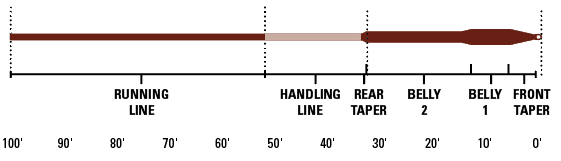
For blind casting, as we do in the ocean and bay for stripers, a short 30-foot head with a short back taper that tapers to a thinner running line that shoots efficiently will excel. These types can be cast quickly with minimal backcast. Quick casting keeps your fly in the water longer and increases your chances of catching fish. See Figure 4, Rio Outbound Short.
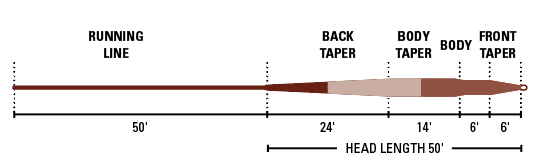
For sight casting, you may need to cast accurately to 50 feet. To make the most accurate cast possible, you will want to limit the amount of line you need to shoot to your target, so you will ideally be holding 40+ feet of line in the air, plus the length of your leader. Longer heads and longer rear tapers help carry more line in the air but often take more time to get the line out. See Figure 3, Rio Flats Pro.
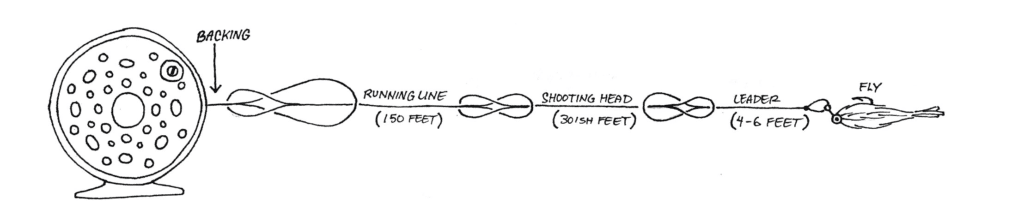
The same logic applies to the questions “How far do I need to cast?” and “How far can I cast?” A shorter, more weight-forward line is better for short casts in the mangroves and for beginner casters, while long heads are better for longer casts and for more advanced casters. However, we have adapted the shooting head into an excellent long-distance casting line by attaching a short 30-foot fly line to a thinner, lighter mono running line that shoots through the guides very well.
Presentation and Fly Size
Are you fishing a large, heavy, wind-resistant fly or a small fly that needs to land softly? This is controlled by line mass and front taper.
For large, heavy, wind-resistant flies, a heavier, more compact head with a short front taper, similar to the lines we use for blind fishing, is the best choice. The short head transfers the most energy to the leader and fly, helping push it through the wind and turn it over. Think of throwing rooster fish flies. See Figure 3, Rio Flats Pro.
For smaller flies and delicate presentations, a longer front taper will reduce the diameter and mass toward the tip of the fly line, helping the line dissipate energy and land more softly on the water. This scenario most often occurs on rare, windless, slick-calm days on the flats or in inside bays. See Figure 3, Rio Flats Pro.
Sink Rate
A sinking and a floating 8-weight line have the same mass. The rate at which a fly line sinks depends on its density—a denser line is thinner and sinks faster. Because denser lines are thinner, they can be advantageous when casting into the wind.
Floating: Popular in flats fishing, shallows, and when fishing poppers.
Intermediate: Sinks at 1-2 inches per second (IPS). Frequently used in shallow or clear water striper fishing, for tarpon and rooster fish. Slightly better to cast in the wind than a floating line.
Sink 6+/ Type 6: Sinks at 5-9 IPS. Popular for beach fishing to cut through the wind and hold in heavy current, but most often used when fishing from a boat.
Color
Color is used in many ways these days. Some anglers looking for an advantage when fishing for permit or pressured tarpon opt for clear lines to disguise their presentation as much as possible, such as Scientific Anglers’ Magnitude series of clear lines available in nearly all tapers. Rio has a built-in tape measure in their high-end lines. Their tri-color design serves two main functions: the first color change is at 20 feet, helping you and your guide calibrate distance, and the second color change marks the ideal load point on the line, meaning where you should pick up the line. The last function is admittedly subjective but helpful for intermediate casters and beyond.
My Favorite Tapers
Best Beginner Flats Line: Scientific Angler Grand Slam | As the name implies, this do-it-all flats line has a 40’ head and a short front taper, making it an excellent choice for beginner to intermediate casters in windy flats situations.
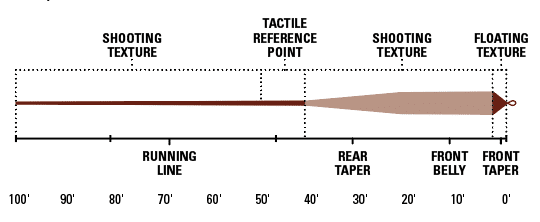
Best Int/Advanced Flats Line: Rio Flats Pro | Another generalist flats line with a 50-foot head length and a graduated 12-foot front taper that gives a ton of presentation control.
Best Baja Roosterfish Line: Rio Tropical Outbound Short | A short 30-foot head with a short front taper is built on a low-stretch tropical core; casts large flies quickly in the wind. The straight intermediate is the go-to for fishing from a panga, but I love the Float/Hover/Int for fishing from the beach because it is much easier to pick up and recast. Even the fast sink can be nice on really windy days.
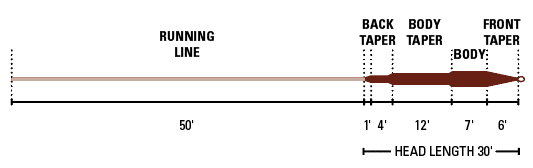
Best Beach Blind Casting Line: Rio Outbound Short | A short 30-foot head with a short front taper is built on a coldwater core and casts large flies quickly in the wind. They come in a variety of sink rates to match your needs. See Figure 4
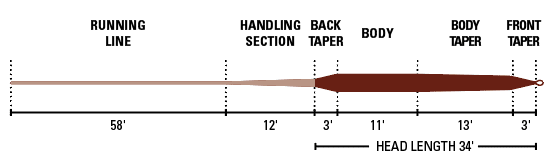
Best Value Line: RIO Avid Trout Gold, the good old 47-foot head of a RIO Gold has caught me a lot of fish. Don’t sleep on the SA Mastery series with nearly all their tapers available in a more price-conscious package.
Do:
Label your fly lines.
These days, fly lines have ID markings. However, they can become scuffed, or bad eyesight can make them impossible to decipher. At the shop, we label every outbound reel and line (even if you say no, I will remember) with our handy Dymo Label Maker. Additionally, I like to mark my lines in Sharpie with the Kreh method at the back: one long bar (5) and three short bars would be an 8-weight: —— – – – (8wt) —— – – – – (9wt)
Clean your fly lines.
If you want to protect your investment in a nice fly line, clean it periodically with warm water and Dawn Ultra Gentle dish soap. On saltwater trips, I clean my lines at the end of each day with a rag and some line dressing.
Stretch your line.
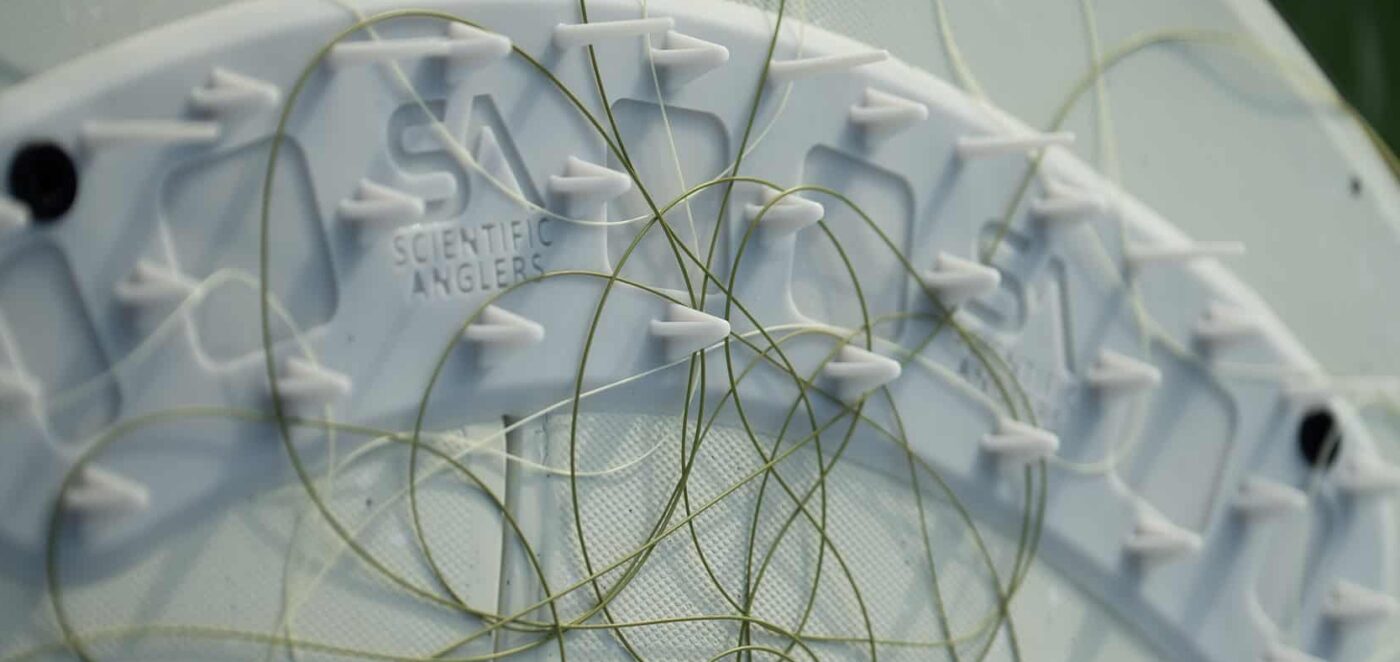
Whenever I am going to shoot line, I take a few minutes to stretch it; it removes all the coils, ensures it clears the deck or stripping basket well, and makes it much less likely to tangle. Some extra time here will pay off.
Don’t:
Leave line out on the lodge rod rack.
I often see clients put their rods in the lodge’s rod rack to bake in the sun for
6 hours, from 3 p.m. until dark, while they happily drink margaritas, unaware
of the damage they are doing to their most important piece of equipment.
Bug spray or sunscreen on your line.
Bug spray, especially DEET, will eat your fly line in short order.
Visit Lost Coast Outfitters in San Francisco to shop fly lines.