
I still remember the first trout I caught on the fly. It happened on the North Yuba years ago, on a bright, cloudless June morning with no bugs on the wing. Most fly fishers count their first trout as a key moment in their angling lives, but for me it was momentous. That should make for happy memories, but I’d be a liar to say it was the case.
I came to fly fishing the hard way. No one in my family ever touched a fly rod. My dad loved to cast plugs and lures for bass and pike, acquiring a stockpile of Jitterbugs and Lazy Ikes that seldom had the desired effect. As for my uncles in Minnesota, they were dedicated bait slingers. If they climbed into a boat, they expected a plate of fried fish for dinner—sunnies, crappies, perch, even bullheads, they weren’t picky.
Those uncles were responsible for making me a fly fisher. They’d drag me along when they visited the local bait shop for an outing. It was an awful place, hot and stinky and filled with doomed creatures. The choices on offer were extraordinary, or so it seemed to a boy of eight or nine, from minnows and night crawlers to caged crickets that never shut up. I felt sorry for the tiny frogs that squealed in misery when impaled on a hook.
I was supposed to be impressed, but the bait shop had the opposite effect. For several years, I wanted nothing to do with fishing of any kind. Only when I moved to San Francisco in my mid-20s did my attitude begin to change. I discovered Anglers Lodge while wandering in Golden Gate Park, not yet employed with plenty of time on my hands. It was the perfect spot for a new arrival to hang out, a peaceful oasis in the heart of the city.
I sat for long meditative hours and watched the artistry on display. I’d never seen anyone cast a fly except in movies. There was a poetic quality to the casting, the angler and rod joined in a way that suggested an inner harmony. The word “zen” was much in use in those days, and I knew it was inevitable that a book called Zen and the Art of Fly Fishing would be published someday.
At a tackle shop on Geary Boulevard—no crickets or frogs in there, thank goodness—I bought a cheap Fenwick, a reel, a packet of flies tied in Southeast Asia, and set to practicing. The internet hadn’t yet been flooded with videos, so I depended on observation, trying to copy the experts at the pools. It came as a surprise to receive so many helpful tips from the other anglers. In a month or so, I developed a tentative self-confidence and judged myself ready to fly fish.
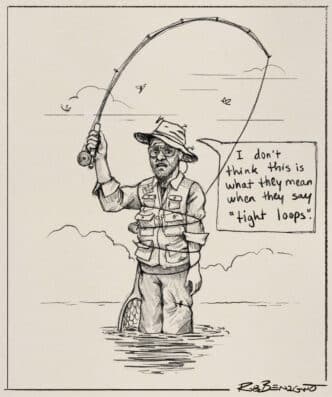
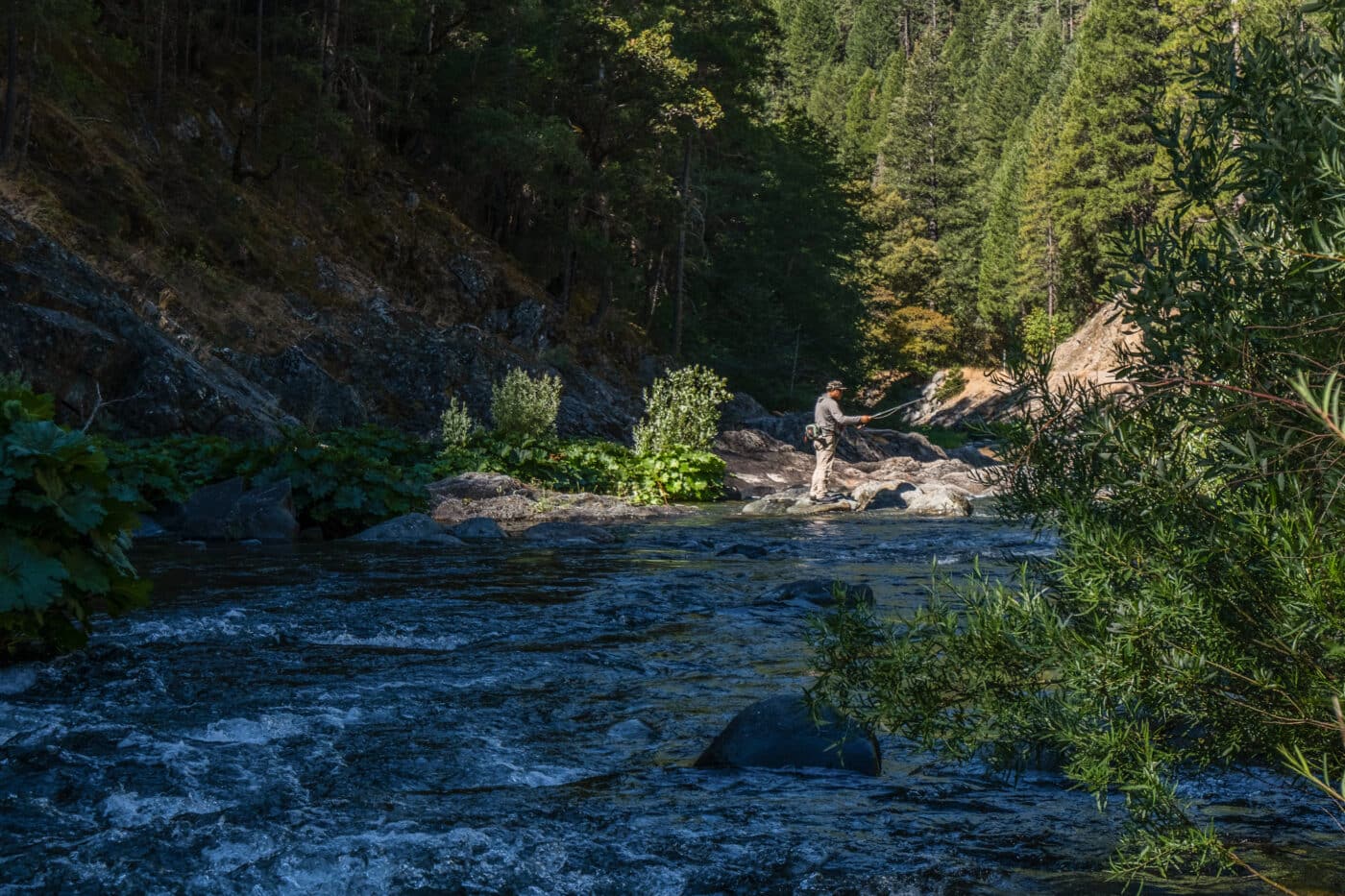
I chose the North Yuba because I’d heard it wasn’t too difficult compared, say, to Hat Creek—if you knew what you were doing. But I didn’t. I still had lots to learn. A casting pool bears no relation to a river. It’s benign. The water doesn’t move, but the North Yuba returned my casts with such speed I couldn’t deal with the slack line and soon found my fingers in a tangle. My fly skittered past and sailed downstream, where a 3-inch rainbow managed to hook itself. I felt no strike, of course. You don’t with a trout the size of your pinky.
The fly was a Royal Coachman. I probably had no more than 10 flies in all, but I favored the Coachman for what I took to be its literary aspect. I liked to imagine Wordsworth fished it on his rambles with his sister Dorothy along the River Duddon, where salmon and sea trout are still caught today. But really, the Coachman was just another sign of my naivete, and the Elk Hair Caddis soon replaced it as my favorite.
I doubted any angler had made such a mess of things until I came across Rudyard Kipling’s essay “On Dry-Cow Fishing as a Fine Art” in an anthology of angling tales. It appeared in The Fishing Gazette in 1890 and told how the author had snagged a cow with his backcast on a small English trout stream. He tried to reel in the cow, hoping to remove the fly, but the cow bolted. Kipling was obliged to follow, or else lose his rod. He solved the problem by biting off his line.
“The wheep of the broken line running
through the rings told me that henceforth the
cow and I might be strangers,” he wrote.
Kipling was a devoted fly fisher. He’d just finished a trip across the U.S., starting out in San Francisco and heading north by rail. He took a steamer up the Columbia, where he was critical of the salmon canneries destroying the habitat. On the Clackamas in Oregon, he hooked a steelhead on a fly and described an epic battle that left him “dripping with sweat, spangled like a harlequin with scales, wet from the waist down, nose-peeled by the sun, but utterly, supremely, and consumately happy.”
Soon, he was settled in England and at work on the books that would make him famous. “I live very largely alone and my wants are limited to a new fly rod and some flies,” he confided to his editor, although two years later he married Carrie Balestier, an American, and moved to Brattleboro, Vermont, where he wrote Captains Courageous and the Jungle Books.
Maybe it’s necessary for every fly fisher to endure a comic episode or two before making any progress. At least I felt in elite company after reading about Kipling and the cow. My only pleasant memory of that long-ago day on the North Yuba is of releasing the little rainbow and watching it swim away, certain that he or she would look twice before taking a bite out of any insect in the future. I hope that trout lived to a great age.
After my first outing, the only recourse I had was to improve. I worked at it, and two years later, on the North Yuba, on a crisp autumn morning, I hooked an 18-inch brown that earned me bragging rights at the saloon in Downieville. At last, I could call myself a real fly fisher, not an amateur anymore.
My prediction about Zen and the Art of Fly Fishing came true in 2018, when James Styring’s book arrived with that title. From what I can gather online, Jim would make a good fishing partner. He grew up in New York City, fell for the American West after seeing John Ford’s westerns, and read the Beats in Greenwich Village coffeehouses before he joined the Marines at 18—a “Hemingwayesque” gesture, as he puts it—and served in the Far East, where he studied haiku and, you guessed it, Zen Buddhism.
Jim lives in the Rockies now and writes scripts, books, and poetry. I imagine he’s been doing what I did today, getting ready for the opener and considering his early-season options. I spent about an hour rooting through a closet for a wading staff I thought I’d stored there, but all I came up with was a pair of worn-out sneakers and an overdue library copy of a Cormac McCarthy novel. I’d be dismayed if I hadn’t been through the drill so many times before, waking from the winter doldrums and eager to wet a line again. twice, but I have a feeling the ghost of Art Flick might rise up and take offense.