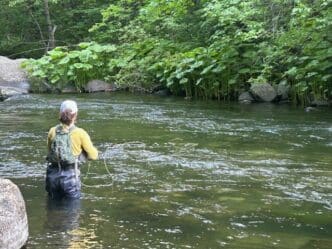
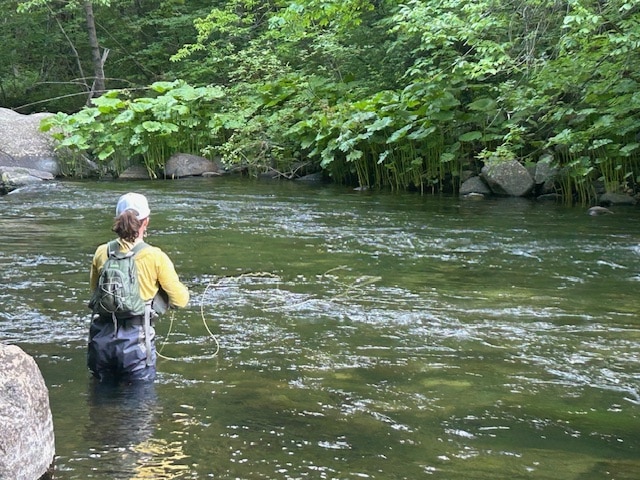
I watched from a high vantage point above one of my favorite streams as an angler worked his way down the shallow, riffled water. His casts were short and efficient, his rod tip high during each drift to eliminate drag, he was methodical in covering the water, and because the most effective flies in this piece of water were no secret, I was confident he was using the right bugs. I’d watched him for 30 minutes, and he had not had a single grab, and his body language said he was getting frustrated by continually hooking the bottom. In short, it was hopeless.
“Wait, what?! But he was doing everything right,” I hear you say. Right technique, right flies, great trout stream—what gives?
While it is quite possible to learn proper casting on a lawn or over water, peruse YouTube videos for correct presentation techniques, or visit your local fly shop to ensure you are using the correct bugs … none of it will make much difference if you aren’t presenting your flies in front of fish.
Reading water—the art and science of determining where fish will be holding in any given body of water—may be the single most overlooked subject in learning to fish, yet it is arguably the most important. The angler I described above had his presentations dialed—I could not have done better myself. Yet for the half hour I watched, he never once put his flies in a spot that held fish … he was simply blindly and methodically covering water in the hopes he would eventually find a hungry fish. And as is so common in this scenario, he regularly cast to water that was far too shallow or slow-moving to even attain a full drift, leading him to constantly hang on the bottom.
When arriving at a new stream and trying to discern where fish will be found, remember the two most important things to a trout—safety and food. Typically, safety means holding in water that hides them from aerial predators—often an osprey or other fish-eating birds. This means either deep or broken, choppy water that is difficult to see into from above. As well, fish often prefer a stream bottom that allows them to camouflage, usually a dark, rocky bottom that their dark, speckled backs will blend in with.
Cruising out over shallow, light-colored bottom substrate is pretty much the equivalent of you or me strapping 50 pounds of fresh tenderloins on our backs and wandering around in grizzly country. I mean, we might be okay, but the odds are pretty good that something bad is going to happen.
Food may be the single most compelling factor in determining where trout choose to be in a stream. They prefer a scenario that combines safety and food (this is the “magic water” I look for), yet if there is enough food in an unsafe place, they will sometimes throw caution to the wind and risk death to keep a full belly. But this is rare. In most stream situations, my idea of perfect holding water will be deeper, fast- moving water with a choppy surface and a dark, rocky bottom. Or, if the river is slow-moving with few or no rocks, I look for weed beds – they provide the perfect combination of food (trout chow loves to live in weeds) and cover that they can quickly dive into if threatened.
Current speed can also be important in identifying the best holding water. Some anglers make the mistake of dismissing water because they believe it is too fast for a trout to hold in. While this is possible, much rushing water will have boulders on the bottom large enough for fish to sit behind, eliminating their need to constantly fight the surrounding heavy current. They are thus able to comfortably hold in flows that appear, on the surface, far too fast, casually nosing out to intercept all the bugs that the same fast current delivers to them. When fishing unfamiliar rivers, I make it a point to fish this kind of water, even if it looks unlikely. As long as there is a dark, rocky bottom, I often find myself surprised, sometimes with the best fish of the day. I suspect this occurs not only because it is a safe, food-rich environment, but also because almost no one fishes there, allowing the fish to remain happy. It is so satisfying to identify a potential holding spot you know others are missing, and hook a fish there!
While some holding water is easy to spot—deeply undercut grassy banks with moderate current flows are normally “money,” for example—I find it important to really take my time and observe more nuanced current seams, as well. A classic example is an inside corner, where the stream makes a sharp bend, creating three distinct feeding zones within a relatively limited area. There is the fast mid-river water described above; the seam dividing the fast and slow water; and the slow water. While all this water can hold fish, the seam will consistently be the most productive (unless the stream is heavily fished, in which case the trout will often push out into the safer-feeling fast flows). Typically, the fast water will offer productive nymphing; the seam will offer a combination of nymph and dry fly action; and the slow water will often only hold fish during heavy hatches, when adult insects stack up, tempting trout to slide into this more “dangerous” water to eat dries.
Finally, I suggest always taking note of foam lines on a stream’s surface. These never-ending strings of foam clearly reveal where a trout’s food and best holding water coincide. Many dry fly anglers recognize this sudsy highway (sometimes subtly and other times obviously) points a finger to water that fish will likely be looking up into, searching for floating or lightly drowned insects mixed in with the foam. Yet these tell-tale scum lines are equally important to nymphing anglers, who find success achieving extended floats with indicators right down the foamy pipelines.
There are other tricks and secrets to reading water, certainly, yet there is no substitute for getting out on the water and experimenting, finding out where the fish on your favorite waters like to hold. Remember that there can be some truth to the old saw that 80% of fish hold in 20% of a stream’s water. Your challenge is to discover where that 20% is, to avoid the fate of the earlier-described angler. Stay alert—I’ve discovered some of the best and most surprising holding lies by carelessly wading through them, only afterwards realizing I’d stepped off a subtle drop-off and into holding water that later produced great fishing. Hopefully, you can turn the hints and observations above into more interesting and fish-filled days!