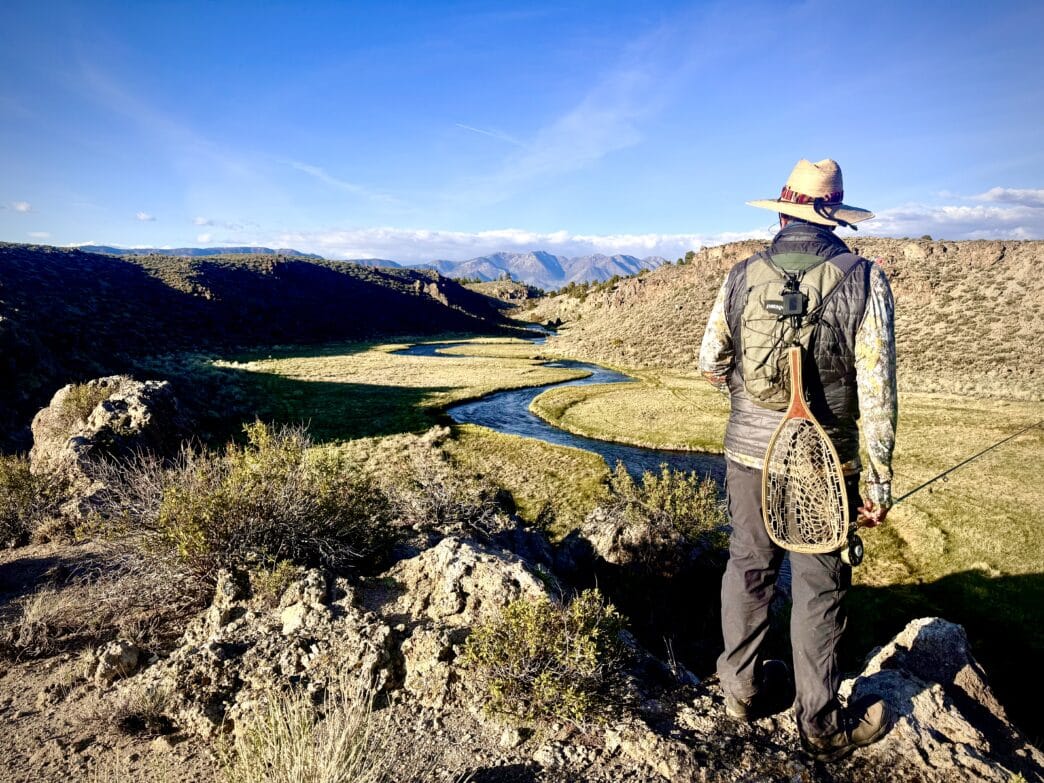
I didn’t start to get nervous until I stepped out of the car and felt the gravel crunch under my feet. Up until that point, the trip had been pretty uneventful, just the long haul north out of the L.A. basin, through the heat of Mojave and then up Highway 395 through Bishop, my son napping in the seat beside me. I am luckier than most people in that I enjoy long drives, even very long ones. I can get lost in the sounds of local radio shows, rock and roll, and enjoying the scenery going by, and I suppose it’s a form of escape. But there’s no arguing with the fact that it’s also a little like watching an old TV; the world is out there going by, but you’re separated from it by a glass shield, and neither the sound nor the picture quality is what it should be. Stepping out of the car and feeling the gravel underfoot was a gritty little welcome back to reality, and to the fact that I didn’t know what I was doing.
Tomorrow would be a piece of cake. Tomorrow was Crowley Lake, Tom Loe, and guaranteed good fishing. Paul and I started fishing Crowley when he was 11, and we’ve had Tom as our guide every time since. It’s become a tradition, as has the after-fishing ritual of a pizza, a video, a hot tub at the rented condo, and a massive breakfast at Blondie’s Diner on our way out of Mammoth the next day. The first time we fished with Tom was because I wanted Paul’s first fly-fishing trip to be a good experience, and I guess I was insecure about being able to deliver the goods on my own. Seemed like a lot of cash at the time, but looking back on it now, it’s probably the best money I’ve ever spent. Tom is one of those magic guides who knows the hows and whys of fishing on Crowley like nobody else, but is also understanding and gentle with kids. Since then, we’ve used Tom each time we’ve fished the lake. Paul is now 15. My guess is that we could do almost as well on our own now, with all that Tom has taught us. But we still fish with him because we enjoy his company. So tomorrow was a slam dunk: fly fishing with a friend for big, strong trout in a beautiful setting, followed by pizza, a movie, and a hot tub. Father-son bonding in a huge way. The day after that, we might try the Middle Fork of the San Joaquin, one of our favorite haunts, a cathedral of sorts for both of us where words are never needed. But today is different.
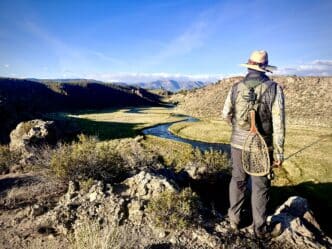
Paul is getting his gear out of the Toyota’s trunk as I sit in the driver’s side seat and try to worm into my waders. I catch a glimpse of him through the back windshield, his hands diving into and out of the trunk retrieving waders, boots, fly boxes. He moves quietly and quickly. His face has that look of concentration I have come to recognize and sometimes dread, as it suggests he is a little nervous. His hands are long and delicate, and he is tall and thin for his age. I have to take a minute to just watch, while he is unaware of me watching. This is part of the fun: Watching him and his anticipation, watching his face. There are times when his hands and face remind me so much of his mother that I temporarily forget to breathe.
He is putting his 5-weight together, and I catch myself thinking that he’s probably at the point where I should get him a better rod. Then again, I have a better rod, and he regularly outfishes me. So maybe I should get a cheaper one and just learn to use it better. I can sense Paul’s excitement by how rapidly he is moving and getting the gear out. His eyes are darting about, taking it all in, but I worry that some of my anxiety has also spilled over into him. Deep inside, maybe he’s not sure if we’re up to this either. Maybe he’s heard me talk about this stretch of water before, and it’s gotten to him as it gets to me. I am not all that sure that I can catch fish here. It’s supposed to be full of trout, but it’s also said to be a challenge at times, with well-educated fish, and I have not been here before. This is Hot Creek.
Like most fly fishers, I have read about Hot Creek often, even while growing up in Kentucky.
It’s one of a handful of waters in this country that has earned, one way or another, the label of legend.
And to be honest, it’s a little daunting to be getting the gear ready. My guess is that this is similar to what a prizefighter might feel when going up against the reigning champ, though that analogy does not really work. I might not catch anything, but I don’t run the risk of getting my face bashed in. So my nervousness has another source.
Like most fathers of young boys, I am revered more than is due. Young men desperately need a male role model, and in lieu of a really good one, the father often fills that void, intentionally or otherwise. What Paul does not suspect yet is that I am a pretty average dad, and this, the fear that he may wake up some day and realize that I am nothing special, worries me far more than the prospect of a fishless day. I’d like to keep the illusion going a little longer. And maybe today will help, but maybe not. It all depends.
About the only ace up my sleeve at this point is Bill Sunderland’s book on blue water trout streams in California. And I’ve followed the directions to the letter so far: turn here … go about this many miles … turn down a dirt road … and there it is. I expected a crowd anywhere I stopped along this creek, but there are just two other vehicles here, maybe because it’s 3:00 p.m. on a Thursday afternoon, and most folks are not yet off work, and it doesn’t look like any bugs are hatching. We have the stream almost to ourselves. So far, so good. But now we have arrived, and the book will offer no more help.
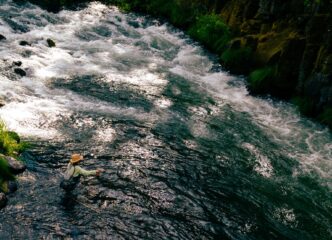
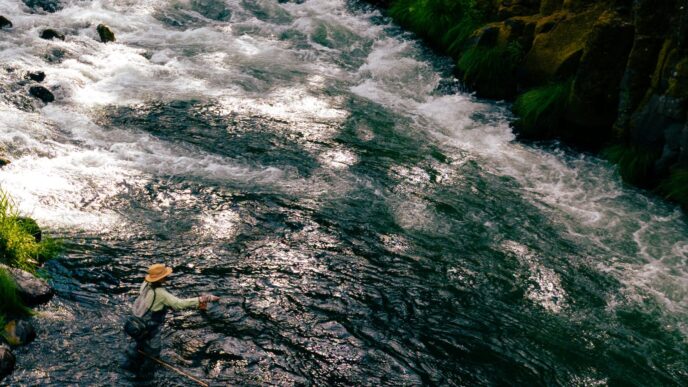
I look around this storied place for some sort of shrine or place to pay homage. There is a kind of central spot here, a little kiosk area with a couple of bulletin boards stating that this is a special-regulations area. But no sign of an altar or anything along those lines. Downstream, I see one other angler, but that’s it. Directly in front of us, the stream is open, inviting, and, not knowing any better, we march straight ahead.
I note with a little dismay that the paths on either side of the creek, going in both directions, are well worn out to a width of about two feet, and even to the side of the hard-packed dirt the grass is matted down as if armies had passed this way yesterday. No reason to expect otherwise, I guess, but it’s always nicer when you can at least pretend that you’re the first person in history to stand here. I suppose you can’t have it both ways. It can’t be a famous place without a lot of folks having seen it.
And now the big decision. With no rises and nothing coming off the water, which fly to choose? It’s not that hard for me, really, since when I don’t know what else to do, I always go for a Pheasant Tail or a Hare’s Ear Nymph, more because I am comfortable with them than for any logical reason. Also, I have hit a rut in my tying ability in the last few months, where every fly that comes off the vise seems to look like one of those two, no matter what materials I start with, so I have an abundance of them, in a surprising variety of materials. I go with a number 16 pheasant tail, selecting one that actually looks like it should. I finally find one with relatively few wild pieces coming off in weird directions, and with the eye of the hook visible. I tie the nymph on—a process that takes longer than it should, my fingers fumbling with the intricacies of the clinch knot—then add a small weight and an indicator. I know that a purist uses no indicator and yet can somehow sense the take, but I am not there yet, or anywhere close to there. I am a long way from Zen.
Paul has tied on a Prince Nymph, always his go-to fly. We have a running competition between his Princes and my Hare’s Ears, with the edge going to him. He looks up at me, smiles, and we turn toward the water, toward a memory.
The stream is surprisingly small for such legendary water. I want to get the fly out to the deeper runs in the middle of the stream, but weeds are a problem. I was warned about this. I could reach some open water, but it’s obvious that I would get hung up in weeds, so casting to midstream doesn’t look like much of an option. In front of me, there is a small island, no more than eight feet long and perhaps three feet wide, with a slot of strong current running alongside it immediately below me.
I drop the fly in, knowing that the window of opportunity will be no more than a second or two before the weeds intervene. The indicator dives, and I am onto a good fish before I know what is happening. The fish heads out of the little side channel and into the main current, pulling hard. It fights harder than I think it is capable of, and when it surfaces, I see why: It is foul-hooked. I think the fish must have hit the fly and then rolled, wrapping the tippet and eventually the fly around its body. However it happened, it’s clear that the fly is lodged at the base of the anal fin rather than in the mouth, and this gives the fish more leverage and makes him difficult to steer; I cannot easily get his head up. But eventually I slide him into the net.
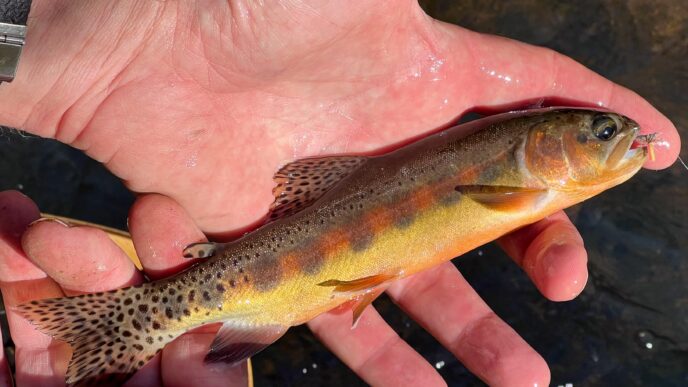
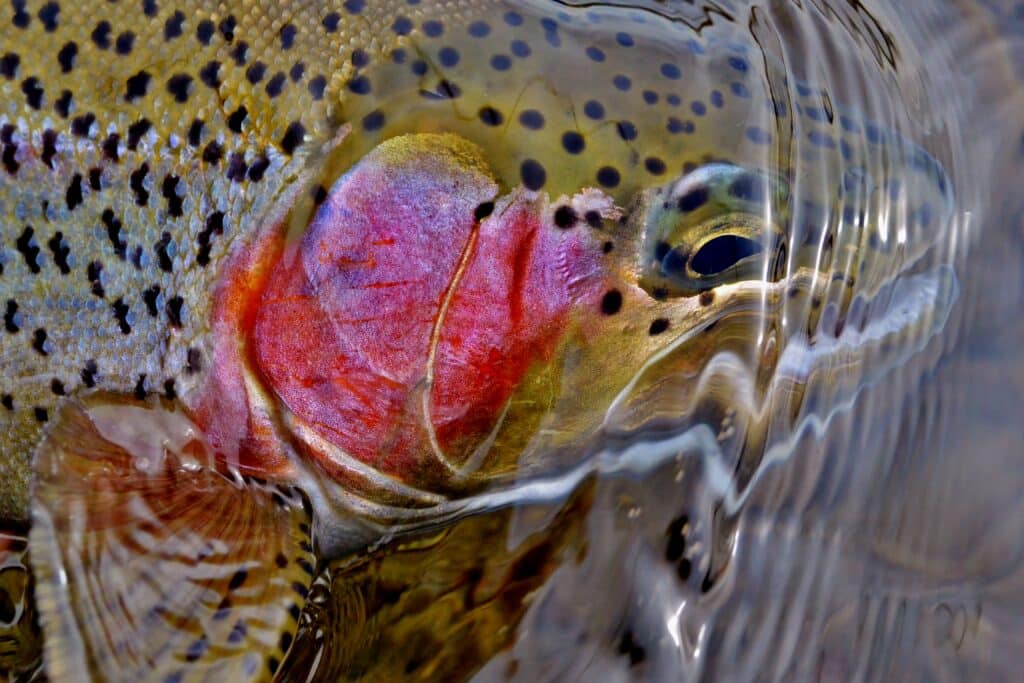
The fish is fat and healthy, dark and beautiful. Paul and I are both ecstatic. The red on its side runs to crimson that splashes up onto its cheeks, and then dark green on his head. It’s a poster fish. Paul has joined me on the bank during the fight; he now thumps me on the back and says, “Good job, Dad!” and it’s like every worry I ever had in my entire life has melted away. For now, at least, the illusion continues. I can still pretend to be a hero, a role model, a good dad. “Wow” is all I can say. “It’s a nice one.”
“It’s a great fish, Dad. Even if you did hook it in the butt.”
Ah. So he did notice after all. But I’ll take it.
The hot tub and pizza are calling, and the sound is wonderful.