



Into the Pit
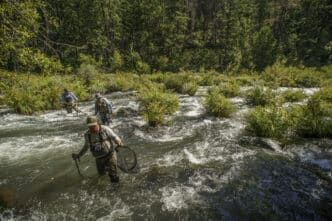
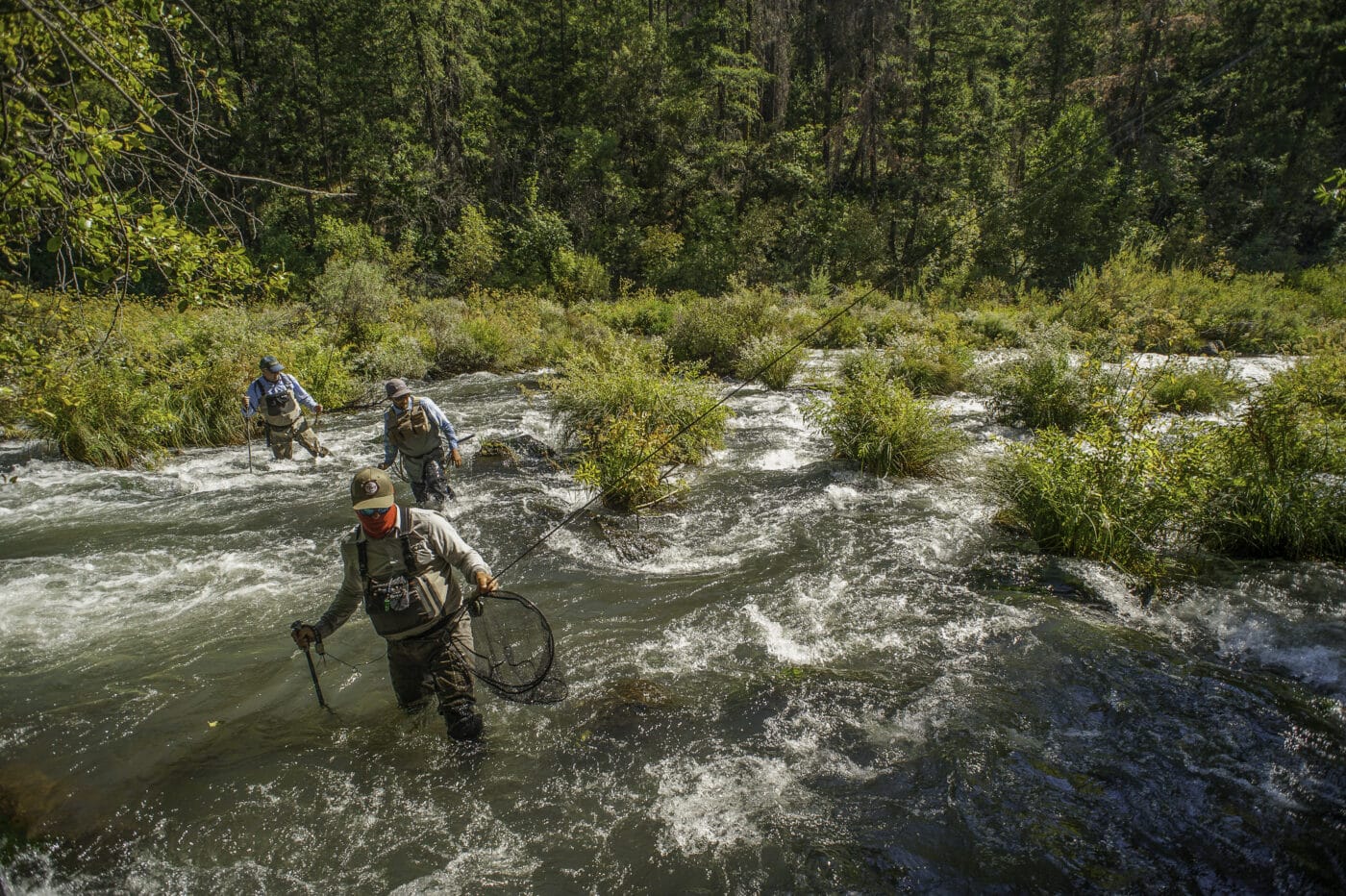
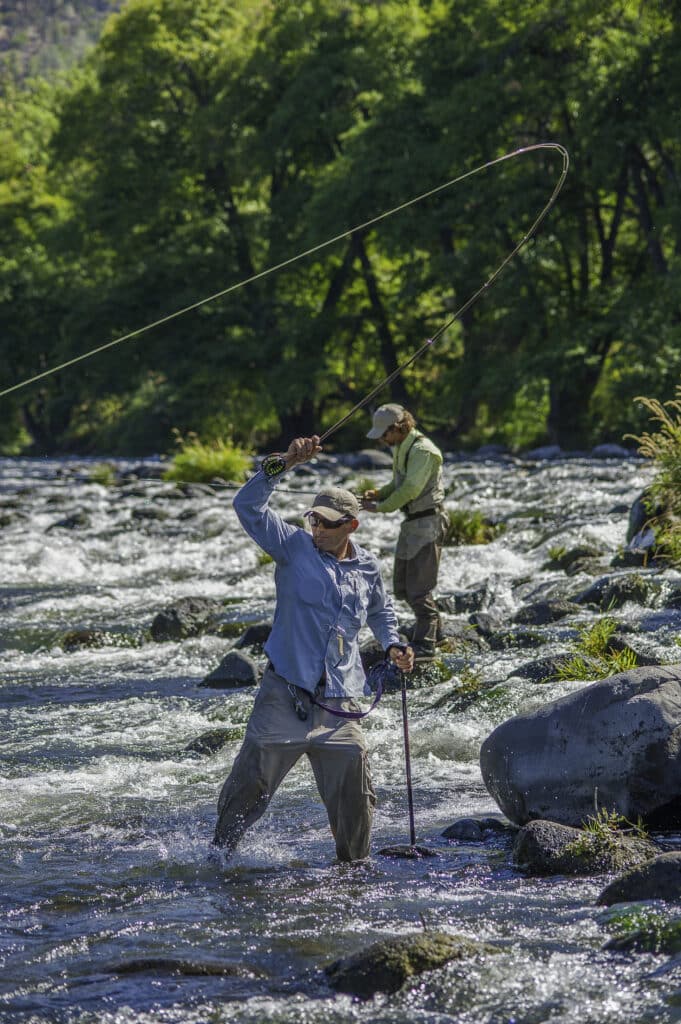
There are rivers that greet you kindly—and others that make you earn the right to stand in them. The Pit River is firmly the latter. From the first step, it reminds you that nothing here comes easily: The rocks are slick with algae, the current presses hard against your legs, and every cast feels hard-won rather than freely given. This is not a place for casual wading or divided attention. The Pit demands presence.
Set deep within a volcanic canyon in Northern California, the Pit has long held its reputation as one of the state’s finest wild trout fisheries—and one of its most unforgiving. The trout are strong, the water fast, and the margin for error slim. Yet that is precisely its draw. Because for those willing to meet it on its terms, the Pit offers something few rivers still can: stretches of water that feel untouched, fish that test both skill and resolve, and the quiet satisfaction that comes only after you’ve earned every inch of it.
Yet that hardship is precisely what gives the river its mystique. For anglers willing to meet it on its uncompromising terms, the Pit offers something increasingly rare in modern fly fishing: solitude, wildness, and the sense that every fish hooked has truly been earned. There are no manicured gravel bars here. No easy drifts handed to you by soft current seams. Instead, the river demands balance, patience, and resolve.
And in return, it gives back moments impossible to experience elsewhere—a heavy rainbow holding deep beneath a basalt ledge, the sound of rushing water echoing through the canyon walls, and the quiet satisfaction that comes only after successfully navigating water powerful enough to humble even seasoned anglers.
The Pit does not reward casual effort. But for those willing to embrace its challenge, few rivers in California leave a deeper or more lasting impression.
Where Better Fly Fishers Are Forged
The first thing you notice is the light.
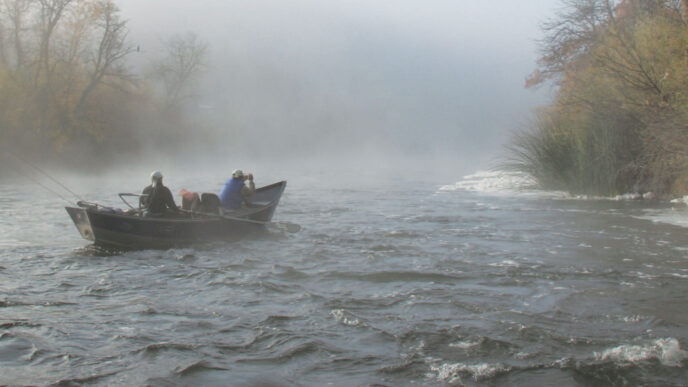
Coming down off the volcanic plateau into the Pit River, the walls close and the sky narrows to a corridor of blue above dark basalt. The canyon offers no gentle introduction. It drops you immediately into shadow, cold, and the roar of water moving faster than seems reasonable. The road above disappears. The trout below—somewhere in the green dark—are already feeding.
This is the moment you came for, even if you didn’t know it when you left home.
Northern California has no shortage of celebrated trout water. All of them are rivers that will meet you halfway, rivers where the casting is long and clear, hatches are predictable, and the fish, in their spring-creek way, demand precision. The Pit offers something else. It is the canyon water, the wild water. It is a river that strips away comfort and reveals the angler underneath.
The Bones of The RiveR
Understanding why the Pit fishes the way it does starts upstream, in three directions at once.
Fall River, Hat Creek, and the McCloud—three of the most biologically productive spring-creek and tailwater fisheries in the American West—all converge with the Pit before it enters the canyon. Each brings its own aquatic wealth: dense invertebrate populations, mineral-rich water, cold temperatures stabilized by spring sources and reservoir management. By the time the Pit enters the canyon below Lake Britton, it carries the accumulated biological output of a watershed unlike anything else in California.
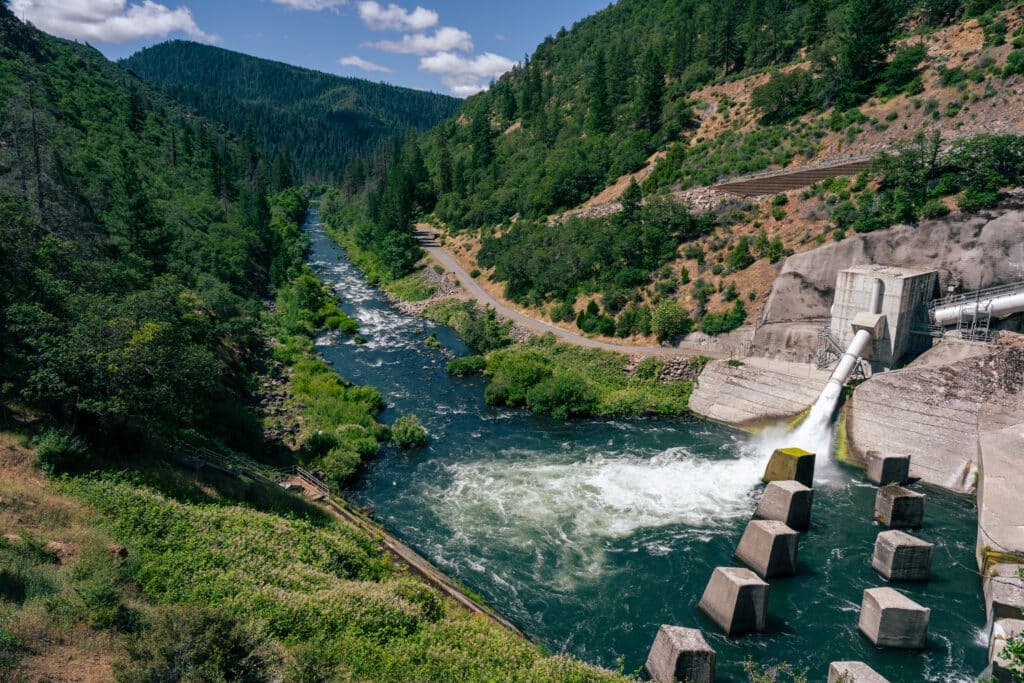
Pacific Gas & Electric’s dam and powerhouse system, begun around 1920, captures that richness and amplifies it. Water pulled from the cool depths of each reservoir re-enters the canyon below each dam, maintaining temperatures that insects and trout both require through California’s hot summers. The result is a river that behaves more like a fertile limestone spring creek than a freestone mountain stream—except that it runs through volcanic basalt at a gradient that will challenge every belief you have about your wading ability.
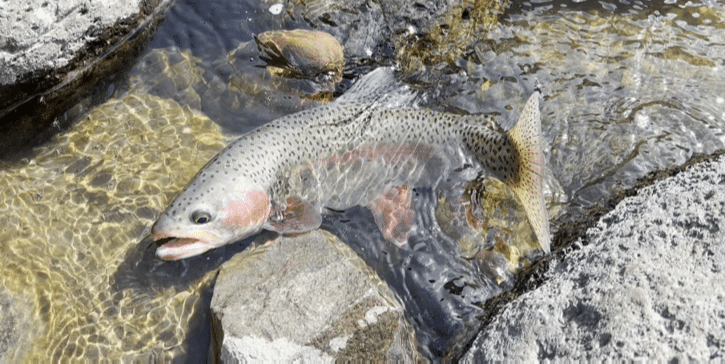
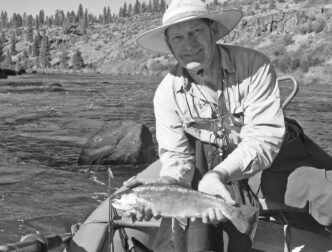
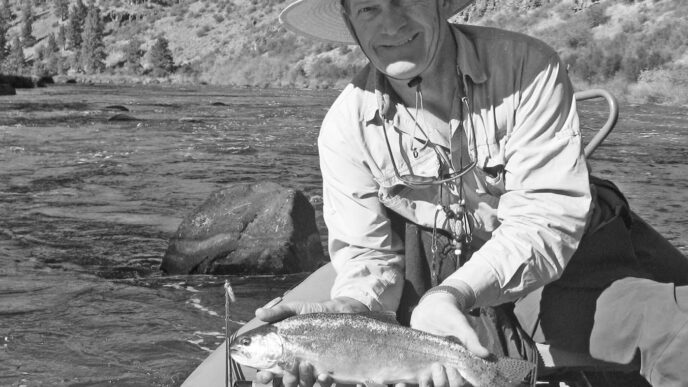
The Pit River rainbow is the native fish of this system, and while years of hatchery supplementation have complicated the genetics below Pit River Falls, what lives in the canyon sections is wild and shaped by the water. These are stout, deep-bodied fish, thick through the shoulder in a way that reflects a lifetime of holding position in strong current. The same hydraulic force that will make your legs burn after an hour makes these fish exceptionally powerful. A 15-inch Pit River rainbow in fast water does not fight like a 15-inch fish. It fights like whatever it needs to fight like to make you question your equipment.
Sculpin are the Pit’s most abundant fish—not rainbows—and their presence matters to anglers more than most realize. The Pit sculpin population sustains a population of trout oriented as much toward protein-rich baitfish as toward surface and subsurface insects. So, from a fly-fisher’s perspective, consider the Pit a river that rewards pattern diversity.
The Canyon in Sections
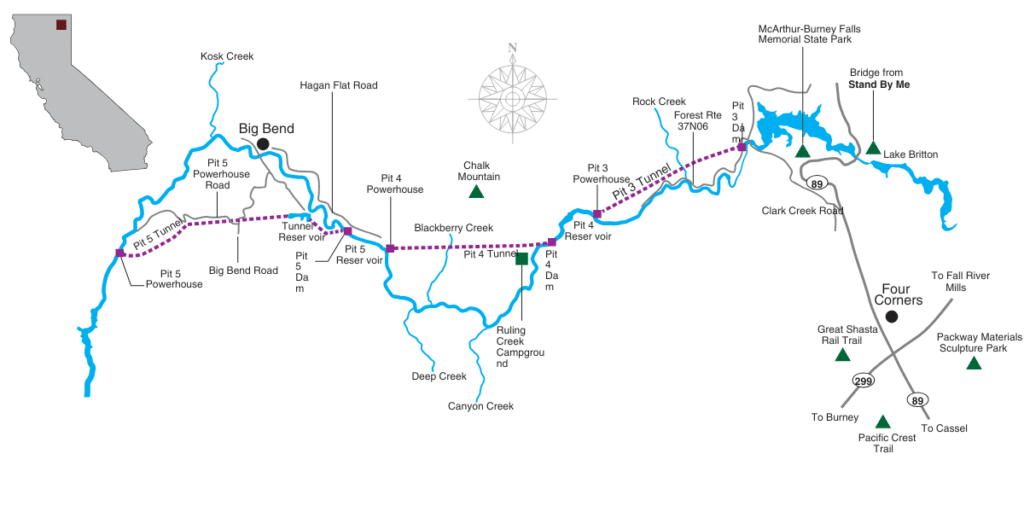
The fishable canyon extends more than 30 miles below Lake Britton, divided by the powerhouses into sections that each fish differently enough to deserve individual attention.
Pit 1 is the orphan of most trip reports, overlooked in favor of the more celebrated canyon water downstream. That neglect is its greatest asset. The stretch between the Pit 1 Powerhouse and the Hat Creek confluence fishes best in spring and fall, when flows moderate and the trout that winter in the deeper water move into more accessible lies. Pontoon boats and inflatables open up miles of water that wade anglers simply cannot reach—and that almost no one bothers to float. If solitude on productive water is your measure of a good trip, Pit 1 delivers it more reliably than anywhere downstream.
Pit 3, below Lake Britton Dam, is where the river earns its reputation. The staircase below the dam drops you into the canyon with a certain finality—there is no casual entry here, and the walk back out at day’s end will register in your legs the following morning. For the first three miles below the dam, the road stays high above the river, and there is no comfortable way down; at Rock Creek, it finally descends, and from there to the Pit 3 Powerhouse, the river is approachable. Regulations here are the most restrictive on the system: artificial lures and barbless hooks only, year-round, with a two-fish limit, minimum of 18 inches, during the open harvest season. Most anglers release everything. The regulations exist because the fishing is worth protecting.
Pit 3’s edges deserve attention that visiting anglers often neglect. The impulse is to wade toward the loud, channeled center—the water that looks most obviously “fishy”—but the productive lies at Pit 3 are frequently in the slower, darker margins where the current wraps around structure and drops into shade. Hugging the bank, covering water within reach of your wading position rather than wading to reach distant lies, produces more fish than the heroic crossing most newcomers attempt.
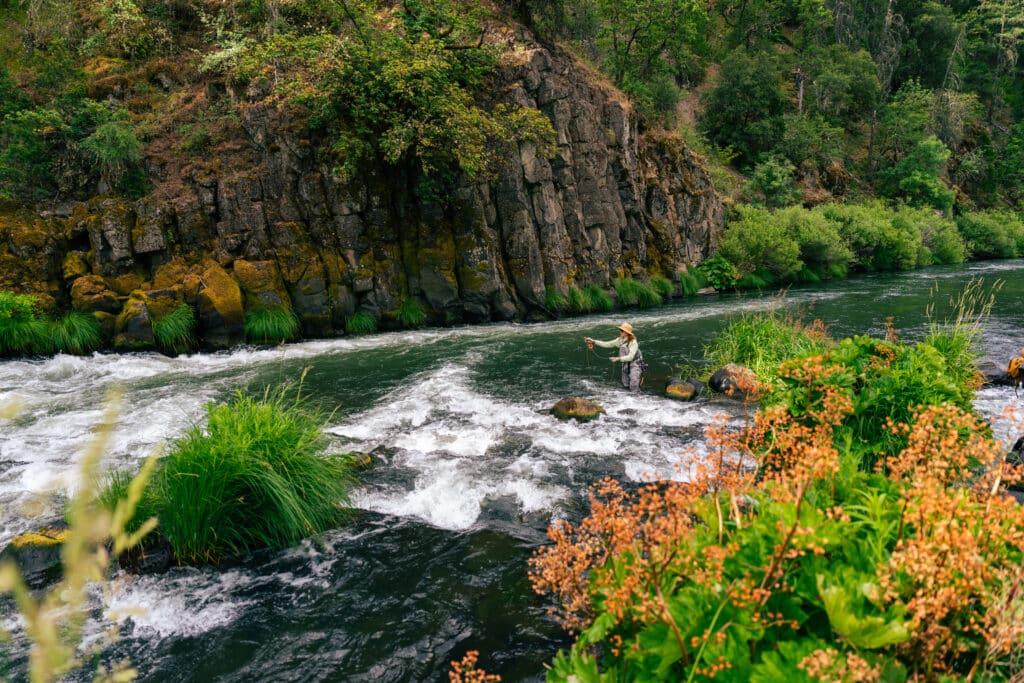
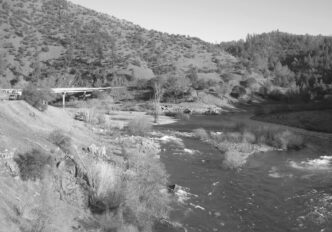
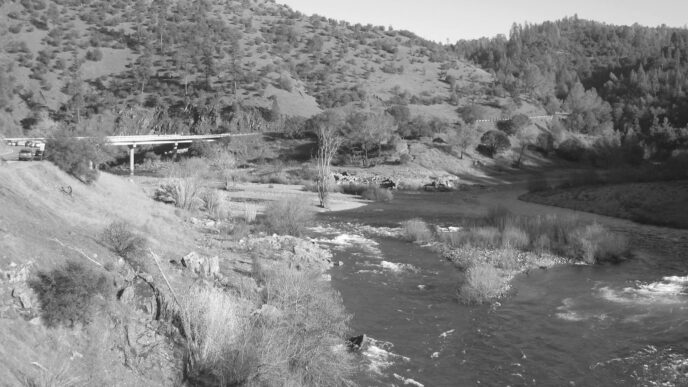
Pit 4 picks up below the Pit 3 Powerhouse and immediately feels different. The canyon here is wider, the gradient less severe, and the river spreads across a broader floor of basalt boulders. Tunnel Campground—named for the diversion blasted through the rock during dam construction, a piece of industrial history now colonized by cottonwoods and anglers—marks one of the most consistently productive access points on the river. The pools in this section have become prime trout water since the increased flows pushed rough fish out of the deep habitat; if you’ve been fishing Pit 4 since before the relicensing, you may need to recalibrate your expectations about where the fish are holding.
The middle reaches of Pit 4, where the road climbs away from the river and access requires real commitment, are worth the effort for anglers willing to hike in from Deep Creek Campground on the river’s opposite bank—a longer approach but one that opens up water most canyon visitors never see.
Pit 5 is where the fish are largest. The section below the Pit 5 Dam offers some of the deepest, most productive pools in the system, and the largest fish reliably come from here. The canyon widens approaching Big Bend, which paradoxically makes this bigger water more manageable to wade in places than the narrower, more constricted reaches upstream. Access is the price: Private land and rough terrain limit entry points, and the standard approach is to commit to a stretch and work it carefully rather than covering ground.
Few anglers speak much about Pit 6 and 7, which may be part of their appeal. They lack the notoriety of the upper canyon reaches, but offer something increasingly rare in California fly fishing: water where solitude still comes easily. Perhaps that is the quiet lesson of the lower Pit. Not every meaningful stretch of river announces itself with dramatic rises or famous riffles. Some waters ask only that you slow down long enough to notice them. The lower Pit may never inspire the folklore of Pit 3 or Pit 4, but rivers do not lose their worth simply because fewer people talk about them.
Wading: An Honest Assessment
The Pit River’s high pH—the same alkalinity that drives its insect production and gives the water that characteristic green clarity—promotes algae growth on every submerged surface. This is not negotiable, and it cannot be managed away. Studded felt or rubber soles are what the river demands. A wading staff is not a sign of caution; it is the practical difference between fishing and swimming.
The post-relicensing flow increases have changed the wading calculus in ways that surprised regular anglers. The additional volume scours algae from boulder surfaces that were previously slimy and opaque, and the improved water clarity makes depth judgment possible in ways it wasn’t before. The river is still demanding. It is no longer quite the harrowing experience that old accounts—many written before 2013—describe. Anglers who were chased off by the pre-relicensing wading conditions may find the current river more approachable than they expect, without being easy.
What the increased flows have clarified is where not to wade. The heavy, channeled water in the middle of most runs is simply not fishable at current levels for most anglers. This is not a limitation—it is useful information. The productive edges, the slower water along the banks and in the shadows of large boulders, now hold more fish than they did at old flows. And, as I previously mentioned, standing close to the bank and covering water within reach outperforms any attempt to reach the center. A longer rod—a 10-foot or longer 3-weight, or a Tenkara rod on the more intimate pocket water—converts the wading limitation into a tactical asset.
Remember to check flows before any trip. PG&E maintains a release schedule, and freshet releases—flows raised to between 1,200 and 1,500 CFS for 21 days every other year to scour the river—occur unpredictably through winter and spring. Do not fish the Pit without knowing what the river is doing. And do not fish the remote sections alone.
A Year of Hatches
The Pit rewards anglers who treat it as a hatch river rather than simply a nymphing destination. Its insect production is extraordinary—a function of alkalinity, stable temperature, and the tributary richness of the rivers that feed it—and the hatches across a full season offer fly fishing that rivals anything in Northern California.
March and April bring the river’s most underutilized opportunity. Blue-Winged Olive hatches on sunny afternoons, particularly between 11 a.m. and 2 p.m., when canyon shadow has retreated enough to warm the water surface, produce some of the most technical and rewarding dry fly fishing the river offers. The fish become genuinely selective. A size 18 Sparkle Dun or CDC BWO on a 6X tippet, presented without drag to a rising fish in clear, cold water—this is spring creek fishing in a canyon, and almost no one is doing it. The anglers who fish the Pit in March are fishing a different river than the one most visitors know.
May and early June belong to the stoneflies. The giant salmonfly hatch is the Pit’s signature event—large, orange-bodied insects emerging sporadically from the canyon’s rough water, triggering a surface response from fish that have spent winter tight to structure. Trout that haven’t tilted toward the surface in months suddenly appear, eating insects that can be an inch and a half long, and the visual fishing is as dramatic as anything in the state. The hatch is not reliable by the clock—it follows water temperature and canyon exposure, so reading conditions matters more than reading a calendar—but the window from mid-May through early June reliably produces days that anglers describe for years afterward. Large foam imitations in sizes 2 through 6, drifted close to the banks where emerging insects concentrate, are the correct approach.
The golden stonefly follows immediately, overlapping with the tail end of the salmonfly emergence. This is often more fishable—more predictable, with better dry fly action spread across a longer daily window—and some regulars, myself included, prefer it to the salmonfly spectacle.
Summer shifts the productive hours toward the edges of the day. Morning sessions before the canyon heats reward the early riser; nymphing the pocket water through midday still produces fish, but requires patience and a willingness to cover water systematically. The evening caddis hatch is the summer’s reward. As canyon shadow advances toward the river and light leaves the water, caddis flies lift from the surface in numbers that build toward genuine feeding frenzies. Fish that have been neutral through the afternoon come alive. An Elk Hair Caddis or X-Caddis in sizes 14 through 16 drifted through the seams in failing light—this is the Pit’s evening offering, and it is reliable enough to plan around.
Fall is the season that keeps regulars coming back. October Caddis—large, orange-bodied, visible from yards away—draw fish to the surface through October in a final productive run of dry fly fishing. A size 8 or 10 orange Stimulator is the standard tool. Slate Drake hatches in the same period add a mayfly option on the right water. The crowds have evaporated by October; the canyon is quieter, the light lower, and the fish are feeding aggressively before the cold descends.
Winter belongs to the midges and the patient. Sizes 20 through 24 larva and pupa patterns take fish through the cold months; dress accordingly and expect to have the river mostly to yourself.
Technique: What the River Rewards
Nymphing remains the groundwork for success on the Pit. High-stick nymphing—Czech-style, meaning a short-line with the rod held high to manage contact through fast pocket water—is ideally suited to the Pit’s character. The technique requires an angler to fish close, positioned within a rod length or two of the target lie, and then drift flies through defined lanes rather than casting to general water. A size 4 to 8 golden stonefly nymph is the year-round anchor; caddis larvae and pupae in sizes 12 to 16 cover summer and fall; green rock worm patterns—imitating the green sedge larva that thrives in alkaline water—are effective and underutilized. Baetis nymphs and Pheasant Tails in 16 to 20 cover the quieter times on the water. Rigging two-fly rigs at different depths is the standard practice.
Streamers deserve more attention than most visiting anglers give them. The Pit sculpin population sustains fish oriented toward larger prey, and a size 8 to 10 Muddler Minnow or Sculpzilla worked along the edges and through pool tailouts produces strikes from fish that have learned to hunt. In the deeper pools of Pit 4 and 5, it may be the most efficient way to locate and catch larger fish.
Dry flies, as outlined above, are available across the season to anglers willing to be present for the right conditions rather than defaulting to nymphing because it’s familiar. The Pit is not primarily a dry fly fishery, but the anglers who treat it as one, at the right time, are often rewarded for their patience.
Why You Should Go
The canyon will fight you. The trout will humble you. Go anyway.
There is a moment—and every angler who has ever stepped into the Pit River knows it—when confidence gives way to consequence. You are midstream, thigh-deep in heavy current, balanced uneasily on a slick algae-coated boulder, staring into a dark seam 20 feet away where a trout has just broken the surface. Your wading staff is planted. Your pulse rises. The question is no longer whether the fish is feeding—it is. The question is whether you can cast to it without losing your footing.
Welcome to the Pit.
Flowing through a rugged volcanic canyon in remote Northern California, the Pit is widely regarded as one of the finest wild trout fisheries in the West—and unquestionably one of the most physically demanding. Roughly six hours from San Francisco and far removed from more forgiving California trout streams, the Pit offers no easy water. Its current pushes hard. Its footing borders on treacherous. The algae-slick basalt rocks have humbled more than a few experienced anglers. Guides familiar with every major trout river in the state routinely describe the Pit’s wading difficulty as an “11 out of 10.”
They say it with admiration.
Because despite the challenge—or perhaps because of it—the Pit occupies a near-mythic place among serious fly fishers. Rivers like Hat Creek, Fall River, and even the McCloud can be technical, but they remain approachable. The Pit is different. It demands concentration from the first cast to the last step back to shore. It rewards preparation and punishes complacency. In return, it offers trout perfectly suited to the river they inhabit: thick, muscular rainbows forged in fast water and strengthened by relentless current.
Every fish hooked in the Pit feels connected to the river itself. Trout do not simply run; they surge with purpose, using the current as leverage and weapon. Even modest fish fight with startling power. Larger rainbows seem determined to reach the next canyon downstream.
The canyon itself helps preserve the experience. Long stretches of difficult terrain discourage casual traffic, leaving anglers willing to make the effort with something increasingly rare in modern fly fishing: solitude. On many days you can spend hours moving through pocket water, riffles, and emerald-green runs without seeing another person. No drift boats. No crowded access points. Just moving water, volcanic stone, and the constant awareness that every step matters.
And then, inevitably, it happens.
A football-shaped rainbow turns on your fly, feels the hook, and instantly drives into heavy current—not in panic, but with intent. Downstream. Across seams. Into water you have no business trying to follow. In that moment—boots slipping, line tight, heart pounding against your chest—you finally understand the river’s hold on those who know it well.
The Pit does not offer comfort. It offers something better.
A challenge worth the reward.
If You Go
Regulations vary by section—check the rules for whichever stretch you plan to fish beforehand. For example, Pit 3 is artificial lures and barbless hooks only, year-round; Pit 4 and 5 requirements and those for the entire river can change year-to-year.
Nearest services are located in Burney and Fall River Mills. Local guides offer full-day trips on the Pit and can put you on fish safely in water you wouldn’t otherwise reach. From the Bay Area, expect a six-hour drive; from Redding, the canyon sections are roughly 30 to 45 minutes away.
Check flows before any trip—electric generation demands can shift releases without advance notice, and the river can rise quickly. Anglers need to be aware of this and have an exit strategy. Always fish with a partner, bring a wading staff, and never underestimate the speed of the current. Flows significantly above 300 cfs require knowledgeable judgment about which sections of the river are safe to fish.
Widely regarded as one of the state’s premier wild trout fisheries, the Pit is also one of the most physically demanding rivers you will ever wade. Yet for anglers willing to embrace its challenges, the Pit offers something increasingly rare: solitude, wild fish, and water that still feels untamed.
What’s in a Name?
Three Eras of a River That Keeps Reinventing Itself
The name seems almost too simple for a river this complex. No Spanish explorer christened it. No gold rush prospector attached his surname to its canyon walls. The Pit River takes its name from holes in the ground—and, like most things connected to this river, the story runs deeper than it first appears.
The River People
Long before outsiders reached the volcanic plateau of northeastern California, the Achumawi had built their lives around the river they called Achoma. Their very name—Achumawi—translates to “river people.” It was not merely where they lived; it was the force that shaped their culture, movement, survival, and spiritual life. Villages lined the river corridor from Goose Lake downstream through the canyon country. Canoes moved between settlements. Salmon, trout, and suckers sustained entire communities. Dip nets, basket traps, spears, and gill nets worked the water in every season, while ceremonies and fasting rituals reflected the belief that healthy fisheries required both stewardship and respect.
The “pit” itself referred to the ingenious hunting traps the Achumawi dug along game trails near the riverbanks. Covered with branches and brush, these deep excavations captured deer, elk, and pronghorn coming to water. Early settlers saw the traps and named both the people and the river after them. In time, the original name—Achoma—faded from maps, replaced by a name rooted not in geography, but in the evidence of human ingenuity and survival.
The Industrial Era
By the early twentieth century, a second era arrived. What the Achumawi viewed as a living river, engineers from Pacific Gas & Electric saw as untapped power. The Pit watershed drains nearly 5,000 square miles of volcanic country, and the river’s steep elevation drop through the canyon made it ideal for hydroelectric development. Construction on the Pit 1 Powerhouse began in 1919, and when it came online in 1920, it was the largest hydroelectric facility in the United States. Additional projects followed—Pit 3, Pit 4, and eventually Pit 5 during World War II as California’s demand for electricity surged.
Massive tunnels bored through solid basalt rerouted the river around long stretches of its natural canyon. Flows below the dams were drastically reduced, leaving portions of the Pit diminished and heavily coated in algae. Yet in one of the great ironies of western fisheries, the cold, regulated releases from reservoir depths created ideal conditions for aquatic insects. The river became extraordinarily fertile. Trout thrived in the nutrient-rich water, growing thick, strong, and abundant inside a system originally engineered not for fish, but for electricity.
The Restoration
The modern Pit River is the product of a third era—restoration. During the Federal Energy Regulatory Commission relicensing process in the late 1990s and early 2000s, agencies, conservation groups, and PG&E negotiated sweeping changes to canyon flows. Minimum releases were significantly increased, seasonal flow variation was restored, and habitat improvements, such as gravel replenishment and woody-structure projects, reshaped sections of the river. The increased flows also improved wading conditions by scouring algae from many of the canyon’s slick basalt rocks.
Today’s Pit River exists as a convergence of all three histories. It remains Achumawi homeland. It remains one of California’s most important hydroelectric systems. And it has evolved into one of the West’s most distinctive wild trout fisheries. The thick-bodied rainbows that hold in its fast seams are products of cold water, volcanic geology, engineered flows, and decades of recovery.
Few rivers in California reveal their history so completely to those willing to step into them.





Just an observation in the article. The McCloud does not flow into the Pit above Lake Briton. Maybe you meant Burney Creek (along with Hat and Fall)?
Great article though. I was just up there this past weekend. Fishing was spectacular on #4 as usual.
Thanks for your comment. While the McCloud River is geographically separate, hydrologically, it is the largest tributary of the Pit River.
Before Shasta Dam was built, it flowed directly into the Pit. Today, the PG&E’s McCloud-Pit Hydroelectric Project diverts flows through tunnels to Iron Canyon Reservoir which releases into the Pit above Pit 6.