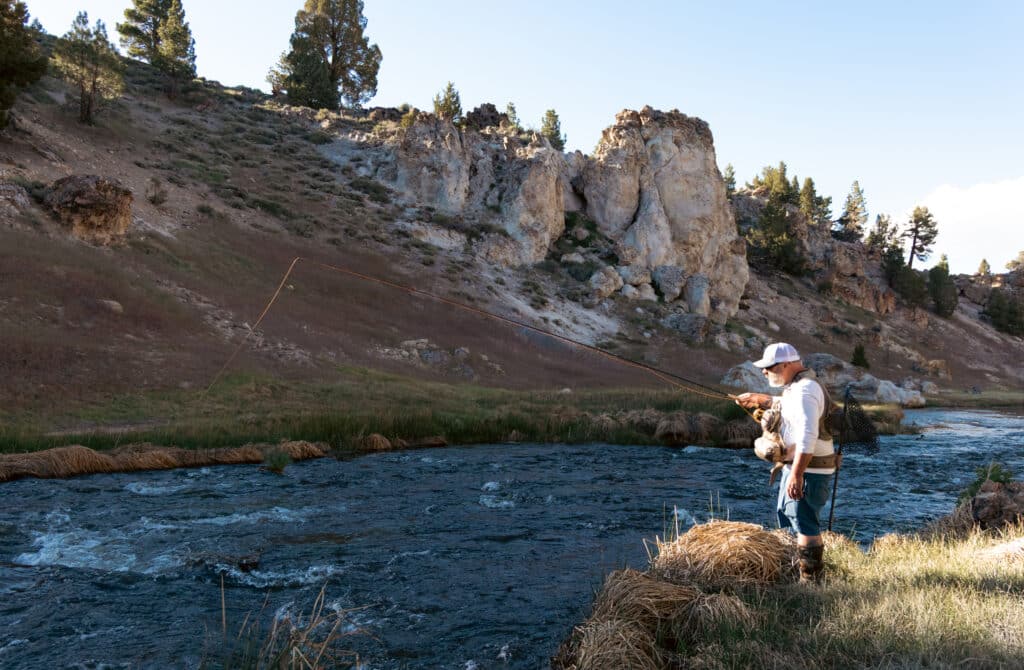
To be honest, I don’t particularly enjoy fishing Hot Creek. The tiny flies, the short drifts, and the educated (though giant) trout. I’ll chalk it up to a skill issue more than anything, because there are folks like Chris Leonard, a local guide and advocate for the Eastern Sierra angling community, who can get this amazing stream to cooperate with them to an extraordinary degree.
“If I had one day left on this planet,” says Leonard, who counts Hot Creek as his home water, “I would spend it fishing at Hot Creek. I’ve fished it countless times, guided it countless times, and taught kids how to fish there. It’s a place I could write books about.”
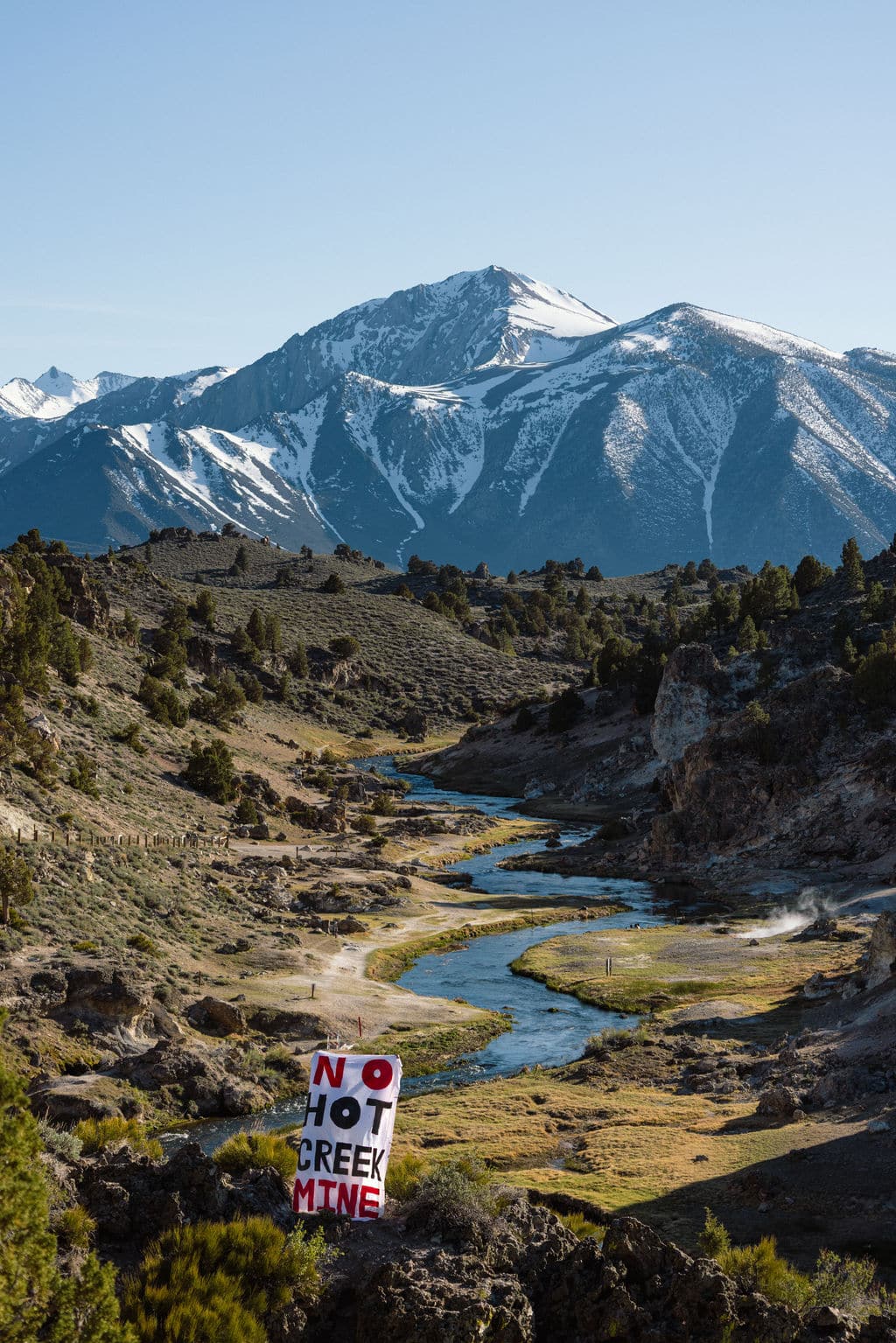
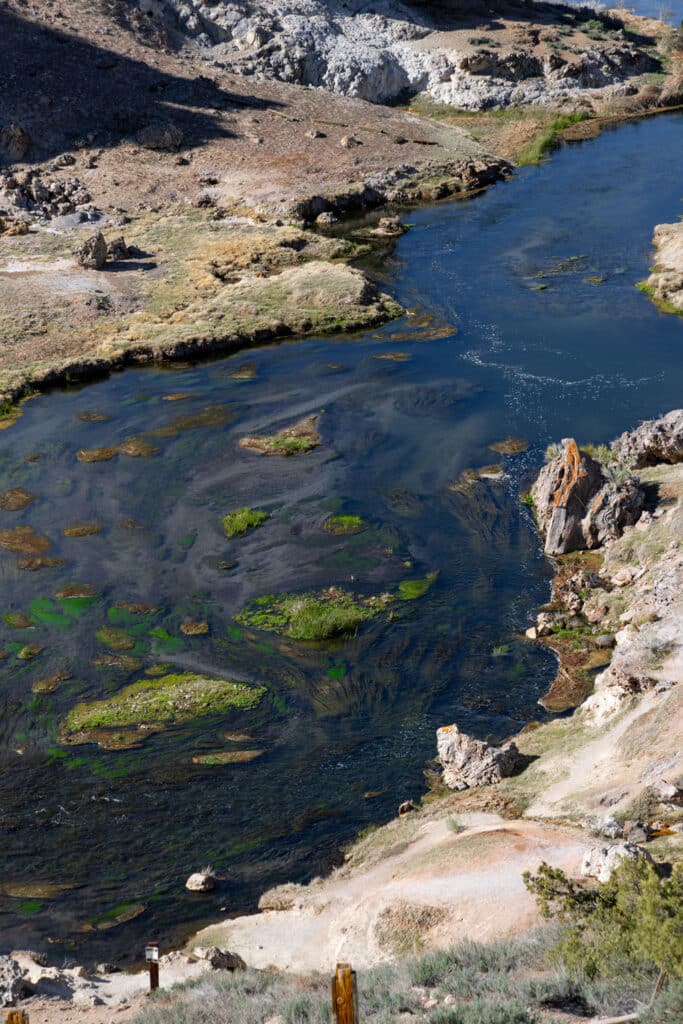
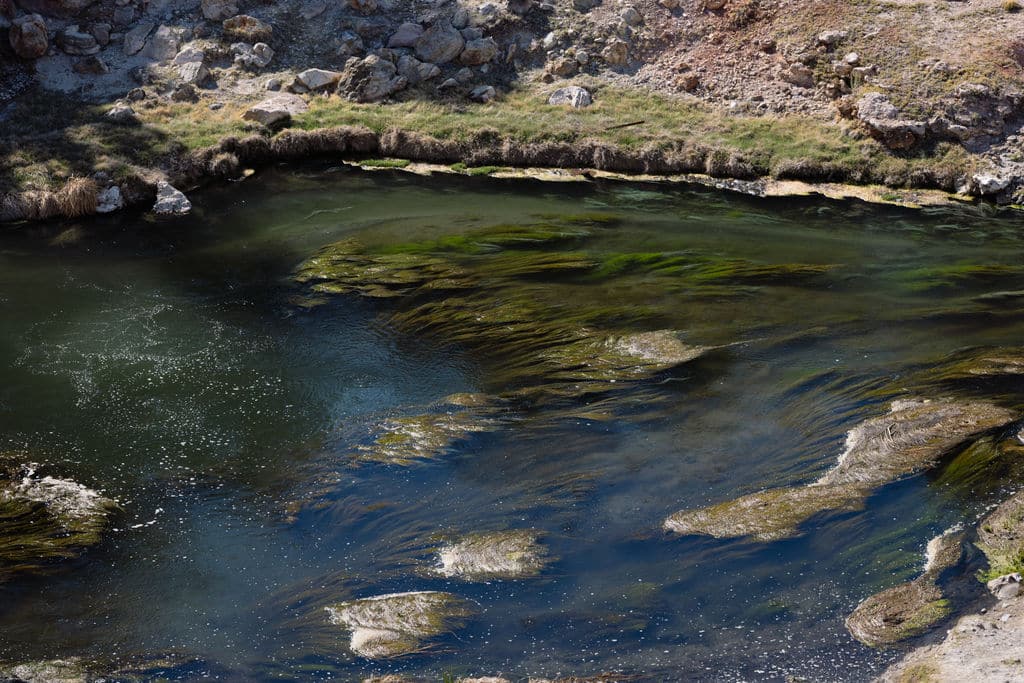
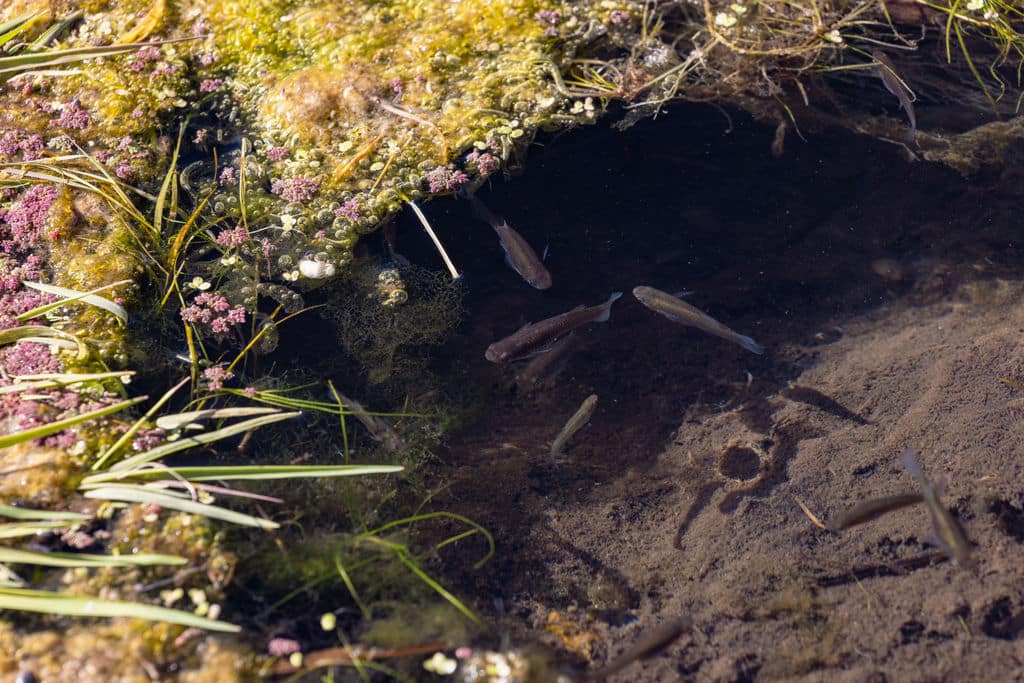
While I may not enjoy fishing Hot Creek all that much, I love sitting on its banks and taking in the world. I’ve spent many hours watching 20-inch browns sip flies from the safety of their lies on the heavily vegetated streambed. I’ve seen the trials and triumphs of anglers cutting their teeth on this renowned trout stream, and families in awe as the short hike down the hill from the Geologic Site parking lot rewards them with a miniature version of Yellowstone. From a grassy spot at the bottom of the canyon, I’ve watched my daughter race up and down the bank, amazed as the area’s geothermal activity pushes countless bubbles from the mud of the stream channel to the surface.
What I’ve never seen amid the splendid views and unique features of this stream—and what I don’t want to see or hear as I drink my coffee in the quiet of the morning from the edge of Hot Creek—is a gold-mining operation. Unfortunately, that is the reality. One of California’s most cherished fly-fishing sites is again under threat from exploratory mining.
This is how we got here.
Unique Geology, Prolific Fishery
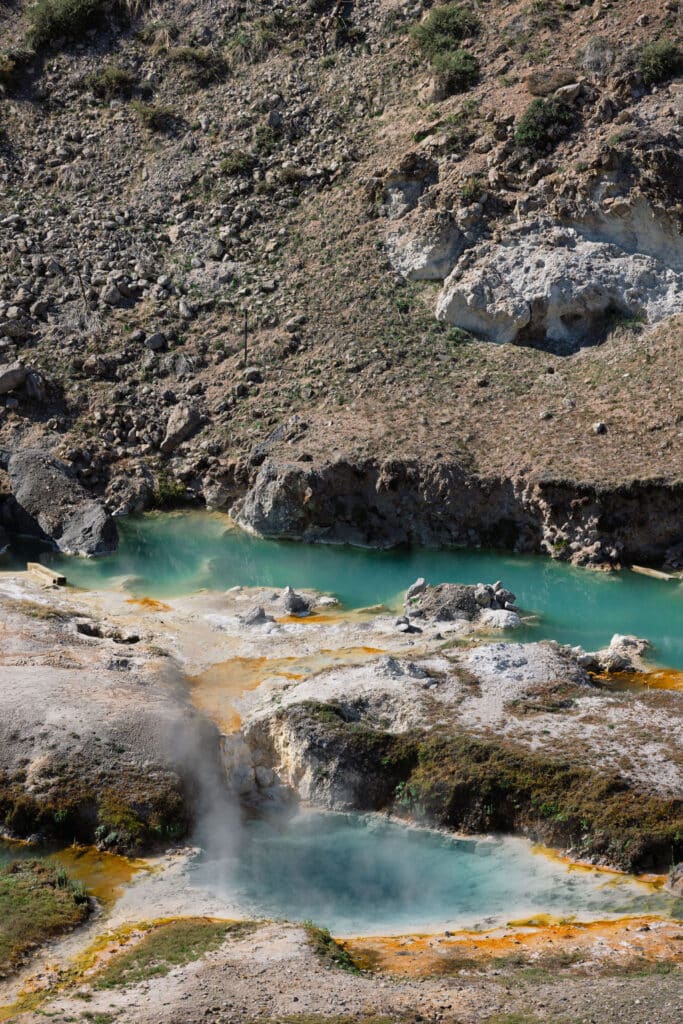
Hot Creek lies within the Long Valley Caldera, which covers roughly 200 square miles in the Eastern Sierra. The stream actually begins as Mammoth Creek and flows through the town of Mammoth Lakes before crossing under Highway 395. There, it receives input from several hot springs and assumes the identity by which anglers around the world know it. Roughly 10 miles downstream, it flows into the Upper Owens River, eventually feeding Crowley Lake. The majority of the land surrounding Hot Creek is public, primarily managed by the United States Forest Service (USFS).
Due to its geothermal inputs, Hot Creek maintains consistent year-round temperatures of 52-60 degrees. The temperature is so ideal for trout growth that the California Department of Fish and Wildlife (CDFW) constructed a hatchery on Hot Creek in the early 1900s. As a direct result of its unique geology and hydrology, Hot Creek produces many trout, many of them trophy-size. According to a CDFW electrofishing survey in 2025, Hot Creek boasts an average of over 6,350 brown trout per mile. As a volunteer on that survey, I personally witnessed a massive 27-inch brown emerge from its perfectly hidden lie under the streambank.
CDFW recognized Hot Creek’s singular quality as a trout fishery by designating it one of California’s Wild and Heritage Trout Waters. This designation requires that the trout and the fishery be managed specifically to conserve the special value they have to anglers.
KORE Mining and the Long Valley Exploration Project
For years, Hot Creek has been threatened by a proposed exploratory gold-mining project located a third of a mile from its banks. Mining is nothing new in the Long Valley Caldera. Gold was first discovered in the 1980s as a byproduct of Standard Industrial Minerals’ kaolinite clay mine. This sparked a wave of exploratory drilling in the area in the 1990s. The last project ended in 1997, and since then the mining claims have changed hands in a convoluted manner common among junior exploratory mining companies.
Fast-forward to 2017, and KORE Mining, an exploration company based in British Columbia, secured ownership of the Long Valley claims. After collecting surface samples and conducting surveys, they produced a Preliminary Economic Assessment in 2020, which concluded that a full-scale mining operation would be profitable when gold is at or above $1,600 an ounce. The time was right to strike, and KORE subsequently applied to the Forest Service for permits to begin drilling.
KORE Mining specializes in exploration projects. Their job is to find gold, and when they do, they sell the claims and the project to a larger operation that will develop the full mine. The permitting processes for exploratory mining projects and full mine development differ. It is important to note that the Hot Creek mine is still in the exploration phase.
For Hot Creek, this exploration phase, as proposed, entails constructing up to 12 drill pads, with each pad supporting up to four core borings. These borings could be drilled as deep as 1,400 feet below the surface and may use directional drilling (drilling at an angle). In addition, access roads will be created or modified to facilitate the transport of equipment and materials.
KORE first submitted its proposal for exploratory drilling near Hot Creek in 2021. This proposal received a fairly superficial analysis through a process known as a categorical exclusion by the Forest Service, and it was released for public comment later that year, prompting a resounding outcry of opposition. Thousands of people and numerous organizations submitted letters urging the agency to deny the permit for the project. Concerns included disturbance of habitat for bi-state sage grouse, visual impacts, the creation of new roads, and the degradation of water and habitat quality in Hot Creek.
This remains the primary concern for Trout Unlimited, the Crowley Fish Foundation, local guides and fly shops, and the angling community more broadly. The hydrology of the area around Hot Creek remains largely a mystery. The geology of the Long Valley Caldera is complex, with highly porous substrates. We don’t have a clear understanding of how water moves beneath the ground here. Given the depth to which KORE may drill, as well as the potential for them to drill sideways, it seems plausible—if not likely— that the project could diminish flow in Hot Creek or introduce new geothermal inputs that could heat the creek to lethal levels for trout.
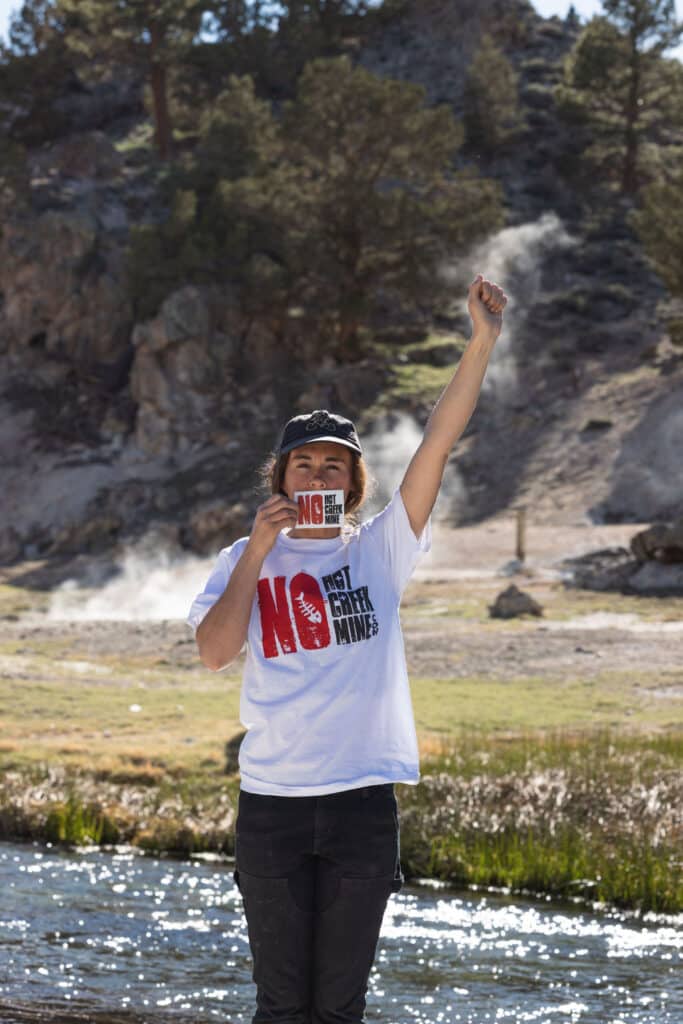
When KORE’s initial proposal came to light in 2021, it drew opposition from people and businesses across the Eastern Sierra. Almost immediately, a local advocacy group formed under the name No Hot Creek Mine. The group educated and organized local residents, including anglers, ranchers, environmentalists, and business owners, and hosted protests and demonstrations against the drilling proposal.
“During the first proposal, we issued a call to action on social media for folks to call and write to the local Forest Service office,” Emily Markstein, co-founder of No Hot Creek Mine, recounts. “Within an hour of the action alert going out, so many people contacted the Forest Service that their phone lines and email system were overloaded and crashed.”
Despite vocal opposition from anglers, the Mammoth community, and local and tribal governments, the Forest Service approved the project in 2022. Late-season snowfall that year delayed the start of drilling. The Sierra Club, Friends of the Inyo, Western Watersheds, and the Center for Biological Diversity filed a lawsuit to halt the project. The Forest Service’s approval was upheld in district court, but the plaintiffs appealed, and the appeals court found that the Forest Service had misapplied its authority under the National Environmental Policy Act. The permit for the project was subsequently revoked.
Since then, the price of gold has skyrocketed, reaching more than $5,000 per ounce in early 2026. Nothing was stopping KORE from returning with a new proposal in an even more lucrative and permissive environment. Advocates for Hot Creek knew there was precious little time to prepare for the next attempt.
Hot Creek is Outstanding
In July 2025, I found myself in a conference room at the Bishop Fairgrounds, testifying in support of an Outstanding National Resource Water designation for Hot Creek. Trout Unlimited had submitted a formal proposal to the Lahontan Regional Water Quality Control Board to confer this designation on Hot Creek, which would permanently protect water quality and values, such as fishing, associated with a water body’s unique water quality characteristics. More than 500 anglers and other parties submitted letters of support for this proposal. If the board voted in favor, staff would begin the process of promulgating the designation. While the vote passed, the Water Board was able to contribute only a modest amount of resources toward it, given limited capacity and other important work, such as the currently underway Tribal Beneficial Use.
Outstanding National Resource Waters, often referred to as ONRWs, are designated by state water authorities under a provision of the federal Clean Water Act to protect unique waterbodies with high ecological or recreational values.
“The ONRW designation is a powerful tool that can be used to protect some of our state’s most pristine waterways,” says Matt Clifford, TU’s California State Director. “Hot Creek, with its world-class fishery supported by unique volcanic geology, is exactly the kind of stream that ONRW is designed to protect. We’re working with California agencies to secure these protections for Hot Creek and several other threatened California streams that qualify for this designation.”
Once a water body is designated an ONRW, land uses that could significantly and chronically degrade its water quality would be prohibited. California currently has two designated ONRWs: Lake Tahoe and Mono Lake. Both fall under the jurisdiction of the Lahontan Water Quality Control Board. These two waterbodies were designated through different processes, and there is currently no statewide, standardized formula for creating new ONRWs. Given the crucial importance of water quality for trout and salmon—and California’s commitment to protecting 30 percent of its lands by 2030—Trout Unlimited, California Trout, Tribes, and other conservation groups are working across the state to secure ONRW designation for deserving waters. The water boards responsible for these regions are working to establish a process for ONRW designation, but progress takes time. In the meantime, the prospect of a large-scale open-pit gold mine a stone’s throw from Hot Creek remains a possibility.
Permitting Reform: The “New” Proposal
In March 2026, the Mammoth Town Council learned that the Forest Service had received a new proposal for exploratory drilling at the same site near Hot Creek. Chris Bubser, town councilmember and former mayor of Mammoth Lakes, was at the meeting.
Chris was a driving force behind opposition to the 2021 proposal and the most recent attempt. She recounts,
“After the entire community,
local governments, and three federal judges
rejected the project, I couldn’t believe
we were doing it again.”
In April, the District Ranger for the Inyo National Forest confirmed that KORE Mining had returned and resubmitted its permit application for the proposed exploratory drilling project.
Over the past year, there have been major changes to the regulations and guidance that govern agencies’ implementation of the National Environmental Policy Act (NEPA). Among the most significant of these changes are an expansion of projects that qualify for “categorical exclusions” from comprehensive technical analysis and a shortening or elimination of the law’s requirement that the public be given an opportunity to review and comment on proposed actions. In contrast to the two other processes under NEPA, environmental assessments and environmental impact statements, categorical exclusions assert that there will be minimal impacts to the environment and are a useful tool for routine projects like road maintenance. Anyone familiar with Hot Creek will know that this proposal is anything but routine.
The Inyo National Forest has a long and honorable record of partnering with groups such as TU to restore and enhance trout habitat and fishing opportunities. However, the current federal administration’s directive to prioritize resource development on public lands weighs heavily on project decisions such as KORE Mining’s proposal. Unfortunately, the Forest Service intends to approve the Long Valley exploratory drilling project under a categorical exclusion and will not accept any public comment on the decision. By the time this issue goes to print, KORE Mining is likely to be breaking ground at the drill site.
What We Stand to Lose
Hot Creek is not only one of California’s most treasured fishing destinations but also a contributor to the regional economy. According to a 2008 economic assessment, 69.7 percent of visitors to Mono County are there for outdoor recreation, and 39 percent come specifically to fish, contributing a total of $517 million in visitor spending. Data from the California Employment Development Department show that leisure and hospitality provide 3,960 jobs in Mono County, compared with 450 employed in the combined mining, logging, and construction industries.
Yet the people who rely on Hot Creek, not only for recreation but also, for many, for their livelihoods, have heard the message loud and clear: The profits of a Canadian mining company outweigh the needs of those who live there.
Wrong Place for a Gold Mine
While it’s true that the technical fishing on Hot Creek may not be for everyone, the site is uniquely beautiful and offers exceptional trout habitat. Over the past century, we’ve lost much of the habitat for trout and salmon to development. Now, the warming climate is putting even more pressure on the cold-water environments that salmonids require. We need to protect the best trout waters we have left.
Extracting subsurface minerals remains a necessary part of modern life. But some places are simply more valuable for their natural, cultural, and recreational values than for their precious metal potential. Bristol Bay, the Alaskan headwaters of the world’s greatest sockeye salmon run, is one such place. Hot Creek is another.
“Hot Creek is too important to generations of California anglers for a mining company to risk,” TU’s Matt Clifford says. “We’re working to implement a solution that permanently protects its unique geologic and scenic value as well as its excellent fishery.”
Dan Johnson is Trout Unlimited’s California and Nevada Public Lands Manager. To learn more about how you can help protect Hot Creek, visit TU.org