The Sacramento perch (Archoplites interruptus) holds the distinction of being California’s only native sunfish. The sunfish, or Centrarchidae, is a family of freshwater fish that also includes more well-known species such as black bass, bluegill, redear sunfish, and crappie. The Sacramento perch is not only native to California but also the only member of the sunfish family naturally found west of the Rocky Mountains, making it unique among North American freshwater fish.
Sacramento perch evolved over millions of years to live in the lakes, slow-moving rivers, and sloughs of California’s Central Valley—their historic range, which included the Sacramento Valley, the San Francisco Estuary and its tributaries, and Clear Lake.
In the 19th century, they were plentiful enough to support a commercial fishery, providing fish for San Francisco markets, where they were popular among Chinese immigrants. Before that, Sacramento perch were a primary food source for Native Americans in the Central Valley.
By the end of the 19th century, Sacramento perch faced a sharp decline in their native range due to commercial fishing, habitat degradation in the Sacramento Delta, and especially the introduction of nonnative sunfish and carp, which consumed their eggs and preyed on their larvae. Fish biologist Peter Moyle concluded that “they simply could not compete with the nonnative sunfishes for reproduction.”
Fortunately, before they were extirpated from their native range, Sacramento perch were transplanted outside their native waters, mostly into alkaline, salty lakes where other nonnative sunfish couldn’t survive.
In the 1960s, they began to appear at Crowley Lake in the Eastern Sierra. In 1988, Department of Fish and Game fisheries biologist Curtis Milliron stated, “I can tell you that Fish and Game had nothing to do with bringing them to the Owens Valley, and we’re not too pleased about it.” At that time, many feared their spread would harm the Crowley Lake trout population.
If you’ve fished Crowley Lake in early summer, you’ve probably caught one while trout fishing: a hard take, then a heavy, dogged fight—not as zippy as a Crowley rainbow.
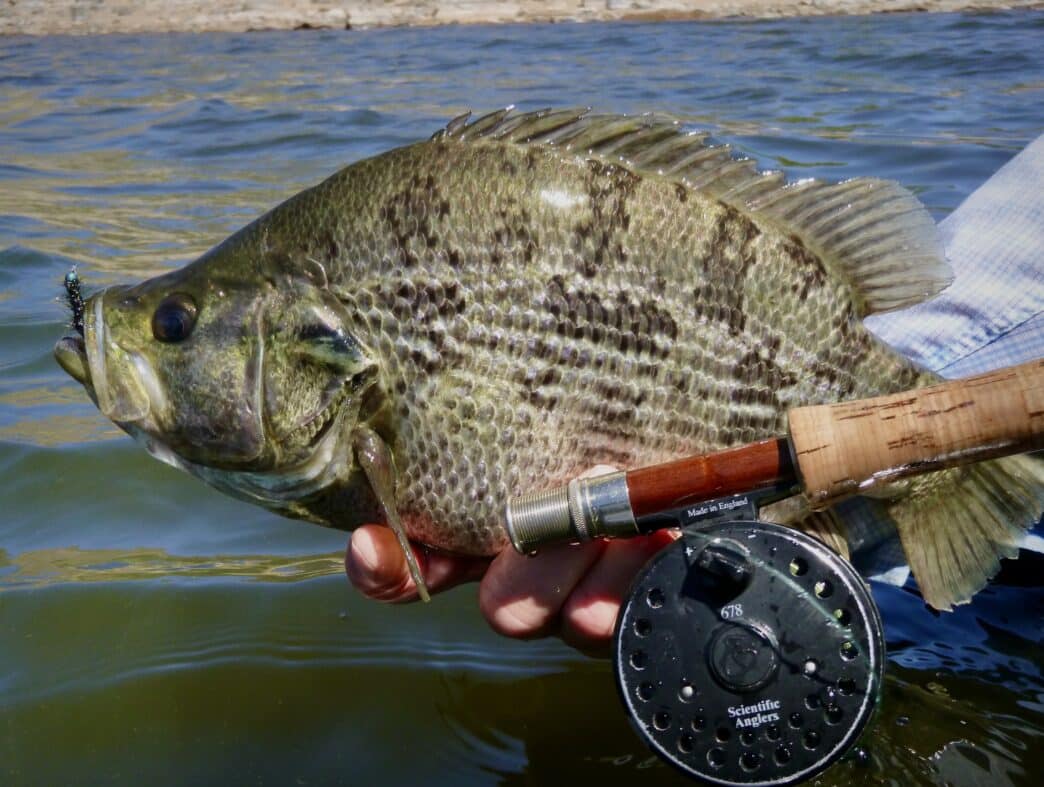
The Sacramento perch has a mouth like a crappie, dorsal spines sharp enough to puncture a float tube, and rough skin resembling rattlesnake hide, often with an iridescent purple or greenish tint. The broken barring pattern gives the fish its Latin name (interruptus) and sets it apart from other sunfishes.
Former longtime Crowley guide Tom Loe once told me that “the reason we don’t have any huge browns at Crowley anymore is that they eat the Sacramento perch and choke on ‘em when the spines get stuck in their throats.”
Whatever circumstances led to their transplanting, today the largest populations of Sacramento perch are found in two Eastern Sierra strongholds: Bridgeport Reservoir and Crowley Lake. In these alkaline reservoirs, they thrive, living up to nine years and often growing over 2 pounds. The California state record was caught at Crowley Lake in 1979, weighing 3 pounds, 10 ounces.
There are Sacramento perch enthusiasts at Crowley and Bridgeport who target them over trout—not for their fight, but because they’re good to eat. Known for their white, slightly oily flesh, they are praised for a mild flavor and flaky texture, often compared to bluegill or crappie. They’re a popular choice for fish tacos, and are also delicious when pan-fried with a light breading or baked with fresh herbs and lemon.
But reservoirs like Crowley and Bridgeport are vulnerable to sudden drawdowns, especially during drought, which can ruin spawning and degrade water quality.
In the spring of 1990, a low-water year, Crowley dropped below the Owens River channel, causing the river to spread into a delta and deposit sediment that increased mineral levels such as phosphorous and nitrogen in the lake. Curtis Milliron recorded a fish kill of 1,225 Sacramento perch, 57 rainbow trout, and 25 brown trout—an alarming total given the perch’s resilience.
Bridgeport Reservoir also has a history of fish die-offs caused by low dissolved oxygen during warm, dry summers. Even these strongholds are vulnerable.
Today, there are about two dozen waters outside their native range with established Sacramento perch populations.
According to the California Department of Fish and Wildlife (CDFW): “Sacramento perch is a species of special concern and now persists only as introduced populations in reproductively isolated waterbodies across California and sporadic locations in other western states.”
The CDFW has accelerated restoration efforts in recent years, focusing first on improving genetic diversity within remaining populations, then working to reestablish the species in its native range through collaboration with researchers and aquaculturists, including partnerships with commercial fish farms.
In 2022, Sacramento perch from Bridgeport Reservoir were stocked into Lindo Lake in San Diego County to establish a new population, but that program has been threatened by an illegal introduction of largemouth bass. That same year, a “genetic swap” between Bridgeport Reservoir and Biscar Reservoir in Lassen County was conducted to improve genetic diversity. Fish from both reservoirs were also transplanted into a pond in Yolo County, reestablishing a small population within the historic range.
In 2024, Sacramento perch were reintroduced to their namesake city when 3,000 juveniles were stocked into a pond at Sacramento’s Granite Regional Park.
Moyle commented that “Sacramento perch are a species that are always going to require continuous management because they simply cannot handle the interactions with nonnative fish.”
Thanks to the CDFW, that management effort is underway and looks promising for the future of Sacramento perch.