Truth is stranger than fiction, but it is because fiction is obliged to stick to possibilities; truth isn’t.
Mark Twain
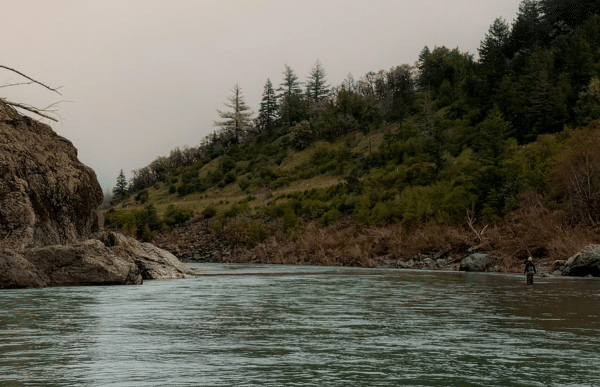
The text message was short and to the point. It said, “Help.” Tom, on the receiving end, was understandably perplexed. The message was from Roger, who was somewhere downstream, fishing in a secluded area of the Owens River known to locals as the Power Plant. The message was a cause for concern. Dave, Tom, and I had been searching for Roger for the past 15 minutes without luck, because it was time to leave. The last time I saw Roger, he had been happily fishing a shallow spot lined with willows and shielded from view from the path, so I wasn’t too worried. But Dave and I had been calling his name without any response, and accidents can happen on a trout stream. Especially at the Power Plant, named after an upstream power station that can, at any moment, release large amounts of water without warning.
Tom had gone back to the truck before us to see if Roger had quit early, and he fully expected to find Roger there with his feet up, holding a glass of bourbon and a cigar. But Roger was not at the truck.
The next thing that happened was even stranger. Tom’s phone buzzed again, and this time it was a call from Dale, Tom’s wife, who was in tears. She was in Kentucky. We were in California. “Are you OK?” she blurted out. “I got a call from Roger—he asked if I knew where you were!” With panic in her voice, she had replied to Roger, “What do you mean, where’s Tom? He’s out there with you! Is he lost?” Then the phone had gone dead, leaving her terrified. “Tom, why would Roger be calling me?”
It was an excellent question. Why indeed would Roger, fishing the Owens River in California, be calling Tom’s wife in Kentucky? Dale was certain that Roger must be calling to say that something bad had happened to Tom. But no, Tom was fine, just confused.
Of the four of us, Roger was the least concerned about catching trout on a fly rod. He loved doing it, like we all did, but it wasn’t the main reason he found himself wading in a stream surrounded by beautiful scenery. Roger was more of a connoisseur of life, and his interests were broader than ours, encompassing fine cigars, good bourbon, and an appreciation of the Kentucky legal system, which the rest of us couldn’t follow. He carried what appeared to be a fly-fishing satchel across his shoulders, but closer inspection would have revealed that most of the fishing gear had been removed to accommodate a fifth of Kentucky’s finest bourbon and a selection of Arturo Fuente cigars. On some occasions, the satchel even contained a laptop computer, for which no explanation was ever given. If that meant less room for things like fly boxes, that was fine with Roger. He was known to stop mid-stream to take a sip of bourbon to celebrate the trout he had just caught or, more often, the one he planned to catch later, and he would sometimes congratulate himself on reaching the trout’s habitat or even on leaving the house by lighting up a fine Cohiba or Padron.
But now he was lost, and it was to some extent my fault. I had organized this trip; Tom and I drove north while Roger and Dave drove south so that we met on the Owens River just upstream of Pleasant Valley Reservoir on a two-mile stretch of river between the Power Plant and the lake that’s normally just stuffed with fish.
Seeing that Roger was not back at the truck, Tom started walking downstream, where Dave and I were still searching for Roger along the paved pathway that parallels the river. We arrived at the same conclusion as Tom: Roger must have quit early and was already back at the truck. But when we looked ahead, there was Tom, out of hearing range but signaling with that universal shoulder shrug to indicate that he, too, was confused about what had happened to Roger.
At this point, I became truly worried. The trip was my idea, and I felt responsible for the group’s success and well-being, even though all of us were adults—at least by age—who supposedly knew what we were doing. I turned and headed back downstream, hurrying this time and calling Roger’s name louder than before. Roger is one of my three best friends—the other two being Tom and Dave—and he had also had some recent health concerns. The thought of him needing help somewhere downstream, to the point that he had used his cell phone to reach out to us, was troubling.
Dave looked at me, and I looked at him, and we took off running—definitely not a pretty sight with both of us in waders and in our sixties.
The willows were so dense that we couldn’t really see the river at all, so we made frequent departures from the main trail to get closer to the water and search for him at every pool and access point. Eventually, guided further downstream by the faint smell of cigar smoke, our shouting was answered: “Over here!” we heard Roger yell.
Dave and I more or less crashed through the willows to reach the stream, poking more than one hole in our waders from the cut willow trunks. The scene that greeted us was not what we feared, and our immediate relief was only surpassed by our incredulity at what we saw. Roger was fighting a fish—a big one—and he had run out of ideas for how to land it. In one hand was his fly rod, his large, meaty fingers gripping both the cork handle and the fly line tightly; in the other hand was his cell phone, which he was struggling to operate with that one hand. The rod, a 5-weight, was bent nearly double, and we could see the flashing of the trout as it bulldogged in a deep pool about 30 feet away. Roger couldn’t make any headway fighting the trout because, for one thing, his other hand was busy with the cell phone, and for another, a large, bizarre knot kept the fly line from going back through the guides of the rod.
What had happened was this.
Roger had been fishing a dry fly, or a fly originally intended to be dry, but he had been fishing it so long that it had become waterlogged and was drifting along a couple of feet underwater. While it was submerged and looked nothing like the dry fly it once was, a very large trout struck it hard. Excited, Roger raised his rod high enough to touch the cigar he was smoking, and the end of the cigar burned through the fly line at about the level of the stripping guide. Somehow, Roger managed to grab the line and hold on, preventing the trout from escaping with the terminal 30 feet of his fly line. Now, he had his rod handle in one hand and the burned end of the fly line in the other. Thinking quickly, he knotted the two ends together, but near the rod handle, where the knot had no chance of passing back through the snake guides. With the trout stubbornly sulking about 30 feet away, the two warriors had come to a stalemate—the fish not able to pull line out because of the knot, and Roger not able to pull the fish in for the same reason. It was at this moment that Roger sought help by digging his cell phone out of his waders to call for our assistance, a move that also rendered that hand useless for fighting the trout. On his second attempt to text us, he accidentally called Tom’s wife Dale instead of Tom, since their names are alphabetically adjacent on his phone.
Dave and I splashed into the stream and headed toward Roger, our concern now replaced by curiosity. Dave reached him first. By then, the fly line and leader had managed to get wrapped around Roger’s legs, with the trout orbiting his left leg in smaller and smaller circles. Roger, grinning as always, smiled at us and raised his cell phone higher, as if that might explain everything.
“What the hell happened?” asked Dave. Roger grinned even wider.
“I burned my fly line in half,” he said sheepishly. But since the entire outfit had been borrowed from Dave, Dave felt the need to correct him. “No,” he said, “you burned my fly line in half.”
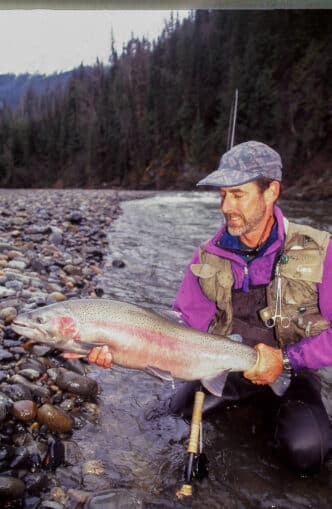
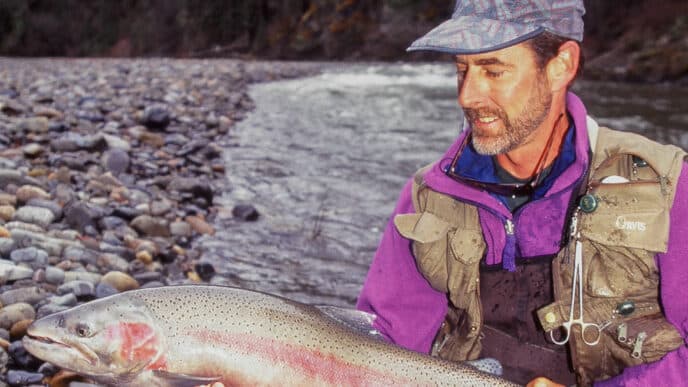
The fish was an enormous rainbow, an easy five pounds and probably closer to seven. To this day, it’s the biggest fish I’ve ever seen come out of that stretch of water. It was also exhausted because Roger had been fighting it for so long without a way to land it, causing its eyes to start bugging out. Our goal to save Roger had shifted into a mission to save the trout from dying of exhaustion.
Dave scooped the fish into his net, let it rest for a few minutes, then unhooked it and placed it in Roger’s hands for some obligatory photos.
“Wow,” I said. “Fantastic fish. That’s the biggest trout I’ve ever seen here.”
“Yeah,” said Roger, “I thought I’d never land him.” “You didn’t,” said Dave.
“Just glad you’re OK,” I said. “Yeah,” said Roger, “me too.”
He grinned again and opened his satchel.