I had seemingly achieved the impossible. I managed to secure a ticket to fish Barrett Reservoir during prime time: the first week of the spring opener.
I camped out on Ticketmaster, watched the seconds on the internet clock count down, and clicked within milliseconds of the ticket release. It was just like getting tickets to a Led Zeppelin reunion tour, where thousands of fans are competing for only a few spots … and I was in! If Barrett Reservoir doesn’t come to mind for you, I bet you have seen its legend. It’s been featured in many fly-fishing TV shows and magazines for the past 50 years. It’s home to thousands of largemouth bass (Northerns and Floridas) over five pounds, huge black crappie, and the largest bluegills I have ever seen.
Now, with the golden ticket in hand, I faced a dilemma. I know my way around a trout stream, but bass fishing with a fly rod? I had little experience and zero expertise. I now found myself with the chance to fish the Augusta National of lake fly fishing for largemouths, yet I didn’t own golf clubs.
I started reaching out to several people in the San Diego Fly Fishers Club (SDFF) for help. “I got a ticket to Barrett in May and really need help on how to fish it.” I kept getting the same two reactions: “No way! How!? Can I go with you?” followed by, “You need to talk to Gretchen Yearous and Kim Jones.”
I had heard of Gretchen and Kim. They came up in every conversation about Barrett. I had heard they were absolute “sticks.” I was amused that, with so many experts in the large SDFF club, every single person recommended these two women for help. I had not met Gretchen or Kim personally, so sheepishly, I reached out to each of them for guidance.
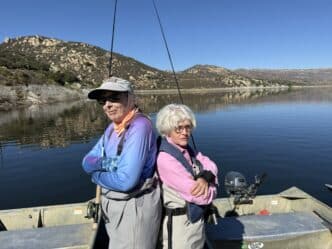
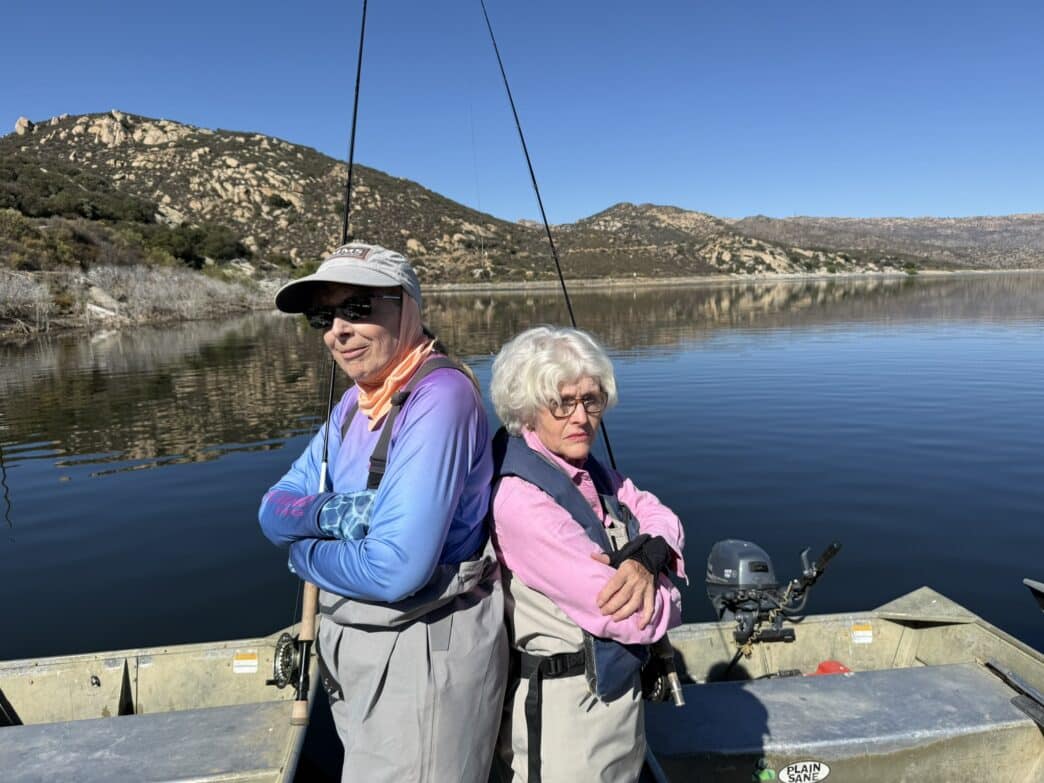
What I received in return was literally pages of pure guidance gold. That was nearly a decade ago. Since then, I have been honored to call these two special, talented fly fishers friends—friends who have been warm water fly fishing together all over San Diego County since the late 1990s. Says Gretchen: “We are sisters of the fly-fishing realm.”
Gretchen Yearous is no taller than five feet, but she carries herself as if she were eight feet tall. Gretchen earned her Certified Fly-Fishing Instructor credential from the Federation of Flyfishers (now Fly Fishers International) in 1994. She has been teaching fly-fishing workshops for women since 1995. Gretchen served as the SDFF club president in 1995 and has won several fly-fishing competitions.
“My mom took me fishing in her small cabin boat in South Texas along the arroyos during my pre-teen years. We later moved to Colorado with my stepfather to a large cattle ranch. He was a fly fisherman, and we would fish the creeks in Boulder County.” Gretchen moved to San Diego about 50 years ago: “My life changed drastically when I found the SDFF club in 1987. That was when the guys introduced me to more than trout. They mentored me for years and transitioned me into warm water so that I could fly fish year-round. Who would not want this luxury?”
Kim Jones first picked up a fly rod at age 10 while living in Billings, Montana. She didn’t touch a rod again until she moved to California 20 years later. She learned about the SDFF Club by stopping at Stroud Tackle to buy flies. Her first club meeting, over 25 years ago, was the night of the annual raffle. “I was blessed to win a Sage 5-weight rod. I was over the moon and totally hooked.”
From that day on, Kim took on many roles in the club, but her favorite was buying prizes for the monthly raffle. “That meant I went to Stroud every month and got to listen to the intoxicating conversations about fly fishing and equipment. Gretchen was the first woman I met at the club, and we quickly became fishing partners. She was a huge blessing to me. We fished all over the county. Gretchen introduced me to the many fishing opportunities in San Diego. We fished for Bonito under the Bay Bridge, trout in Kitchen Creek in the mountains, carp in Moreno Lake in East County, and waters both north and south of San Diego. Of course, Barrett was our favorite. In our younger years, we would arrive at 5 a.m. and fish until the sun went down. In those days, you could hear us hooting and hollering over every fish we caught. Every hook-up was a celebration!”
When Kim wasn’t fishing with Gretchen, she was entering fly fishing contests and winning them—often as the only woman entered. You can imagine how her legend grew. Kim did a lot of fly fishing with the guys then and now. “I was thankful for those men; they always treated me with respect, friendship, and willingness to share locations and techniques.”
With Kim and Gretchen’s blessing, I’ve summarized the extensive knowledge and guidance they have generously shared with me over the years.
THE RESERVOIR
Located 30 miles from San Diego and just 6.5 miles from the Tecate Border crossing into Mexico, Barrett Reservoir covers approximately 900 acres. The only access is via a 3-mile winding dirt road. There are only two places, within yards of each other, to launch your watercraft: the marina and Pigs Point, which is a steep dirt road down to the reservoir’s edge. There is no wading at Barrett. There is no road encircling the reservoir, nor is there a trail around it. To fish at Barrett, you’ll need a float tube or kayak. Alternatively, you can rent one of 10 motorized boats available for reservation on Ticketmaster. From these two launch points, you can head in one of three directions.
South to the dam—here, you’ll find many of the conventional fishers who fish the deep water.
Heading north to the Pine Creek arm—my favorite spot. In my kayak at first light, I can get there in about 20 minutes and enjoy having the end of the Pine arm to myself for most of the day.
East to the Hauser arm — seemingly the first spot where the pros go. I have seen the largemouths torment bait boils of shad there.
SEASONS
The fishing season at Barrett is short, lasting only five months from May to September. Additionally, it opens for fishing just three days a week—Wednesdays, Saturdays, and Sundays. The available dates are released in monthly batches on Ticketmaster. You can register on the website to receive alerts when a month’s dates go on sale. Securing tickets is much easier in summer and fall than in spring, mainly because of the fishing conditions and the intense heat out there.
FISHING TACTICS
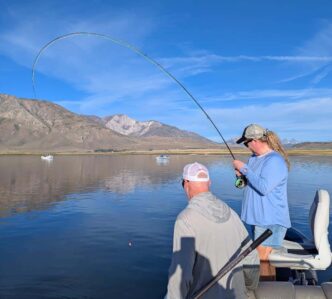
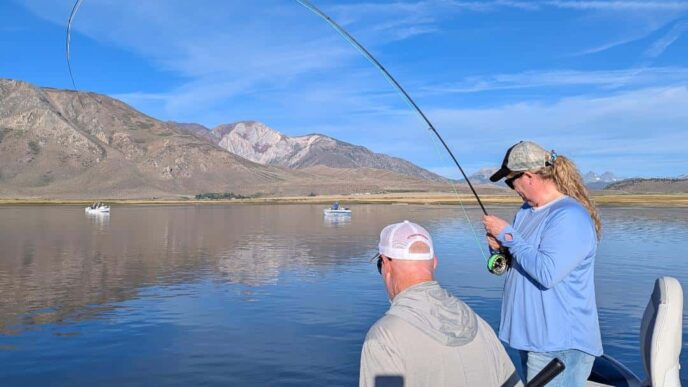
The true experts, like Kim and Gretchen, secure a Ticketmaster reservation that includes a motorized boat. They load their float tubes into the boat, motor to their favorite spot, anchor, and launch their float tubes. After they rope about 20, they move on. Similar to the float tubers on Lake Crowley, most will gather around the guide boats; the “wannabes” like me just follow Kim and Gretchen around. A few seasons back, I stopped fishing and watched Kim for 15 minutes in awe as she stuck fish after fish, cast after cast, from the same spot in her float tube.
Gretchen recommends fishing popper flies and other floating bass flies in the low light of the morning. Frogs, trout, and any popper fly that pushes water will work. I have found that the somewhat realistic poppers (rainbow trout and frogs) work best. Many experts successfully cast foam-based floating “leggy” Chubby Chernobyl-like flies in the same way.
When popper (or any topwater) fishing, cast tight to the bank. Let the fly sit for two to three seconds, then do small, short strips. Unlike stripping streamers for trout, this method is painfully slow, but the strikes are fierce, making that patience totally worth it. You need to be quick with your strip set—a trout set will fail you.
When the “popper bite” slows down, it’s time to switch to a medium (or heavy) sink line and “pound the banks.” Kim mentioned that even casting onto the bank and pulling the fly back into the water works well. Yes, you’ll probably hang and lose some flies with this method—that’s just part of it. Expect to lose flies in Barrett. When using this technique, streamers that mimic bait or shad patterns, common bass sinking streamers, and traditional trout streamers like the Woolly Bugger will produce results. Strip streamers faster than when popper fishing, but not as quickly as when streamer fishing for trout. You want to strip slowly enough that the streamer rides in the lower part of the water column but fast enough to avoid hanging on the bottom. The Clouser minnow fly was made for this exact technique and is deadly in Barrett.
As shocking as it sounds, I have found that when moving locations crossing the lake—if I troll a streamer on a heavy sink line—the fish, even largemouths, will catch themselves. That’s how good the fishing in Barrett is.
Barrett holds some of the largest and most aggressive bluegill in the state, and you’ll catch them when targeting bass. Barrett also has big black crappie, and you might catch them too while bass fishing. The first time I caught a black crappie, it was about 18 inches. I texted Kim a picture and said, “What the hell is this?” Which answers a question you might have. Yes, there is cell coverage in many places on Barrett, even though it’s in the middle of nowhere.

FIGHTING THE FISH
Frequently, largemouth jump when hooked, but they don’t typically do acrobatic spinning, uncontrolled jumps like trout. A largemouth will tail walk the water while shaking its head violently to shake the fly loose before it jumps. As you get better and gain more experience, the process of tail walking before a jump can be predicted quite accurately, so you can be ready for the jump. When a bass jumps, the experts are torn between “bowing the rod” to give or tightening up and setting again midair. I have found that with largemouth bass, keeping tight midair is more effective than going slack by bowing the rod. Either way, you are going to get shook frequently. It’s part of the deal.
TIPS FROM KIM
- Don’t use two flies because of the number of snags underwater. I hate the idea of constantly getting snagged, and it’s bad enough with just one fly.
- A beadhead black Woolly Bugger with lateral flash is my go-to fly.
- Carry Crystal Buggers, small Clouser’s, and poppers in white to match the shad when they breed in springtime. The bass go mad eating them.
- Fish a Balanced Leech in black and olive green without a strike indicator to change things up. I know it’s very productive to use a strike indicator with a balanced leech and toss it into the stick-ups. I just don’t have the patience to do this.
- If bass aren’t biting, look for bluegills. Since bass hang out with bluegills, you could catch either.
TIPS FROM GRETCHEN
- Barrett’s water level constantly shifts, causing the holding spots for food and fish to change. Knowing the locations of drop-offs, ledges, shrubs, and rock structures is very helpful in finding the holding spots.
- Start with a 6-weight full-sinking line and experiment with different sink depths to locate the strike zone. Switch to a 7- or 8-weight full-sinking line (heavy sink) to handle the wind, using size 6 and 4 conehead flies for fishing deeper and faster.
- Use medium-fast action rods so they will bend enough to save the leader and tippet, while working the fish sufficiently for a healthy release.
- After a rain, runoff causes the water to become murky in Barrett. When this occurs, use a fly that contrasts with the murky water, such as one with a very dark or very light pattern and a contrasting red or orange throat.
- In murky conditions, try to get the largemouth’s attention with noise-making flies (rattle), or ones that have a lot of movement like flies with legs and marabou tails, or flies with eyes.
A HERO IN THE STORY
Former San Diego City Lakes Manager, Jim Brown, who served in that role for over 30 years, can be credited with introducing catch-and-release fly fishing to Barrett. He also brought the Florida strain of largemouth bass into a hotbed of northerns and made it successful. In 1974, Jim embarked on a mission to bring fishing back to Barrett and several other lakes in San Diego that had been closed for decades. One of the main challenges to opening Barrett to anglers was securing access. Located in rugged terrain, Barrett required an access route. Jim negotiated an agreement with local ranchers to use a rough dirt road, which remains the access road to this day.
With the help of biologist Larry Bottroff, Jim developed the special fishing regulations that remain in place today, which are believed to be the first designated public waters in the nation with catch-and-release regulations for warmwater species. Now retired and north of 80 years young, Jim is a storyteller. A favorite of mine is how Jim solved the challenge of managing the high demand for tickets to fish Barrett by turning to Ticketmaster. On the first day tickets went on sale, the Ticketmaster website crashed from the surge in traffic. So, my Led Zeppelin metaphor is not so far off.
FINAL THOUGHTS
There are two queens and a hero in this story. But there’s also an Empress. Her name is Laurie Gensler, the Barret Reservoir Keeper. If you get the chance to visit Barrett Reservoir, you’ll probably see Laurie’s smiling face overseeing the chaos in the pre-dawn hours as vehicles loaded with float tubes and kayaks pour in.
I love this lake. Last spring, I found myself all alone in the Pine arm, just sticking ‘em on poppers for hours and telling myself, “I can’t imagine fly fishing being any more fun than this. I’m going to fish poppers all day.” I did, and it never slowed down. I caught Barrett on a magical day.
Trust me, you should fly fish at Barrett Reservoir. The challenges of its remote location, float tubes and kayaks, cost, heat, and the difficulty of getting a ticket are all worth it. Make sure to add it to your bucket list.