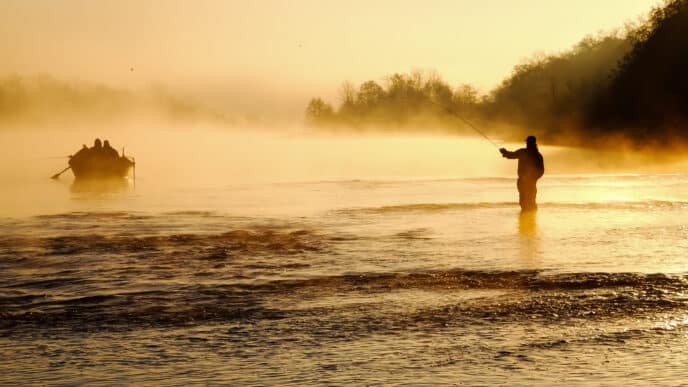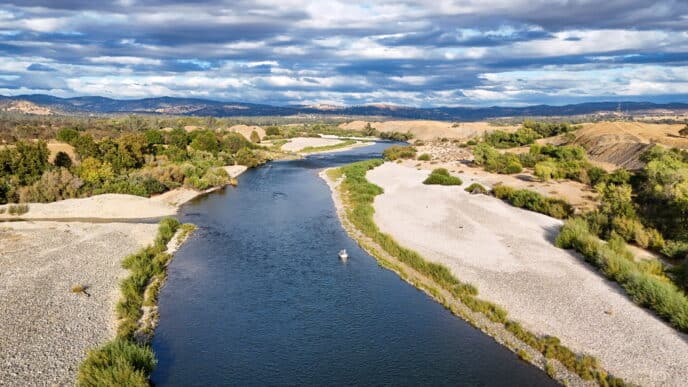
San Diego is a city shaped by light—that soft glow rising over the eastern hills and settling across the coast each evening.
It’s where ocean breeze meets desert air, where mornings carry the scent of salt and chapparral, and where the rhythm of tides blends seamlessly with the pulse of the city.
Most people think of San Diego as surfboards, sunshine, and an easy coastal pace. But tucked between neighborhoods, canyons, bike paths, and busy corridors lies one of the most diverse and accessible urban fly-fishing landscapes anywhere in the United States.
You don’t have to travel far or venture into the backcountry. In San Diego, you can fish stillwater trout at dawn, sight-cast to warmwater species by midday, and finish the evening wading a saltwater flat as the sun falls behind the Pacific. From Lake Murray to the rugged canyon waters of the San Diego River, the broad shallows of Mission Bay, and the rolling surf of Mission Beach, these fisheries create a patchwork of wild, unexpected water right within the city.
LAKE MURRAY
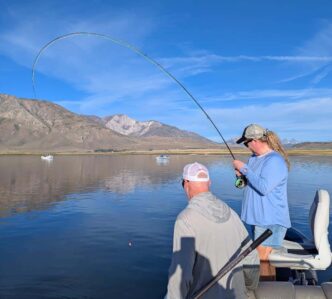
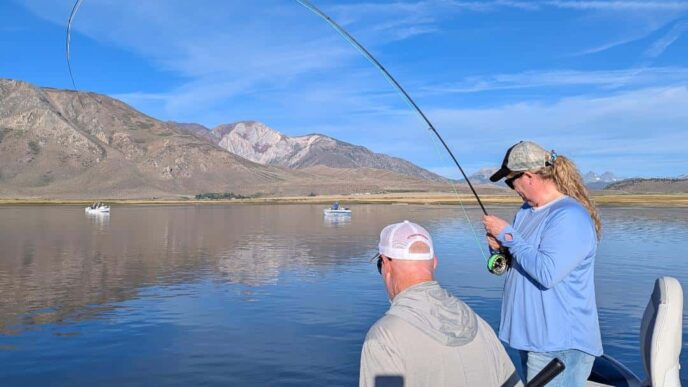
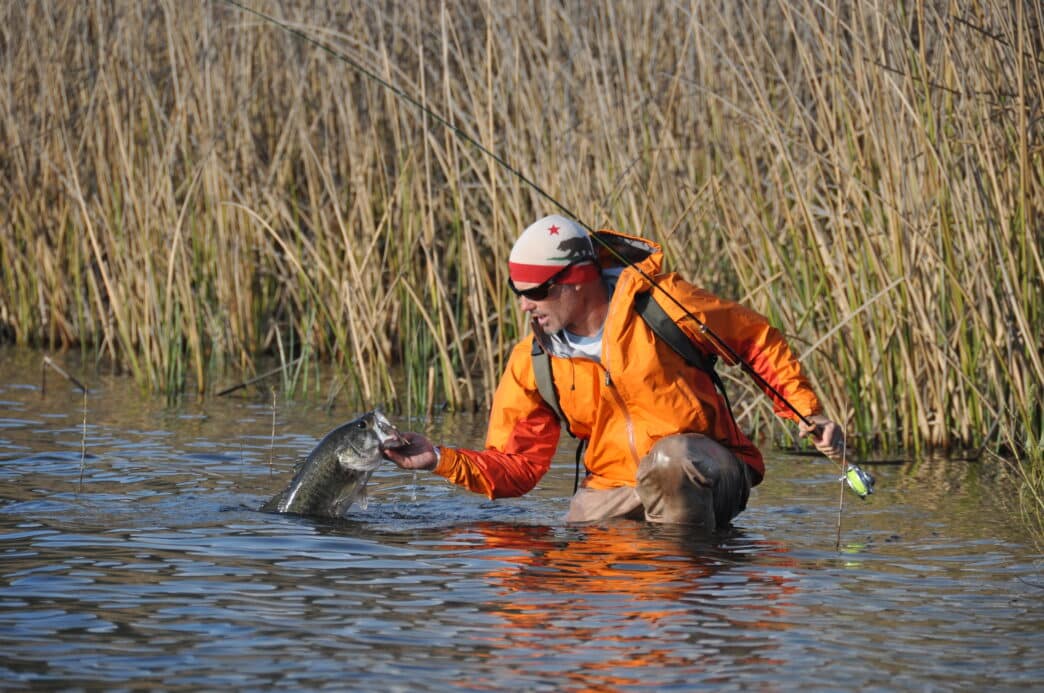
Lake Murray sits quietly within the city, but as the sun edges over the eucalyptus trees at first light, it feels like its own world. In summer, the lake often lies mirror-flat at dawn, with threadfin shad flickering beneath the surface and egrets stalking the shoreline. From May through October, mornings can erupt with topwater chaos. Bass slash through bait, sending shad flying and creating the kind of surface energy that makes a popper disappear in an instant.
Winter brings a different kind of excitement. From January through April, the California Department of Fish and Wildlife regularly stocks rainbow trout. During a midge hatch, the lake becomes a classic stillwater dry-fly fishery—rings spreading across the water, trout head-and-tailing in rhythm, and swallows swooping overhead.
Local angler and schoolteacher Ron Montoro waits all year for this moment:
“March and April are my favorite times to target surface-feeding trout at Lake Murray. I look for the swallows eating midges—once I find them, I look for rising trout. Alvarado Bay and Padre Point are my go-to spots. My cast is usually 40 feet or less. Accuracy is everything, especially early or late in the day.”
For trout, a 9-foot 4-weight floating line and a 9-foot leader with size 16–18 midges, small mayflies, unweighted nymphs, and terrestrials like ants and termites are perfect. Many of the trout cruise tight to shore, especially during low light, and the fish can be surprisingly selective.
For bass and bluegill, a 5- or 6-weight works well with small baitfish patterns in sizes 6–8. Matching the lake’s threadfin shad is often the key. In the evenings, bluegill rise to small dries, while bass push bait up against weed lines and rock piles.
One of the deadliest setups here is the float-and-fly rig—a suspended balanced leech or baitfish pattern beneath a strike indicator. It shines in late winter and early spring when bass and bluegill suspend off structure. Fish it near docks, tule clumps, or deep edge transitions. It’s slow, methodical fishing—and incredibly effective.
Productive areas include the north shore near Mission Trails Golf Course, San Carlos Arm, Cowles Bay, and the buoy line east of the dam. Access along Perimeter Road is excellent, and float tubes, kayaks, and rental skiffs provide access to the lake’s deeper water. Daily permits are available at the Lake Murray concession stand.
THE SAN DIEGO RIVER
Flowing quietly through Mission Valley, the San Diego River is one of the city’s most unexpected fisheries. In 1769, Mission San Diego de Alcalá—the first mission in California—was established on its banks. For thousands of years prior, this river supported the Kumeyaay people, whose history and cultural knowledge are preserved today within Mission Trails Regional Park and its Interpretive Center.
Above Mission Valley, the river enters rugged terrain where chaparral-covered hills give way to oak- and sycamore-lined corridors. Mule deer still slip through the brush, owls roost in the cottonwoods, and herons stalk the shallows—reminders that this river has always been a vital lifeline.
OLD MISSION DAM SECTION
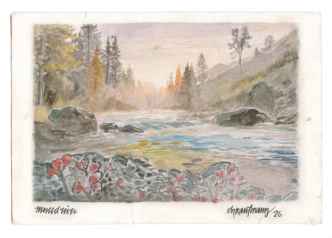
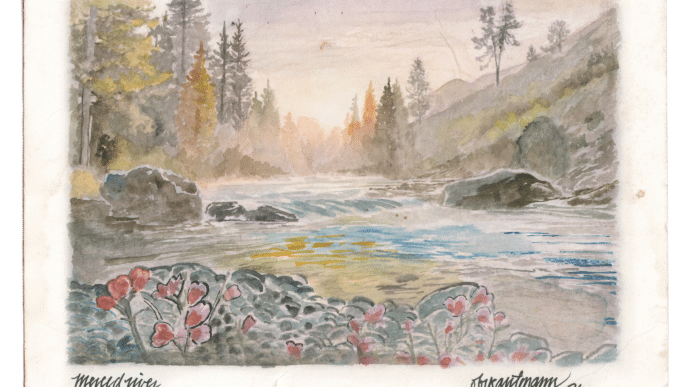
Just east of the Mission Trails Gorge lies the Old Mission Dam section of the river—a stretch that flows west through the Mission Trails canyon before entering Mission Valley. This is one of the most unique urban fisheries in Southern California: a warmwater freestone-style creek tucked inside a deep canyon, far removed from the surrounding urban areas.
In this canyon stretch, the river looks and behaves like a mountain creek. Clear water tumbles through tight pockets, fast riffles, shallow runs, and shaded pools. It’s intimate, technical water—the kind that requires crouched approaches, delicate drifts, and casts no longer than 15 feet.
The river holds green sunfish, bluegill, and small largemouth bass, all eager to rise to hoppers, ants, beetles, and terrestrials. Sight-fishing is often the name of the game, with fish positioned tight to shade lines or tucked beneath overhanging branches.
A 7½-foot 3-weight is perfect. A 7-foot leader allows accurate punch casts under branches. Many anglers love a 7½-foot Tenkara rod here—simple, sensitive, and incredibly packable for longer hikes deeper into the canyon, where the terrain becomes steeper and access more challenging.
As the canyon widens, the river slows below Old Mission Dam, forming stillwater pockets that hold bass, bluegill, and green sunfish. This quiet stretch offers a peaceful transition between the fast canyon water and the wider river downstream.
Farther west, the river opens into Mission Valley. Shopping centers, trolley tracks, and Snapdragon Stadium dominate the skyline, yet just a few steps away runs the San Diego River Bikeway—a paved trail that runs alongside a long, slow-moving stretch.
This bike trail makes access remarkably easy. A fly angler can pedal or walk along the paved path and drop down to the river through numerous small access points. These pockets—hyacinth mats, weed edges, and shaded cuts—hold crappie, carp, bluegill, and largemouth bass. For the urban angler wanting to cover water efficiently, this stretch is ideal.
MISSION BAY
West of I-5, Mission Bay sprawls across 4,000 acres of channels, eelgrass beds, sand flats, and coves. For wading fly anglers, it’s one of the most dynamic year-round fisheries in Southern California.
During early-morning flood tides, barracuda, spotted bay bass, and shortfin corvina slide onto the flats. When bait pushes shallow, the bay wakes up—flashes, wakes, and quick cuts beneath the surface betray feeding fish.

San Diego fly-fishing guide Tylor VanOsdell breaks it down perfectly:
“I like low-tide periods when channels, sand points, depressions, and weed lines are more accessible. An intermediate sinking line keeps the fly just off the bottom or above the eelgrass.”
“Spotted bass, halibut, and corvina hold where the bait concentrates.”
“Wade fishing is one of the most productive ways to fish Mission Bay—there are so many access points.”
For anglers wanting a wider reach, renting a skiff at Dana Landing Market & Fuel Dock offers quick access to Quivira Basin and the bait barge—a winter magnet for bonito and barracuda when offshore waters cool. The steady flow of live bait brought to the barge each day keeps predators close, and on the right tide, surface action can be explosive.
MISSION BEACH
Walk onto Mission Beach, and you step into the Pacific’s rolling energy
—shifting sandbars, rhythmic surf, and a horizon that feels endless. Fly anglers come here for corbina, surfperch, yellowfin croaker, and occasionally striped bass cruising the inside troughs.
A 7-weight with a 200-grain shooting head allows you to punch casts through wind and surf. Size 6–8 shrimp, crab, and baitfish patterns match most forage species. The stretch from the Mission Beach Jetty to PB Point consistently produces, especially at first light. A stripping basket is recommended to make fly line management easier.
Winter reveals one of San Diego’s most overlooked fisheries. As the ocean cools, surf perch spawn, drawing in larger predators that hunt them aggressively.

Local surf angler Angel Martinez has seen the surf come alive:
“Over the years I’ve seen very large striped bass, white seabass, and even yellowtail cruising the surf line and chasing bait into inches of water. It happens during low light—early morning or late evening. It’s exhilarating.”
“If you time the tides and put the work in, you’ve got a real shot at one of these game fish.”
CLOSING
San Diego’s urban fly fishing is as diverse as the city itself, comprising still lakes, tidal bays, winding rivers, and open surf. Whether you’re casting to rising trout at Lake Murray, hiking into the Old Mission Dam canyon, or wading Mission Bay at first light, there’s always another piece of wild water waiting nearby.
This is the wild side of San Diego.
You just have to know where to look.
Urban Fly-Fishing Gear Checklist
Rods & Reels
- 6–8 weight for Mission Bay
- 4–5 weight for Lake Murray
- Salt-safe reel for Mission Bay
- Lightweight trout reel for Lake Murray
Lines, Leaders & Tippet
- Mission Bay: 250-grain shooting head
- Lake Murray: Floating line for dry flies and midge fishing
- Mission Bay: 6 feet of 12–15 pound fluorocarbon
- Lake Murray: 9 feet of 6X
Flies
- Mission Bay: baitfish patterns, clousers, surf candies, crease flies, poppers
- Lake Murray: Brooks’s Sprout Midge (16–18), Zebra Midge (18)
Tools & Essentials
- Polarized sunglasses
- HemostatsNippers
- Small pack or sling
- Net
- Waders (optional)
- Dry fly floatant
- Light wire leaders (Mission Bay)
Optional Add-ons
- Hand towel
- Lightweight rain shell
- Headlamp
- Sunblock
For additional resources on fishing in San Diego, read the 24-hour guide.