In the early 1980s, I traveled the streets of London selling drugs.
Every weekday, I’d visit doctors’ offices, clinics, and hospitals to tell them about Ismo 20, Bezalip, and Spiroctan. Well, that was what MCP Pharmaceuticals expected me to talk about. Several doctors were more interested in talking about fly fishing. Our conversations often centered on those magical moments when we made a difficult cast and caught (or nearly caught) a particularly challenging trout. Quite often, there would be pantomimed casts and excited voices. These “sales” visits always concluded with a firm handshake and a warm smile.
SELLING DOPAMINE
Whenever we engage in a challenging task, the brain releases hormones, such as dopamine and norepinephrine, that focus our attention, enhance our mood, and deliver a feeling of euphoria when we eventually succeed. Remembering such events also triggers the release of these hormones. This is why the doctors got so animated.
Certain types of fly fishing can be especially challenging. Dry fly fishing on highly technical waters such as Fall River or Hat Creek is a good example. Not only do your casts need to be accurate and delicate, but they also need to incorporate drag-defeating curves. If the fly drags by a fraction of an inch, the fish will ignore it. That can be a real challenge when you need to cast across multiple currents that are moving at different speeds. But as anyone who has mastered dries will tell you, watching a trout rise to your carefully delivered fly is one of the most sublime experiences in fly fishing.
Another challenging technique is fishing with shooting heads. In many ways, heads represent the opposite end of the fishing spectrum from casting dries. The primary reason (though not the only one) for using a shooting head is distance. In the right hands, a head can put more than 100 feet between you and your fly. Even semi-proficient casters can add 20 feet to their best cast. When you are working big rivers, lakes, or the surf, that extra distance gets your fly in front of fish that others can’t reach, and that’s a sure-fire way to release a lot of feel-good chemistry.
Perhaps you have tried shooting heads and haven’t been able to throw them much farther than a regular fly line. Or maybe the experience was so frustrating that it had you pulling your hair out. Here are some ways to make it easier for you to become a head master.
VIDEOS
One of the simplest ways to dial in a shooting head cast is to watch YouTube videos by people who know what they are talking about. Folks interested in casting heads on single-hand rods should check out Lars Bentsen’s “Casting With Shooting Heads.” Those who want to throw them with double-handers should find the Scandi and Skagit head videos by Tim Rawlins, also known as The Line Speed Jedi, helpful. If you want to master overhead casting with a doublehander, Tim Rajeff’s “Boost Beach Fundamentals” provides solid advice.
HEAD BANGING
One of the frustrating things about fly casting is that it can be counterintuitive. Common sense tells us that extra distance requires extra effort. You add some “oomph” to your usual cast and watch the fly drop 10 feet farther away. Encouraged, you put even more power into the next cast, but gain no extra distance. Confused, you give it all you’ve got, only to see the fly drop 10 feet closer than your normal cast. Been there, done that.
The truth that almost no one believes is that it takes very little effort to throw a shooting head. Take a look at the videos listed above and notice how relaxed and compact the casting strokes are.
SMALL LOOPS
To cast farther, you need the line to form a small loop. This is because a small loop cuts through the air more easily than a wide one. Ideally, the distance between the top and bottom of the loop should be less than four feet. Of course, as countless fly fishers have found, this is easier said than done.
There are numerous articles and videos explaining how to throw skinny loops. One approach that I’ve found to be effective is to continuously false cast with just a few inches of shooting line out of the rod tip. Start by making deliberately wide loops, and then try to narrow them down with each subsequent cast. Once you start making decent loops, concentrate on how the cast feels in your hand. Recognizing and repeating this sensation delivers better casts, which your brain rewards with hits of dopamine.
CORK STRANGLERS
A common cast-killer is using too much grip strength, which limits your ability to feel the rod and line’s response to your casting stroke. Some have suggested that you hold the rod as if it were a baby bird, though few of us have experience of this. A slightly more practical suggestion is to hold it like a car’s steering wheel. If you are fishing and find your casting starts going awry, check your grip. In all likelihood, you are unknowingly choking cork.
SHOOTING LINES
The line that connects the shooting head to the backing is called a shooting line, because that’s the bit that “shoots” out of the guides. They come in three flavors: plastic-coated, braided nylon, and mono.
Coated shooting lines are the most user-friendly, since they are essentially a skinny, regular fly line. If you are just getting started with heads, a coated line will make the transition from regular fly lines much easier. The weight of these lines also makes them less prone to tangles when it’s windy.
Braided shooting lines are coil-free and supple straight off the reel, and their texture makes them easy to hold. The downside of that texture is that it can capture fine particles. If you fish in waters that have suspended sediment, or you strip line onto the ground, braided lines can quickly ruin a set of rod guides.
Monofilament has a super smooth surface, the smallest diameter, and the least weight of all shooting lines. This makes mono the choice for all-out distance, but its light weight means it is more prone to tangling when it’s windy. It also has a memory problem.
BAD MEMORIES
One of the downsides of coated and monofilament shooting lines is their tendency to coil. This is because the line “remembers” the shape of the reel. These coils will occasionally tangle and snag in the guides. Obeying Murphy’s Law, this always happens when you have launched an epically long cast to an enormous fish.
Fortunately, there are solutions. The simplest approach is to stretch the line before use. This can be done by firmly pulling it between your hands as you strip it off the reel. Another option is to attach the fly to a solid object, pay out the line until you are a cast away, and then give it a good stretch. If you are in a boat, let the line out and tow it for a few minutes. Just make sure to keep it well away from the motor.
HYDROTHERAPY
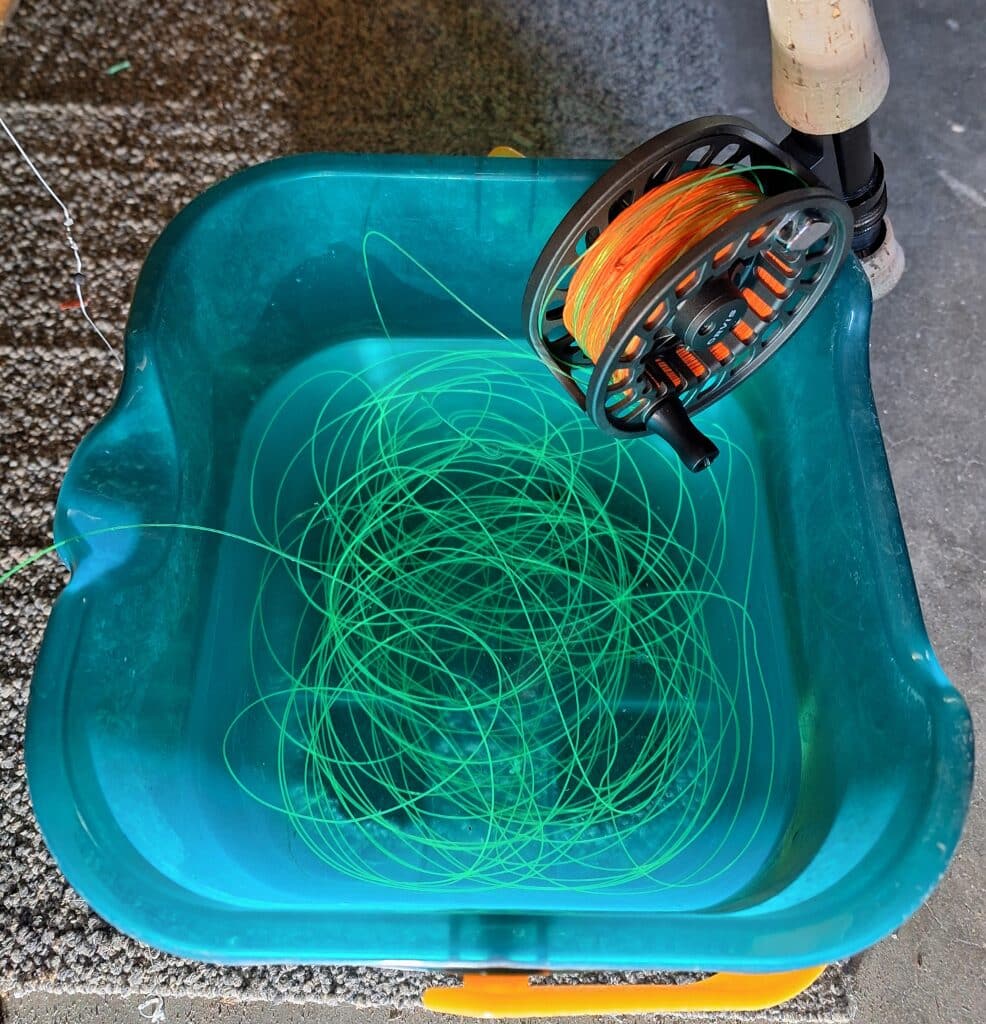
A good stretch usually tames coated lines. However, even when stretched, mono remains somewhat stiff, which can increase tangling. Thankfully, mono gets more supple when it absorbs water. This process takes several hours at room temperature, so don’t assume a few minutes of fishing will do the trick. The simplest approach is to strip the line into a bucket of water and let it sit overnight. You can speed up the process by “brewing” the line for 15 minutes in water that is as hot as a cup of coffee. Do not use boiling water; it may weaken the line.
Once you have the mono fully hydrated, you can keep it that way for a few days by placing a wet plastic bag over the reel when not in use. This is a practical solution for a multi-day freshwater fishing trip, but not something I’d recommend for saltwater excursions. Salt and 100 percent humidity are a good recipe for corrosion.
STEP KNOTS
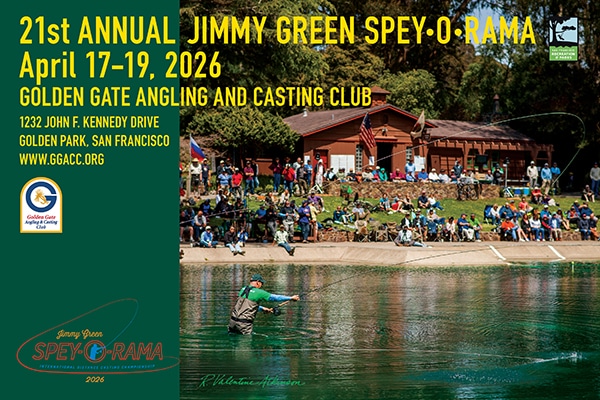
The knot that connects a mono shooting line to the head can hang up in the rod guides. Not surprisingly, this can mess up your cast. One solution is to cover the knot in UV epoxy, so that it forms a smooth cone. This setup works well, but you’ll have to bring UV epoxy and a UV flashlight with you if you want to change heads on the water.
My solution is to needle-knot pieces of smaller diameter mono onto the shooting line and slide them up so they are snug against the head knot. This creates a series of small steps that keep the knot from jamming in the guides. If you need to change heads, slide the knots down the shooting line and slide them back once the new head has been attached. This system works best with 10-pound steps. For example, a 30-pound shooting line works well with 20-pound and 10-pound step knots. Folks who use 20-pound shooting line will need just one 10-pound knot. Tied correctly, these knots typically last as long as the shooting line.
LARGE ARBOR
Despite soaking and stretching, mono will have some residual coiling. The smaller the coils, the more likely they are to tangle. Back in the 1970s, some UK fly fishers solved this problem by storing their lines on bicycle wheels. These days, all you really need is a large arbor reel. You’ll still get coils, but they’ll be wide enough to be relatively tangle-free.
FRICTION
New coated shooting lines have internal lubricants that migrate to the surface and reduce friction. Over time, those lubricants get depleted, and the line also develops microabrasions and a patina of crud. These all reduce the line’s shootability. Regular cleaning and application of line dressing help keep these gremlins in check.
There is a simple way to clean and lubricate your line while you fish. Make a finger cot from a microfiber towel and put some line dressing on one side. Put the cot on your index finger and draw the line over the lube-free side with every retrieve. This instantly removes any contaminants. When you feel the line needs some lubrication, twist the cot on your finger so the line is drawn over the side with the dressing.
Shooting heads will put your fly in front of fish that others can’t reach, and that’ll give you one heck of a dopamine rush. Don’t worry, it’s totally legal and doctor-approved. g a fly with the right moves. Do not deny yourself that pleasure.