Have you ever wondered what you might discover if you lowered a waterproof camera into a lake or the ocean?
Several years ago, curiosity got the better of me. A GoPro was attached to a kid’s spinning outfit and dropped into Lake Almanor. The surface waters were relatively clear, suggesting there should be enough light for at least the first 20 feet. Beyond that depth, who knew? The camera reached the bottom at 43 feet and was retrieved in one-foot increments. The GoPro wasn’t mounted on a stabilizing gimbal, so it moved around as it was raised. Under normal circumstances, this would make a lousy video, but it proved to be quite fortuitous.
WHERE’S CAPTAIN KIRK?
I wasn’t sure what to expect from the video. The footage was booted up, and a surreal scene appeared on the computer screen. The water was divided into two parts: a dull olive below the camera’s mid-level, transitioning to a bright chartreuse above. It looked like a scene from a Star Trek episode.
Then, as if out of nowhere, a brown trout shot into view.
The camera was about six feet above the bottom when the fish charged directly toward it. This behavior was repeated several times, with the final pass about 18 feet down, where the water was starting to turn from chartreuse to a light blue-green. Judging from the video, the fish had seen the camera from more than 10 feet away. It is possible that the camera’s outline caught its attention, but a more likely explanation is that the bobbing motion reflected light off the flat plastic case and silver buttons. The GoPro was acting like the flashers that anglers who troll for trout and salmon often swear by.
FLASHING BAITFISH
Why would a fish react so rapidly to flashes of light? Many species of baitfish have silvery sides that reflect light, which can betray their presence to predators, often at a considerable distance. You’d think that evolution would eliminate any species of fish that makes itself so obvious, but there’s an upside to being highly reflective. When swimming normally, the silver sides reflect ambient light, providing almost perfect camouflage. Flash is only produced when the fish turns and one side angles upwards or downwards, or it is injured and unable to control its motions. Like a mirror, this reflects direct sunlight or the lighter-colored waters above. This is one reason why the spinners and spoons used by conventional anglers are so incredibly effective.
LOW LIGHT FLASH
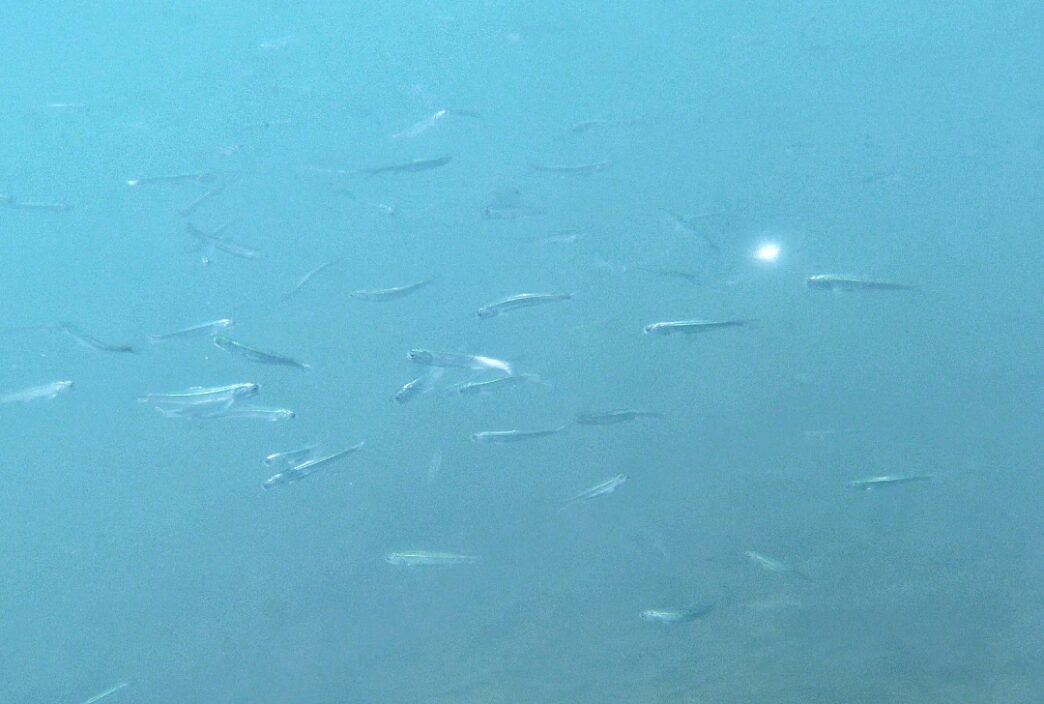
At first, it seems obvious that a silvery baitfish swimming on a bright sunny day would reflect more light than it does at dawn or dusk. This is true, but the critical factor is how bright the reflection is relative to the background, which scientists refer to as Weber contrast. A video shot just after sunset demonstrated this effect.
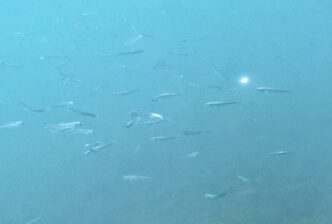
The fishing flotilla was patiently waiting for the Almanor hex hatch to start. A school of smelt swam by the boat, so, naturally, the GoPro was lowered into the water. The camera faced west, which meant there wouldn’t even be the sun’s residual red sky glow to reflect off their sides. Remarkably, the smelt still flashed quite noticeably and were visible from several feet away. The difference between the overhead sky (reflected by the fish’s sides) and the background water was enough to make the fish visible. Trout would have no trouble locating the school under these conditions.
FLASHY PLATES
Another day, we were fly fishing for rockfish on Monterey Bay, dodging lunge-feeding humpback whales, when a school of anchovies surrounded the boat. I quickly reeled in, grabbed the trusty GoPro, and shoved it underwater, just in case a 50-ton mammal decided to have a boatside snack. The whales swam off, but the anchovies stayed around for several minutes.
As with the other videos, the anchovies were quickly betrayed by flashes of reflected light. However, some of the flashes were exceptionally bright. The anchovies were doing something different from the smelt. Watching the video in slow motion, the reason for these extra-bright flashes became apparent: The fish weren’t turning; they were feeding. Anchovies feed by swimming through the water with their mouths wide open and their gill plates flared. The smooth, mirror-like surface of the gill plates reflected light more strongly than the body scales. This high-intensity flash stopped when the fish closed their mouths.
DOUBLE COVERAGE FLIES
Streamers are often used as searching patterns, covering as much water as possible. Long casts are one way to increase the amount of water covered, but another option is to increase the visibility of the fly. In the simplest two-dimensional case, doubling the distance over which a fly can be seen doubles the area it is visible to fish.
The key to creating bright flashes that broadcast over the greatest possible area and volume of water is to combine a highly reflective surface with a wobbling or spinning motion. This is easy to do with metal lures but more challenging with flies. Strands of Flashabou are simply no match for a slab of chromed steel. Thankfully, there are flashy fly options for folks who buy them and for those who tie them.
BUYING FLASH
When it comes to flash and wobble, the obvious solution is the spoon fly. While most are designed for saltwater species, you can get them in sizes that work well for trout. As with most wobbling or spinning patterns, adding a swivel to your leader will prevent it from twisting.
Patterns like the Wiggle Minnow, Wiggle Bug, and Wobble Fly make the right moves, but there don’t seem to be any on sale with highly reflective surfaces. One solution is to apply shiny, heavy-duty aluminum duct tape to these flies. This provides plenty of flash and generally sticks to the fly for several hours, as long as it’s applied before the fly gets wet.
Another pattern worth considering is the Spinster, a jig-hook Clouser with a spinning blade attached just ahead of the eyes. Unfortunately, they aren’t on sale at this time. However, you can mimic the pattern by attaching a spinning blade to a mini swivel and placing it on the tippet just above the fly. The blade is held in place by bobber stops mounted ahead and behind the swivel. Attach the fly with your favorite knot and adjust the stops so the blade spins just ahead of the hook eye. If the blade slips down the tippet, add another bobber stop.
FLASHY TIES
If you tie flies, there are a couple of patterns that reflect a lot of light. The first is the Castblaster, a spinning tube fly made from shiny aluminum duct tape. You can find details on how to make it in the August 2023 “Catchy Ideas” column.
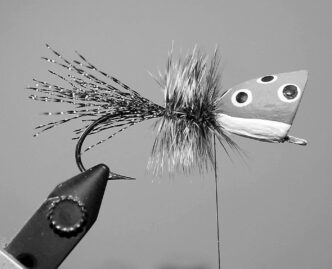
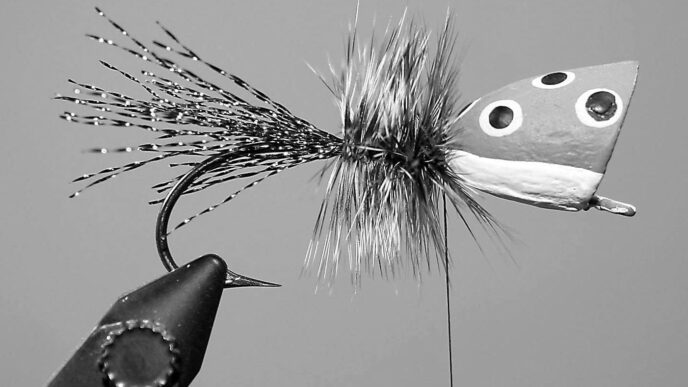
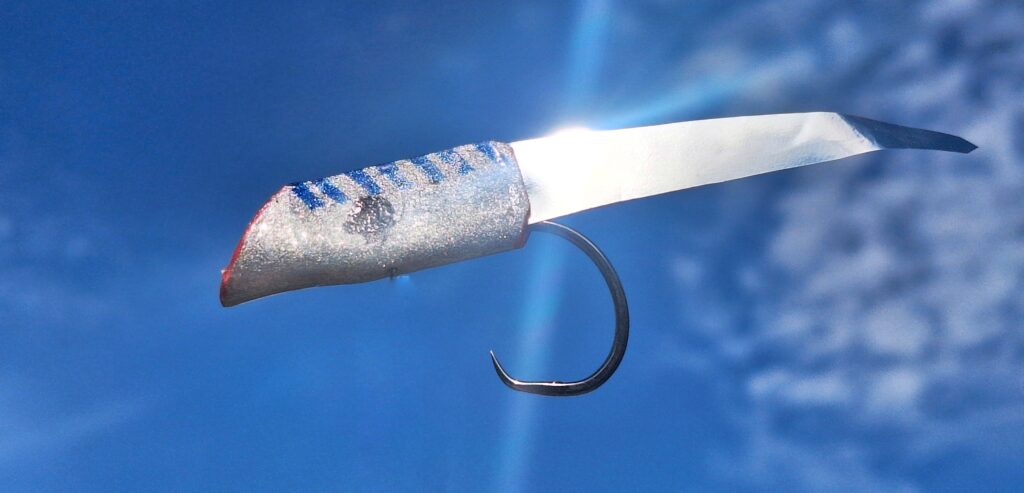
The other pattern is the Upside-Down Crease Fly. The fly differs from the original Crease Fly by placing the crease along the hook shank. This allows you to cut the foam so the fly has a lip, giving it a Rapala-like action. Combine this wobbling motion with highly reflective materials, and the fly directs flashes of light throughout the water column.
It has been a couple of decades since I first tied a lipped version of the fly. I could not find any recent articles or posts to see whether anyone had improved the pattern. I checked with Scott Leon, author and former editor of Fly Fishing In Saltwater, to see if he had seen anything. He checked back issues of the magazine and called some friends. Nothing. Somehow, it had vanished. It’s time to resurrect and photo-enhance this incredible fly.
THE PHOTON TORPEDO
The foam body of the Upside-Down Crease Fly can be coated with silver transfer foil or silver paint, and when combined with a flashabou tail, produces quite a bit of flash. However, a tail made from a triangle of metalized Mylar sheet provides a flat, mirrored surface with reflectivity of more than 90 percent. I’ve tested countless flies underwater, and nothing comes close to the flash produced by flat mylar. This material is used in food packaging, gift wrap, emergency blankets, and nail foils. You can also find it at craft stores and online. An alternative is to use iridescent acetate sheets, which are available online and at craft stores. In a nod to Star Trek, I named this variation of the fly the Photon Torpedo. If you can use scissors and superglue, you have all the skills you need to make one.
As millions of anglers fishing with metal lures have proven countless times, nothing beats the fish-attracting power of flash. Pop some flashy flies into your box and join in the fun.
Tying The Photon Torpedo
- Run thread along the hook shank. This ensures superior glue adhesion between the foam and hook.
- Clip a lightweight snap-link into the hook eye. This makes it easy to attach to the tippet while keeping the articulation point behind the lip.
- Cut some 2mm sheet foam into a rectangle that is approximately twice the width of the hook gape, and long enough for the end of the snaplink to be exposed.
- Fold the foam, pull the crease up against the hook shank, and squeeze it between your thumb and finger so the hook eye leaves a small mark.
- Form the lip by folding the foam and cutting from the front end of the crease to just above the mark left by the hook eye.
- Cut a triangle from the Mylar (or acetate) sheet, with a base that’s the same width as the folded foam. Abrade one-quarter inch of the base (both sides) with sandpaper for a strong glue bond.
- Apply a thin layer of superglue (gel style works well) to the last quarter-inch of one side of the foam. Press the abraded end of the mylar onto the glue and hold for at least fifteen seconds.
- Add superglue to the thread wraps and a thin layer to the foam body behind the hook eye. Don’t put glue ahead of the eye; this section will become the lip. Pull the foam up against the hook shank, and squeeze (a bit harder than you’d hold a pen) between your thumb and forefinger for at least 15 seconds.
- Drop the fly into water to make sure it barely floats and that the hook keels the fly in an upright position. If the fly floats on its side, cut some foam off the top.
- A coating of UV epoxy makes big torpedoes (larger than size 1 hooks) more durable. For even more flash, use silver-coated foam or superglue pieces of silver Mylar before applying the epoxy.