


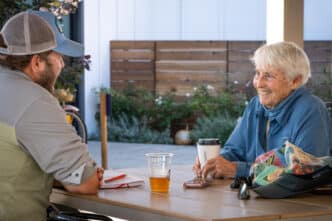

Photos by Rick Chapman
I first met Sally Stoner in a crowded room during a local club banquet.
She’d hunted me down, as she phrases it, to book a trip for “her and her gals” to Iceland. She stood out immediately—not just as a woman in a room filled mostly with older men, but because of her bluntness. She wanted me to take them fishing on the Central Coast first, to test me out and see if I’d be a good fit with her group of ladies when they went to Iceland. Later, when she sent me an email to finalize some details, her legendary sign-off stood out to me: “badass river chix: anglers, artists, musicians, writers.”
Sally is a character—a kind, strong woman who goes after what she wants unapologetically and is a champion for women anglers. She showed up to our first fishing trip in a large white van with her longtime partner Deb Cox—together, they estimate they’ve taught between 800 and 1,000 women to fly fish.
As she opened the van door, a big
sticker popped into view and made me laugh:
“Stoner Chicks Rule.”
From that moment on, you know it’s going to be a good time.
About a year later, my girlfriend was on a road trip with her mom in Montana and asked if there were any fly shops they should visit. I told them to check out Kelly Galloup’s shop—like most fly anglers my age who like to fish streamers, Kelly is a legend—and they swung by to pick up a signed book for me. While at the shop, they kept hearing, “Sally’s back in town!” Asking around, it turned out they were talking about Sally Stoner, who was on one of her annual three-week-long all-women trips to fish the Madison River.

These trips are legendary, it turns out. One of the first things you notice when you see Sally and her group is the wide range of ages and fly-angling skill levels. You have experienced anglers like Sally and Deb, who have been doing this for years, but you also see newer anglers they’ve brought into the fold.
It’s clear when you dig into Sally’s past that she continues a long tradition of women teaching women. Sally started fishing as a kid; her dad was a fisherman in San Diego, but she truly got into it when she stayed in a cabin with her mom and aunt in the Eastern Sierra. There, she learned to fish and spent entire days fishing and enjoying the outdoors, with only women and children in the cabins.
Yet fly fishing didn’t become a major part of Sally’s life until she was in her thirties. By then, she had been a teacher, traveled all around the world, moved to the Central Coast, and landed a job at PG&E. She noticed a fly-fishing magazine on a friend’s coffee table, decided that was how she wanted to fish, took her partner at the time to a lodge on the Fall River, and started her journey as a fly angler.
She credits meeting Maggie Merriman as a life-changing moment. Merriman was an avid fly angler, teacher, and writer, and hugely influential in encouraging women to participate in outdoor activities. In 1994, the Department of Fish and Game started a program called Becoming an Outdoors Woman (BOW), with Maggie leading the inaugural program in California. Sally and Deb later took over teaching the BOW classes at Lake Cachuma and Feather River Inn. For 15 years, they instructed a revolving door of women who came for the weekend to learn everything from fly fishing to canoeing. Sally describes this experience as transformative for most of these women—not only in learning to fly fish but also in gaining greater confidence to spend time outdoors.
Sally has lived many lives through her fly-fishing journey. She’s an accomplished writer, having contributed to A Different Angle, a collection of essays by women in fly fishing edited by Holly Morris. Sally’s essay “Women in the Stream” is a classic tale of fly fishing through the midlife crisis, but instead of buying a motorcycle and traveling cross-country, Sally recounts a fierce battle with menopause and discovering peace among other women along the riverbank. In 2000, Sally published a collection of her own stories, illustrated by Deb, from their travels around the western states, titled Shared Treasures. Deb illustrated moments from their travels with little descriptive notes, and Sally wrote stories to accompany the images. The book sold around 8,000 copies and received positive reviews, including one from Lefty Kreh: “Sally Stoner reveals so well how we “feel” about fly fishing. Deb Cox improves on the writing with her subdued but beautiful art. This is a book to sit down and read when you just want to relax. I promise you will enjoy it.”
Sally has also dipped her toes into the world of TV shows. In 2000, inspired by shows on the Outdoor Channel like Hunting with Hank, Sally raised $10,000 to produce and edit a TV pilot about women fly-anglers called Women in the Stream. The result is a beautiful episode of television, where Sally and Deb fish with Jene McCart, a retired WASP (Women’s Air Force Service Pilots). Like most of Sally’s writing, the episode isn’t about showing off or delving into technical details of fly fishing, but rather about capturing the experience of being outdoors—casting for fish in the company of good friends in beautiful surroundings.
You can tell that Sally poured her heart and soul into this episode, which is still available on YouTube, as she does with everything she undertakes. She’s not one for halfhearted commitment to anything. She spent four days in a studio editing, recording voiceovers, and even getting her friend to compose the music for the show. After putting together a 17-minute pilot, assembling a marketing package, shopping it around, and then finally being approved by the Outdoor Channel to host the show, they had to find their own sponsors to fund it all. This was during a downturn in the fishing industry—fly shops were going out of business—and no company was willing to support this show about middle-aged women, as Sally phrases it, “with no tits or ass.”
Nothing has come easy to Sally in the fishing industry. Soon after the dream of the show died “a silent little death,’ Sally was diagnosed with breast cancer. She partly blames the diagnosis on her struggles to get certified as a casting instructor by Fly Fishers International (FFI)—“hardest damn thing I’ve ever done.” They didn’t have mentors like the ones who help anglers go through the process today, and Sally tried repeatedly to find a good teacher who would help her, only to be ghosted or excluded, along with Deb, from the certification process. But they kept at it, watching Mel Krieger’s tapes to learn. Every opportunity to get tested was taken, each time ending in failure, until, on the fourth try, when they were tested by Simon Gawesworth from RIO, they finally earned their certification. Sally describes “falling into his arms, sobbing” the moment Simon passed her. Many would have given up by then, but Sally and Deb were determined to earn this certification to boost their credibility as teachers.
Sally’s story is inspiring in many ways, regardless of your gender. She has had a clear drive to contribute to the fly-fishing industry—mentoring women anglers and championing the female experience in the outdoors. But the most impressive and inspiring thing about Sally might just be her incredible determination not to take no for an answer and to follow her passion for teaching and fly fishing despite any struggles and adversity life may throw her way. After her breast cancer diagnosis, she went on an all-women’s trip to New Zealand to fish with local entertainer Lynda Topp, whom Sally had taught how to fly fish on the Central Coast. Through this connection, Sally helped establish Casting for Recovery in New Zealand and returned multiple times to teach and fish there.
It’s this quality of Sally’s—the drive to share not just the “how to become a better angler,” but to impart the things that truly make fly fishing special, the little moments shared on the water—that makes her such a legendary figure to those lucky enough to know her. Everywhere Sally goes, she leaves a positive impact on the people she meets. It’s evident through her writing, her TV pilot, and the time I’ve personally spent with her that she’s someone we all should aspire to be more like. She slows down to enjoy the moments, whether it’s a bug emerging or a beautiful sunrise. She’s a keen observer of people, a trait that makes her an excellent teacher. And she’s an incredibly passionate angler, measuring the quality of the day not by how many fish she catches, but by the experiences she has while on the water. You see this in the people around her, who want to be near her.

I’ve met many “famous” anglers during my time guiding in Iceland and California, and a common trait among them is that they often talk a lot about themselves and their achievements, and usually, they’re alone. Not so with Sally— she’s surrounded by a close group of friends who make time to be with her, and she’s never boasting about her own glory tales, but always about the people who inspired and helped her. She’s the first to admit she’s not the greatest angler in the world, but she’s part of a long line of women supporting women in the outdoors. It raises the question: Does being a great fly angler mean having the longest list of accomplishments, being the best caster, or catching the biggest fish? Or does it mean being a positive influence in your community, inspiring others, and contributing in a meaningful way to the fly-fishing world in ways that truly matter to those who have a shared love for this sport?
If so, I think Sally Stoner might just be the greatest angler you’ve (probably) never heard of.


Thank you for introducing Sally Stoner – an accomplished and inspiring woman angler. Glad to know of her, and good for California Fly Fisher magazine for profiling this amazing senior woman angler.
Further proof that women seem to be evolving faster than men. Great article about an amazing woman.