The first fish I remember seeing up close was already dead: A salmon, probably bigger than I was, that my dad brought home from one of his weekend fly-fishing jaunts. It lay spread out on the kitchen table of our Chicago townhouse, bleeding into the Sunday paper that served as Dad’s filleting station. He stood over it like a surgeon, the sleeves of his flannel shirt rolled up, explaining to me something about the fish or the knife or where he’d caught it. I must have been around four at the time. I mostly remember the intense smell and feeling uncertain about witnessing something so visceral.
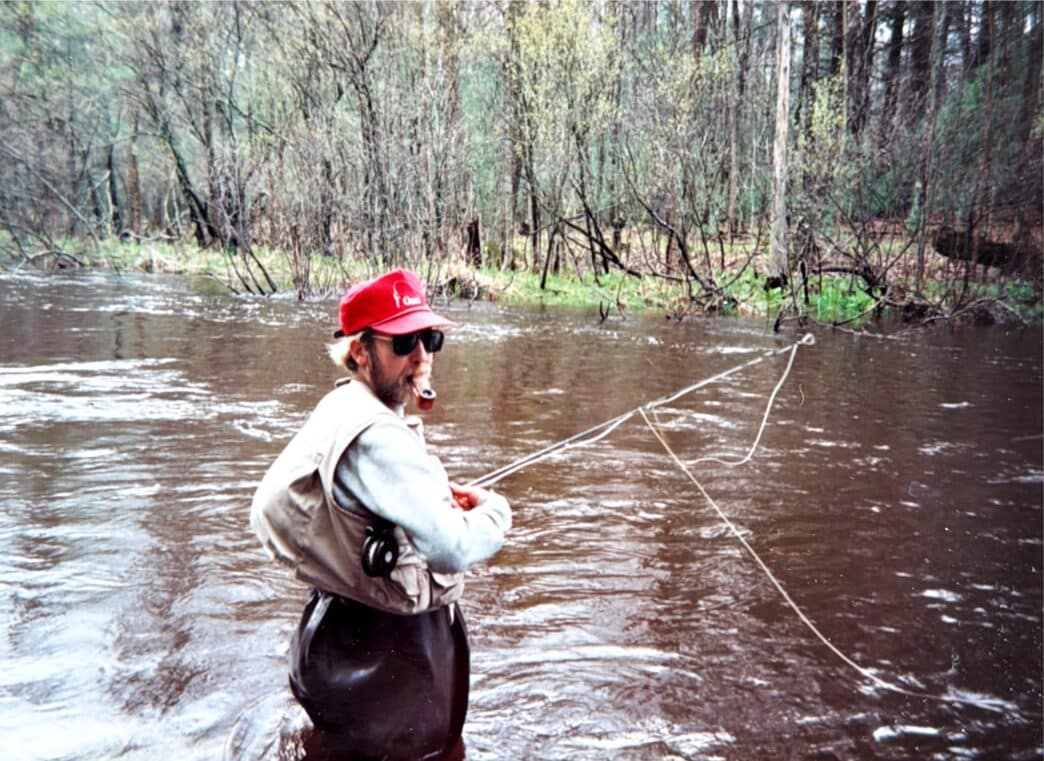
My dad was a poet, a college professor, and an obsessive fly fisherman. Perhaps most pertinent to his impact on me, he was gone by the time I was six. I’ve spent much of my life trying to remember him, to know him. Sometimes I wonder if I took up fly fishing myself as an attempt to cast backward through time.
I didn’t touch a fly rod until my mid-to-late twenties. By then, I’d worn myself out on more vices than I’d care to admit and was finally growing out of the kind of grief that made everything feel like someone else’s fault. I was employed, back in school, finally building a decent foundation.
But I still struggled with the regularness of life on life’s terms. Sober weekends usually meant either gambling or fishing. While fun at first, I hardly made enough money to play poker regularly, and getting skunked enough times in the hot sun made bass fishing lose its luster.
During my third year of sobriety, my mom gave me a bunch of my dad’s old fly-fishing gear. Wading boots, a couple of rods and reels, a pair of waders, and one of those archetypal fishing vests with endless pockets and tethered clippers dangling from the chest. Most meaningful of all were the couple boxes of flies he’d probably tied himself. He was a pretty thrifty guy (which partly explains all the self-tied flies), but his equipment was mostly Orvis and probably among the only things he ever bought brand new. In hindsight, it’s probably best I didn’t have access to these heirlooms earlier in life, as they may have just ended up at the local pawn shop.
I was eager to learn how to use it all. Though I had some experience with spinner reels and deep-sea fishing, I had never really even seen someone fly fishing before, aside from watching A River Runs Through It once or twice (and I’ve since learned that Brad Pitt’s casting is BS anyway).
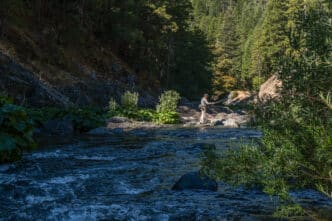
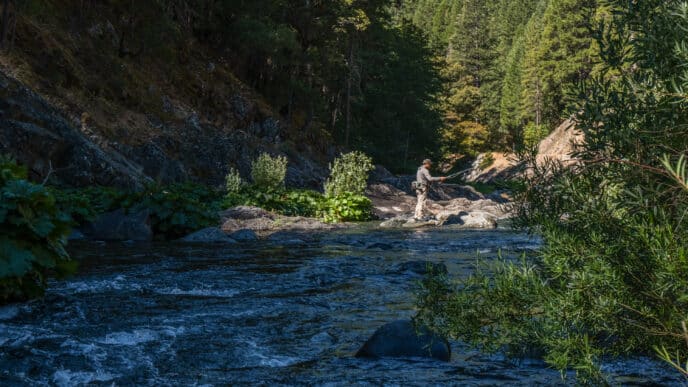
I signed up for a beginner guided trip on the Kern River and was expecting a guaranteed fish in the net by the end of the day. The guide was surprised to see how old my equipment was, inspecting each piece like a museum relic and remarking, “Yep, they sure don’t make ‘em like they used to.” Dad had loopless fly line, so my first lesson was watching how long it takes even an experienced angler to execute a proper blood knot.
The guide had a walking stick and bestowed one to me as well, explaining how it will help me keep my balance in the river as well as scare away rattlesnakes during the off-trail hike to his honey holes. I learned the basics: ten-and-two casting, mending, basic entomology, and even unearthing rocks to match the hatch. We were primarily throwing hopper-dropper rigs, which supposedly doubled the odds of catching a trout. After hours of instruction, a few spot changes, and some fleeting moments that might’ve been bites, my expensive introduction to the world of fly fishing left me feeling overall dissatisfied. The guide would ultimately chalk it up to less-than-ideal river conditions, so at least I had something to blame it on.
I thought about my dad a lot that first day on the river. There was a kind of poetry to the fruitless endeavor of two men, teacher and student, braving the elements in search of treasure beneath the observable world.
Ever since I was a teenager, dragonflies have reminded me of my father. They always seem to show up when I miss him just enough. That day, whenever one passed by while I was out there in his gear, I’d think, “If you’re out there, give me a fish.”
Nothing would happen, of course. But afterward, there was always a feeling I can only describe as nature’s cosmic giggle.
Whether it was fish I was after, or something else entirely, I couldn’t seem to stay off the water.
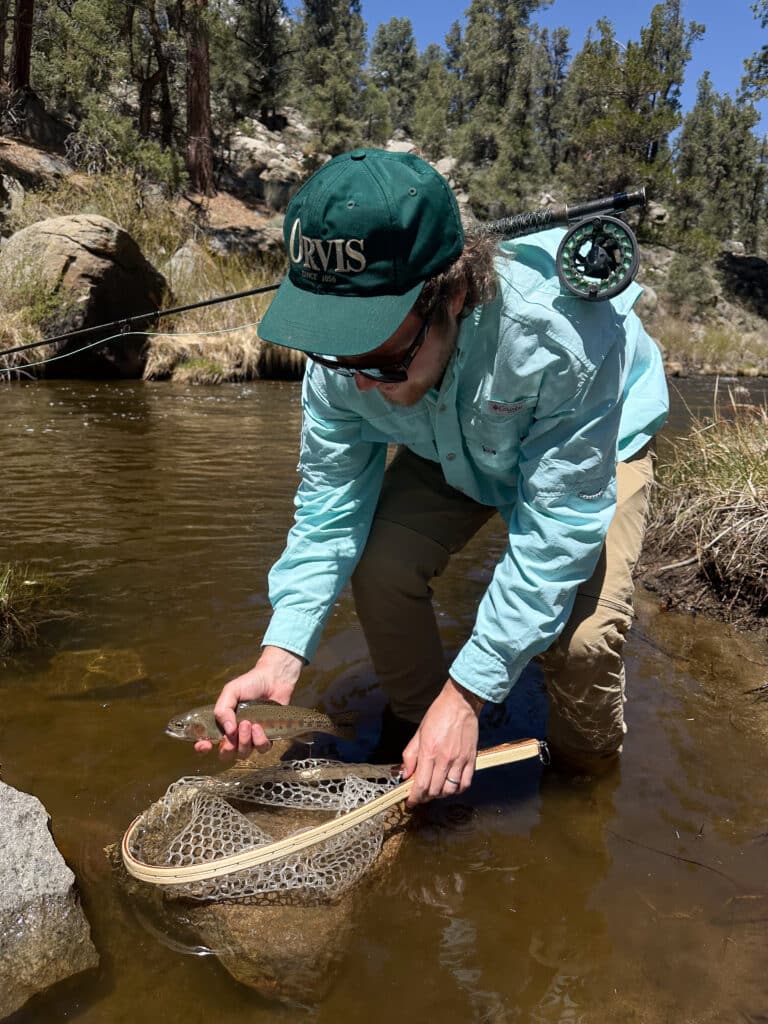
That summer, I was on a camping trip up in Mammoth Lakes with some friends. We spent all day hiking, cliff-jumping, and swimming in the creeks and small lakes near Mosquito Flats. I fished all along the way, switching flies every 50 casts or so when I got frustrated enough to say out loud, “It must not be the right time of day.” By the time we left that area, I had burned through every fly the nearby tackle shop owner swore would do the trick and caught nothing but tree branches and a sunburn. My first experience on the Kern felt like bad luck, but this time felt more like sheer defeat.
With an hour or so of daylight left and not wanting to give up just yet, I peeled off from the group and drove southward to Convict Lake by myself. I walked around the perimeter until I found a spot to cast from and tied on something random from my hand-me-down tackle box. I was guided more by impatience than strategy. As the deepening orange glow of the setting sun danced across the glassy surface of the lake, the sound of crickets hummed louder as the wind subsided. I made peace with such a marvel being my only reward for the extra end-of-day push.
Then it happened.
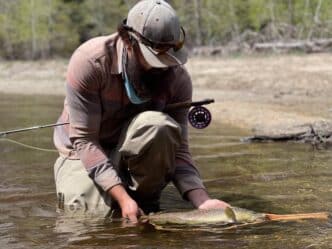
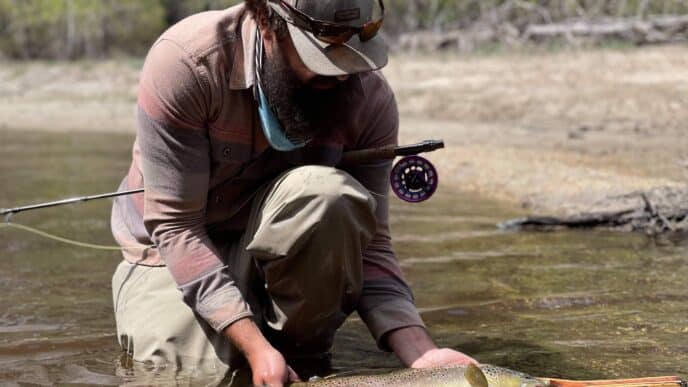
I didn’t even realize the take occurred. In the first second, I was sure I’d snagged a weed, but then my line zigzagged across the surface, and I realized something was alive on the other end. My heart pounded in a way it hadn’t since I got clean. I knew this was a critical moment; I had to contain my elation and keep my guard up or that barbless hook would fly right out. It broke the surface for a moment and flared its tail. I didn’t even own a net back then (never needed one until that moment), but by some miracle I landed that glorious brown trout in my mountain-chapped hands. I couldn’t help but start laughing in disbelief; the cosmic giggle made manifest. Fish in hand, there goes a dragonfly. A gentle nod from beyond.
The moment felt ripe for a quick meditation, but the sun had nearly vanished and I needed a physical witness to my triumph. It wasn’t a brag-worthy fish, but I intended to return to camp with proof. Proof for my buddies who had watched me casting in vain all weekend, and for myself to justify all the energy I’d poured into stumbling through this new artform.
In a seemingly rite-of-passage way, I built a small fire and sloppily cleaned my catch with a pocket knife that had mostly been used to open Amazon boxes. It had more bones than meat on it, and after only a few bites, I confessed that it tasted more like firewood than a filet.
Now, hundreds of fish later, I haven’t eaten another fish I’ve caught on the fly.
Eventually, the sentimentality around Dad’s equipment faded, and it became clear it was time to get my own. His slightly-too-small boots gave me blisters, and my favorite rod in the quiver snapped while I was bushwhacking along the San Gabriel. The second or third time I finally got around to using his old waders that winter, they began to disintegrate in the river, like some slow-motion metaphor. When I brought everything into the Orvis store, the guy behind the counter tried not to laugh before telling me that the 25-year warranty on everything had expired … well, 25 years ago. I didn’t want to let go of his things, but I needed to. I needed gear that fit me. Gear I could dent up and scratch while I learned how to drive.
Like everything else, I had to figure it out on my own, the way fatherless boys do and young men eventually must.
Somewhere along the way, I became a therapist. I sit across from people who are wading through their own murky waters, trying to untangle trauma or grief or meaninglessness. Mostly, I listen. I nod. I wait. Being a therapist feels a lot like tight-lining on the water; you give the line just enough slack to let things move naturally, but stay taut enough to feel the tug when something stirs beneath the surface. The hookset especially matters. Too forceful and whatever’s down there spooks or slips away.
I’m still learning.
But I can read water now.
I know when to wait.
I know when to mend.