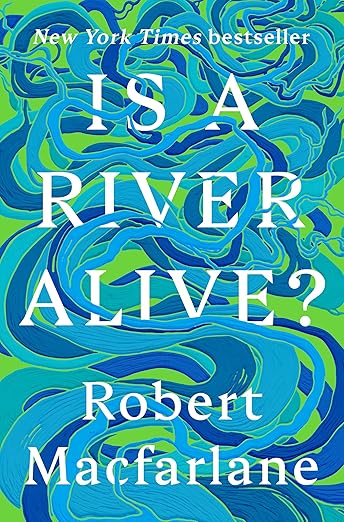
IS A RIVER ALIVE?
By Robert Macfarlane
$32, W. W. Norton & Company
2025
Reviewed by Sean Stiny
To Read
Trout and nymphs, swallows and willows. The flowing water and the stubborn boulders. A river is a damn movable feast of life.
But is a river alive? That’s the question Robert MacFarlane poses in his recent meditation on running waters, Is A River Alive? He travels to three distinct waterways on three different continents to contemplate the question of the book’s title.
Rio los Cedros, a.k.a River of the Cedars, deep in the Ecuadorian mountains, is first on his exploration list. Ecuador’s government gave individual legal rights to the natural world in 2008. Dubbed the Right of Nature, they even rubber-stamped it into their constitution. Everything from the toucan and its trees, the fungi, and the soil beneath them. And yes, the rivers wending their way around the equator down there. All are recognized as legal bodies. Imagine that.
Macfarlane reports back from the cedar forest, “There are only a few hundred cedars left in the cloud-forest now: the others have been felled and dragged out in chains for their soft-grained, sweet-smelling wood.”
The fungi are themselves a character, one whom the mycologist gets on her hands and knees and belly to observe and report (and whisper sweet nothings). To her, “They are another of the earth’s small wonders, like the smallest brook trout may be to you and I.”
At twilight, Macfarlane experiences moths as they “perch on my hat like a fisherman’s flies, on my shoulder like leaves, on my cheek like touch after gentle touch.”
But maybe the life of the river is not so obvious, especially when you think about such rivers as the Cuyahoga in Ohio, which caught fire many times over. It was more chemical than water. Or the Los Angeles River, cemented in, neutered and sterile.
Or even my local Petaluma River, with its tires and sofas and exercise equipment rusted and sunken in the mud. The water is brown. Not a gentle brown either, nor a chestnut brown like an acorn, nor a slick brown like a root beer. But a sludge brown, a molasses brown, a virulent brown. Like the water is just one tick below a solid. Coke cans and energy drinks ebb with the tide that comes up from San Pablo Bay.
But, look a little closer at this blight and you’ll see a kingfisher surveilling the waterway. A snowy egret perched on a branch in the shade. And mallards, lots and lots of mallards, locking wings for splashdown around sunset. And wait, is that a sardine in the kingfisher’s bill? Some godforsaken guppy sentenced to a life aquatic in the Petaluma River, only to fall prey to a fish-hungry bird with an oversized bill. The river is vibrant with life, even amongst the flotsam.
Later, Macfarlane travels to India seeking out another slow-moving serpent of a river. Then onto Canada in his Patagonia vest for a crisp and northerly artery of water. The Mutehekau Shipu (Magpie River) runs 120 miles through Quebec and, in 2021, was granted sovereignty. Yes, it is now recognized as a legal person, with all the rights and recognition occurring thereto.
“To call a river alive is not to personify a river, but instead to further deepen and widen the category of ‘life’.”
So, is a river truly alive? Resoundingly, yes. It’s a living, breathing organism unto itself. Not a parcel to develop, tax, and trade. It cleaves through rock and nourishes everything nearby for millennia, and asks for little in return. Maybe for just a slight reprieve from the boundless encroachment of its shores and the never-ending plunder of its water, but little else. Seems obvious to some. Less so to others.
Read Macfarlane’s rumination on rivers for its otherworldliness. Stand on the shore not for the opportunity at a trout, nor for its Thoreau peacefulness, but for the connection it bestows upon us. Glimpse a river as a fellow creature, rather than a means to an end.
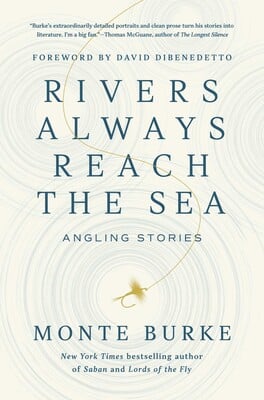
RIVERS ALWAYS REACH THE SEA: ANGLING STORIES
By Monte Burke
$29, Pegasus Books
2025
Reviewed by Sean Stiny
Monte Burke, in his new collection of angling tales, Rivers Always Reach the Sea, is a chip off the old John Gierach block. His fishing haunts are up and down the Eastern Seaboard, though. From Labrador for Atlantic salmon (“an ideal spot for introverts with bear spray”) down to the Bahamas for blue ribbon tarpon.
John Gierach, whom we lost a year ago, was indeed the journeyman storyteller of all things angling. The fishing scribe paterfamilias. Flies and boats and ponds and trucks. Fishing buddies and songbirds and dogs and beer. A cornucopia of tales and yarns, every slant and personality that goes into this damn crazy fly-fishing thing.
In each of his stories, Burke sets out on boats and skiffs to hook more formidable quarry. It’s not Gierach’s small stream tales for cutbows. But his love song for the cast and the take remains the same. In earnest, Burke writes, “Love is probably not strong enough of a word. I was, and remain, incurably drawn to water. The fly rod has been my downing stick.”
He fishes New York (not upstate, mind you, the harbor, as in the damn New York Harbor around Lady Liberty; he even eats a keeper striper out of it), New England and its Thoreauvian streams, and the Keys down in sweaty Florida. A lot of Florida. A whole lot. He even ends the book tarpon fishing with popular Florida novelist Carl Hiaasen (friend of Thomas McGuane and the late Jim Harrison).
Another chapter follows Andy Mill, formerly of the U.S. Ski Team, now of the Florida tarpon team (if such a thing existed). Mill wins tarpon tournaments, guides for tarpon, and, I suspect, is part tarpon himself (surely his jaw angles slightly up).
In one of the closing tales, Burke puts his rod down to document a lake, a pond really, in Escondido, California. Dixon Lake (Dixon Pond, really) gets planted with thousands of pounds of hatchery rainbows each year by the CDFW. Enough to fill stringer after stringer, every campfire and barbecue clear to San Diego. Thing is, the pan-sized trout also fatten up the largest largemouth bass in the country. A 25-pounder has been hooked at Dixon Lake, and Burke was there to witness it.
But talk of the ‘greatest this’ and the ‘largest that’ doesn’t stir Burke the same way as streams and songbirds. “Turn off the phone. Take the music speaker out of the boat. Take a look around. Listen to the river or the flat. It’s telling us something.”
Short stories like his make for good reading in the warm sun during an afternoon lull. Or next to a fireplace for a couple of minutes before your eyelids are weighed down after a day on the water. And like Gierach, Burke has some one-liners and quips that are immensely quotable. “My line, perhaps not totally dry from the day before, was kinkier than Rick James.”
Burke assures that each day on the water, each fish, hell, each cast, is a story. As long as your fly spends more time in the water than not. And a lifetime of stories make up an angling life. “Fly fishing is, after all, a love story. And like all loves, it needs constant care and maintenance.”
Burke is well in line to carry the Gierach torch. As long as he keeps up the writing. And fishing.
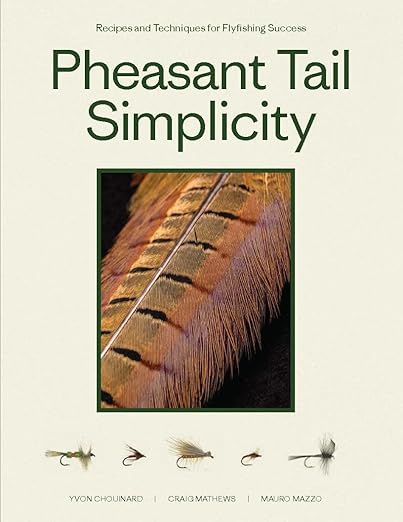
PHEASANT TAIL SIMPLICITY
By Yvon Chouinard, Craig Mathews, and Mauro Mazzo
$25, Patagonia
2025
Reviewed by Sean Stiny
Is it not the dream of every sportsman and sportswoman to:
- Drop a pheasant rooster in fall.
- Tie a pheasant-tail pattern with it in winter.
- And catch a trout on it in spring?
The full circle. At least for this sportsman. A badge should be given for such an angling accomplishment. Like a Boy Scout badge. Perhaps a masters scout badge. Masters, the polite way to say, ahem, older.
Such is the topic of Pheasant Tail Simplicity by Yvon Chouinard, Craig Mathews, and Mauro Mazzo. Yes, that Yvon from Patagonia. Each author takes a stance in favor of one kind of angling, with fly patterns to match. Yvon and Mauro prefer wet fly patterns for nymphing, while Craig is partial to dry patterns that match the emergers in the running water before him. Craig is a man after my Royal Wulff heart.
In his intro, Yvon proclaims this a guide not for beginners, nor for gearheads or anglers who fish with reckless abandon. This is for the angler who sits at his vice with a mess of upland feathers and traces back to quiet observations had on the water.
He identifies five important aspects to fool a trout with a fly and ranks them as follows:
- The position of the fly. Did you present the fly where the trout are feeding?
- The action of the fly. Is there drag on it, or does it float with a natural twitch?
- The size of the fly. If the fish are feeding on sliders (size 18s), don’t present them with a woolly bugger double cheeseburger.
- The shape of the fly. Does it look real, or do your grasshopper legs look all catawampus?
- The color of the fly. If the drakes are brown or olive on the water, don’t throw a pale dun at them.
The result at the vice is a fly similar to one you’d buy at your shop, but singular to a river, a hatch, and an angler. These are flies to be tied, forgotten, then pleasantly rediscovered in a riffle with your open fly box. The pheasant tail you tied several months back is surely the foolproof one to rouse a hungry trout.
This is a photo book as well. And a swell one at that. The artistry at the vice is captured in close-up for every thread and loop and turn of every fly. Me, I’m partial to the X Caddis, “arguably the simplest dry caddis pattern on the planet.” The simplicity is a few pheasant tail barbs wrapped around a metal hook, with a deer-hair cape and tail. Simple, effective, perfect for the discerning dry fly connoisseur.
The close-ups of pheasant and Hungarian partridge feathers (Huns for you uplanders) are spellbinding. Each fiber is singular, but urgently important to the entire feather. So too are the vanity shots of grayling dorsal fins in Italy, underwater bonefish in the Bahamas, and a hatch on the Henry’s Fork as thick as a London fog.
The best photo books glue you to your seat while also making you want to jump out and go. That’s how this one feels. The shot of the Firehole River with steaming geysers and the sunrise ablaze, well, it takes me to a chilly morning I had in Yellowstone watching a herd of bison ford the Madison.
Near the end, Mathews recounts fishing the Madison while knee deep in December snow. “My attention was drawn to a pair of mature mallards as they lifted off the quiet water near the shoreline. I wished I’d had my shotgun, since I’d promised friends duck for Christmas dinner.” A white Christmas trout tale with “small flies on light tippets” would have to suffice.
The most important lesson, though, is in the book’s title. Simplicity. In a pursuit that’s become overrun with gear and plans and the latest gadget on your vest or app on your phone, simplicity is routinely overlooked.
A simple fly pattern gently presented at the top of a riffle and given the hope that a rainbow or brookie will rise. That’s the essence of it. No more and no less. The rest is insignificant. What pair of wading boots you wear, the latest hickory-handled net swinging on your back, the lightest wading staff, the vest with the most pockets. All neat, all fun.
But they distract our attention away from the true pursuit, the true presence of angler and trout. And the pheasant tail that may align the two of you for a single moment in time.
To Watch

THE LEMURIAN CANDIDATE (2025)
Comedy
Crossing Bridges Films
Written and Directed by Casey Cooper Johnson
Reviewed by Yeti and Gangiman
On a cool night in November, on the eve of a fishing trip, two anglers travel to Shasta to see The Lemurian Candidate.
Gangiman: It’s the Shasta Parable. A conflict of: Civilization’s constraints and the liberation of the wilds; Ho-hum reality and the absorption of myth; The worthlessness of being wasted and Shamanic insight; Camping as a pleasant misery and the lure of home.
Yeti: Nice summation, Gangiman, but I get the sense that this movie is low budget in every aspect. It’s a silly, ridiculous, and at times humorously wacky buddy film set in the idyllic town of Mt. Shasta and the majestic mountain itself. Three friends go on a drug-fueled camping trip. Two are there to do an intervention on Jesse, who suffers from mental illness, while Jesse secretly aims to find the portal to the Lemurian City of Telos, with whom he has been secretly “communicating” back home. The humor is juvenile; the drug trips, though realistic, are just mildly comical distractions; and the “save your buddy” plot is utterly predictable and tired.
Gangiman: We measure the quality of something based on our experience minus our expectations. It was great partly because we had low expectations. This is a campy, low-budget film, but writer-director Casey Cooper Johnson accurately depicted the myth (or scientific hypothesis) of the Lemurians who fled the sinking Lemuria Continent to find refuge in the hidden city of Telos under the sacred mountain of Shasta. The harshest critics would have been the Shastans we saw the movie with, but they found it legit, calling out local spots, laughing at the CGI drug trip experiences, and cheering local legend Jack Trout’s cameo as ‘trippy smiling guy’.
Yeti: Speaking of low or erased expectations, there was a strong skunky smell in the theater that night that enhanced the viewing experience once the contact high kicked in. As I started to feel the Lemurian vibe, the film became legitimately funny. I still find myself laughing out loud about Stan (Oliver Cooper), who’s on a serious trip from ingesting tree frog poison and ends up making hallucinogenic love to a manzanita bush. Declaring, “Man, I really screwed up! My wife is going to find out, she’s smart!” Cooper’s comedic timing was the highlight of this classic stoner film. Honestly, among the pantheon of stoner films like Up in Smoke, Fear & Loathing in Las Vegas, and Superbad, this one will endure.
Gangiman: I concur, it could become a cult classic. Escape from reality was the consistent theme. We escape too when we go to Shasta. Even when you’re not catching fish, it’s a great front for spending time outdoors. I’m often just hunting around for a rock shaped like a lounge chair. A few steps off the trail, though, and you could get lost. There was a moment in the movie when it was clear that the three of them could get into serious trouble. They weren’t map-and-compass types. Each character faces their own life, which leads them back to each other. People lost in the woods often die of shame, but with the right mindset, it’s a journey, an adventure.
Yeti: Speaking of ‘escape from reality,’ we can’t overlook the mental health aspect of this film. Three friends go on a camping trip, and two of them secretly plan to do an intervention on Jesse, who seems to suffer from some form of schizophrenia but refuses to take his meds. They know Jesse is on the verge of a “breakdown” and needs help, but Jesse believes he’s actually on the brink of a “breakthrough.” The Lemurians have beckoned Jesse to Shasta to travel with them back to their home planet. There’s a theme of delusion and mental illness versus revelation and escape. You’ll need to watch the movie to see whether Jesse has a breakdown or a breakthrough. Jesse aside, I agree with you, Gangiman—that Shasta is also our escape. Long days hopscotching mossy bowling balls in the river, trying to divine the whereabouts of trout, are partly delusional and partly revelatory. It’s also pretty great for my mental health. A day on the water is filled with little breakdowns punctuated by the dopamine-pumping breakthrough of a fish on the line. I paraphrase something I read in this magazine recently, that “success is measured by hours on the water, not fish caught.” Amen to that—and I believe the Lemurians, if they fish, would agree.
I guess the big question is, do you believe in Lemurians?
Gangiman: It’s hubris to dismiss things just because we haven’t seen or understood them. I’m open to the idea that there are things we don’t know. UFOs, now called UAPs (Unidentified Anomalous Phenomena), are openly discussed at the government level. I am more apt to believe the dark forest theory—that these entities exist but are smart enough to avoid us. Sasquatch would have long been conscripted to a day laborer. Nature offers endless fascination: In Shasta, we have water traveling through underground tunnels and springs that lack radioactive isotopes, indicating the water fell to earth possibly more than 75 years ago. Maybe we will be caught unawares. Did they find the Lemurians in the movie? I think we recommend seeing it to form your own conclusions. By the way, Yeti, do you believe in Lemurians?
Yeti: Gangiman, I want to believe, and really, the essence of belief is cocktail blind faith, optimism, and curiosity.
Yeti is artist Bob Nydam who paints in a fever dream directly from his subconscious. @Nydam_art
Gangiman is architect Mark Gangi FAIA who designs places that evoke memories of civilizations that never existed.
Both are passionate fly fishermen who have spent many years on trips to Shasta under the casual mentoring of Craig Ballenger.
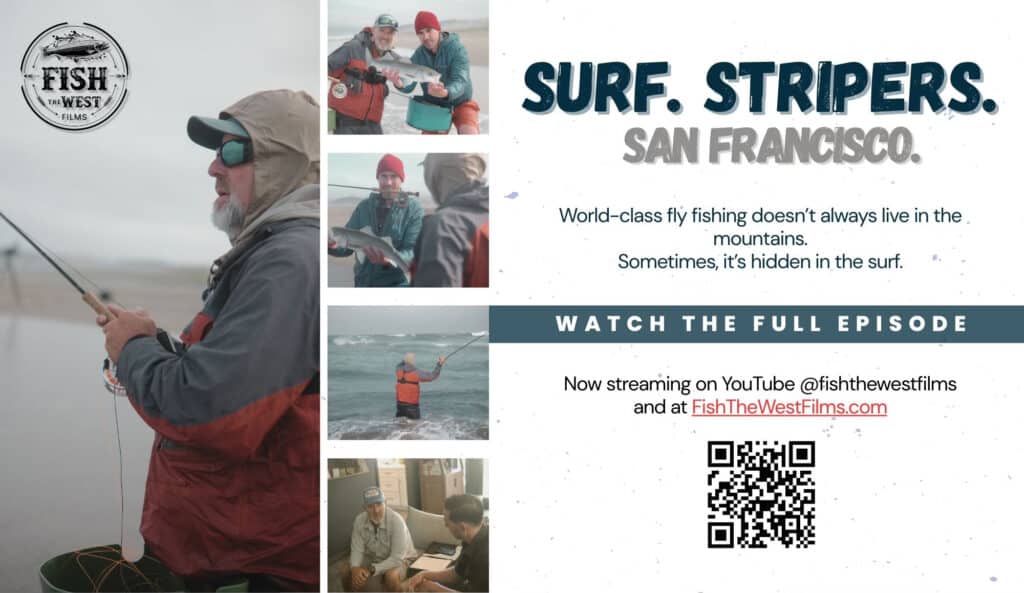
FISH THE WEST FILMS: EPISODE 3
THE URBAN ANGLER’S REVOLUTION, GEORGE REVEL
Director/Producer Devan Homis
Host/Producer Guy Jeans
Available on YouTube at Fish the West Films
In this episode of Fish the West, host Guy Jeans heads into the rugged surf of the San Francisco Bay Area with George Revel—national casting champion, guide, and one of the most influential figures in California fly fishing. While many anglers overlook the surf, George has spent decades learning its rhythms—reading tides, currents, and structure to intercept striped bass moving through the breakers. This fishery is raw, technical, and unforgiving, demanding precision, patience, and commitment from those willing to step into it. Beyond the surf, this episode explores George’s impact on the fly fishing community—from rebuilding casting culture in San Francisco to shaping generations of urban anglers who now see the coast as legitimate, world-class fly water.