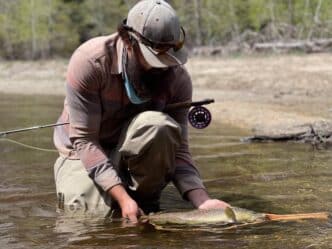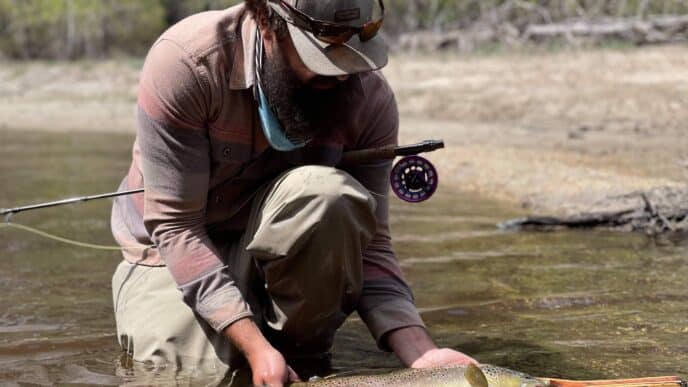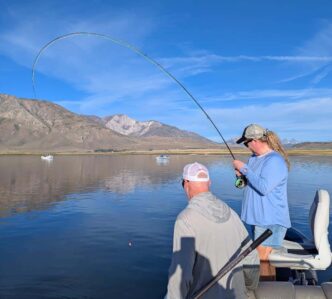
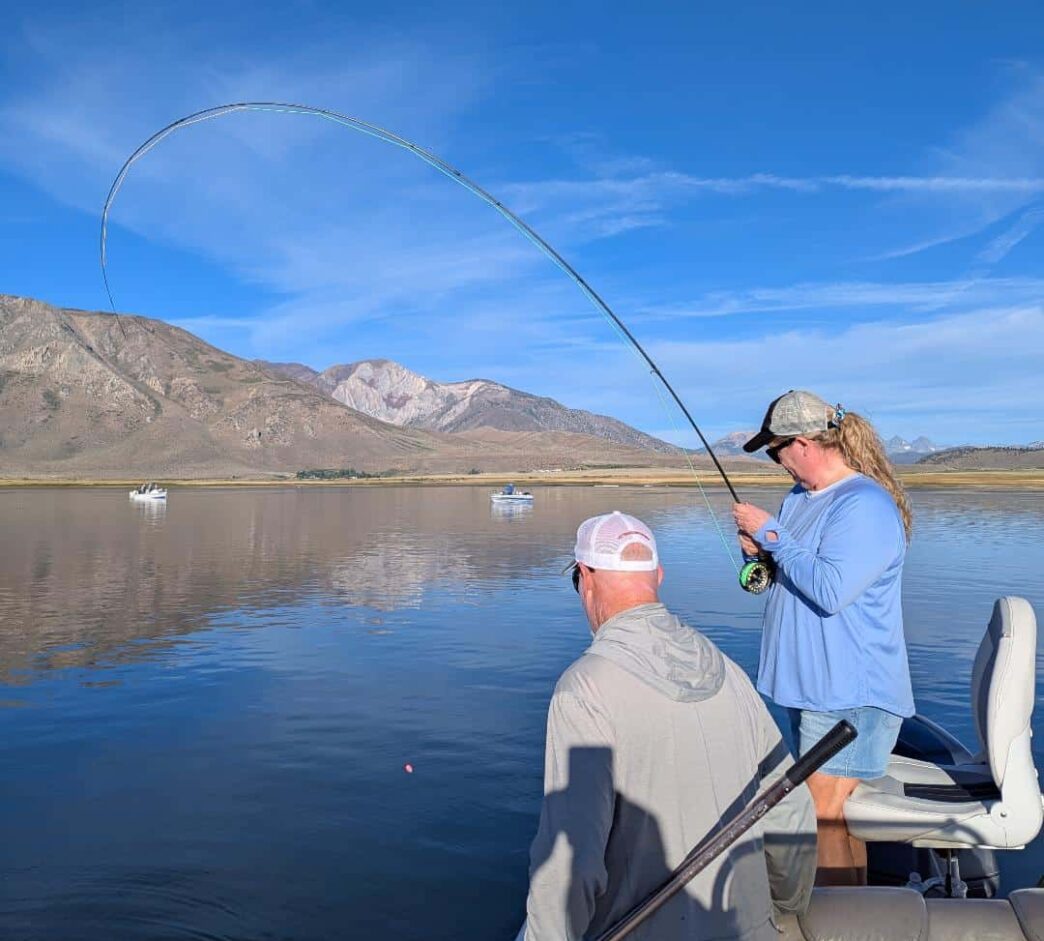
All I heard was Joe saying to Kirsten, “You’re on fire, girl!” I listened to that repeatedly all morning. Then Joe looked at me on the bow of his boat and said, “Come on, Lance, hook one!”
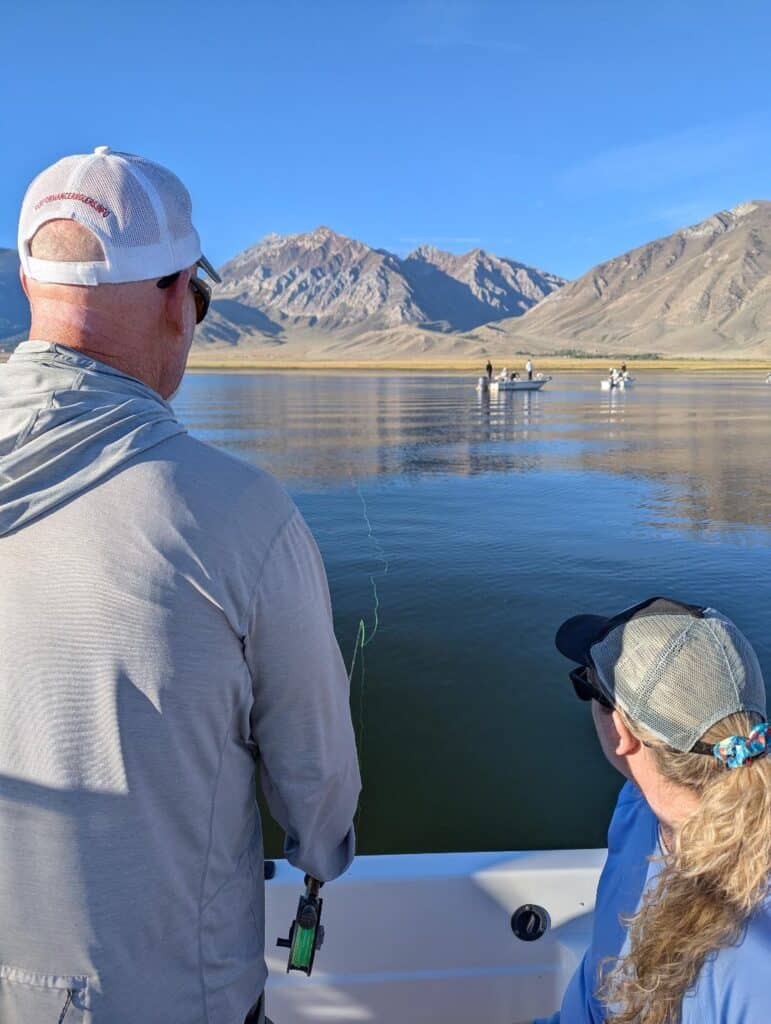
Kirsten and I fished Crowley Lake last summer with veteran guide Joe Contaldi of Performance Anglers. We met Joe at the Crowley Lake Fish Camp boat ramp and hopped into his boat. We motored out to his “secret” spot at McGee Creek only to find it’s not so secret anymore. About 15 to 20 boats were already there, so we anchored 100 feet from the others. Joe laughed and used his trolling motor to perfectly align the boat in our chosen spot. Joe is like me at Almanor. I know which way the fish move and where the weed beds, mudflats, and bottom shelves lie. When we align our boats, we do so to be in the most favorable position to get our flies in front of moving or feeding fish as much as possible.
We started fishing at 8 a.m. and finished just two hours later. We landed 25 fish—15 for Kirsten and a modest 10 for me. Joe was netting fish left and right. We landed browns, rainbows, and cutthroats all on midges under indicators. Many times, on the cast right after releasing a fish, the flies had only a few seconds to soak before the indicator disappeared again. It was nothing short of a fantastic morning.
Crowley Lake’s cold water, thriving aquatic insect population, and stocked fish make mornings like this possible. Did I mention the lake is easily accessible? It is. This combination makes Crowley Lake a fly-fishing wonderland.
CROWLEY LAKE BACKGROUND
Crowley Lake was formed in 1941 when the Los Angeles Department of Water and Power (LADWP) built the 126-foot-high Long Valley Dam on the Upper Owens River. The lake is named for a local hero and padre, Father John J. Crowley, aka “The Desert Padre.” At an elevation of 6,939 feet, the lake is approximately 12 miles long and five miles wide, impounding about 183,465 acre-feet of water. The lake’s deepest spot is about 100 feet, and it features many flats and coves, with depths ranging from 12 to 25 feet. At the south end of the lake is Crowley Lake Fish Camp, which, in cooperation with LADWP, provides lake access to all visitors. Visitors looking to bring their watercraft, camp, or rent equipment on the lake must go through the Fish Camp gates, open Sunday through Friday from 6 a.m. to 9 p.m. and Saturday from 6 a.m. to 10 p.m. If bringing your own watercraft, stop by the free Quagga Mussel Inspection at the Fish Camp.
FISH STOCKING
The California Department of Fish and Wildlife plants 430,000 fish annually; additionally, there are privately funded fish plants and spawning fish in the lake. Nick Buckmaster, CDFW’s lead biologist for Crowley Lake, shared that in 2024, CDFW stocked about 334,000 trout, and the recent 2025 hatchery die-off did not impact the hatchery that supplies the lake. While all the fish planted in Crowley are fertile, Nick said they don’t see much reproduction from the rainbows. CDFW expects to stock the same number of browns, rainbows, and Lahontan cutthroat trout this year as it did in 2025, possibly more.
SEASONS AT THE LAKE: SPRING
Spring fishing kicks off the last week of April. This early in the season, the fish are still scattered throughout the lake. For fly fishers using personal watercraft, the coves and inlets are prime fishing spots. Alligator Point, Green Banks, McGee and Hilton Bay, Layton Springs, and Sandy Point offer easy access and plenty of fish. These shallow-water areas are characterized by highly oxygenated water, weed beds, and scattered springs throughout the inlets and coves. Weeds are relatively low early in springtime, but by summertime, they are tall and flow with the currents. Fly fishers need to use a combination of flies and tactics during this time. Midge flies and balanced leeches fished under indicators, stripping damselfly patterns, Callibeatis nymph, and leech patterns are all productive. A bugger or leech pattern trailed by a nymph like a Prince Nymph or Lance’s Swimming Black AP can be a killer combination in a trolling and stripping situation.
For fly fishers using larger boats, the entire lake is accessible. You can reach all the coves and inlets and fish the mud flats beside the old creek channels. Midge or balanced leech fishing is popular, especially focusing on midges. Anchoring with a traditional or electric-motor anchor is required. Deep- and shallow-water indicator fishing is the ticket. Often, the midges only soak for a few minutes before hungry trout take them.
SUMMER
In late June through the first of September, the weed beds can reach 13 to 15 feet tall. Fly fishers in personal watercraft can concentrate their efforts around weed beds, channels, and floating dead weed beds with Callibeatis and damselfly nymphs. June and July are fantastic months for the damselfly hatch. Stripping damselfly nymphs on an intermediate line is a terrific and rewarding day. One of the best nymphs for Crowley Lake is The Zack Attack Damselfly Nymph.
In late June and early July, Crowley Lake is prone to algal blooms. These blooms usually coincide with the lake turning over. Fish tend to seek the cold waters of coves, inlets, and around the lake’s springs. McGee Bay, Crooked Creek, and Hilton Bay are prime spots to fish during this period. There may also be a Daphnia hatch at this time. Daphnia is a tiny crustacean that serves as nutrient-rich food for trout. During this period, Daphnia gather to mate and lay eggs. When they cluster to reproduce, they form small, orange and chartreuse balls—using a Daphnia bundle fly works well here. I also like to use a fly I designed for the same creatures in Lake Almanor—I call it the Lake Almanor Special Balanced Leech. This fly performs great under Ernie’s Indicator rig.
Come late July and early August, the algae bloom begins to die off, and the trout feed on baby perch in the shallow water and the lush weed beds of the coves and inlets. Both damsels and perch fry can be found seeking refuge in the weed beds. Many midge hatches occur during the cool morning hours, allowing the fish to return to the mudflats to feed. The areas to focus on during these dog days of summer are Green Banks, McGee Bay, and the Layton Springs. Fly fishers in large watercraft should concentrate their efforts early in the morning in the spring-cooled waters.
FALL
Fishing remains just as good in the fall as in spring, with fewer people on the water. The water has cooled, the algae bloom is diminishing, and the fish are once again scattered, feeding on whatever they can find: midges, leeches, perch fry, and other available food sources. Fly fishers using personal watercraft should target the coves and inlets. Those in larger motorized boats can fish anywhere on the lake. Fish tend to feed in transition zones. Inlets, dying weed beds, drop-offs, mudflats, and old creek channels all become productive spots. This is also the time I like to strip flies. My favorite is stripping the famous Loe’s Punk Perch fly. The perch provides a rich protein source for hungry fish.
ASK THE CROWLEY LAKE EXPERTS
I reached out to several guides and shop owners around Crowley Lake, asking them to share their knowledge. The morning Kirsten and I were fishing with Joe Contaldi, I asked him what his favorite midge fly was. He laughed and said, “The one I have tied on.” I saw that coming. I stripped in my fly line and looked at the midge flies he had rigged on the rod. There was a Tiger Midge with a Krystal Flash tail and a Gray Midge. Joe usually ties his own midges, and they’re not a set pattern. Like many guides, he puts an individual twist on common flies. The Tiger Midge features a copper tungsten bead, a black-thread body, and a copper wire rib. In some circles, this fly is called a Copper Top Midge. Joe’s version had a single strand of pearl Krystal Flash as a tail. The other fly was a Gray Midge with a black tungsten bead, a gray thread body, a silver wire rib, and a single strand of Krystal Flash tail.
I contacted Kent Rianda, owner of The Trout Fitter fly shop in Mammoth Lakes. I asked Kent when his favorite time of year is to fish at Crowley Lake. He shared not a favorite time, but the time with the highest probability of catching the most and biggest fish. I dubbed it the “McGee Miracle.” Each year, as the water temperature rises, it reaches a point, usually around 70 degrees, where the fish are drawn to two sources of cold water. The largest source is the mouth of the Owens River, but since it is usually heavily weeded out so guide boats can’t even get there, restricting it to float tubes.
The second-largest source is McGee Creek, and sometimes, during July, a fish migration occurs for a very brief period, roughly two or three days. The fish will concentrate over the underwater stream channels for a week to 10 days until they disperse. The temperature could be 62 degrees at the bottom of the channel, and just 10 feet off to the side, it might be 66 degrees. If your timing is right—especially if you happen to be there on the first or second day—catching 10 fish over 18 inches is not uncommon. As word spreads about the fishing, pressure increases and you may struggle to find a place to anchor a boat. The fish spread out instead of just parking right over the underwater stream channel, which causes the catch rate to decline, but it still remains excellent for a couple of weeks.
When I asked Kent about his favorite tactic to fish Crowley, he didn’t hesitate with his answer, “midging,”—fishing a three-midge setup underneath an indicator. The top midge flies that Kent recommended are the Albino Baron and Kent’s Olive Optimidge.
Fishing streamers in Kent’s words is the “lost art,” and big fish love streamers. The area where the fly fisher needs to concentrate while fishing streamers is at the edge of weed beds at low light, early mornings, and late in the evenings. Kent also recommends streamer fishing from a personal watercraft. He likes the float tube advantage of getting close to the weed beds and fishing parallel to them. He added that the tube is constantly moving. Stripping perch, Tui-Chub, and trout fry imitations approximately four inches long are the ticket. Kent’s favorite is the Perfection Perch. Kent likes the SA full-sinking fly lines in Types 2 to 4, depending on water depth. This tactic is especially productive for big browns.
Kent’s tip for fly fishers who want to learn the lake is to hire a guide. Guides can provide up-to-date information on locations, rigging, and flies, giving anglers the information they need to plan future trips to the lake.
Next, I checked in with veteran guide David Carranza, with Trucha Fly Fishing. David spends the season at the Crowley Lake Fish Camp RV park guiding or fishing on the lake every day. He was quick to answer the favorite fly question. He likes two midge patterns, the Copper Tiger and the Blood Midge or Mud Candy, in sizes 14 and 16. David stressed that he likes fly hooks with a bend—hooks like the Daiichi 1760, Tiemco 200R, 2457, and 2488. David also likes to fish streamers with leaders that are 7 to 9 feet, with a minimum 3X tippet. David shared that “Crowley trout are not leader shy, especially when they are on the hunt and prowl for moving food sources.” He also suggested that if you’re fishing in or around the weed beds, you should go with heavier 0X–2X tippet. They slam the streamers!
Last but not least, I talked to veteran guide and owner of Rick’s Sports Center, Rick Flamson. I asked Rick what his favorite season was to fish the lake. He likes June because the fishing is excellent, but he also likes October. “October is a great month,” said Rick. “The fish are eating, and there are fewer folks on the lake.” Asked which midge fly he likes, Rick stated, “That’s a hard one.” He likes to pump the stomach of the first fish he catches to match the contents to his midges. For streamers, he likes to fish what he calls a tag setup—basically an indicator setup with a midge as the terminal fly and a small balanced leech, perch fry, or damselfly nymph as a dropper, tied off a tag above the midge. He recommends twitching this setup now and then to add animation to the flies. For personal watercraft users, Rick recommends fishing Hilton Bay, Sandy Point, and Green Banks.
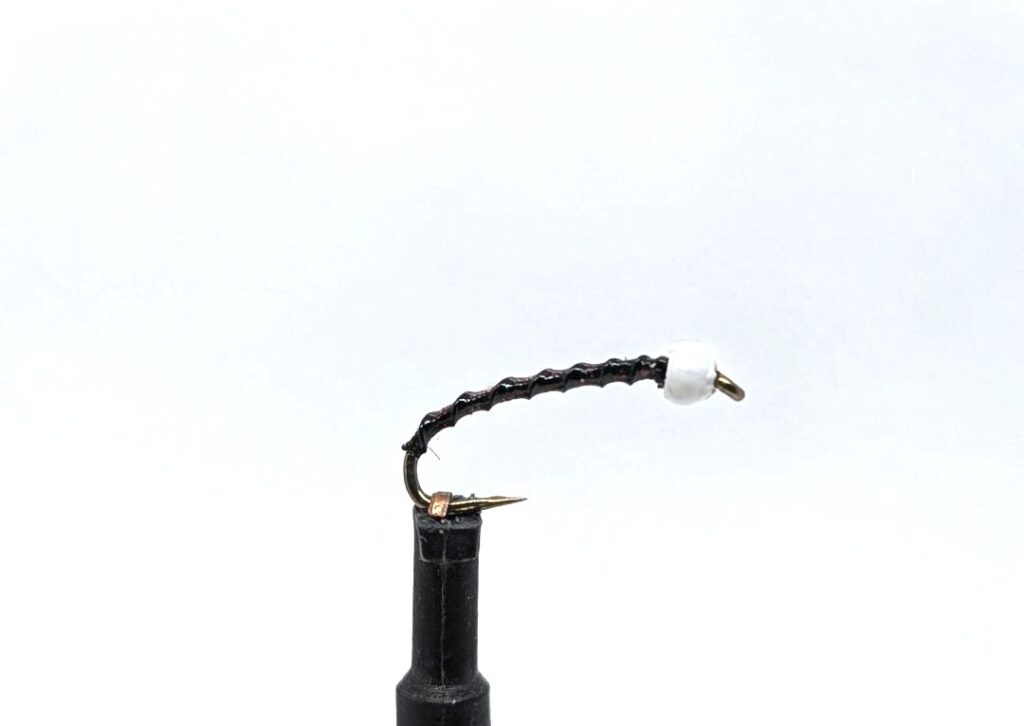
Mud Candy Midge
Hook – Daiichi 1760 Size 14-16
Bead – White/pearl tungsten bead to match hook size
Thread – Danville Flymaster wine
Rib – Black BR wire
Finish – Solarez Bone Cure
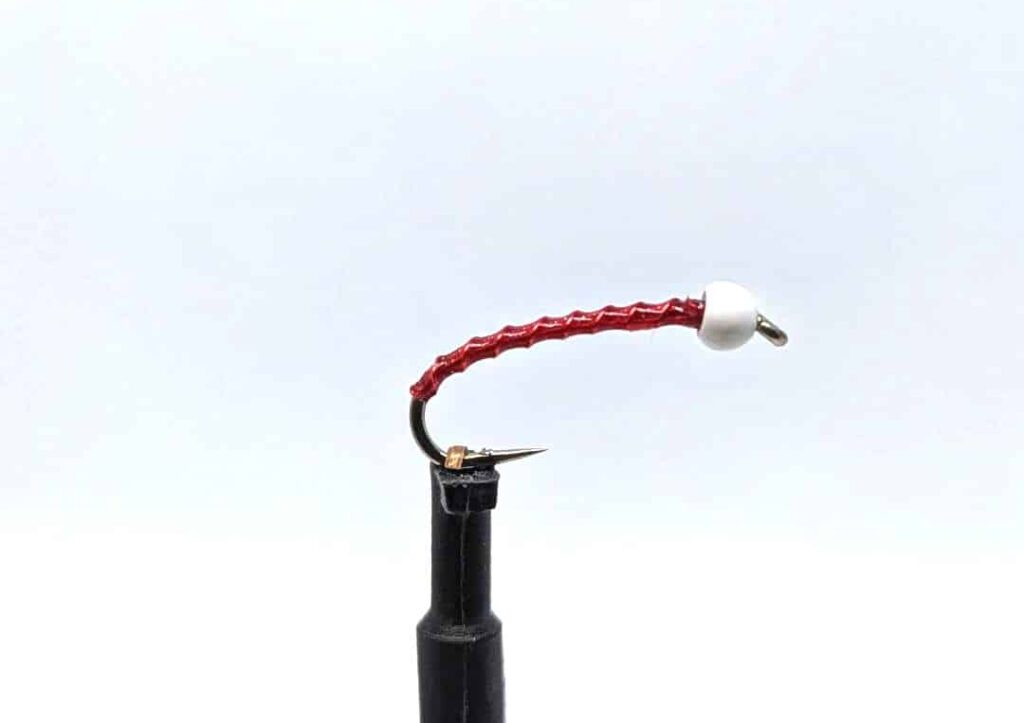
Blood Midge
Hook – Daiichi 1760 size 14-16
Bead – White/pearl tungsten bead to match hook size
Thread – Danville Flymaster red
Rib – Red BR wire
Finish – Solarez Bone Cure
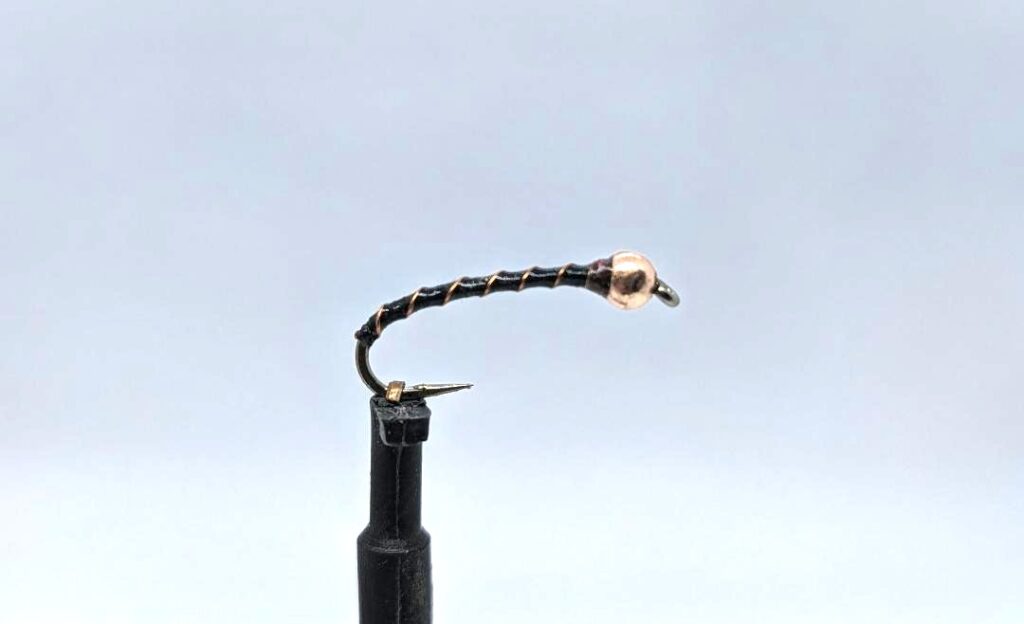
Tiger Midge
Hook – Daiichi 1760 size 14-16
Bead – Copper tungsten bead to match hook size
Thread – Danville Flymaster black
Rib – Copper BR wire
Finish – Solarez Bone Cure
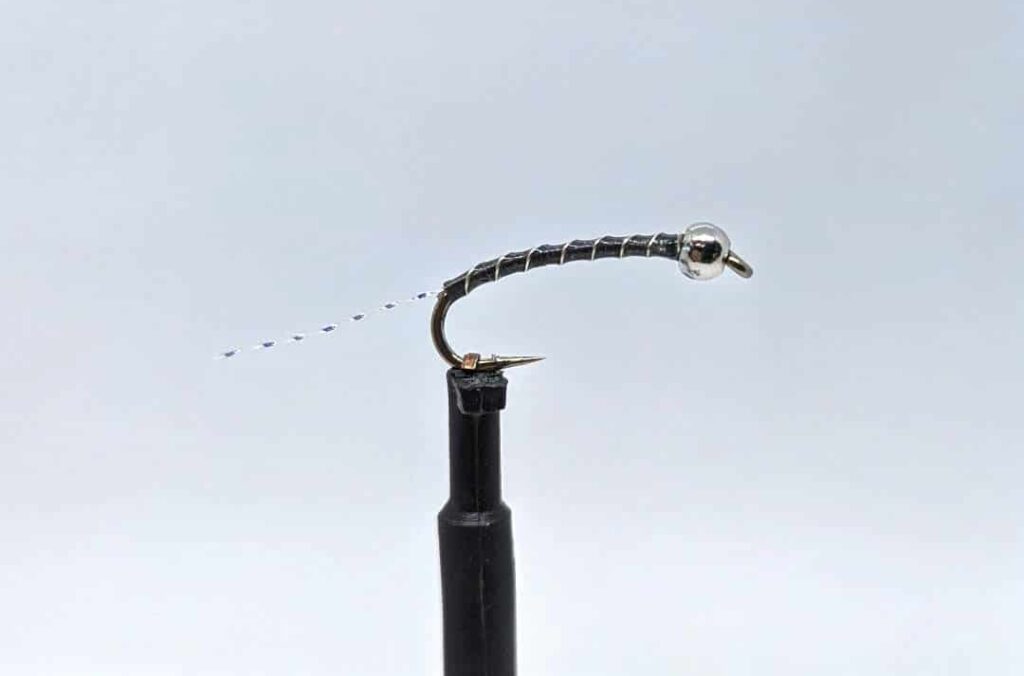
Joe’s Gray Midge (Lightning)
Hook – Daiichi 1760 size 14-16
Bead – Silver tungsten bead to match hook size
Thread – Danville Flymaster gray
Rib – Silver BR wire
Finish – Solarez Bone Cure
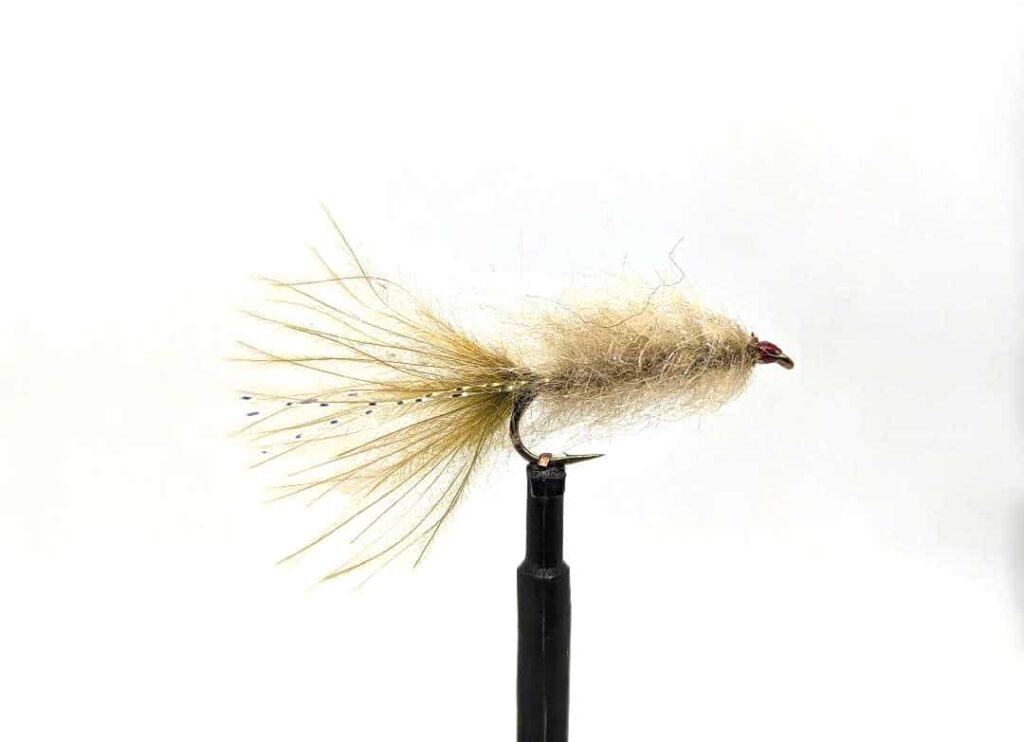
Tom Loe’s Drifter’s Punk Perch
Hook – Daiichi 1710 size 6-16
Thread – Danville Flymaster olive
Head – Danville Flymaster red
Body – U.V. Light Olive Ice Dubbing/U.V. Black Ice Dubbing mixture
Tail – Brown olive marabou
ABOUT CROWLEY FISH FOUNDATION
The Crowley Fish Foundation is a volunteer-based, nonprofit organization dedicated to preserving Crowley Lake and its tributaries as a world-class fishing destination.
The foundation consists of fly-fishing guides and professionals from all walks of life who volunteer their time and skills to protect the region’s watersheds and enhance the experience for people at Crowley and beyond. Joe Contaldi, the foundation’s president, aims to get veterans and youth out fishing and putting a smile on their faces … and his.
To learn more and support the foundation, visit CrowleyFishFoundation.org