To Read
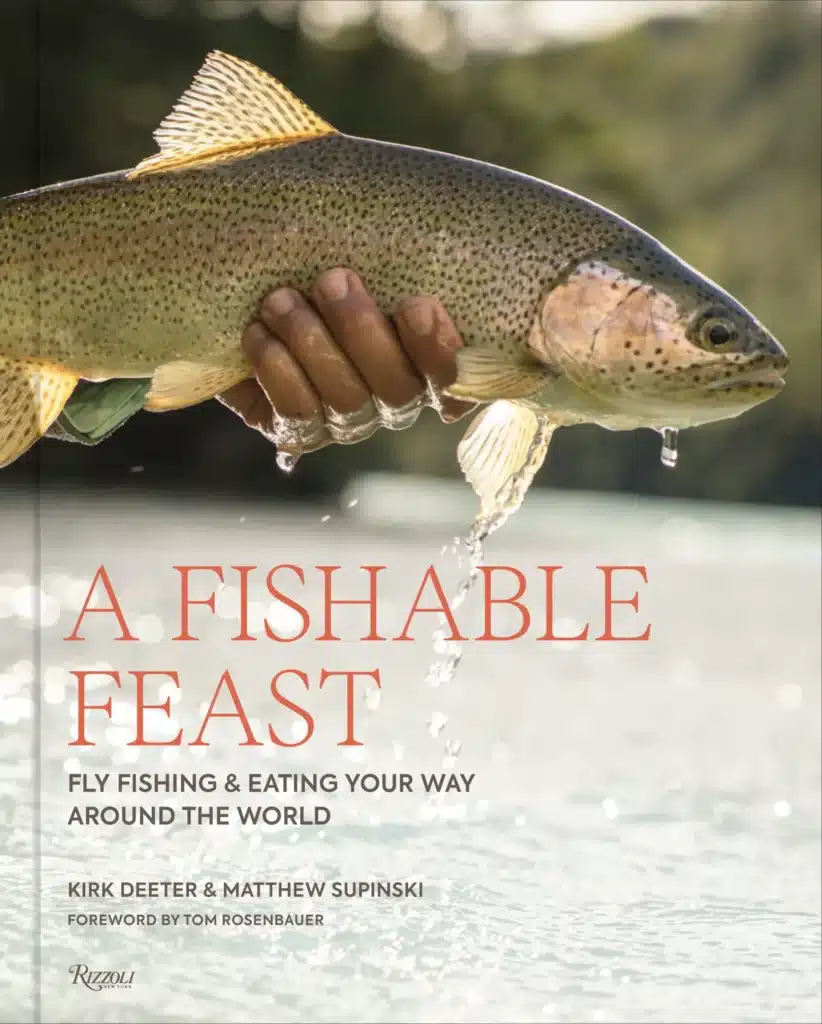
A FISHABLE FEAST
By Kirk Deeter and Matthew Supinski
$45, Rizzoli
2026
Fishing and eating. Is there anything greater in this godforsaken world? Well, maybe a roll in the hay. But after that, fishing and eating.
And no, I’m not talking about eating the colorless 10-inch rainbow you caught yesterday that was stocked by one of those fish and game tanker trucks.
It’s fishing all day, then returning to your cabin, lodge, resort, campground, rental, hovel, sleeping bag under the truck, then frying up chanterelles, or slow cooking pork green chili, or grilling elk backstraps topped with whiskey cream sauce. With red wine from Argentina. Cabernet from Washington. Riesling from New Zealand. Scotch from Scotland. Or just a damn cold PBR from Milwaukee.
Damn the physician who warned you to limit your salt intake.
That’s just what A Fishable Feast, the hefty hardback by Kirk Deeter and Matthew Supinski, serves up (pun intended). Amazing photos of angling destinations that take your breath away, then spectacular photos of local cuisine that doubly take your breath away.
Flip to any page and you’re on the water or at the table. Take the Baja section, which features roosterfish by day, shrimp and octopus ceviche by night. France features chalk stream browns, then chanterelles and a pâté en croûte. “Here, the gentleman anglers often sip cognac, smoke cigars, and wait for the royal drake mayfly of the evening hatch to appear.”
This be an angler’s (and glutton’s) dream. Hell, there’s even Poland, with its brown trout and grayling, followed by a hearty Gołąbki (cabbage rolls with beef and sausage).
And the Italy chapter, well, the fly fishing is secondary of course. A young lady in a big hat holds an attractive brown trout in an Umbrian creek. Then the fabulous Mushroom Gratinati greets you back at the villa:
“The ultimate antipasto dish: mushrooms, fresh mozzarella and Parmigiano-Reggiano, and tomatoes, which are all synonymous with Italy, especially Umbria.”
The Alaska section (which does feature dishes you can catch) has a baked halibut with blueberry glaze. A grizzly’s delight! Two pages later, a wild berry cobbler. A grizzly’s double delight!
Then we get to Montana. The last best place in the lower 48. There’s a reason Jim Harrison chose to live here. And the fly fishing was secondary to his famed three-hour, nine-course, five-wine dinners of grouse and elk and trout and fowl. The fishing is near Livingston, Yellowstone cutthroats on PMDs. The eating includes bison meatloaf and chocolate tart with a Flathead cherry port.
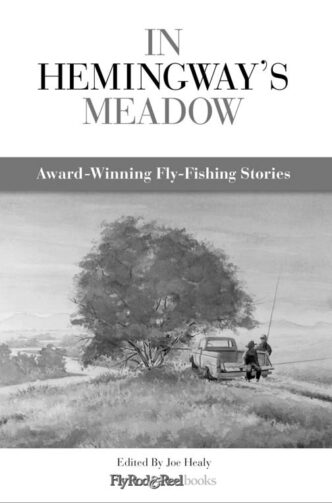
The book’s title is indeed a nod to Hemingway. Its foreword is by fly-fishing literati Tom Rosenbauer. Its angling anecdotes are great, but the book’s premise is exceptional.
In fact, it’s a distracting read, with the soaring images of angling and food. It almost needs an “Angler Discretion Advised” warning because of how, well, sensual it is. There’s a brook trout that makes my heart flutter, followed by a caramel chocolate apple dish (The Homestead Apple) that makes my tummy tingle.
A Fishable Feast is perfect coffee table fare (pun intended). And you may find yourself booking that fishing lodge you’ve been eyeing. The one with the expert guides and the chef with the stars (and the punishing price tag).
Finally, I’ll leave this here (from Quebec of all places) for you to nibble on (like a trout on a mayfly). Gordie’s Raspberry Pie:
“Gordie was my salmon ghillie on many of my trips to the magnificent Gaspé of Quebec. While he loved being a guide, his true passion was baking raspberry pies. A classic, rustic pie bursting with fresh raspberries and a flaky, buttery crust—his pies are simply the best on the planet.”
SHARED WATERS: AN ANGLER’S GUIDE TO FLY FISHING CALIFORNIA
By Michael Malekos
$25, Available at Amazon
2025
Shared Waters, the first book by California Fly Fisher regular Michael Malekos, is a breakdown of many of our favorite waters in California and the peccadillos of fly fishing them.
The fish, the flies, the terrain, a little history, whether you should shlepp a float tube alongside your waders, the cast of characters you’ll see on the water, spring angling, winter angling, Manzanita Lake, the Upper Sac, San Pablo Bay (who knew), and sharing a life of fishing with those you love and a few you tolerate.
But it’s also something more, something hard to put a finger on. Flipping through the pages and the waters, I found myself nostalgic for trips taken and fish caught. From page one at Baum Lake, I felt the cool water in the fall, fighting its slight current with flippers, the pulse of a rainbow on the end of the line, and walking over to your truck at the end of the day in those flippers like a duck.
“My first visit to Baum Lake began like a scene from a spaghetti western. I stood on the lake’s shore, lit a cigar and stared intently out at the water.”
Same as me, minus the cigar. I was 12.
Memories from my own fishing Rolodex began to flip as I turned the pages and got, well, just a bit sentimental. Of all the fishing guidebooks out there, how many can do that to an angler? Few. Very few.
Later at Hat Creek, Malekos writes, “Just as there are more published books regarding fly fishing than about all of fishing combined, I suspect there are probably more articles written about Hat Creek than any other California fishery.”
Weird, because when I fished there with my father as a boy, I thought Hat Creek was his and mine alone. Nobody else knew about this brook near Lassen and four hours from our Sacramento home.
See, what’d I tell you? Sentimentality welling up.
Malekos is skilled at mixing technical information about fly patterns and Euro nymphing, with yarns about panning for gold with his father and catching lunker bass at a Napa winery. Sections about reading water and golden trout are constructive, as is the photo of a 39-inch brown that died of old age on the bank of Burney Creek.
He even offers up a few pages on how to get your significant other out on the water (others may have written how to keep them away from the water). And sometimes it’s not the trout or the water or the beauty of the river. “The one crucial element I deemed necessary to make this trip successful: a women’s restroom.”
In the section on the Upper Sac, Malekos writes about midges and mayflies, Ted Fay, and the Mount Shasta Ski Park. But he begins with Cantara Loop, the section decimated in 1991 by a train derailment that spilled a tanker’s worth of herbicide into the water. It’s also where, as a young boy, I hooked a trout with my grandfather beside me.
There’s that sentimentality bubbling up again.
Malekos could easily be your fishing buddy, your guide, your friend at the bar. In fact, you’ve probably crossed paths with him on Manzanita Lake or Lake Britton. He’s the one in the float tube, cigar in mouth, trout likely on the end of his line. He’s the founder of the Casting a Rise Foundation, and all proceeds of his book, the one you’re reading about right now, go to California Trout.
A writer, philanthropist, and damn fine angler, you’d be lucky to cross paths with Malekos in the fly shop. After all, the tie that binds is a love of fly fishing. And he’s got that in spades.
REEL SALTY
By Ryan Johnston
$20, RJ’s FlyTrips
2026
As a trout angler, there are a ton of factors I have to worry about. Are the fish biting? Will the beer reach maximum coldness in the Yeti by the time I’m back at the truck? Well, that pretty much covers it.
Okay, maybe not so many factors, especially when you consider the saltwater anglers among us and the myriad ways their day can quickly go sideways.
Mostly there’s the sea, the most powerful element on this planet. Then the sun, the fish, the tackle, the motor, the tides, the wakes, the bugs, the seasickness, the faulty gear, the twisted knots, the 50-pound tarpon when you only have 20-pound test, the sharks that spook the fish, running out of backing, the warm cervezas in the hold, the sting of seawater in your eyes, the winds, the mighty winds, and the open ocean. The most formidable and terrifying thing on this planet, the thing where all the action takes place, the open ocean.
Trout fishing can mean myriad mosquitoes. And that moment every afternoon when you just want to rest your weary eyes for a few minutes in a meadow. But there’s always DEET (the low-percentage one). And your fishing vest can serve as a pillow instead of a rock.
Ryan Johnston’s book Reel Salty is a welcome change of pace for the exclusive trouters among us. I was raised on Hat Creek and Baum Lake, so tales of saltwater with fish as big as a dining room table are foreign but fascinating.
Johnston begins the book with a dedication to his wife, whom he met while attending UC Davis. I, too, was an Aggie. Maybe this saltwater thing isn’t as foreign as I thought (Go Ags).
Johnston’s book also begins rather blasphemously. “If I never saw another trout in my life, I would be okay. Yet, if I could never fish the ocean again, I would quickly become a bitter and salty old man.” Count me skeptical. He continues:
“My favorite part of being out on the ocean in a fishing boat is actually not the fishing. Instead, it’s the feeling of being small. Something about being surrounded by water with nothing in sight. No land, no other boats, no physical sign of man’s influence on this world.”
Count me intrigued.
His book is chock-full of saltwater anecdotes. Things I myself have wondered about, and things you’d never encounter on, say, the McCloud. Things such as poling the flats, where to cast to even have the remotest chance at a permit (“These fish are like beautiful, elegant women. They need to be wined, dined, and treated respectfully if you want to score”), and how to release a bird you’ve hooked, in this case a pelican.
“He quickly grabbed a large red towel and dipped it in the water. He threw the wet towel over the bird’s head, and once it couldn’t see, the captain reached out and grabbed the bill of the bird.”
As is the case with saltwater, so it is with fresh, the guide inevitably comes to the rescue. Here, he knows how to wrangle a bird in a way that saves your fly (and the bird).
One anecdote that Johnston relays secondhand from his guiding buddy is so shocking in its ending, I had to re-read it. A guide friend of his in the Bahamas has the lottery-winning fortune of guiding a Sports Illustrated swimsuit model (she was shooting a spread at a nearby resort and wanted to spend her free day fly fishing). Her Spanish olive skin, the hot day, the fish biting, it reads like a 15-year-old’s fishing fantasy. And she’s a damn good angler to boot. Except the chum they end up using is so unexpected—so, well, just so unexpected—I had to read it twice.
Give Reel Salty a read on your next flight to the Bahamas or Belize or Mexico. You’ll be a smidge more ready for what comes your way, be it bonefish or tarpon or bikini models that fly fish.
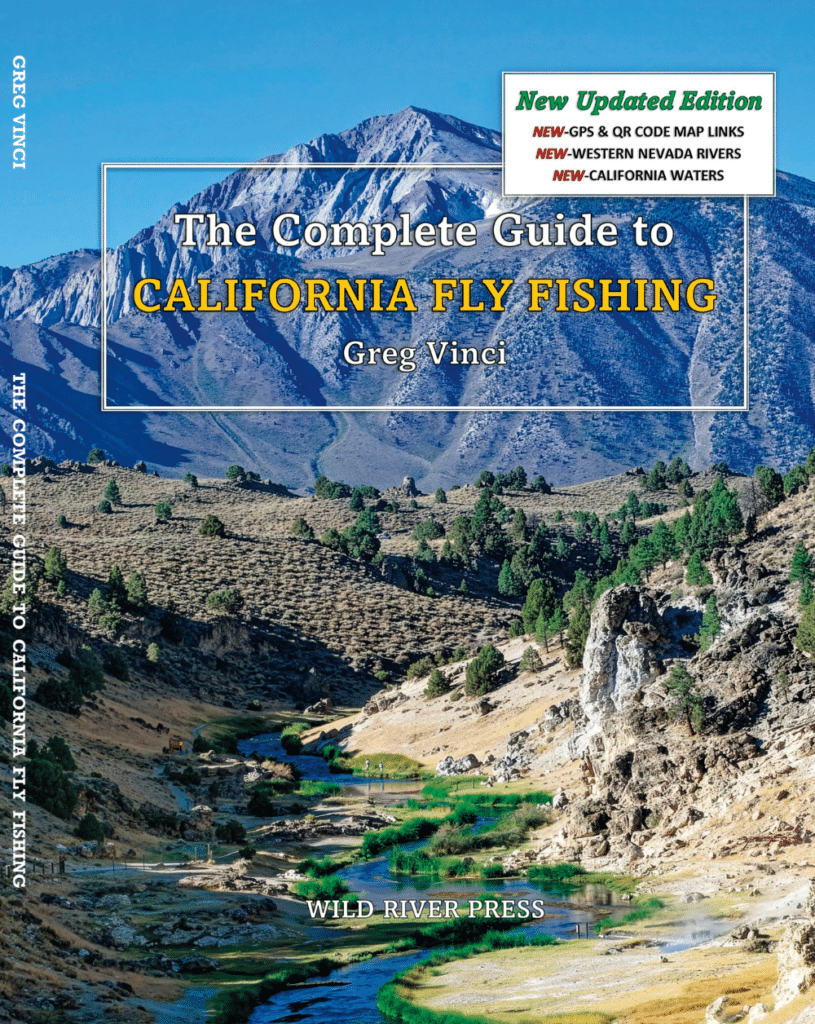
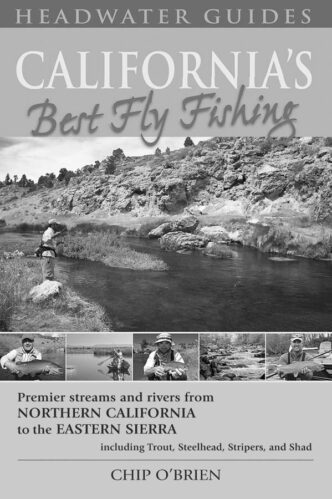
THE COMPLETE GUIDE TO CALIFORNIA FLY FISHING
By Greg Vinci
$40, Wild River Press
2026
California has more trout streams than stars in the night sky. Well, not exactly, but it sure feels that way.
Sometimes you need something practical to guide you to the best spots along the river. Something between a road atlas and A River Runs Through It. Not a soliloquy about the beauty of a pastoral brook, but not a highway map either.
That’s where The Complete Guide to California Fly Fishing (new updated edition) comes in. Written, and now updated, by Greg Vinci, it covers the Klamath and Pit Rivers down to the Kern River in the southern Sierra. Included are larger rivers, a few creeks, all familiar waterways, and many you’ve fished.
Take Putah Creek and its wild rainbows, for example. Ample description, stream facts, a hatch chart, a grip ‘n grin with a large spawning female, and a map showing access points. Each map includes a QR code linking to a terrain view on Google Maps. You can literally plan your entire fishing trip using Vinci’s guide, from which flies to pack to where to park.
The Little Truckee section is one I’ve used while veering down Stampede Dam Road, one eye on the water and another on the road. There are trophy wild trout in that river, persnickety ones that will rise to a PMD if you present it just so. And even though the map in Vinci’s guide shows parking lot two, you should ignore that lot and pretend it’s not there. There’s no good fishing around there (wink wink). Only mosquitoes and black bears (and warm beers) lurk. Nope, not the best pockets and riffles for lunker browns (wink wink, again). And some of the most beautiful Tahoe landscape (and troutiest water) you’ll find in the Tahoe Basin.
I flipped to the Russian River page next, the river closest to me here in Sonoma County. It included a fish-run chart (always helpful), river flows, and a few side roads (for a nice Pinot tasting near Healdsburg before you wader up). The redwooded waters meander with steelhead in the damp months and feisty smallmouth in the warmer ones. It even harbors a few Dungeness crabs where it spills into the Pacific.
I’ve seen osprey and cormorants patrol the Russian River for their supper. Hell, I was wadered up in the dead heat of August last summer, but I had to pause my fishing as three maidens on horseback in red bathing suits (them, not the horses) hooved into the middle of the river to cool off (and their horses). They were like the three sirens on three mares. I had to pause. Not to stare, but because they rode directly through the riffle I was fishing. Though I welcomed the pause. The sight was so beguiling.
This guide is heavy on maps and facts, but it’s not without colorful descriptions, some great photos, and even flashes of humor where you’d least expect them. The Putah Creek section opens with: “Any flyfishing water with a name like Putah has to be a place that offers the promise of some kind of orgasmic pleasure.” In a fly-fishing guidebook, that line gets an “oh my!”
A good read at the campfire as you plan tomorrow’s fishing, and a must-have in your truck when you explore new waters or want to find some new crannies on old ones.