For years, Levie Isaacks woke up in the middle of the night screaming. Three, four, five times a week, he dreamt about horrors in different forms—that the helicopter he was riding in was blowing up or that his wife was hit by a mortar round on her way to the mailbox.
In recent years, the nightmares dwindled. Last year, the Vietnam veteran had only one nightmare. Isaacks, a retired cinematographer, knows why: Fly fishing.
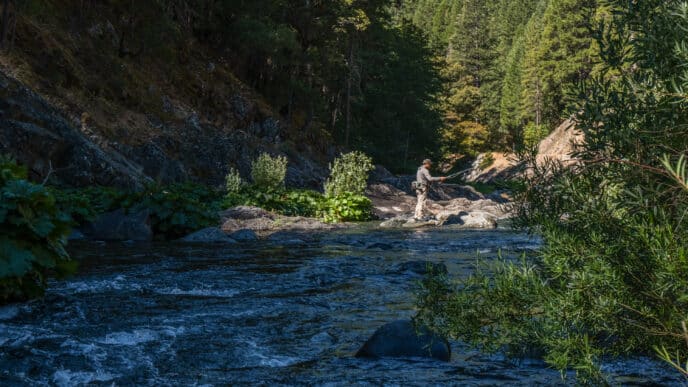
In 2019, he joined Project Healing Waters, the fly-fishing program for veterans. It has been a tonic. Post-traumatic stress disorder, he says, involves rumination. It’s hard to ruminate on anything but catching a fish when you’re out on the Fall River or the Trinity—his two favorite places. It’s hard to ruminate when you’re with friends. After a recent day of fishing on the Sacramento River, he and members of his group gathered to make dinner and share stories. A couple of submariners regaled everybody with tales of the pranks they used to play on each other. “I mean, we all just laughed and laughed,” Isaacks says. Laughter is such good medicine. He credits fly fishing and Project Healing Waters for the progress he’s made in conquering his PTSD. “This is real stuff. This is a real benefit to me, you know—I can get a good night’s sleep.”
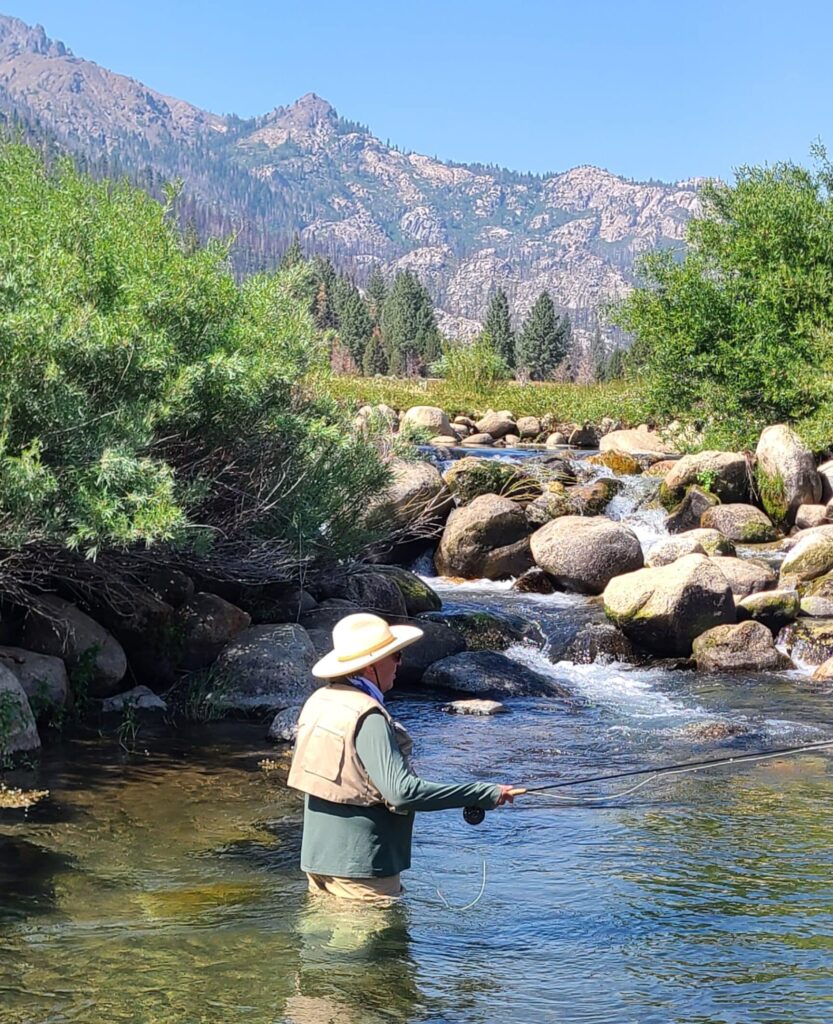
More than half a dozen studies conducted over the last 15 years indicate that fly fishing is good for your state of mind. Fly fishing seems to lessen anxiety and depression, improve sleep quality, impart a sense of control, and promote personal transformation. Most of the studies have been small—some of them tiny—involving just a handful of participants. Several have focused on veterans. Some of the studies suggest that fly fishing can be a good complementary therapy to more traditional therapies.
In the last three years, two larger studies expand on these findings. A survey of 1,752 anglers in the UK found that those who fished regularly experienced better mental health and well-being and fewer symptoms of depression and anxiety than those who fished less regularly. They had reduced odds of schizophrenia and suicidal thoughts. The study was published in 2023 in the journal Epidemiologia. It did not specify how many of the anglers were fly fishers.
Last year, a study of 1,882 trout anglers in New Zealand, a majority of them fly fishers, found a linear-dose relationship between fishing and mental health. The more you fish, the better your mental health. In the study, published last June in the journal Leisure Sciences, 52 percent of the anglers surveyed were fly fishers, 36 percent were spin fishers, and 9.5 percent were fishing from boats. The study did not specify how many people on the boats were fly fishing. The research found that anglers who were more active had higher well-being scores and lower levels of distress, anxiety, and depression than those who were less active. Active anglers were 52 percent less likely to report thoughts of self-harm and 46 percent less likely to experience moderate to severe anxiety. Those who waded, walked further while fishing, and fished with companions had better mental health scores. The boat and fly fishers had higher well-being scores than the spin anglers.
Why is fly fishing good for your psyche? The authors of a 2025 review of 41 fishing research studies have several hypotheses. For one thing, fishing occurs in nature. Past research indicates that being in nature activates parasympathetic (calming) responses and lowers cortisol, a stress hormone associated with the fight-or-flight response. Beyond that, repetitive and rhythmic casting may be like meditation, resulting in present-mindedness, focused attention, less rumination, and a state of mindfulness. And finally, the anticipation of a reward—catching a fish—activates the neurons in your brain that trigger the release of dopamine, which the Mayo Clinic defines as a neurotransmitter and “feel-good” hormone that regulates mood, motivation, and motor control.
In the UK, there’s growing interest in fishing as a therapeutic intervention, and in England, the National Health Service is teaming up with the charitable organization Tackling Minds to encourage angling for people struggling with anxiety and depression, according to the UK study.
In California, at least five organizations offer fly fishing as therapeutic support to those who seek it. Casting for Recovery hosts fly-fishing retreats for women recovering from breast cancer. Cast Hope introduces fly fishing to at-risk and underserved kids, many of whom would probably never get the opportunity otherwise. Bold Face Fly Fishing offers an intensive day of fly fishing to first responders. The Mayfly Project teaches fly fishing, fly tying, conservation and entomology to kids in foster care. These organizations are not just in California. All operate in other states as well.
PROJECT HEALING WATERS
Project Healing Waters is the biggest and best known. It got its start when, in 2005 at Walter Reed Army Medical Center, a Navy captain wanted to teach fly fishing to recovering soldiers. He started them out casting on the grass outside the hospital. Since then, Project Healing Waters has grown to 158 chapters that span the nation, including eight programs and a fledgling satellite in California. The organization has helped more than 69,000 vets since 2012.
One of them is Mike Allen, a former machine gunner in the U.S. Marine Corps, who lives in American Canyon, California. He says fly fishing gave him a badly needed identity. After leaving the army, he was diagnosed with bipolar disorder, and the bottom dropped out of his world. The VA hospital referred him to Project Healing Waters’ Martinez program. At his first meeting, he was met by David Lipscomb, founder of the program, and Bill Hopkins, a participant. Allen had never seen a fly rod before. “I don’t know if I could’ve picked one out in a photograph,” he says. But Lipscomb put a rod in his hand and told him, “This is yours to keep for as long as you’re in the program,” Allen recalls. Instantly, he had a purpose (to help other vets), identity (as a fly fisher), and companions. “Fly fishing didn’t fix me,” he says, “but it gave me a place to go where I wasn’t a problem to be solved.”
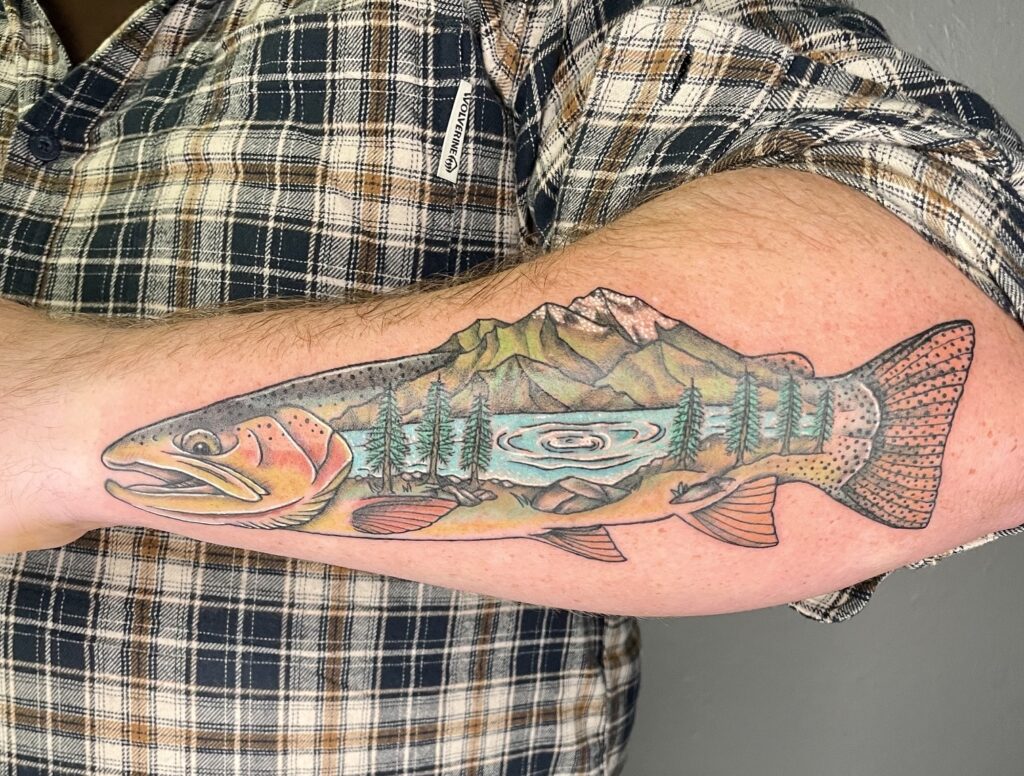
Fly fishing takes Allen’s mind away from his problems. “You have to read the water. You have to read nature. Focus on your cast. Slow down your breathing,” he says. But for him, the identity piece is most important. At a time when he was unemployed and struggling, “I got to tell people I’m a fly fisherman.” When he was in the hospital about two years ago, fishing helped him stay grounded—reminding him of who he is. The giant fish tattoo on his arm was a constant conversation piece. Everybody all around him wanted to know about his fishing. Hopkins visited him every day with coffee and a fly-fishing magazine.
Allen is now a peer support specialist working with youths who’ve experienced psychosis. He is contemplating starting a casting program for them, possibly connecting them with Cast Hope. Allen says his favorite place to fish is “the little duck pond” at Travis Air Force Base because that’s where he gets to help other vets—those in wheelchairs and with other mobility issues—with their fishing. He also kayaks and fishes on the Napa River.
BOLD FACE FLY FISHING
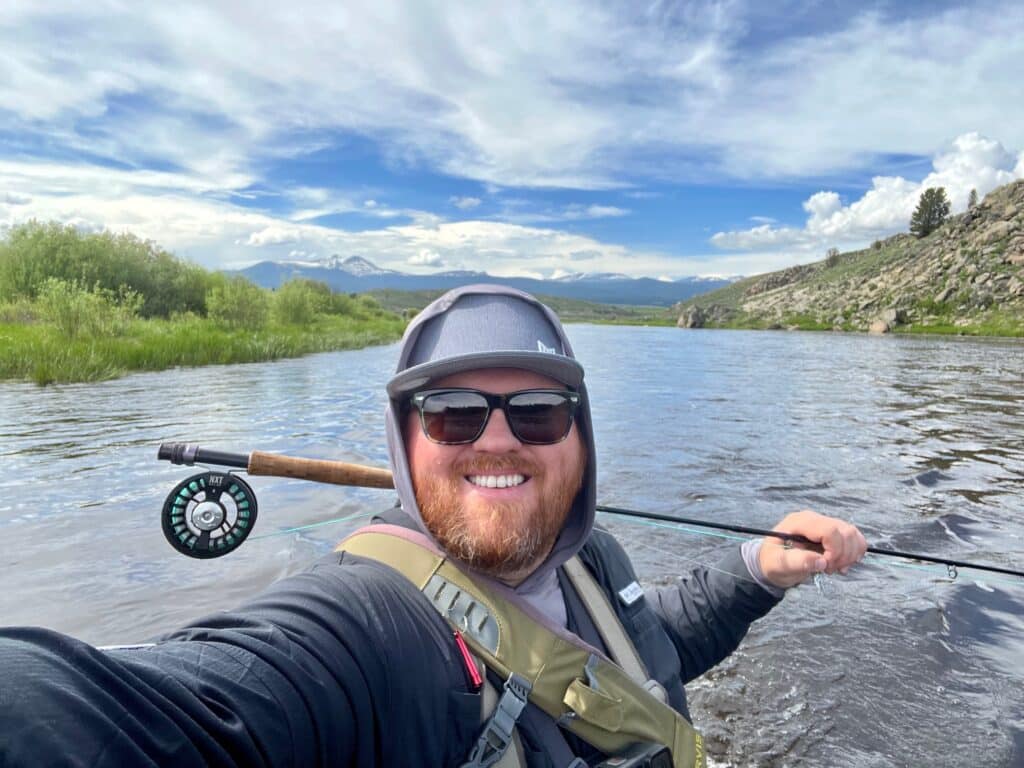
Ryan Padgett co-founded Bold Face Fly Fishing to help first responders deal with what he calls “the elephant in the room”—the hangover from traumatic events they witness at work but generally can’t talk about at home. As an aviator in the U.S. Air Force, he delivered cargo to Iraq and Afghanistan with trips home in between. “It’s a weird juxtaposition to go from one day you’re being shot at to the next day you’re back home,” says Padgett, who moved to Colorado three years ago after having spent most of his life in California. At home, he couldn’t reset, he says. “I wasn’t always a nice person.” It was his wife, Krisha, who figured out the remedy: Give him his fishing rod and send him out fishing. After a day on the water, he’d be himself again. When Padgett retired from the military in 2023, Krisha gave him a brand-new R.L. Winston fly rod and told him to go fishing for two weeks.
Experiences like that caused Padgett, along with Redding-based fly-fishing guide Ryan Avezzie, to start Bold Face Fly Fishing for military first responders, emergency medical responders, police, firefighters, and healthcare workers. The organization, Padgett says, is much smaller and more no-frills than Project Healing Waters. It provides one day of intensive fly-fishing instruction to each participant, who works one-on-one with a Bold Face mentor or guide. The day is designed to give the new fly fisher a list of procedures to memorize and apply to fishing similar to the Air Force’s Bold Face procedures that soldiers are trained to commit to memory and execute in an emergency. The organization supplies participants with videos, a power point with links, and access to a private pin bank of best fishing spots. It also provides them with a customized chatbot—a virtual fly-fishing mentor that can give instruction, generate fly-fishing reports, tell you where to find native cutthroat.
Bold Face Fly Fishing is now in 11 states and has a total of about 30 mentors (leaders), four of whom are professional guides, and 40–50 students across the country. In California, three mentors are currently working with four participants in the Reno-Tahoe area. Padgett, who is president of the organization, is getting a bachelor’s degree, plans to get a master’s and go on to become a therapist for military first responders.
CASTING FOR RECOVERY
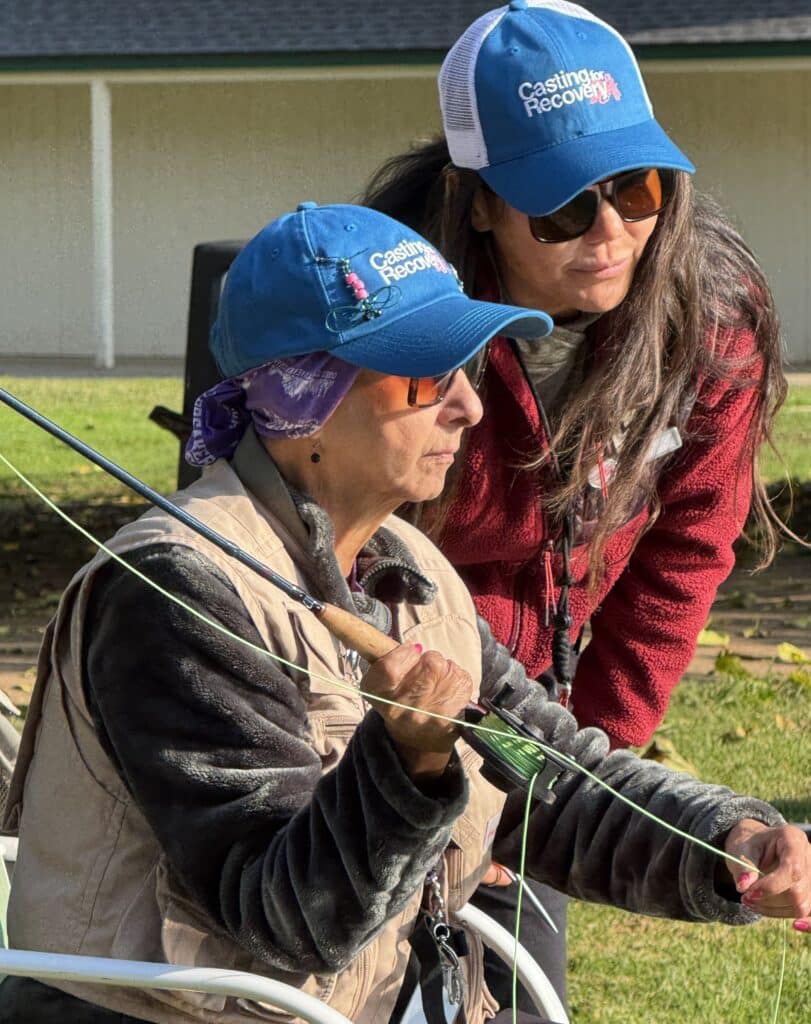
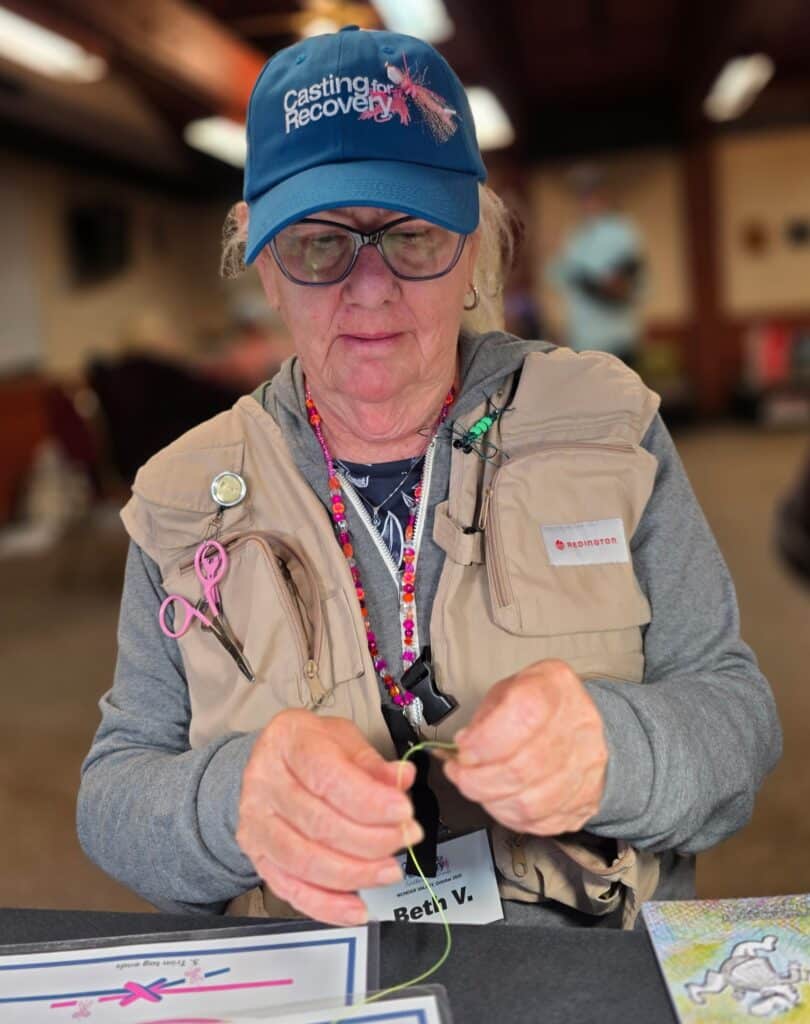
Casting for Recovery combines fly fishing with oncology and mental health support for women in treatment for or recovering from breast cancer. In Southern California, the organization hosts one or two two-and-a-half-day retreats a year. Since the organization can’t accommodate everyone, 14 women are drawn from a lottery and invited to participate. They come together to meet each other, meet with medical and psych/social counselors, and to learn to fly fish. A breast cancer diagnosis can turn you into a “hot mess” emotionally, says Cindy Wilson, speaking from experience. “Your life is consumed by doctors’ appointments. You are haunted by uncertainty: Is it going to come back? Will it get worse? How am I going to be able to handle this?” Wilson, started out as a participant in the program and is now participant coordinator for the organization’s Southern California and Central Valley program.
Fly fishing is a panacea. The rhythmic motion of casting is good but not overly strenuous physical therapy, especially for those who’ve had surgery or radiation. Fly fishing also provides a mental health break that’s invaluable. “Your mind literally cannot think of anything other than what you’re doing at that moment on the water,” Wilson says. That’s a unique experience for a lot of the women because breast cancer is all they’ve been thinking about. On the water, the worries “just kind of melt away.”
Casting for Recovery has programs in 50 states, including two in California. About 12,500 women have participated in its retreats since it began in 1996. About 200 women have participated in Southern California retreats since 2014.
CAST HOPE
Cast Hope introduces fly fishing to at-risk and underserved kids—kids who come from impoverished families or transient families who move from one hotel to the next. Some of the kids have gotten in trouble at school for theft or drugs. Some are learning to fly fish by court order. Matt Heron, well-known Truckee River fly-fishing guide, has a word he uses often when speaking of Cast Hope: The word is “impact.” Through Cast Hope, he and his guides have the opportunity to change the course of a child’s life. When Heron was asked to be the regional director for Cast Hope’s Reno-Tahoe region, he didn’t hesitate. “It was a no-brainer,” he recalls. Now his region is the biggest of Cast Hope’s five regions which means “we have the ability to impact the most kids. It’s exciting!”
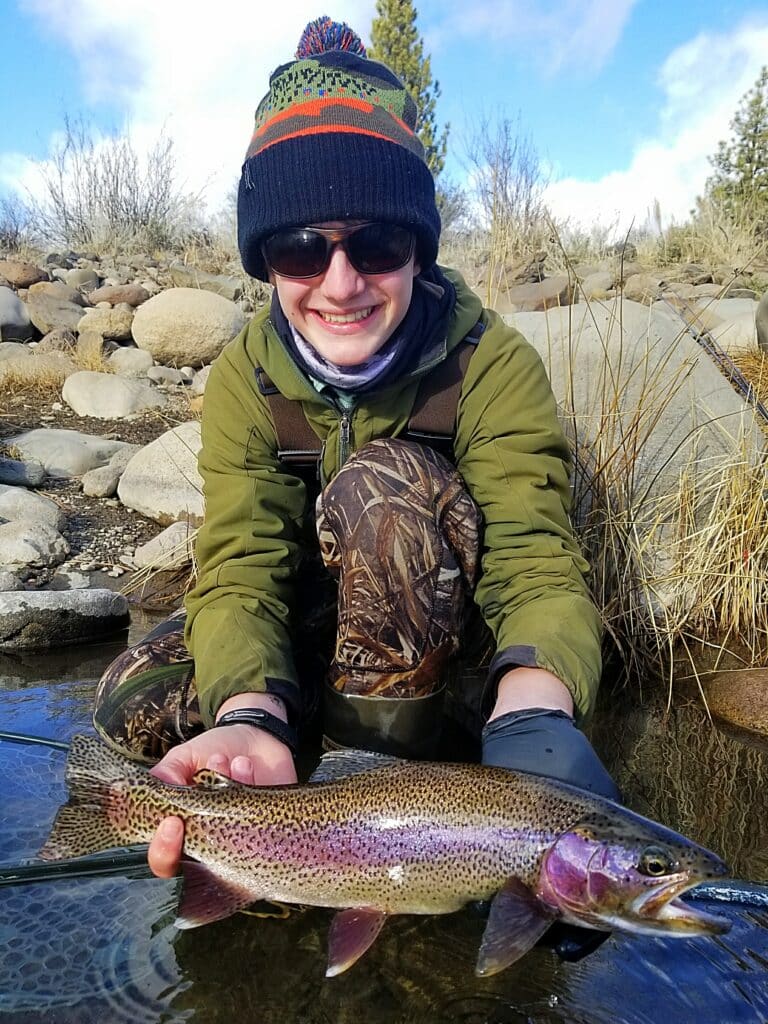
This year the organization expects to work with a total of about 1,000 kids in California, Montana, Idaho, and North Carolina. About 300 of those kids will be fishing in the Reno-Tahoe area with the group of fishing guides Heron has assembled. About a third come for a day of casting lessons; the rest go on day or half-day guided trips—either one-on-one or in groups of four to 12. Not every kid—most of them are in middle school—takes to fishing. But those who do—those who pester their parents to call Heron up and beg for more fishing—get to go again, sometimes five or six times. Some of the kids get free equipment so they can continue to fish.
What constitutes impact in Heron’s mind? A super-timid kid who was badly bullied, took to fly fishing and is now a college graduate conducting lake trout studies.
THE MAYFLY PROJECT
The Mayfly Project takes foster kids fishing in hopes that it too can change lives. The project is in more than 66 locations in the U.S., including Los Angeles and San Francisco. It serves about 500 kids a year.
Foster kids have their own kind of trauma. The average time a foster child stays in one home is 21 months, according to the U.S. Department of Health and Human Services. “They jump from home to home. They don’t know where they’re going to be tomorrow. Are they going to be able to stay where they’re at? Will they have enough food to eat,” says Jane Winer, lead mentor for the Mayfly Project in Los Angeles. Their futures are unknown and out of their control. The program is based on the theory that fly fishing is therapeutic. Every other week for about 10 weeks, Winer and 30 volunteers (called mentors) take the kids and their families to Puddingstone Lake, the Whittier Narrows, MacArthur Lake, the ocean—waterways in their communities that the kids will be able to visit again when the program’s over. The mentors teach the kids how to assemble a rod, to cast, conservation principles, catch-and-release ethics, and how to tie Woolly Buggers and Girdle Bugs. The mentors teach them the “characteristics of an angler”—patience, building self-confidence, having grit, taking care of the environment, and seeking wisdom. At the end of five sessions, they give the kids a curriculum booklet and a rod and reel. The lead mentors follow up—with fishing opportunities, newsletters, and information about fly fishing clubs where Winer has requested that Mayfly Project kids get discounted memberships. Fly fishing relieves what Winer calls “brain strain.” “It settles the psyche. It gives kids an inner peace and sense of belonging.”
As it does for us all.