
Get Ready!
Fly fishing guides talk on the phone a lot.
Like teenagers on social media—a lot. There are many reasons for this. Most interactions between guides on the river are a quick “Hey, what’s up—talk soon!” as we’re grabbing sandwiches, launching boats, or getting ready to push off at the ramp with clients. This leaves really no time to talk or catch up.
Guides also spend a fair amount of time staring out the windshield. Podcasts, radio, and music can only keep us entertained for so long, so we talk on the phone most days while driving to and from our various bodies of water.
A few weeks ago, I was talking with my good friend and mentor, Jason Lozano of 530 Outfitters. We were discussing coaching clients, and one of the biggest challenges is the ambiguous nature of many of the adjectives and verbs that guides use. For example:
“You fought that fish too hard—that’s why you broke it off,” or, “Oh man, that one got away. You gotta put the wood on it.” These are overly generalized terms that do little to help the client. What really needs to happen for improvement is experiential learning—the feeling of “too hard” or “too soft” that only comes through doing.
Jay brought up another situation that got me thinking. The classic: “All right guys, get ready … get ready—we’re about to hit the next spot!” The ever-ambiguous and totally open-to-interpretation “Get ready.” I had to laugh, because I have two teenage boys who have very different and often conflicting interpretations of that same phrase. “Boys, get ready for practice … school … church …” produces vastly different outcomes from each of them and hardly meet their mom’s or my expectations.
So, I asked Jay what “get ready” looks like from the perspective of a veteran drift boat guide—something every guide probably says dozens of times a day. Helping clients understand what a guide means when they say “get ready” can make the entire experience on the water much more enjoyable for everyone in the boat.
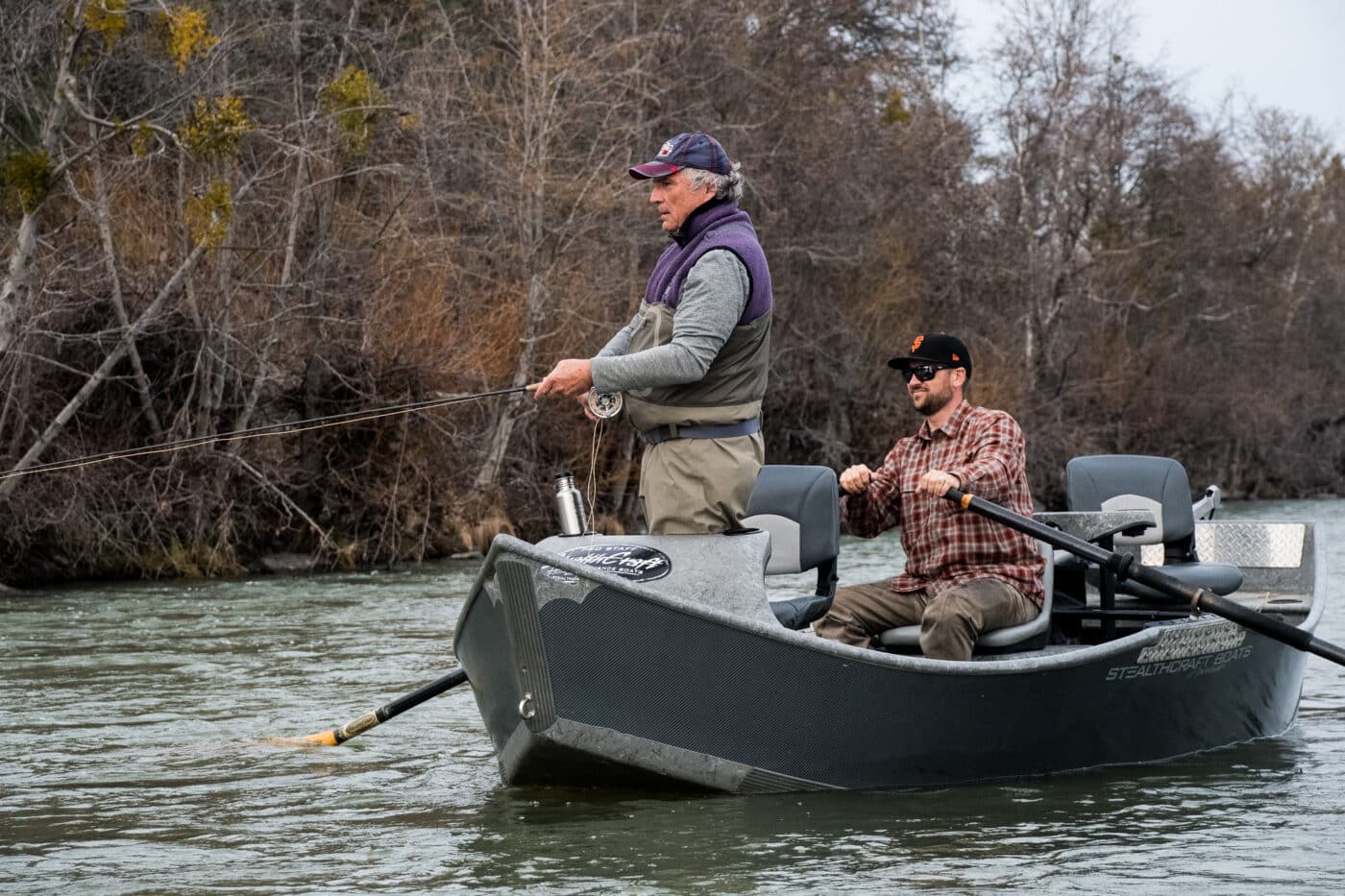
With ideal conditions for some excellent fall caddis hatches, we’ve been finding our fish up tight in the shallow water, along the edge of drop-offs, and tight off the shelves. This is some of the most fun fishing you can do from a drift boat. Having great boat chemistry is key—two anglers who fish together often and a guide excited to set the drift up perfectly for the guys to make the right cast at the right moment. When it’s done right, nothing beats it.
As we approach the “next spot,” I’m always trying to talk about it long before we get there. I mean like a long time before we get there. I usually start mentioning the next spot as soon as we’re letting the fish swim out of the net from the last one. “Okay team, next spot’s coming up here on the right in about 30 yards, let’s be ready.”
“Let’s be ready” is the cue to take inventory of your space, understand where the guide wants the cast to land, and for the person in the back, check in with the front angler to ensure both anglers get a shot at the spot.
What do I mean by taking inventory? If you’ve sat down while rowing from the last spot to the next, pick up the rod and making sure the line isn’t wrapped around the tip, make sure you have enough slack off the reel to make the necessary cast and make sure your slack is in the correct launching spot—for the front angler that’s in the bow, and for the rear angler it’s piled up to the side of the knee locks on the side that the flies will be fished. Make sure the line isn’t wrapped around the chair, under a foot, or hung up on a water bottle in the cup holder, which will help make the cast at the right time. Knowing where the guide wants the flies and making the cast quickly and effortlessly will get you more fish on the line. Straight up.
The angler fishing from the back of the boat has a huge advantage. They can see the entire picture. The back angler should always stagger the drift by about a foot to cover different water. If the guide has communicated the drift clearly beforehand, and both anglers understand what’s expected of them, the back angler can see where the front angler lands—whether they hit or miss—and make any necessary adjustments to nail the spot.
On the approach, I’m always communicating what needs to be done. Listening and focusing on execution instead of preparing is the key to getting ready. When I am coaching through a spot, it is nearly impossible for an angler to execute if they’re not ready and organized … if they haven’t taken inventory.
“Being ready” is all about understanding where the flies need to be and doing everything you can to get them there efficiently and in a timely manner. Next time your guide says, “Be ready,” take inventory and stick that fish!