For many North American fly anglers, especially those who took up the sport after the early 1990s, it is hard to imagine a time before the indicator. Some might reminisce about a time of simplicity, craft, and purity, when the dry fly reigned supreme, when guides were few and far between, and when nymphs and the methods for fishing them most effectively were still in their infancy.
California has long been a hub of fly-fishing innovation. The shooting head, the double haul, the cripple dry fly, and the hackle stacker are all California originals. There are many others, but in terms of shifts in the sport’s trajectory, the advent of the strike indicator is an innovation whose long-lasting impact has proven nothing short of seismic. This is its origin story.
DAVID AND DEAN PROBLEM-SOLVE
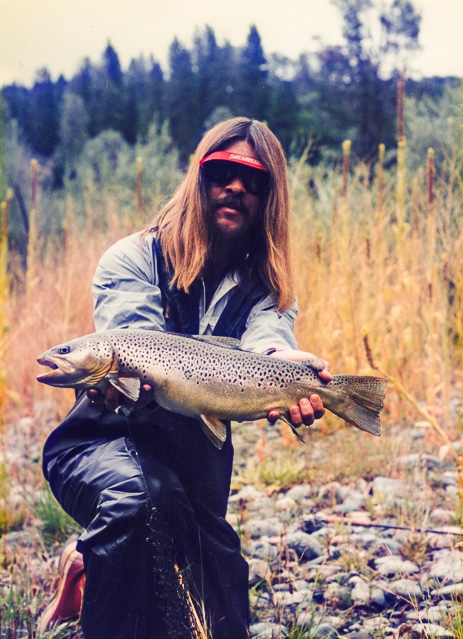
David Hickson and Dean Schubert met through the budding outdoor industry in Berkeley in 1976. They were in their 20s and both skilled, serious anglers. They began fishing together on Putah Creek, eventually making it to the upper Trinity River, which back then was one of North America’s finest trophy brown trout systems. There, like many, they would wait for the hatches and cast to rising fish. Sometimes there were countless fish dimpling the surface, some well over 10 pounds, feeding selectively, and then the hatch would suddenly stop. In these times, they would peer from high banks, rocks, and bridges and see the browns, often in deep slots between weed beds, feeding casually on passing nymphs. Some were monsters, north of 15 pounds, and try as they might with streamers and nymphs, they could not figure out how to present to them effectively.
One day in 1977, as they watched big browns feed at five and six feet down in a narrow slot between wavering weed beds, they wondered whether there might be a way to suspend a weighted fly at a predetermined depth. Their thinking had nothing to do with strike detection, but rather with how to suspend a fly so they could feed it to a sighted fish. In their minds, they were simply trying to take sight-fishing dry flies to the depths where the fish were feeding during the off hours. Through their time hanging out at André Puyan’s Creative Sports Enterprises (the infamous intellectual hub of western fly fishing), they knew that on rare occasions anglers had trailed wet flies off buoyant deer hair dries, and that Dave Whitolock had at times threaded small segments of bright orange fly line onto his leaders to better detect subtle subsurface takes when fishing still waters. With this knowledge and their specific objectives, they drove to the nearby Plug & Jug in Lewiston to see if they could find something that might help them solve their problem. There wasn’t any fly tackle at the Plug & Jug, but Dave found some steelhead yarn called Grizzly Fat Yarn. It was hot pink and, fortunately, synthetic. They hurriedly made the purchase and raced back to the bridge, where the fish were still lazily feeding.
They tied a tuft to the end of a tapered leader, combed it out, greased it up with flotant, and then tied on five feet of 4X at a right angle above it, affixed a weighted nymph, and gave it go. There were no bead heads back then, nor micro-shot, so they had to set up their drifts with lightly weighted flies deliberately and well above their targets. One angler spotted, the other fished. The results were immediate and somewhat astonishing.
PERFECTING THE TECHNIQUE
Over the coming seasons, with their partner in their guide business, Tip Top Fly Fishing, Bob Howe, they refined their preferences for polypropylene yarn. They made their own liquid floatant with silicone and trichloroethylene (affectionately referred to as rocket fuel). They loaded small flies with additional lead and continued to perfect their techniques. Because they were dedicated sight fishermen and often had a spotter while fishing, they were also among the first to identify and understand three-dimensional drag and how to overcome it. When fishing fast tailouts, it was blatantly apparent that the swifter surface current would pull their weighted offerings at an unnaturally high speed through the lower water column. To correct this, they developed sophisticated mending methods, most notably stack mending, where, with a short 11-to-1 loading motion, they could flip the indicator above the fly, enabling the fly to drop freely and drift in unison with the deeper laminar flows for a short time. They came to describe this process as the “turnover point,” and it is sadly lost on many nymph anglers today.
Using the same mending style, they also shot reservoirs, or “cushions,” of slack line near the indicator, enabling them to navigate complex differences in surface flow and achieve long, sophisticated, drag-free drifts, the likes of which had never been achieved. As part of their journey, they organically developed what would be seen today as single-handed Spey casts that avoided tangling the double nymph rigs and later split shot with the indicator; as well as underpowered aerial curve casts that dropped the nymphs downstream of the indicator, with slack above, negating the need to mend at all.
They were elegant casters, true technical masters, and while their methods were unconventional at the time, watching them fish was nothing short of beautiful.
THE REVOLUTION BEGINS
It is well documented that bad news travels faster than good news, but when it comes to fishing, especially good fishing, the inverse is often true. Word of Schubert and Hickson’s success on the water spread quickly among their friends and the guide community in Redding. The revolution had begun, and there was no getting the genie back in the bottle. In 1985, they jointly published a piece in Fly Fisherman magazine about their techniques, and from that point forward, the spread and adaptation of nymph and indicator fishing moved into high gear.
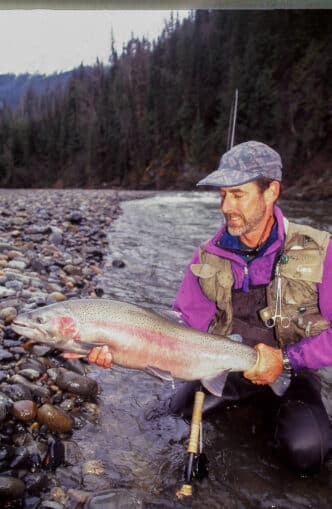
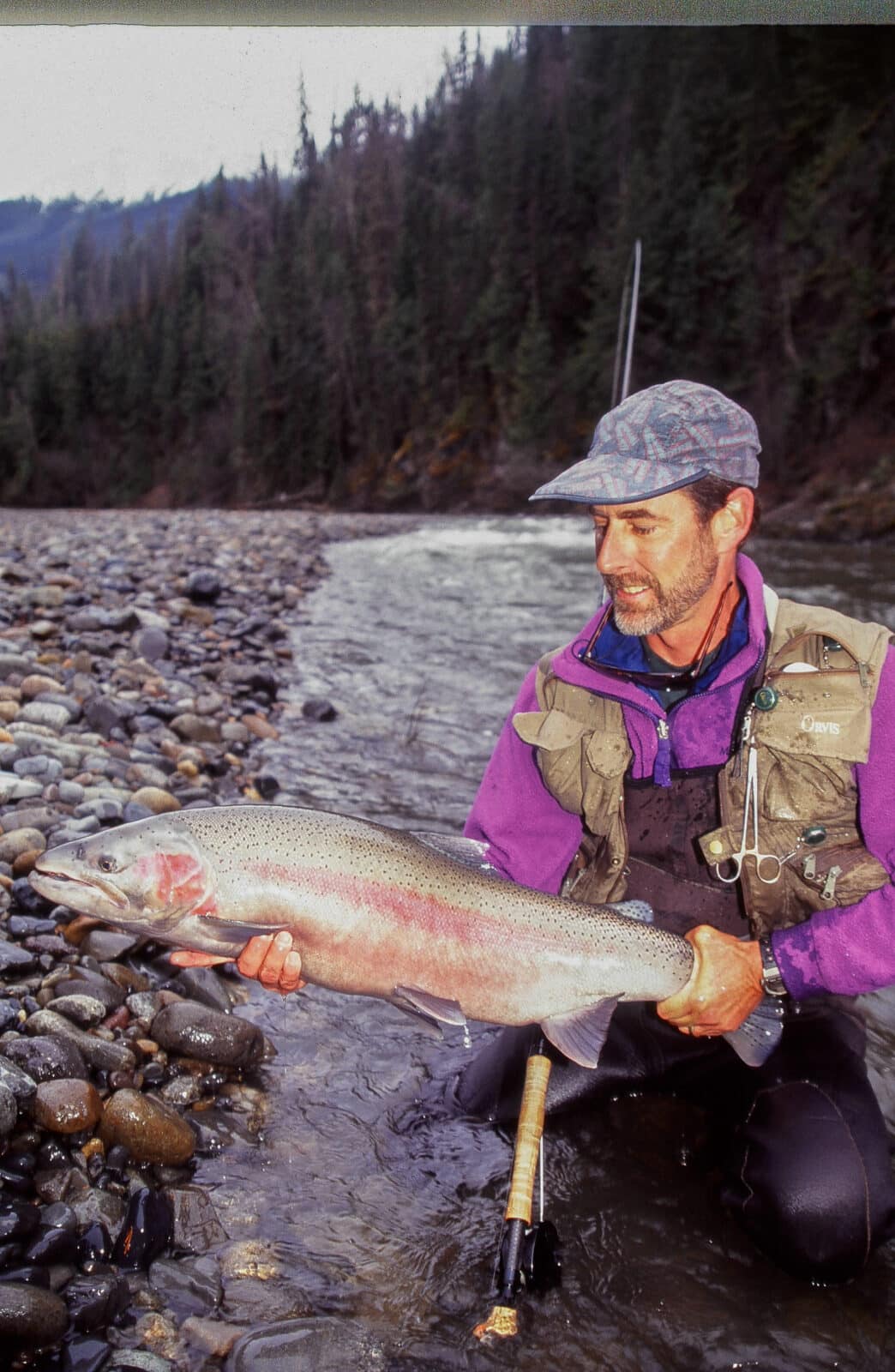
In 1984, they began fishing for summer steelhead on the North Umpqua River. Returns were robust, often exceeding 10,000 fish, bolstered by thousands of hatchery fish in the fly-only water. Their methods proved ridiculously effective, with 10-15 fish days common. It did not take long before they were berated by longtime traditional anglers who disapproved of their approach and took exception to the number of fish they were catching. At times, they and others who fished similarly were accused of not moving through the runs, and more commonly of sore-mouthing all the fish that might otherwise have been willing to move to a swung fly.
In 1986, David Hickson made his first pilgrimage to the Kispiox. He went often, and in low-water conditions he did so well that even gear anglers were known to complain about him. Ten-fish days were not uncommon, and some observers referred to him, with his shoulder-length hair, as “Jesus of the Kispiox.”
In June 1990, Jim Vincent published an opinion piece in Fly Fisherman titled “What is Fly Fishing? Questions on float-and-nymph steelheading.” It was based on his and others’ encounters with Hickson (whom he described as charming, polite, and forthright with his methods) on the Umpqua and Kispiox. In summary, his issue was that this was gear fishing with fly rods, it was too easy and effective, and that not only the aggressive fish sought by swing anglers would eat their offerings, but the “sleepers” would as well. They were hogging the resource, and in low water, there was no refuge for the steelhead, which were wild and limited in number.
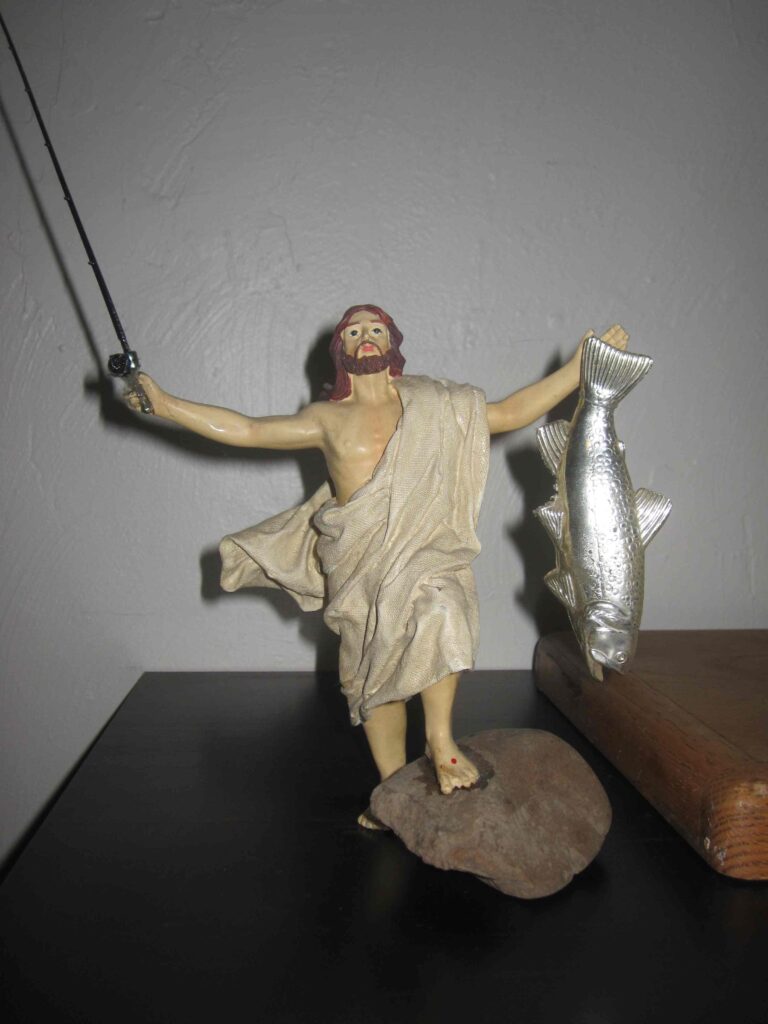
A ‘folk art’ gift from Gorden Briggs as a tribute to “Jesus of the Kispiox.”
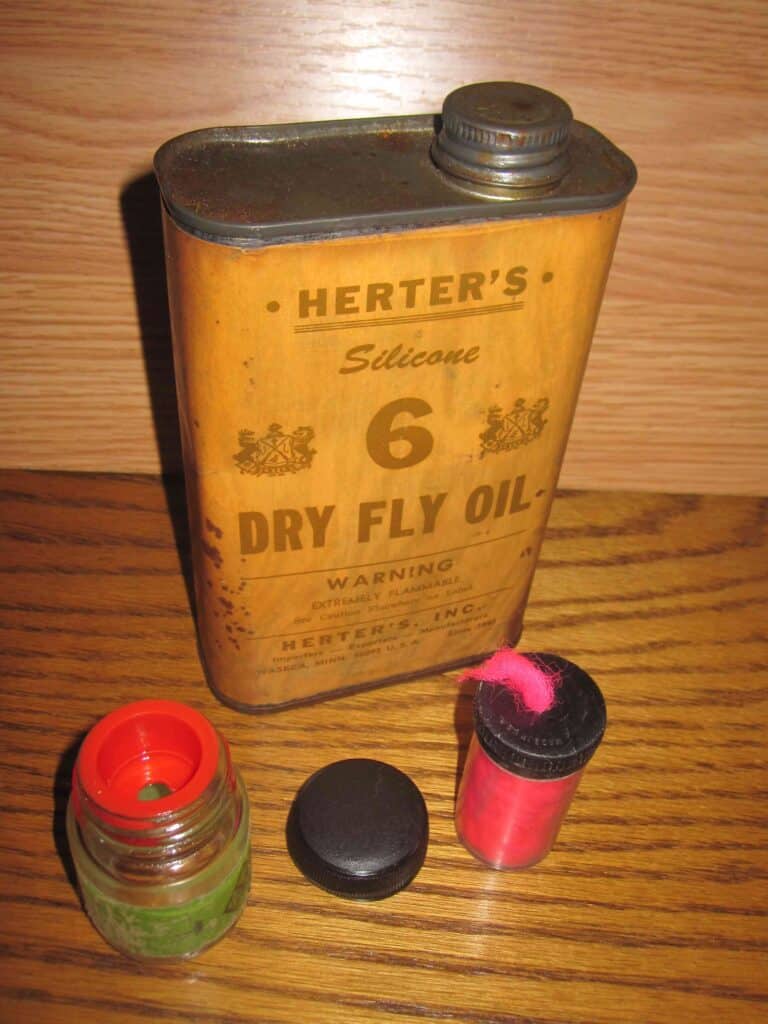
Early Rocket Fuel and ‘cator paraphernalia—Fat Yarn, Herter’s Fly Oil, and an ‘hourglass’ floatant bottle by ABU Garcia.
In July 1990, Hickson and Schubert responded to Vincent and other critics with “What is Fly Fishing? Who Cares?” Their perspective stemmed from their attraction to fly fishing because it was challenging and offered skilled anglers the opportunity to present something similar to what fish actually ate in a subtle, realistic way. To diminish their innovations was simply the same sour-grape, holier-than-thou argument Halford levied against the “heretical” G. E. M. Skues when Skues invented the first nymph and fished it with great success prior to 1910. California angling legend Russell Chatham received the same scorn before Schubert and Hickson when he and his cohorts first fished the Umpqua’s Camp Waters with sinking lines. They too did well, plying a deeper, unexplored dimension and implementing a new set of nuanced skills for our ever-developing sport. His eloquent response to his critics can be read in his essay “On Ethics” in Dark Waters.
INDIVIDUAL JOURNEYS
We all evolve as anglers, and for most, our preferences shift over time. But we must be careful not to judge others on their journey. These days, Dave Hickson almost exclusively swings for trout. I no longer indicator nymph for steelhead. It has been 15+ years since I have, and I left it without regret. I continue to practice and perfect my indicator craft when fishing for trout in situations that warrant it. I am one of the few who still prefers yarn indicators. A traditionalist, if you will. I respect their true castability and the way they land and drift lightly upon, as opposed to within, the surface currents.
Some argue that nymphing is simply too easy. Schubert and Hickson would, in many cases, agree. I think of standing on the Sundial Bridge, or the banks of the Bighorn, Green, or virtually any of the popular day floats in the American West, taking in the procession of logoed guide boats side-drifting large, molded plastic indicators and multiple nymph rigs. Their clients are enjoying the sport and catching fish, but few of them will ever cast a full fly line, let alone half of one, with an indicator. Aerial mending and a true understanding of three-dimensional drag will remain lost to them, as the classics of the literary canon are to the illiterate. Some techniques evolve with time. Others, I could argue, devolve.
I think back to 1990, when my lifelong fishing partner, Ned, and I spent two months in New Zealand. Along the way, we bumped into Dean Schubert and spent a month with him sight fishing and honing our long-line nymphing skills. We worked as a team, adjusting our rigs and presentations to virtually every opportunity we encountered. We were deep into the craft, and when done right, it felt like creating living art.
I have an image of Dean burned into my memory; him standing on a high bank of a stunning river, slowly paying out line with his ultra-smooth double-haul on my soft 9-foot 5-weight Scott G-Series rod. It was rigged with an 8-foot tapered leader, knotted to a quarter-sized tuft of greased polypropylene yarn, a five-foot right-angle drop of 4X tippet, a modest split shot, and his deadly #14 Amber Flashbacked Caddis Pupa tied to the end. There was a big fish far away, up and across, near the opposite bank. Soon he had the whole fly line out, flying gracefully through the air as if there were nothing more than a #16 Adams tied to the end. The cast landed softly 20 feet above the fish with a deliberate downstream hook, negating the need for an impossible mend. We waited as the fly settled and dropped into the holding lane. We saw the big brown move left and then back. Dean set before the indicator even twitched, and we watched him calmly reel the backing knot back onto the arbor as the head shakes began. It was game on.
And yet, some say it’s too easy. …