A beautiful place to fish
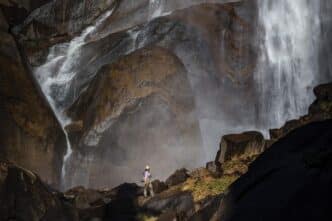
In the summer, the Merced River just above El Portal flows through a steep granite canyon, dropping almost 350 feet per mile, rolling and tumbling in glassy pockets through fields of rock and boulders the size of San Francisco apartments.
I was … well, I was hung over. I had just one day to fish as much of Yosemite National Park as possible. This was the first place my host, David Gregory, owner of Yosemite Outfitters, had chosen, promising that covering as much of the park as possible would be a marathon effort.
So I took a few deep breaths of fresh mountain air as my companions, Gregory and his friend and coworker, Greg Nespor (a former park ranger and owner of Gregory Nespor Fly Fishing), pointed out fishy water and stressed the danger of the stretch. It was—like the rest of the water above El Portal but below Yosemite Valley—incredibly beautiful and rugged, even here, close to the road. And it flowed with power. Anglers had drowned here while fishing, Nespor and Gregory said. This fact sobered me up a bit.
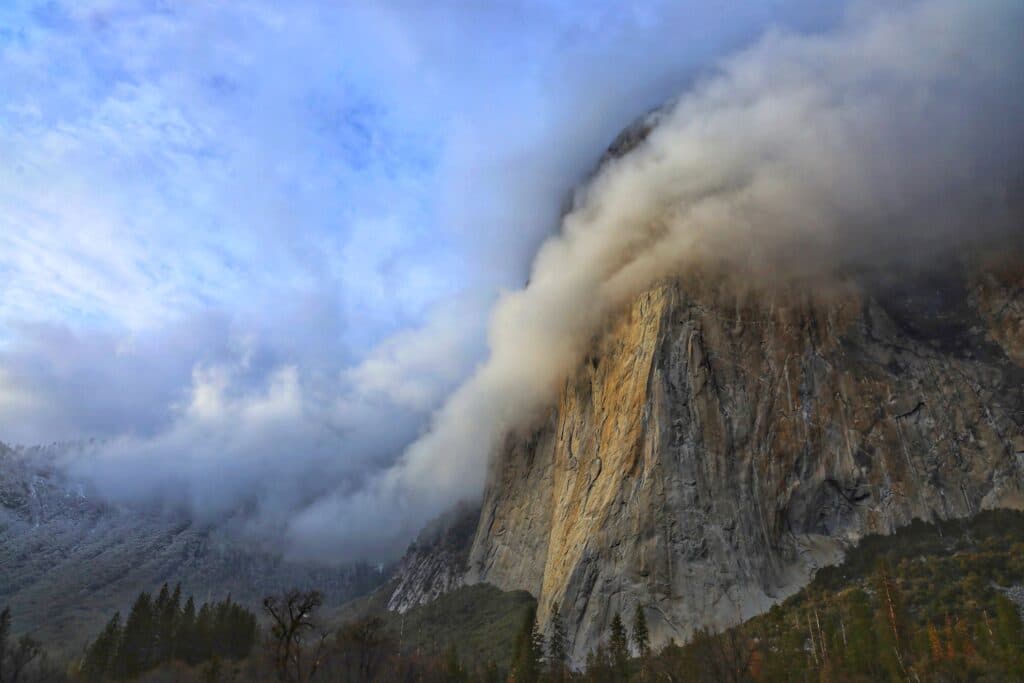
Yosemite is wild country and deserves respect. Though Yellowstone was the first National Park, Yosemite was the first piece of land set aside for protection and public use when, in 1864, Abraham Lincoln signed the Yosemite Grant Act. Yosemite’s designation as a national park in 1890 helped shape the early conservation movement and influenced the eventual creation of the US National Park System. Yosemite is roughly the size of Rhode Island at 758,123 acres, over 95 percent of which is designated wilderness. The park is also part of the second-largest tract of roadless land in the lower 48. Its vast natural majesty is unrivaled. Yet because of these facts—and Alex Honnold scaling El Capitan, etc.—over four million people visited the park last year. It’s gained a reputation. “It is crowded, in certain areas like Yosemite Valley,” Nespor said. “We call them magnets. Yet so often when we’re fishing, we’re isolated. I don’t think it’s known as a fishing place.”
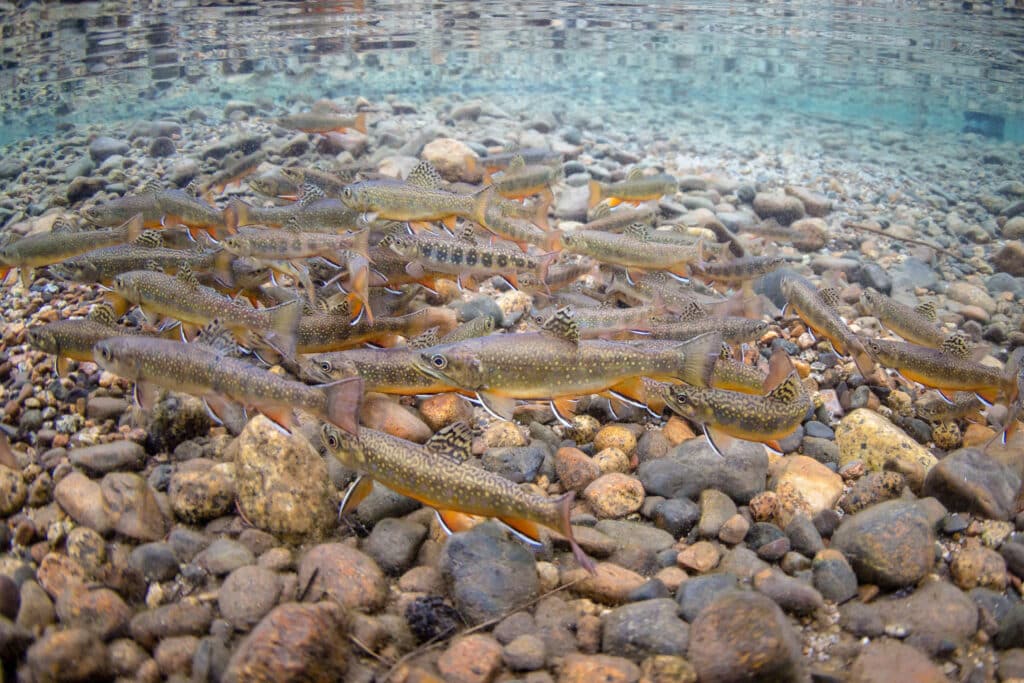
In fact, Yosemite is a place full of contradictions: filled with people yet also vast, empty spaces. It’s an incredible place for backcountry and front-country fly fishing that hardly registers among the state’s more famous rivers, such as the McCloud, Owens, Truckee, and Klamath. Maybe that’s because it’s so big as to elude singular fishing advice: Yosemite offers over 800 miles of fishable rivers and creeks and more than 200 fish-bearing lakes. In some parts of the park, in one day you can catch all five species of trout: goldens, brookies, browns, rainbows, and cutthroats. All the trout in Yosemite are wild; though the park was stocked for over 100 years, stocking ceased in 1991.
Already, seeing the Merced coursing through this giant canyon, I knew I had been missing out. “It might not be the absolute best fishing in California,” Gregory summed up, “but it is the most beautiful place to fish. There’s a massive range of fishing opportunities.”
Gregory, too, is a man of contradictions: a talented angler who also likes to fish “like Sasquatch”—that is, trout-bum-style, in swim trunks and flip-flops, shaggy dark hair shoved under a trucker hat. When this ‘Squatch opens his mouth to describe Yosemite’s rivers, he sounds a little like John Muir.
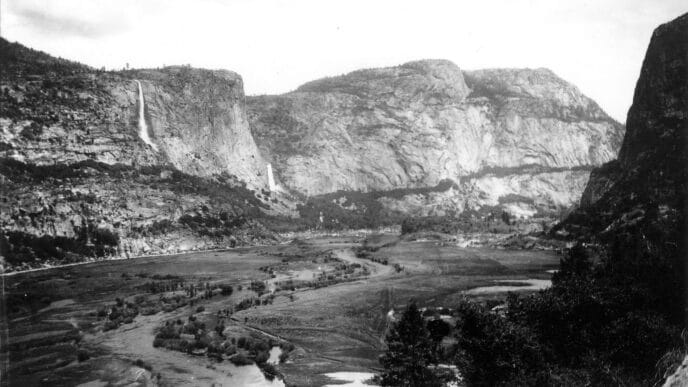
The Merced and Tuolumne are freestone granite beauties. The Merced is fed by melting Sierra snowpack, which flows as crystal-clear surface headwaters and gathers at Washburn and Merced Lakes. The river cascades dramatically over Nevada and Vernal Falls into Yosemite Valley, where tributaries bolster its flow, along with subsurface water that has sunk into fractures, faults, and folds in the mountains’ granite before being forced back to the surface as springs. After a seven-mile-long meander through Yosemite Valley, the river pours through a gorge section to El Portal, flattening as it leaves the park. The Merced drops 9,000 feet in elevation across roughly 30 miles in the park.
Gregory describes it as “a classic trout stream, with runs and pools at El Portal; crazy pocket water and plunge pools in the canyon; meandering meadows in Yosemite Valley; and then back into another crazy gradient above.” Thinking broadly, you’ll find brookies, browns, and rainbows at higher elevations, with rainbows and browns dominating the lower-elevation sections. Average fish sizes are 8–12 inches, but there are plenty of larger fish to be found, including a rare large brown trout down where we were fishing, just off Highway 140 above El Portal.
Gregory had warned me that water temperatures could be problematically high by 10 a.m., and the sun was already hot at 9 a.m. Gregory dipped his thermometer: 66 degrees. The Merced is particularly at risk of rising water temperatures. Though dammed in the Central Valley, blocking the migration of steelhead and salmon upstream, it is undammed in Yosemite. This preserves nature as it is, but it also means there are no cool tailwaters created by cold reservoir depths.
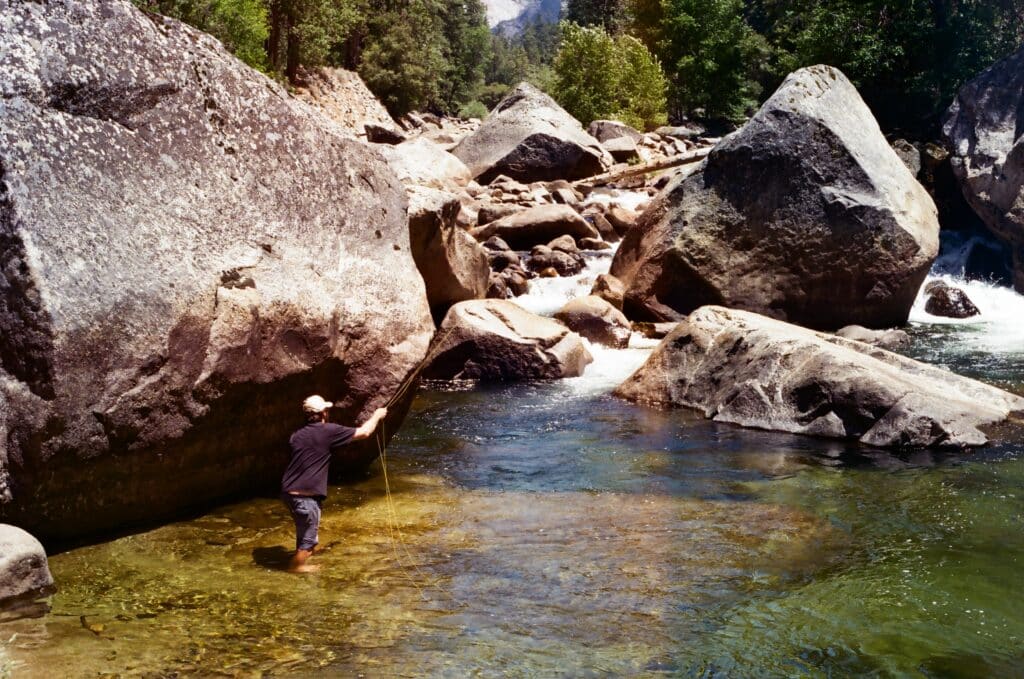
The river here was running fresh and blue, crashing through steep rapids into a long, deep, doglegged pool. I checked my indicator and my two-nymph rig, hangover forgotten, and licked my lips.
I had heard Nespor and Gregory mention on a podcast that the choice of fly didn’t matter much here, particularly in June and July, the best months for fishing in the park. Nymphs like a Gold-Ribbed Hare’s Ear, Pheasant Tail, or various Caddis Pupae in sizes 14–20 all produce.
Nespor fishes a brassie most often, he said, because he accidentally bought five pounds of them in size 16 years ago. “I meant to buy five ounces. So I use them all the time. The pile’s not gotten any smaller.” In his honor, I tied one on myself as the point fly, with a Beaded Hare’s Ear in size 12 up top and three small splitshot 12 inches above that.
I flipped my rig into the inside seam of the deep run and watched my indicator. But Yosemite distracts. A raptor called above us, and I looked skyward to the rim of a canyon 80 feet above. All at once, the millions of years of evolution of this place, one of America’s most famous valleys and one of its natural wonders, came crashing into me, and I realized I was just a tiny speck within it.
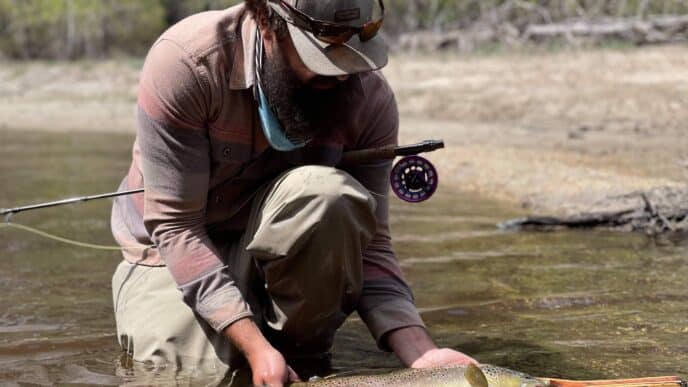
The fact that the Merced here holds browns upwards of 18 inches, along with powerful rainbows whose ancestors were steelhead trapped upriver for millennia, returned my attention to my indicator. I had just enough time to watch it swirl once in the seam before the bobber jerked and I set into a flash of angry silver. A long, strong rainbow of maybe 16 inches came into my hand a few minutes later, with a big head, broad shoulders, and chromey sides.
After the release, we checked water temps again—68 and rising fast. Gregory recommended a swim—which we did—while he gave a short history of trout tickling and the finer points of delicate fish-handling as raptors called above.
A DELICATE BALANCE
On my drive up the night before, the road to Gregory’s house outside the park near the Merced River had been blocked by CalFire trucks. Firefighters had doused a small fire in his canyon, preventing its spread. Other, larger fires were threatening nearby, and the air still smelled of charcoal when I arrived at Gregory’s friendly home in the woods. “I live in a zombie forest,” he told me as he poured me a much-needed mug of Pliny the Elder. The steep hillside, once filled with ponderosa and sugar pines, was transitioning under the pressures of high temperatures, concentrated rainfall, and fire into oak scrubland. “The fire is a reminder that we are on the forefront of climate change in Yosemite,” he said.
On Gregory’s porch, listening for owls, we talked about more ways the park and fishery are changing. New regulations require anglers to kill brown trout they catch on the Merced between the end of Yosemite Valley and El Portal. This isn’t popular among the anglers I spoke to, starting with Gregory. “It’s convoluted for me,” he said. “To me, you can’t morally require someone to kill anything if they don’t want to.”
There was a sense of playing God. “In Yosemite Valley, we can eradicate and remove fruit trees less than 50 years old. But we keep trees older than 50 for historical context in the park. It’s complicated. From the fisherman’s perspective, the brown trout have been here for well over a century and are a historical and cultural resource, especially in that lower Merced area.”
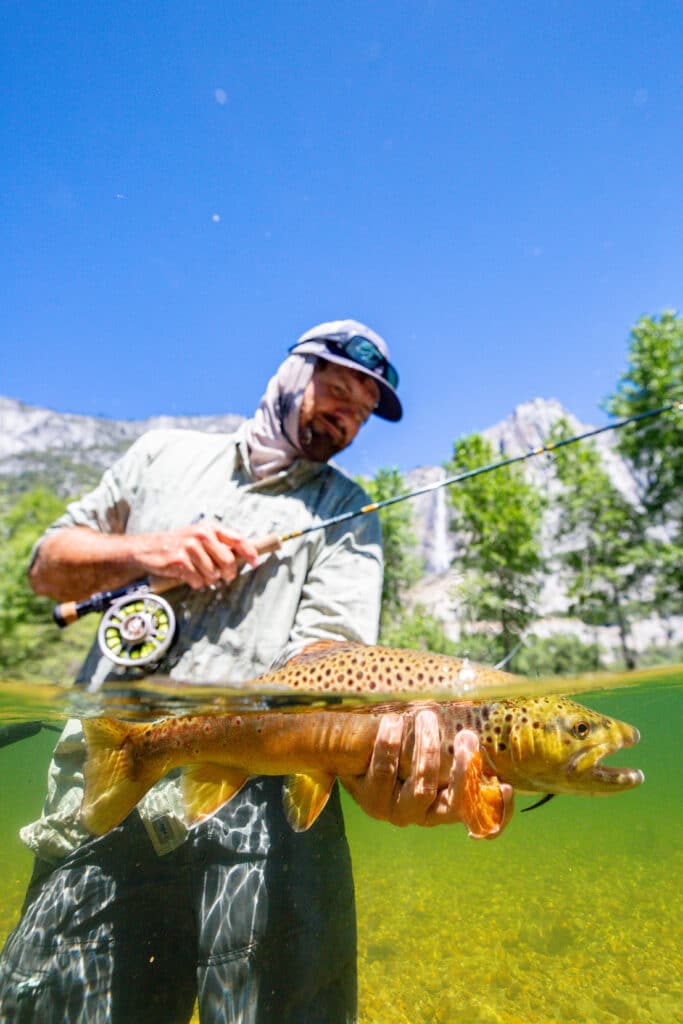
Studies have shown that, despite extensive stocking with hatchery rainbow trout strains, some rainbow trout populations in the Merced and Tuolumne rivers in Yosemite retain indigenous ancestry, including adaptive genomic variation associated with anadromy. Gregory was part of a NOAA study that identified an original strain of Yosemite rainbows, believed to be steelhead blocked from anadromy by dams and natural barriers. He hopes steelhead can be reintroduced in his lifetime. “If you’re going to bring back anadromous fish, the Merced and Tuolumne are great places to do it,” he said.
Climate change is leaving an unmistakable imprint on the park. Gregory worries about the effects of warmer water temperatures and lower flows, particularly on the Merced. “Trout on the Merced River, quite literally, live and die by the snowpack we get every season,” he said. In California, changes in weather patterns associated with climate change have led to more intense precipitation events over shorter periods and longer, more intense underwater “heat waves” during the hot summer months. (See my previous articles “Drought and California’s Trout Waters,” August 2023, and “Bugs and Climate Change,” Summer 2025.) In 2026, as I write this story, the Sierra snowpack already tells us that water levels and temperatures in the river will not be safe for fishing in August and likely September.
Much of what Gregory does as a guide concerns the impact humans have on nature in Yosemite. “This national park became a thing in the first place because of the environmental battles that were taking place here,” he said. “The Southern Sierra Miwok, Paiutes, and Monos were all better stewards of the land than we are today. We need to carry forward that respect and protect these places.”
When you are a fishing guide hoping guests will visit the park where you work, navigating this ethical landscape is complicated. Gregory sees a path forward, through educating visitors about the delicate balance of nature and doing better than “Leave No Trace.” “Pick up trash,” he says. “Handle fish carefully. Start with intention, no matter what you’re doing.” He hopes to teach his clients a mindset that could help save the natural world—by forcing us all to care. “Observe. Keep it simple. There’s beauty in simplicity and presence—in the national park, as it is.”
GOD’S COUNTRY
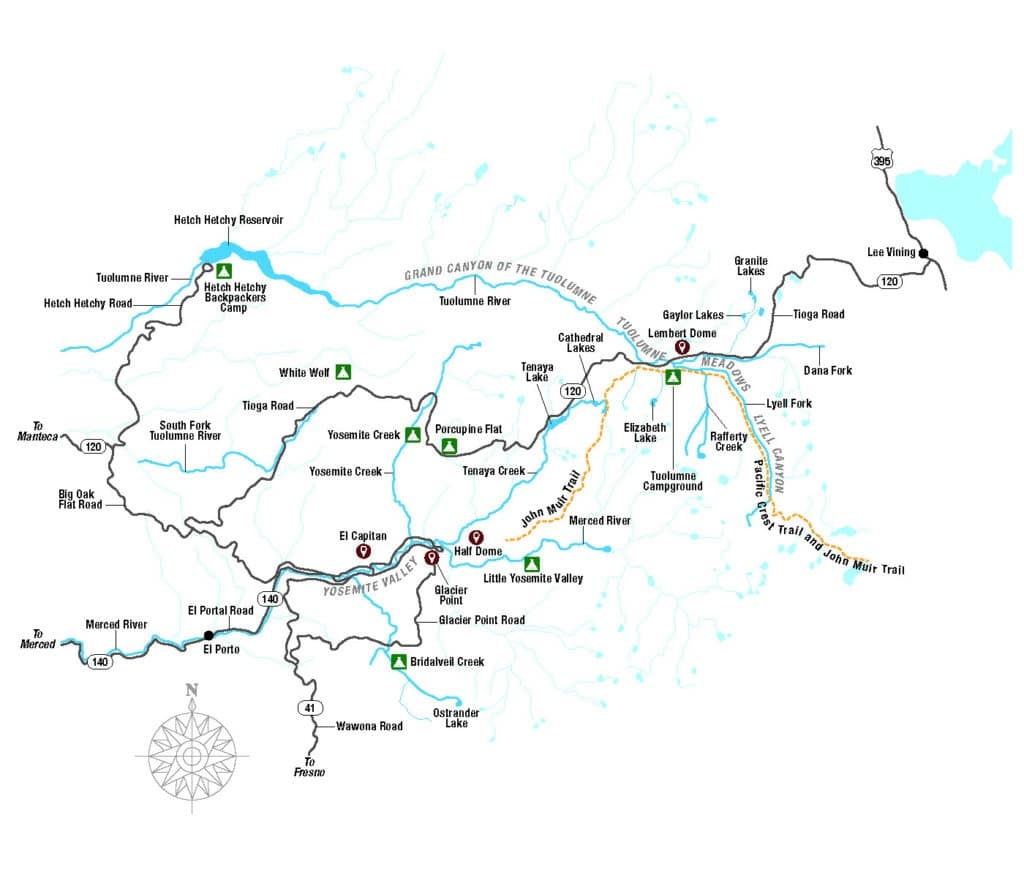
It’s an hour-and-a-half drive each way from Merced to El Portal then to the Dana Fork above Tuolumne Meadows, every second of it a gorgeous view. We stopped at the Merced in epically grand Yosemite Valley, where Gregory explained that the slow, deep stretches were challenging to fish (but do contain the rare, sizable brown and offer unreal views). Then we rolled up Highway 120 toward Tioga Pass, skirting pine forests and massive vistas.
When Tuolumne Meadows appeared, the river bright with sun glare and meandering among enormous subalpine meadows, my heart jumped. The Tuolumne (pronounced two-ALL-uh-me) is the spectacular “other river” of Yosemite. Because it doesn’t flow through Yosemite Valley, it is far less visited than the Merced—but just as incredible a river and fishery. The river forms at the confluence of the Lyell and Dana forks, then flows east to west across most of the park, exiting near the Mather ranger station. The Tuolumne’s higher elevation and glacial origins act as a buffer against high water temperatures compared to the Merced. “That’s god’s country,” Nespor said when the Tuolumne was invoked.
At Tuolumne Meadows, at 8,594 feet, the river meanders through a gorgeous valley five miles long and a mile wide. This stretch is popular with hikers and offers exciting, if challenging, fishing. Steve Beck, in his excellent book Yosemite Trout Fishing Guide, writes that trout here love ants and other terrestrials—but fishing can be difficult when water levels are low and slow. Don’t give up! Steve also writes of spotting a brown trout at least two feet long and “probably six pounds” passing by on its way to a cutbank.
The 10-mile stretch from Tuolumne Meadows downstream to Waterwheel Falls transitions from meadows to pocketwater and pools as it cascades toward the Grand Canyon of the Tuolumne. According to Beck, it is “perhaps the most spectacular stretch of river I have ever seen, especially during the runoff period.” Below this section, the river flows 25 miles through the Grand Canyon of the Tuolumne. This stretch offers great fishing for rainbows, browns, and brookies, and is accessible only by a steep, tough hike, either downstream from Tuolumne Meadows (upper canyon) or by driving to White Wolf Campground off Highway 120 and hiking in. “Though high-water times can be challenging, in general, the Grand Canyon of the Tuolumne is a year-round playground,” Nespor told me. “Come July and August, this is dry fly heaven.”
The same can be said for fishing in the Poopenaut Valley below the 360,000-acre Hetch Hetchy reservoir—many miles of excellent fishing, accessible only by a steep trail that’s one hour in and more like two to get back out. (Read about the history of Hetch Hetchy.) This is a tailwaters fishery with big trout and deep pools. It’s also one of the most rattlesnake- and bear-frequented regions of the park, so come prepared.
The Tuolumne River forms at the confluence of the Dana and Lyell forks upstream of Tuolumne Meadows. The Lyell Fork begins at the Lyell ice field on the northern slope of 13,120-foot Mount Lyell. (The ice was delisted as a glacier in 2013, having lost any movement; science no longer considers it a glacier.) From there, the river flows 10 miles through Lyell Canyon and can be hiked and fished the entire length along the Pacific Crest Trail. The river and the surrounding country are gorgeous, and the hike is relatively flat. At lower elevations, there are browns up to 12 inches, and at higher elevations, brookies, some up to 9 and 10 inches. You’ll find the occasional rainbow, too. “I take the old cavalry trail eight miles up,” Nespor told me. In the nearby Vogelsang region, anglers can target golden and cutthroat trout to get the “mega-slam.”
The Dana Fork, where Gregory took me fishing, forms at 13,053-foot Mount Dana and runs west to join the Lyell at Tuolumne Meadows. Route 120 runs directly alongside this fork, providing easy access from Tuolumne Meadows to Tioga Pass. The Dana here is shallow, fast-moving water filled with smaller brookies, browns, and rainbows.
Gregory and I took turns spotting and casting to rising trout in small, rocky pocketwater. We were a five-minute hike from the lot, alone in a calm, gorgeous alpine wonderland. To be honest, my hangover had transitioned into a pleasant exhaustion that comes with traveling long distances and fishing exciting places. The trout, though small, attacked like sharks and leapt like salmon. I caught a beautiful brook trout on a bow and arrow cast, then hooked a feisty brown in a gorgeous granite slab pool. It wasn’t the “mega-slam,” but did I fist pump for catching a rainbow, brown, and brook trout in one day? I sure did.
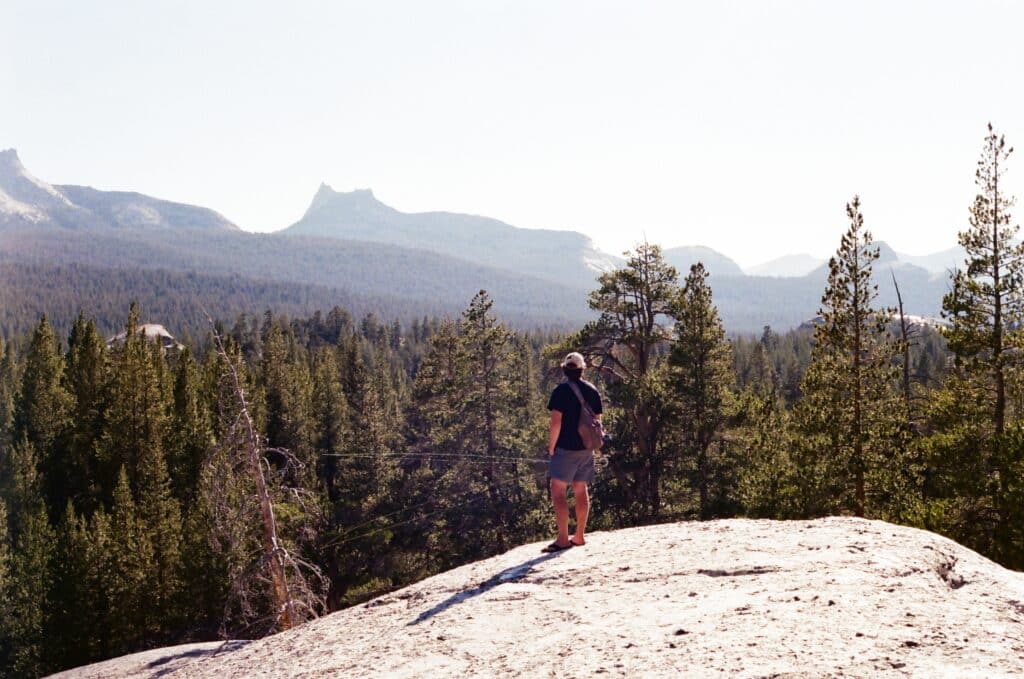
Often, Gregory takes his clients to a quiet spot in the park and asks them to take some time to sit in gratitude. He does the same himself, believing it teaches us what is important in life. Looking out over Tuolumne Meadows, I reflected on the beautiful fish I’d seen and battled in a single day and multiplied that beauty across the vastness of the wilderness before me. I thought about the risks facing the future of the park’s waters, and also the wealth of waters that will provide great fishing and adventuring for many years to come. It’s hard to fathom Yosemite in a single go, and I knew I’d be back for more sooner than later—ready to keep learning.
Rules for Fishing Yosemite
- Bring a thermometer.
- Leave no trace—and pick up trash.
- Pinch your barbs.
- Don’t fish below 4x.
- Be safe in wild country.
- Explore further to find the best spots.
- Practice safe fish handling.
- Be intentional and practice gratitude.
Fly Fishing The Merced & Tuolumne
Fishing in Yosemite can be good in the spring, including a salmonfly hatch in April, but water levels can be dangerously high depending on runoff. May brings peak flows, giving way to excellent fishing in June and July. August through early fall can be challenging with warm water and low flows.
A 4- or 5-weight rod with floating line and a 9-foot leader works well on both rivers. In summer you rarely need to go below 4X tippet, and fly selection is flexible—attractors and naturals in sizes 14-20 produce on both dry and wet flies. In clear, low water, increase leader length to 12 feet or more.
Nymphing is consistently effective, though dry fly fishing can be incredible. In summer, Greg Nespor loves fishing an elk hair caddis through fast water. “It’s literally tight-line dry-fly fishing,” he says. “I cast it horizontally, bring the rod tip over it, then swing it through whitewater riffles and over rocks. I get grabs all the time.”
Fishing The High Mountain Lakes
You can fish roughly 250 mountain lakes in Yosemite—though that number may dwindle to around 225 in the coming years. The end of stocking, combined with efforts to protect endangered amphibians, means some lakes are becoming fishless. Still, more than 200 lakes support naturally reproducing trout, creating endless stillwater fishing opportunities.
Gregory and I stopped at Tenaya Lake, the only lake you can easily access by car in the park. Many of the park’s backcountry lakes, however, are true gems—offering serenity, silence, and plenty of trout, including plenty of big ones. Lakes in the Tioga Pass area, such as Gaylor and Granite, can be reached via day hikes for those in good shape. Other lakes great for fishing include Ostrander, Kibbie, Lake Vernon, Edith, Bearup, Lower Branigan, Elizabeth, and Cathedral lakes. These lakes hold a mix of trout species, particularly brook trout and rainbows, with some fish measuring 15 inches and above.
Greg Beck’s Yosemite Trout Fishing Guide and Gary LaFontaine’s Fishing the High Mountain Lakes include all the knowledge you’ll ever need to catch fish and explore these regions.
Yosemite | Quick Guide
MAPS
Yosemite has many maps detailing the hiking trails, rivers, campsites, and landmarks. The National Park Service site has the most comprehensive downloadable maps, and they’re free.
LODGING
The towns around the entrances to Yosemite offer a wide selection of places to stay. The further you get from the park’s entrance, the more options you have. A few of our favorites:
Big Oak Flat Entrance (Highway 120 West):
Rush Creek Lodge & Spa – This family-friendly, B-Corporation lodge opened in 2016 and has 143 rooms, suites, and villas.
Evergreen Lodge – Established in 1921 to house workers building Hetch Hetchy’s O’Shaughnessy Dam, this historic resort has 88 cabins and 22 glamping sites.
Arch Rock Entrance (Highway 140):
Yosemite Bug Rustic Mountain Resort – Just 27 miles from Yosemite Valley this mountainside retreat offers cabins, tent cabins, and hotel rooms along with a health spa and cafe.
Tioga Pass Entrance (Highway 120 East):
Lake View Lodge – This family-owned lodge offers accommodations in cabins, lodge rooms, and ‘camping in style’ RVs. Located in Lee Vining, it’s an easy hop to the Tuolumne Meadows creeks.
South Entrance (Highway 41):
Narrow Gauge Inn – This rustic retreat is a historic mountain lodge built in the 1950s by Swedish immigrants. It has charm aplenty and is dog-friendly. Located on Highway 41 in Fish Camp, it’s a 30-minute drive to the park’s south entrance.
Camping
There are many campgrounds in the park but making reservations early is imperative. Sites in the Valley are convenient for fishing the Merced River. Tuolumne Campground is near Dana and Lyell Forks and the Tuolumne River. Aspen and Big Bend, outside the east entrance, are good options as well. Reserve through Recreation.gov
FLY SHOPS
Yosemite Rivers Fly Shop, located at the south gate, is there for all your gear needs before entering the park. 40827 Highway 41, Oakhurst, 559-683-7664.
The Trout Fitter has a full-service shop and guide service located in Mammoth Lakes, southeast of Yosemite. 2987 Main St. Mammoth Lakes, 760-924-3676.
Ken’s Sporting Goods, located in Bridgeport, northeast of Yosemite, has fly-fishing, camping, and outdoor gear to meet your needs. 258 Main Street, Bridgeport, 760-932-7707.
Sonora Fly Co., is the best fly shop on the west side of park with a huge inventory of fly gear along with apparel and footwear. 78 South Washington Street, Sonora, 209-297-9393.