
Snowbanks and Sierra Steel
CalTrans Highway Road Camera—that’s where every Sierra trek in winter begins. What am I up against?
Which is usually followed by a slew of other unfavorable micro decisions. All-wheel drive should get the job done in “severe winter storm conditions,” right? What’s the full scope of the “all” in all-season tires? It’s all too rare for us to ask—Isn’t it bizarre how strong the call is from anything other than the ordinary?
Flipping between Interstate 80 cams and the weather app, I said to my brother, “It looks like our only shot is hitting the pass between four and five o’clock—that way, we can sneak over before the worst of it rolls in.” It was 11 in the morning on a Friday. We’d both be off work in a couple of hours. We were heading to the Upper Owens to catch the tail end of the snow ‘bow season. Ahead of us, a meager 378 miles and the Donner Pass. It was a poor start. We left at three from the outskirts of Bay Area traffic. I scanned Interstate 80 cams at Blue Canyon and Kingvale. They seemed blurry. I checked the camera at Donner—there was snow covering the lens. I asked my brother to check the Truckee CHP’s Facebook page. He searched, paused, and asked, “What does a snow bomb alert mean?” Truckee CHP has a funny way of communicating prudent warnings, but their data is firsthand. “It means all-wheel-drive and all-season tires are not going to get it done,” I responded.
You know you’re in trouble when you start doing the math. It was about four o’clock. The plan was to get to Upper Owens by eight or nine. We’d layer up in our best base layers, pump up the mattress, lay out the 800-fill down bags, and catch a luxurious night of sleep in my five-star hotel on wheels. At this rate, I wasn’t sure I could confidently make the pass. Chains are great, AWD can get it done, but severe storm traffic is a problem. California is known for 70-degree weather year-round. Ironically, most folks heading to the slopes aren’t prepared for a bit of snow. This wasn’t a bit of snow; it was a “snow bomb”—a blizzard, thick snowpack, and whiteout conditions. The kind of drive where you hope the car in front of you knows where the road is, and ice starts to build up under your wipers. As long as we survived the pass, conditions would improve after Verdi and onto the 395. We’d see our first Mammoth sign at one o’clock, but at least we’d wake up on the river. I caught myself negotiating with reason out loud. This was dangerous. CHP was giving every reason not to try the pass unless absolutely necessary.
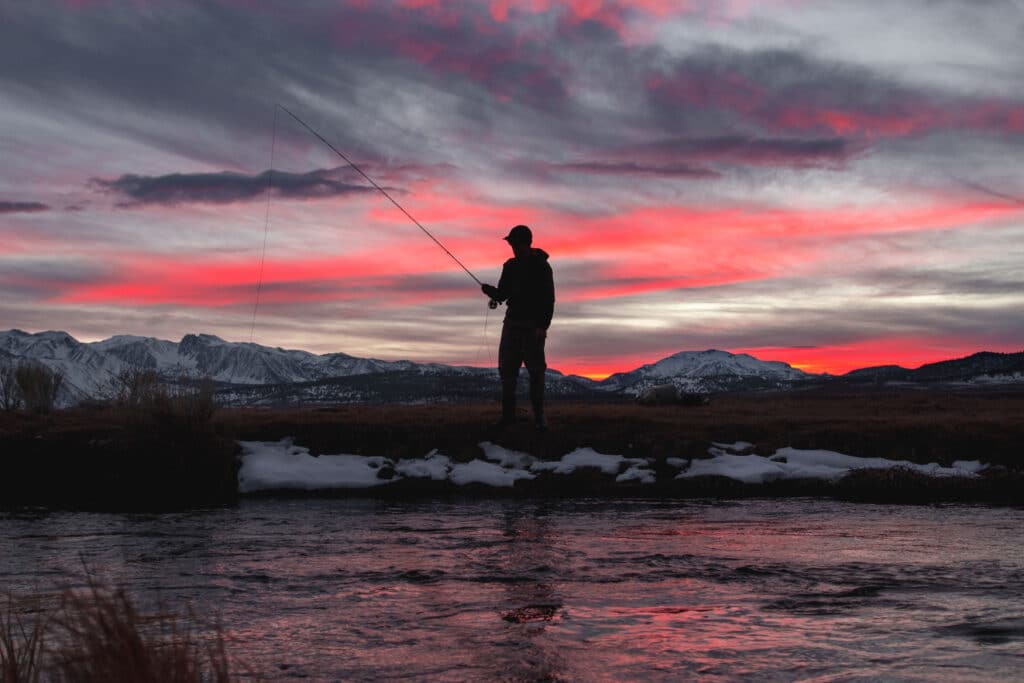
But even with all the evidence throbbing against my better judgment, I had to get there. I could see the morning light against Mammoth, steam lifting from the river, and miles of snow. I could feel the hunt. Bucket after bucket and bend after bend of cow pasture carving the river. A system ripe with 20-inch “Sierra steelhead.” There aren’t many fish in the Sierra above 6,000 feet that pull quite as hard. All of it was one nasty trek over Donner Pass away. Despite the intoxication, I made the call. We’d stop at our parents’ in Placerville for the night and avoid the worst part of the storm altogether. We would hit the road after the first plow. It wasn’t the ideal call, but it was a safe one. I’ve earned enough miles chasing passes as they open to know that close calls teach good lessons.
We were up at five and at chain control by seven. There was a light dusting, but visibility was clear. I rumbled with my chains past CHP. I asked, “How was last night?” He glared, “A nightmare, everyone with 4×4 and AWD thinks they’re invincible. Multiple closures, multiple spinouts. Take it easy.” I rolled on, keeping under 35 mph. I doubled my distance from other drivers, tapped the brakes when needed, and dropped to a lower gear on downgrades. Slow, vigilant, and safe—no sudden actions, that’s the key to driving in the snow. Chains off, we passed Verdi, and before we knew it, we were on the 395.
All that work to get to the Eastern Sierra. The 395 is a clash of rugged high-desert terrain, with rock formations and sagebrush. The dry landscape is set against the western sub-alpine backdrop of Humboldt-Toiyabe National Forest. It is the area I dream about when work drags on and the routine is too routine.
As we passed the June Lake Loop, I realized I needed to dial in my brother. I turned to him and monologued: “So the Upper Owens, it’s a cow pasture stream that flows into Lake Crowley. Every winter, rainbows make their way into the system to prepare for spawning, and browns follow. They are lake-run. Think big shoulders, explosive fights, but wary. They want cover. Imagine fish moving from the security of a lake hidden by depth to being entirely exposed in a stream.
They will find every bucket, deep riffle, undercut bank, and swirling bend to hide in. But don’t skip the skinny riffles; that current over their heads can act as protection, too. There’s no structure or trees on the bank, so you are extremely visible. Even more so after a big storm. Be mindful of your shadow as you fish up. Read the water well and scan for any holding zones.
The toughest part of fishing the Owens is getting down. It’s turbulent, despite looking like it gently meanders. Your mending needs to be early, and you need to get your flies down by the time they pass the best holding zones for fish. Pay attention to where your flies land and where they actually go as they drift. When we fish streamers, realize that these fish are fired up protecting the limited holes they can safely feed from. When we high stick, shoot the bugs down with force and keep your rod tip low to the water—you need them to sink, and it’s often deceptively deep.
When you hook into one, you have to put the hammer to them, within reason, but they will take you for a ride. There are root balls at the bottom of the river and undercut banks with vegetation. They will find all of it, so keep them under control. They are going to pull hard. Move with them if you need to. Got it?”
“I’m hungry,” he replied. “What flies are we using?”
I laughed, “We’ll grab some burritos and coffee to-go at Stellar Brew in Mammoth. I’ll start you with a bead and a caddis under an indo. I’ll rig you up with a big weight to get down. It’s cheesy, but it’ll get you into fish.”
We rolled past June Lake Loop, and he asked if the brewery was any good. It’s one of the best. I pointed out dirt turnouts to trailheads and painted stories of high-alpine lakes well above 10,000 feet. You have to see the loop in fall. If you catch it at the right time, you can see the golden reflection of upside-down aspens and snow-capped mountains on the water.

Right: The CalTrans Highway Road Camera—where every Sierra winter trek begins. Photo by Tyler Graff
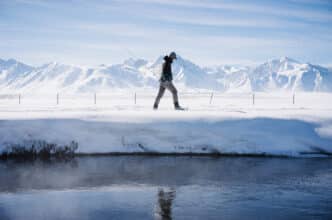
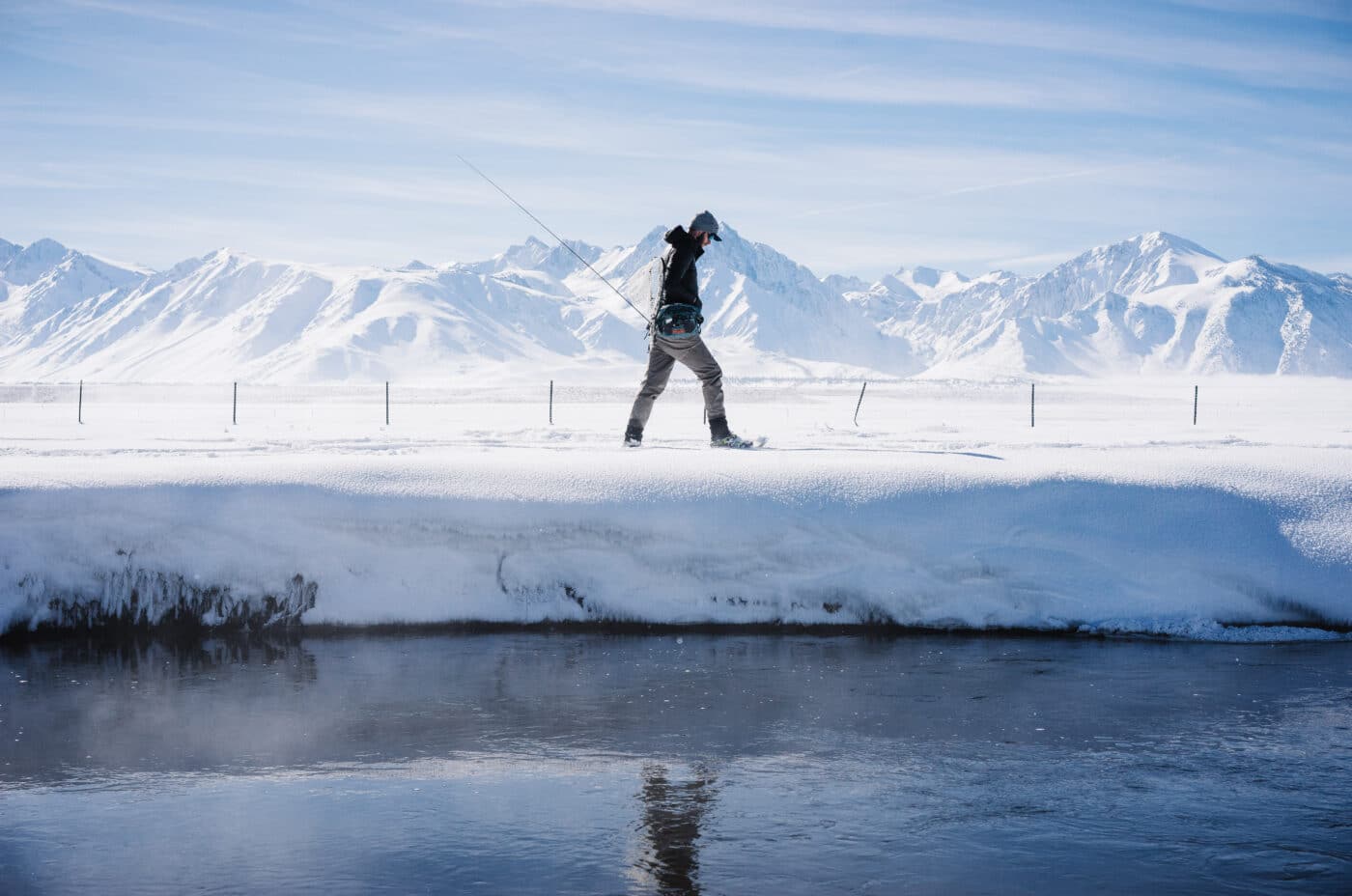
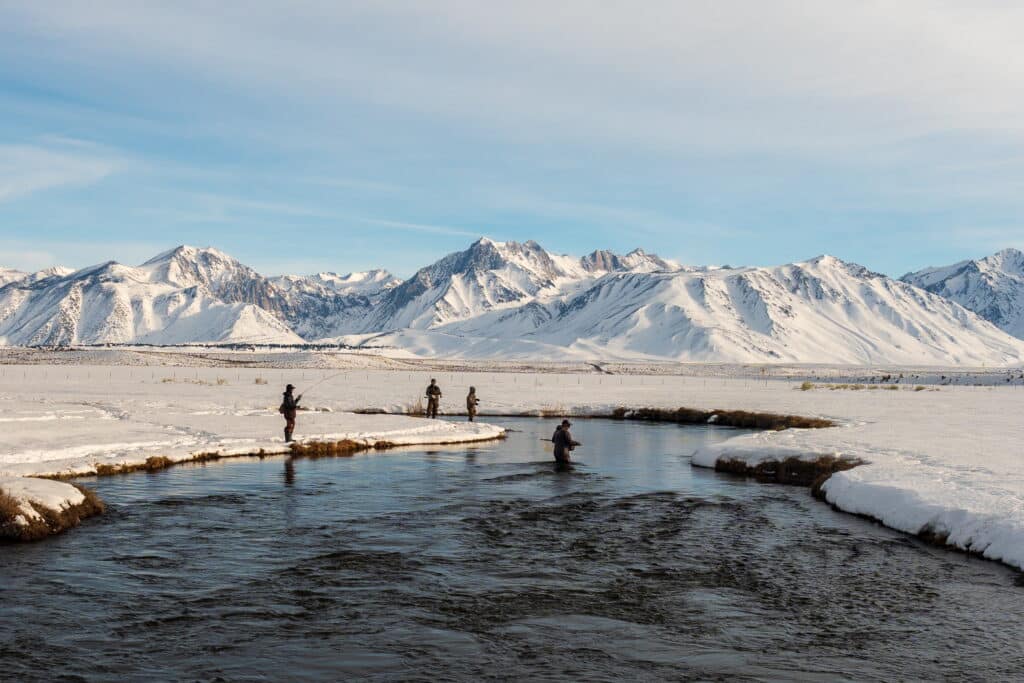
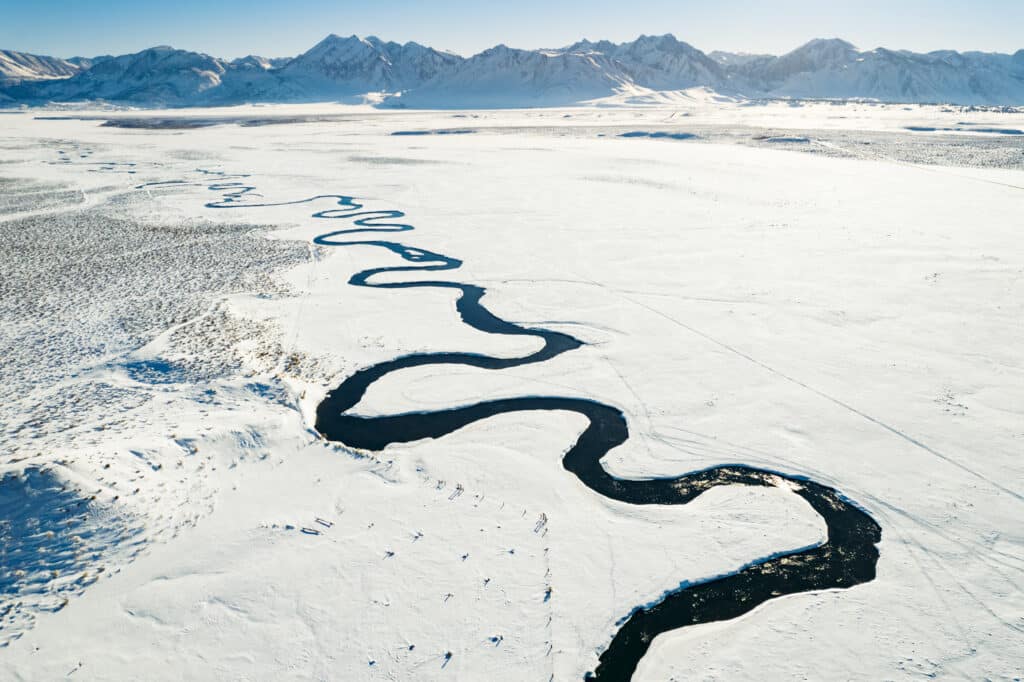
Finally, around 11 a.m., we saw the Little Green Church covered in snow, and I was relieved that the snow plows had already taken care of Benton. It was a blanket of snow with a slim line of pavement interrupting. As we descended the final hill of our trek, a mound of snow-covered earth on each side of the road framed a perfect scene. A white valley, so monochrome that every variation in its terrain blurred into itself all the way to the shaded peaks and crests of the shallow mountain range across to the east. An entire vista of white snow valley cut across a pale blue sky in a meandering pattern. It was stunning, but the best views lay ahead, looking west.
From asphalt into fresh snow, we followed tracks north, found the first safe spot to park, and hopped out. We layered up in wool, then down, and added a rain shell to lock in heat. I was thankful for new fleece bottoms beneath my waders and thick Smartwool socks. I passed my brother a 6-weight indo setup, grabbed two rods for myself, and we headed off to fish.
Twenty-two hours after leaving home, we were punching the first prints in soft snow along the banks of the Upper Owens. There were no signs of its defining grassy cow banks—only rounded piles of glistening ice guiding the current along. We crossed to the east side to manage our shadows and walked a bit upstream. At that first pool, there wasn’t a riffle that could disturb the reflection of the sky on the water. I checked his depth to be sure it was nine feet from indicator to weight, then gave him the first at-bat. He made his first cast to our side of the river along the soft edge, five feet from the current. I was proud to see his bugs land nicely out front of his indicator. We watched as it drifted and drifted. And then it dunked! First run, first drift—fish on!
“WOAH!” he said as the white foam zipped across the surface toward the far bank.
“Drop your rod horizontal!” I responded. “First cast? Let’s go!”
“They’re strong!” he laughed as he pulled the backside of his rod to his left shoulder.
I dumped the snow I had scooped from the bank out of my net and pointed off to the right. “Plan to land him here at this clear, sandy spot. How’s he feel, big?” The indo dug down with a few good head shakes, and I looked at my brother. His face was serious. I interrupted, “Dude, how cool is this?”
“He’s big, haha!” he said with a smile, breaking his focus. He lifted and the fish tugged back before making a run toward the back of the pool, heading for a bend. “Do I go with him?”
“Yeah, don’t give too much, but move with him. Drop your rod to the other side and pull in line when you can. You’re going to land him—just turn him to the bank once you feel his spirit break.”
I followed behind him as he caught up to what could be seen of the indicator. He stumbled through some snow covering a tall grass mound. He stepped onto a high bank with some leverage. The fish had settled in a small bucket in the next pool. I tapped his shoulder as I passed him and said, “There’s another clean stony bank there.” I pointed it out. “Is he ready?”
“Yeah, I’ll swing him over to you,” he replied as I stepped into the water. We both saw him flash a big silvery side. It was a very good ‘bow.
“Turn him hard, and I’ll get net on the first pass. It’s cold, so let’s not wear him out. I’m ready,” I instructed. He pulled the rod back steadily on his right side, keeping it horizontal. The fish turned out of the bucket toward us, made one last tug at the middle, but the current and bent rod brought his broad side down toward my bank. With one hand at the base of my net and the other near the basket, I drove down and scooped up a stud of Sierra steel.
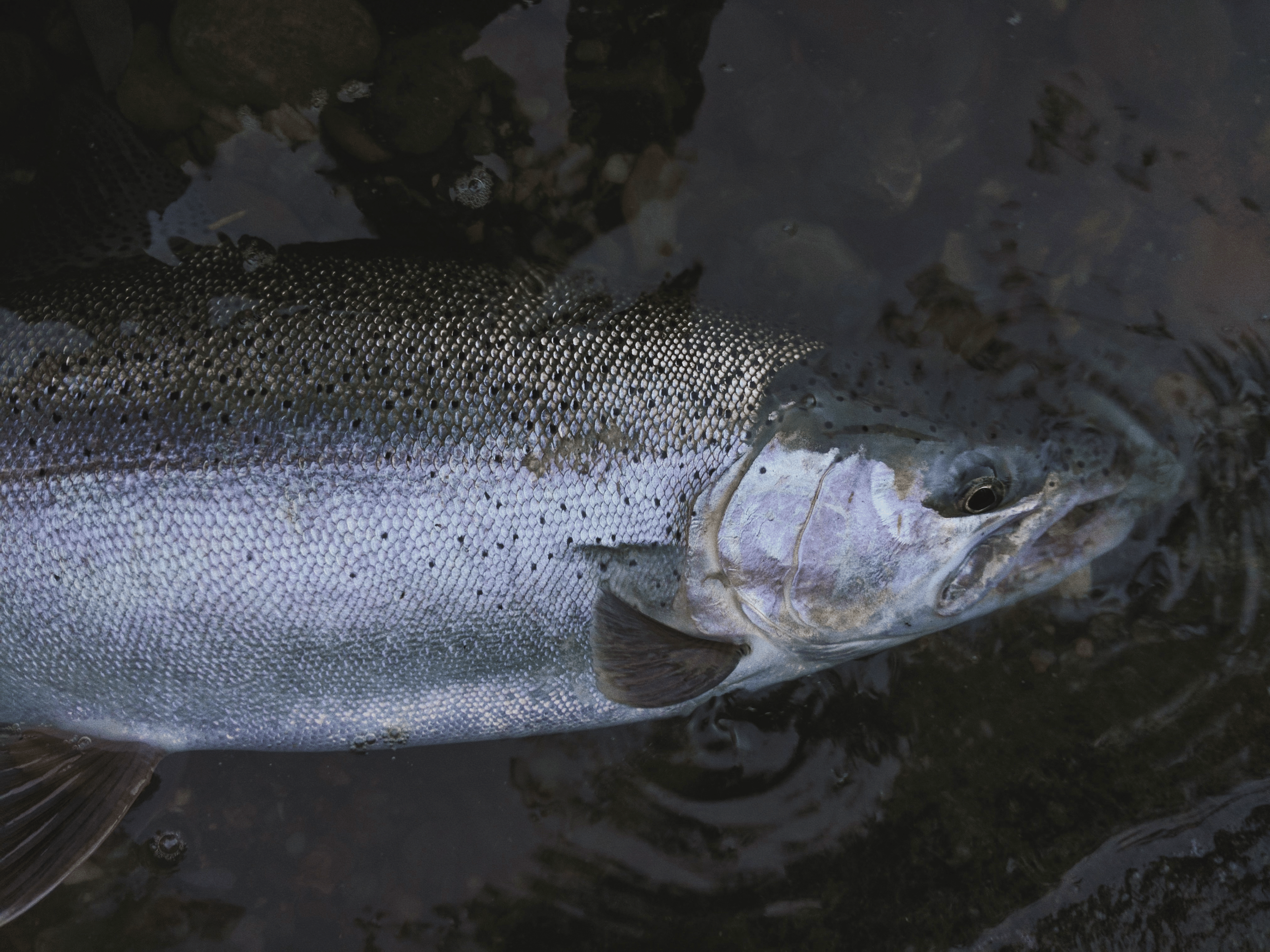
My brother’s tension turned into elation, and we broke the silence with laughter. He stepped down the bank and looked proudly into the net. It was a dark male with massive green shoulders, a rich red gill plate, and a wide brush of pale pink across its 20-plus-inch side. “No way,” he said through a big smile. I reached in and slid the dark olive caddis out of his upper lip. We tossed the rod on the snow and snapped some pictures. We took a moment to admire his white-tipped fins in the net, and he shot off on the release.
We gave each other a big hug, and my brother looked down at his red hands. “I can barely feel my fingertips!”
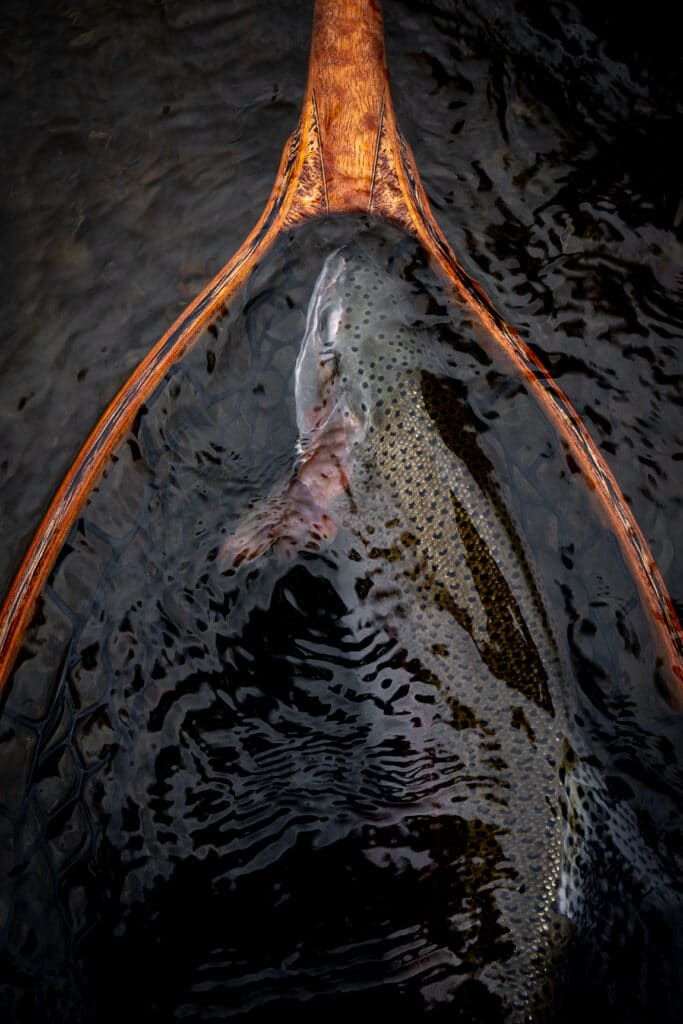
“It’s all so worth it,” I replied. We sat on the bank to laugh and debrief. I pulled the zipper on my Yeti and pulled out a thermos of coffee. “The drive, the snow, the chains, and the cold fingers, it’s all worth it.”
“Agreed, but it’s your turn,” he replied.
“I’m in no rush.” I reached into my bag to find my pipe and pipe tobacco to warm my hands.
We spent the next few hours switching off on the indicator rig. Bucket after bucket, we found fish. Some took a bead, but most took the caddis. We lost a couple to some bad sets, but overall, the fish were biting, and we could laugh at the misses. Eventually, I handed him the indo setup and decided to make a point of bringing my high-sticking rod. I was curious if they’d take something bigger, so I tied on a rust-colored micro streamer as my point fly. I knew the size 4.6 tungsten bead on it was heavy enough to get down, so I opted for a size 14 Frenchie with a bright collar for my tag fly.
My next run was a fast bend into a deeper pool. At the top of the section, there was a soft pocket next to the current. I sent a cast up above the soft pocket into the current and manipulated it into the pocket. It hadn’t gotten down fast enough. I picked it back up and recast it with a sharp stop to shoot the heavy point fly through the turbulence.
Lowering my rod tip to the water allowed the line to sink through the swirling current. The mono between my fingers ticked the bottom, ticked again, and then a jolt shot through my index finger extended out across the graphite of my rod. “Good fish!” I shouted downstream.
I could feel every bit of that fish’s weight on my 11-foot, 3-weight. Once it realized that the meal wasn’t real, it took off! Pinballing from side to side before it erupted out of the water like a football headed for a field goal. It was a bright, heavy female, and she was pissed off. She kept diving down before turning and exploding into the icy air again. I was afraid she’d jump up onto a snowbank before she settled down. I sent a big grin towards my brother as he watched the fish put on its display. I pointed to let him know where I planned to land her. I hollered to my brother, “I’m going to throw a big streamer after this one!” She filled the basket with chrome and iridescent hues. It was clear she hadn’t let her eggs go quite yet, and I made a point not to take her out of the water despite her size.
We paused for a bit after that to heat some water using the single burner I’d packed. My little brother pressed two Banquets into the snow, and we stared at the most dramatic view of the trip so far. Looking west at the Sierra mountain range, we could see each ridge as shadows cast dramatized depth. With the valley dressed uniform in primer white, the mountains looked even closer. If it weren’t for the steady flow of water, the view could’ve seemed from a different planet. I took off my polarized lenses to truly appreciate the masterpiece without alteration. Both the ice-cold beer and spicy hot ramen did their jobs in warming us up.
We finished out the afternoon trading off runs and landed a few more fish, feeling gluttonous with the day we’d had. I even managed to get a brown and a really dark ‘bow on the streamer, fishing deep with a sinking line. Despite the aggressive eats from the day, the fish didn’t want to chase much in the cold, so I realized it was better to get the big meals down to the very bottom.
As the sun passed through some clouds on its final descent, it started to get really chilly, and our guides were freezing much faster. We realized how exhausted we were and regretted letting the excitement of a generous bite distract us from caring for our faces and lips. Every exposed inch of skin was dry and cracking from the cold. We laughed because we both couldn’t feel our toes, and our calves were sore from hauling snow stuck to our wading boots. But we were beyond satisfied. I wasn’t entirely sure how much snow had melted, and I wasn’t interested in spoiling our day by getting stuck in slush on the way out. So instead of reapplying more lip balm to the guides, we decided to head to the car. I lit one last bowl of tobacco to warm my hands and take in the view.
There was a point the morning before that I had considered calling off the trek over Donner. I wondered if it made more sense to fish somewhere along the west side of the Sierra, in the foothills, or even chase some proper steelhead high in one of the valley systems. Even after years and years of fly fishing, I still cannot shake the call. Resting atop a snow-covered riverbank, I turned a handwarmer in my chest pocket and thought to myself.
It’s madness, driving out here—a 14-hour round trip through the snow for six hours of fishing on the Upper O. Yet, I’d do it all again just to experience how beautifully harsh this environment can be. It’s a stark reminder of what truly calls to us from the water. What would compel us to trek through a Sierra Nevada blizzard along an icy Interstate 80? It’s not just the fish; it’s the pursuit of anything beyond the mundane. It’s the pursuit of finding peace in discomfort and challenge. It’s the sensation of snow compacting under wading boots and earning seat heaters after a long day of the kind of cold that needs to be wiped from beneath your nose. Are there fish to catch? Yes, and that’s always top priority. But when the day is done, I’m simply grateful knowing the wild still exists and I am made of enough to bask in its ferocity, beauty, and seasons. The trout are simply the wink of “well done.”
Recommended Rigging And Flies
RIGGING
Indicator Rig:
• 5 or 6-weight rod with floating line
• Off-colored water: 4x tippet
• Clear water: 5x tippet
• 10 feet of fluorocarbon to an orange molten bead
• Size 8 Bead hook roughly 1.5 inches behind the bead
• Heavy Loon weight 8 inches above bead
• 18-inch fluro tied off the back of the hook
• Jigged 4mm tungsten bead point fly
High Sticking:
• 11-foot 3-weight rod
• Monofilament-core Euro line
• 30 feet of 30-pound Maxima Chameleon
• 3 feet 0X Euro BiColor Euro indicator line
• 6 feet of 6 pound Seager Red Label to a double surgeon’s knot, 6 inch tag, and 18 inches to point fly
FLIES
Jigged-style nymphs:
• Sizes 10-14
• Dark Olive Caddis wrapped in flash
• Guide’s Choice Hares Ear with flash
• Frenchie
• Holo-point jig
• Kerotin
• Peaches and Crème
Micro streamer:
@racks_and_rivers Golden Ticket pattern
Streamer:
@Dohertybroflyco DnDs in black or olive
@trouttrap Eyelash Buggers
Upper Owens | Quick Guide
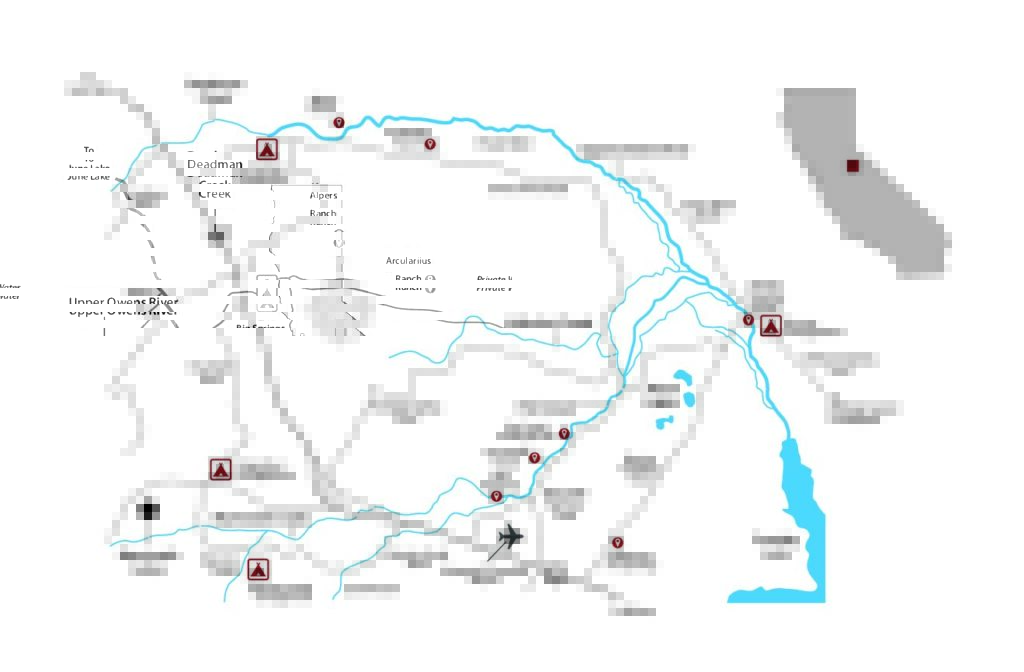
Access Maps
FlyFishingtheSierra.com has a comprehensive selection of maps covering the Upper Owens and the entire Sierra range. Maps include regulations, hatch charts, fish identification, and fly suggestions.
DavesSierraFishing.com offers maps, fishing location details, and campground information.
Seasons
Read about how the Upper Owens became a year-round trout fishery with the “Perch Loophole.”
Lodging
The town of Mammoth Lakes offers a wide selection of places to stay, from four-star resorts to motels, to VRBOs, while Bishop, 30 miles south of Lake Crowley, offers small-town charm and a relaxed vibe.
A few of our favorites:
Outbound Mammoth – A selection of guestrooms, cabins, chalets, and condos, this resort promotes community and gathering spaces, with on-site eats, free video arcade, steam room, and lobby wine bar. OutboundHotels.com/Mammoth
Convict Lake Resort – With 28 mountain cabins and three lodges, the resort can accommodate any angler’s taste—and all cabins are pet-friendly! ConvictLake.com
Wayfinder Bishop – With Bishop Creek meandering through the property, this updated, well-appointed hotel has it all—pool (closed in winter) and hot tub, Whistling Trout breakfast buffet, and Creekside Club for wine and craft beer. WayfinderBishop.com
Camping
There are several campgrounds in the area, and while closed for winter, they are a great option for your warmer-weather trips. Sherwin Creek, Convict Lake, and McGee Creek accept reservations through Recreation.gov. Big Springs is an Inyo National Forest campground and does not take reservations. Browns Owens River campground is privately owned. Reservations open April 1, 2026 for the season.
Fly Shops
The Trout Fitter is a beacon for fly-fishing enthusiasts with a full-service shop and guide service located in the heart of Mammoth Lakes. The shop offers a wide selection of fly-fishing gear, and their friendly, experienced staff is ready to assist you. 2987 Main St., Mammoth Lakes, 760-924-3676.
Points of Interest
Hot Creek Trout Hatchery – A historic site and major supplier of trout for the lakes and streams in the area. 121 Hot Creek Hatchery Rd., Mammoth Lakes. At the time of publication, the hatchery was closed due to winter weather damage. Call for an update, 760-934-2664.
Hot Springs – check out the area’s geothermal activity at the Hot Creek Geologic Site. Go one step further and enjoy one of the thermal baths at Hilltop, Shepherd, Wild Willy’s, or The Rock Tub.
Petroglyphs – Carved on rock cliffs thousands of years ago, the Volcanic Tablelands petroglyphs offer a glimpse into ancient Paiute-Shoshone culture.